Tuesday, October 14, 2008

THE AMBASSADOR HOTEL LESSON: Demolishing such iconic buildings not only destroys history, it wastes resources

Opinion by Diane Keaton | LA Times


October 13, 2008  - Last week, I drove past the 22-acre vacant lot once known as the Ambassador Hotel. As I looked at the rubble of our lost cause, I pulled over, sat back and gave in to a feeling I can only describe as guilt. I thought about my connection to the once-iconic hotel, about why places like it are so difficult to save, and about what it takes to be a better, more effective advocate for historic buildings.

I was just a little girl the first time I visited the Ambassador. My father held my hand and led me down a long hallway before we stopped in front of an ornate facade. I remember Dad's smile as he slowly opened the door to ... the fabulous Cocoanut Grove nightclub! In the magic of a perfect moment, I looked up and saw a parade of dreams etched across the face of the man I loved more than anyone in the world. It was at that moment that something clicked inside my little 9-year-old brain, something that helps me, even today, believe in the ability of the built world to change the trajectory of our lives.

In our battle against the Los Angeles Unified School District's decision to tear down the Ambassador and put up a new school, we made many arguments. We focused on "reuse" as an economic incentive. The LAUSD wasn't buying it. We hired a team of architects to come up with options that would transform Myron Hunt's 350,000-square-foot building into a series of classrooms, administrative offices and low- and moderate-income housing. That didn't fly either. Neither did the argument that the Ambassador was a national landmark, or that six Oscar ceremonies had been hosted there, or that Judy Garland, Frank Sinatra and even Barbra Streisand broke hearts on the stage of the Cocoanut Grove. It didn't matter. Nothing stopped the Ambassador from becoming another little death of no consequence.

Preservation has always been a hard sell in Los Angeles. But maybe in the years ahead it won't be as hard as it used to be, considering several new facts. No. 1, as my Dad would have said, a building represents an enormous investment of energy -- much bigger than we thought when we were fighting to save the Ambassador. No. 2, we now know that construction of new structures alone consumes 40% of the raw materials that enter our economy every year. No. 3, according to the Advisory Council on Historic Preservation, the resources required to manufacture these materials and transport them to a site and assemble them into a structure is the equivalent of consuming 5 to 15 gallons of oil per square foot. No. 4, a Brookings Institution study indicates that the construction of new buildings alone will destroy one-third of our existing building stock by 2030. And finally, No. 5, the energy used to destroy older buildings in addition to the energy used to build new ones could power the entire state of California for 10 years, according to the National Trust for Historic Preservation.

We've treated old buildings like we once treated plastic shopping bags -- we haven't reused them, and when we've finished with them, we've tossed them out. This has to stop. Preservation must stand alongside conservation as an equal force in the sustainability game. More older and historic buildings have to be protected from demolition, not only because it affects our pocketbooks but more important because it threatens our environment. Let's face it, our free ride at the expense of the planet is over.

I'll never understand why architecture is considered a second cousin to painting and film. We've never been married to our romance with architecture. A building, unlike a canvas or a DVD, is a massive work of art with many diverse uses. We watch movies in buildings. We look at paintings on their walls. We pray in cathedrals. We live inside places we call homes. Home gives us faith in the belief of a well-lived life. When we tear down a building, we are wiping out lessons for the future. If we think of it that way, we will begin to understand the emotional impact of wasting the energy and resources used to build it in the first place.

As for me, I'm keeping the door to the Cocoanut Grove open. I'm still holding on to my father's hand and the memory that grew to inspire my dream of a golden -- now green -- future among structures that stand as invitations to a past we can only imagine by being in their presence.


Diane Keaton is an Oscar-winning actress. She is a former board member of the Los Angeles Conservancy and is currently a trustee of the National Trust for Historic Preservation.

●●smf’s 2¢:  As a member of the Bond Oversight Committee I voted to demolish the Ambassador. That was a very difficult decision – my mother and father met in the Embassy Ballroom at the grand old hotel and there was a certain amount of lobbying from both of them. In the end the public need for a school, the cost in time and money, and my fiduciary duties to the voters and taxpayers outweighed the interests of historic preservation. Ms. Keaton’s heartfelt appeal notwithstanding the school bonds were not voted to preserve old hotels – especially ones in such sad disrepair as the Ambassador. I have no problem with private money or public money being dedicated to historic preservation – but not school construction money.

That being said, there was a an excellent story on CBS Sunday Morning about that lack of historical preservation in truly important American buildings and I commend 4LAKids readers to it.  (notes below)

I also refer anyone interested in this subject to the issue of the restoration and reopening of the Southwest Museum – Los Angeles’ first museum – in Mount Washington. The museum’s truly extraordinary collection has been pirated by the Autry Museum to Griffith Park and now the Autry proposes to transfer the museum property itself to the Community College District – sticking the bill for historic preservation to the taxpayers of the Community College District …even though the Southwest Museum property appears nowhere in the master plan for the college district! 

The Los Angeles Times in their tortured justification for this – claims: “The district is only setting aside funds should space become available. If that happens, classrooms would supplement the museum, not replace it, and building them would represent an entirely legitimate use of this small portion of the bond proceeds”  - disregards Prop 39’s legal requirement for specificity in spending.

  • setting aside funds?
  • should space become available
  •    …if that happens?

– sets an entirely new Orwellian definition for the term “legitimate use of bond proceeds!”


Fast Draw: THE CO$T OF HIGHER EDUCATION

from CBS News

The price of higher education is getting higher and higher and, as the CBS News Fast Draw team illustrates, gathering funds can be like climbing a mountain.

La Opinión: SUPPORT EDUCATION – Vote Yes on Community College and LAUSD Bonds

La Opinión Editorial

October 14 - Los Angeles voters must decide on two local measures related to education funding, one on the community college system, and the other on the Los Angeles Unified School District (LAUSD). Both cases involve authorizing bond issues paid for with minor increases in property taxes.

Measure J seeks approval of $3.5 billion in bonds to be invested in technology for the area’s nine community colleges, following a detailed plan. The cost of the bonds will be paid for by tax increases of $17 for every $100,000 of assessed property value. Community colleges are a key part of education and professional training, and this proposal deserves our support.

Measure Q calls for an issue of $7 billion in bonds for the renovation, modernization, construction, and expansion of LAUSD school facilities. The investment to be made is not as detailed as Measure J, but it will be under the supervision of a Citizens’ Oversight Committee, including the presence of the Los Angeles Chamber of Commerce and taxpayers. It will be paid by the property tax already earmarked for the LAUSD, which would go from $123 to $185 per $100,000.

An attractive aspect of Measure Q is using $450 million for charter schools, although this fund would not be turned over directly to them.

Economic times are hard enough without increasing this kind of tax burden, but the investment in education is a necessary move with a solid return. For these reasons, we believe that both proposals should be supported. Vote YES on Measures J and Q!

Sunday, October 12, 2008

6-FIGURE INCOME TOUGH FOR ANY TEACHER TO GAIN

Op-Ed/Letter to the Editor of the Daily News by Terry Sobel


October 10, 2008 -- The Daily News has consistently portrayed teachers in the Los Angeles Unified School District and their union as power grabbers who place their own interests above students' welfare.

I believe most teachers are hardworking professionals who have the best interests of students in mind as they go to work each day. The district is not struggling because teachers are too highly compensated.

LAUSD test scores are rising and are comparable to those in other large metropolitan districts in the nation with similar demographics. Large minority populations, immigrant students and large numbers of English-language learners, combined with relatively low per-pupil spending at the state level and low per capita family income within the district, produce a challenge for teachers.

Let me explain what it has taken for me to earn a $110,000 salary. I have been with the district since 1969. I have a degree in physical education, a teaching credential that took an additional year to earn, and a master's degree in motor learning from California State University, Northridge.

I have taken additional college courses to move to the top of the pay scale and have stayed with the district to earn career increments. I have hoarded sick days throughout my career and now have a balance of 200 days. I have been evaluated every other year with the highest degree of competence.

I have gone back to CSUN to earn another credential, which allows me to work with special-education students in our adapted physical education program. I have qualified for the adapted physical education national standards certificate through study and by taking an examination. I am a national board-certified teacher. Earning that certificate took two years.

I have had almost continuous training in the last decade dealing with English-language learners, cultural diversity and computer literacy. I go in to school by 6 a.m to exercise because I believe a physical-education teacher should be a physical role model to students. I work morning supervision and always teach summer session.

Let me tell you about my lifestyle. I am still married to my loving wife of 38 years. We raised three boys on my teacher's salary. My wife retired to raise our children and now works part time. Very few teachers can raise a family on one income. Many teachers are single or have spouses who work full time.

I am frugal in a Great Depression sense. I have not had a professional haircut in 30 years. Our "new" car is 20 years old, and my other car has 0.3million miles on it. I used money from my first district paycheck ($650) to buy it in 1970.

My bicycles have more miles on them than your car because I commute nearly 25 miles per day by bike. My diet consists mostly of oatmeal and peanut-butter sandwiches. I own one suit; it has moth holes in it and was purchased secondhand from a used-clothing store. I sometimes ponder what is the smallest amount of toothpaste I can use.

My wife and I do not exchange gifts at Christmas. I have not been to Europe and have been on an airplane fewer that 10 times in the last 10 years.

I took the publishing of my salary in the Daily News ("Top-heavy district," Sept. 28) as a breach of privacy, even though it is legal. Your paper could have accomplished essentially the same objective by merely stating the teacher's pay range and the average salary.

I am near retirement and, by sheer persistence and some good fortune, my wife and I are looking forward to a comfortable retirement. We will have just a little more money available, as I have just canceled my long-time subscription to your paper.


Terry Sobel is a physical-education teacher at John Burroughs Middle School in the Hancock Park area of Los Angeles.

The news that doesn’t fit from October 12th

VALLEY CONSTRUCTION: EDUCATION

10/13/2008 - Educational institutions are responsible for creating by far the largest number of construction projects in the Valley. Below, the Business Journal provides a roundup of education-based construction projects in the area —clip_image001elementary, middle and high schools and community colleges. While the projects differ in scope, the common thread is that they are each part of a renaissance of sorts in education-based construction in the area. In many cases, the projects mark the first time Valley schools will be equipped with the types of facilities needed to transform their grounds into first rate campuses.

Two from La Opinion: STATE ALLOCATION TO SCHOOLS IN DANGER + EDUCATION REFORM IS NECESSARY

STATE ALLOCATION TO SCHOOLS IN DANGER: Sacramento in fear of not being able to send funds to School Districts due to lack of liquidity

2008-10-06 -- The letter that governor Arnold Schwarzenegger sent to Treasury Secretary Henry Paulson, requesting $7 billion a federal loan has surprised more than one school district, not because of insufficient funds but as a result of the way these measures were taken in Sacramento.

EDUCATION REFORM IS NECESSARY: Experts say that changes in the system are needed to improve academic results in California

Some education analysts have started to point out the California must immediately embark on a profound reform in terms of education, if the golden state wants to guarantee increases in academic achievement and prepare for students for college.

Although in the last years some changes have been implemented, like the advent of a new database system, hiring quality educators and providing flexibility to schools, these are but some of the key issues that according to experts, must still become aligned.

COURT RULES IN FAVOR OF LOS ANGELES CHARTER SCHOOL IN LAWSUIT AGAINST LAUSD

New West Charter Middle School (New West), a high-performing charter public school in West Los Angeles, was victorious in a court ruling Friday, when the court ruled that Los Angeles Unified School District (LAUSD) had violated the law after the school district denied New West students their legal right to classrooms under Proposition 39. The court ordered LAUSD to provide space for 285 students at Fairfax High School or another acceptable school facility in conformity with Proposition 39 by October 8, 2008.

AID FOR SCHOOLS INCLUDED IN FINANCIAL RESCUE BILL

Congress has approved a $700 billion plan aimed at stabilizing credit markets that also included an authorization of long-sought funds for rural school districts.

  • The financial rescue package also includes an extension for two years of the Qualified Zone Academy Bond program, which provides $400 million a year in tax credits to holders of bonds used for school renovation and repair projects and certain other school costs. The credits are meant to cover the costs of interest on the bonds.
  • And the bill includes a two-year extension of a $250 income-tax credit to help teachers purchase books and other supplies for their classrooms. Without the extension, both the school construction and teacher tax provisions will expire at the end of 2008.
GIRL SHOT LIVES TO DELIVER MESSAGE

  It's been two weeks, since 12-year-old Mercedes Hearn became the innocent victim of a gang related shooting. She spoke out about the suspects that shot her and delivered a sobering message about school safety on Friday.

Mercedes Hearn, 12, is still recovering after suffering three gunshot wounds. She was shot twice in the leg and once in the chest.

"I feel as if they should of never shot me. I am not a gang banger -- none of that. I stay in the house. I do not even know the people that shot me," said Hearn.

L.A. UNIFIED MUST START OVER ON MAYWOOD SCHOOL PLANS: The district abandons its preferred site for a new high school, citing heavy contamination that would cost at least $22 million to clean up.

October 6, 2008 -- Los Angeles school officials are starting over on a high school project in Maywood because the preferred site is so contaminated by industrial chemicals that it would cost at least $22 million to clean up, which would delay construction by as much as six years.

The cancellation, announced last week, means that the Los Angeles Unified School District will be forced to break its long-standing pledge to take all schools off year-round operation by 2012.

VALLEY CONSTRUCTION: EDUCATION

By Nadra Kareem | San Fernando Valley Business Journal Staff


Panorama City Elementary School

10/13/2008 - Educational institutions are responsible for creating by far the largest number of construction projects in the Valley. Below, the Business Journal provides a roundup of education-based construction projects in the area —elementary, middle and high schools and community colleges. While the projects differ in scope, the common thread is that they are each part of a renaissance of sorts in education-based construction in the area. In many cases, the projects mark the first time Valley schools will be equipped with the types of facilities needed to transform their grounds into first rate campuses.

Under Construction
The Los Angeles Unified School District currently has more than 40 new construction projects underway in the San Fernando Valley and outlying areas.

Planned Projects
The $45 million Fulton College Preparatory School will be built on on district-owned land at Fulton Middle School. It will consist of two small learning communities and contain 30 classrooms. STV/ R.L. Binder is the architect.
Sylmar and Porter Ranch will be home to new K-8 schools. In Sylmar, the district will spend nearly $63 million to build 41 classrooms to relieve overpopulation at Dyer, Herrick, Hubbard and Sylmar elementary schools and Olive Vista and San Fernando middle schools. IBI Group will serve as architect.

Porter Ranch’s proposed $55 million K-8 school will sit on 12.8 acres on the east side of Mason Avenue and the south side of Sesnon Boulevard. It will contain 41 classrooms, relieving overpopulation at nearby Castlebay and Germain elementary schools and Frost and Lawrence middle schools.

No architect has yet been named.

Panorama City is home to two proposed elementary schools. The most costly of the two is a $75 million project that will sit on 5.46 acres on the northeast corner of Lanark Street and Cedros Avenue. The school will contain 38 classrooms, relieving crowding at Burton, Chase, Noble, Panorama City, Ranchito and Valerio elementary schools.

North Hollywood is home to an elementary school currently in construction and a recently completed elementary school. The completed school—Maurice Sendak Elementary School—cost $41 million to build. It sits on 4.15 acres at 11414 W. Tiara St. and has 35 classrooms, a library, an administration area and a multi-purpose room with outdoor/indoor stages.
Leidenfrost/Horowitz & Associates was the architect and Turner Construction Co. served as general contractor.

Community Colleges
A number of community colleges in the Valley have major construction programs underway. The entire campus of College of the Canyons is getting a makeover sorts, and schools in the Valley that belong to the Los Angeles Community College District are also undergoing a number of construction such as Mission College, at which ongoing construction will serve to give the school a more academic setting, according to President Judith Valles.

“The history of this college is that it didn’t have any buildings,” Valles told the Business Journal in August. “It was all in storefronts. The college started originally in ’75 with storefronts all over the city. It was a dream from the founding faculty to eventually have actual buildings. It’s going to be a pride of the Valley.”

Approximately 40 projects are either in process or have recently been completed at Mission. Among the five most highest-priced construction projects are a $51.6 million family and consumer studies building and a nearly $49 million fitness center. Both projects are currently in progress. Recently completed is the $23 million Parking Structure A. Rounding out the top construction projects at Mission are a $13 million child development center and nearly $6 million of construction work on the campus’ general infrastructure. Both of these projects are ongoing.

On May 21 officials celebrated the completion of a $1.9 million solar farm built on top of a new parking structure. College officials said they expect to save about $80,000 per year in reduced energy costs.

Valley College recently completed construction of its approximately $65 million Allied Health and Sciences Center. Other work at the school includes a library and learning resource center with a cost of $56 million, a new student service center valued at about $27 million and a new education building at a cost of $24 million. Rounding out the Top 5 most costly construction projects at Valley is $22.7 million of campus-wide improvements, including work on the college’s central plant and major upgrades to the utilities infrastructure.

Pierce College is also a gigantic construction site. Their most expensive project is the $53.4 million Center for the Sciences.

Valley is also spending about $37 million on campus improvements to utilities. Is this Pierce? Rounding out the top most costly construction projects at the school are a $22.5 million student services building and a $20 million general P.E. facilities building.
The College of the Canyons’ campuses in Valencia and Canyon Country have a multitude of work underway. The adjunct Canyon Country campus, opened a year ago, is currently an all-modular facility and six two-story buildings totaling 240,000 square feet are planned, according to spokesman John McElwain. On Sept. 11 at the main campus, COC celebrated the grand opening of its 21,543-square-foot physical education building which cost $10 million project and includes six tennis courts.

In Summer 2009, COC plans to open the $38 million Dr. Dianne Van Hook University Center, a 110,000 square foot facility that will provide space for public and private colleges and universities to offer bachelor’s, master’s and doctoral degree programs on campus.

As existing construction projects are underway, COC is planning future construction projects, including a 52,000-square-foot expansion of its 37,345 square foot library and a major expansion of Mentry Hall, the college’s Media and Fine Arts facility.

Tuesday, October 07, 2008

Two from La Opinion: STATE ALLOCATION TO SCHOOLS IN DANGER + EDUCATION REFORM IS NECESSARY


STATE ALLOCATION TO SCHOOLS IN DANGER: Sacramento in fear of not being able to send funds to School Districts due to lack of liquidity

Rubén Moreno | La Opinion

2008-10-06 -- The letter that governor Arnold Schwarzenegger sent to Treasury Secretary Henry Paulson, requesting $7 billion a federal loan has surprised more than one school district, not because of insufficient funds but as a result of the way these measures were taken in Sacramento.

“It is a letter conveying in its message our invitation and support of the federal bailout, otherwise the credit markets will close their door on us,” said Megan Reilly, Chief Financial Officer for the Los Angeles Unified School District (LAUSD).

At state government, sources confirm that the lack of liquidity California’s coffers, could stall or temporarily freeze the monthly allocation provided to school districts, and thus affect teachers’ salaries.

Representatives from the Teacher’s Union had not returned calls made by La Opinion by the close of this edition.

H.D. Palmer, spokesperson for the California Department of Finance, told this newspaper that the problem would start to become palpable by the end of this month if the state does not have the needed $7 billion by October 28th, at the latest, to cover public expenses until June of 2009.

However, among the school districts that provided interviews to La Opinion, there is another common denominator: optimism. And not so much because California could get the money requested, but because of President George W. Bush’s signing of the financial rescue plan yesterday.

“We are closely watching Sacramento, but we hope that this rescue plan helps bring stability to the credit problem that we’ve seen in the last couple of years,” said Ian Hanigan, spokesperson for the Irvine Unified School District (USDI).

Contrary to what one might expect, school districts remain unshaken -at least for now- even upon hearing that the state may run out of funds by the end of the month.

On the other hand, at this stage of the fiscal year and after the historical delay in the approval of the state budget, it is rare to find a school district that has not taken essential and judicious measures.

“If school districts do not receive funds from the state, it will does not mean that they will not be able to fulfill their obligations and pay the teachers. It would be more difficult, but they can look for other ways to find funds,” said Melvin Iizuka, LACOE's assistant director of business advisory services, “they could even ask for a loan from the County’s treasury.”

Most of the school districts ask for loans during the summer in order to mitigate expenses until they receive their allocation.

“In August we asked for a $500 million loan from the market and got a good interest rate,” said Reilly, “we have funds secured for teacher salaries through a two-month period. Hopefully after Christmas the state will not face liquidity problems, so it can stabilize the fund allocations to school districts.”

“If that were the case, we would have to ask for loans again in circumstances that would not be the most advisable in the market. Our advantage is that LAUSD has very strong credit, while the state is in the lows,” she added.

Jack O’Connell, state superintendent of public instruction, was not surprised by the letter, and he told La Opinion through a telephone interview that “we cannot wait until Christmas,” to solve the problem.

“Potentially, we face a crisis if school districts are not able to pay for salaries. Many school districts have already cut programs and asked for loans, which affects them. But I will do everything possible to resolve this problem in a timely fashion and ask everyone to carry out their duties, since teachers also have personal and financial responsibilities.” According to Sources form the Irvine school District, which requested a $16 million loan last July.

The same serenity permeates in the Long Beach Unified School District (LBUSD), third among the state districts.

“We have not gotten word that the state may delay the monthly allotments,” USCLB officials said, as they recalled that “whenever problems have risen in the past, payment has not been interrupted,” additionally, districts are obligated to keep at least 2% of the budge on reserve.

“At the end of the road we hope that all problems get resolved. Simply put, it’s all about putting pressure to allow the market to thaw out,” Palmer said. But the question remains how will the market respond and when will that window open. We don’t know if the conditions and terms set forth before the crisis will remain the same.

“As of April, which is the most important month for us, we had not gotten most of the interests,” he added.

“For now, everybody can cover their needs; being able to say what will happen in the future would be great. The situation changes by the minute. Each district has to look out for itself, and when they draft their own budgets they must consider a loan request.” Iizuka added.


EDUCATION REFORM IS NECESSARY: Experts say that changes in the system are needed to improve academic results in California

Ruben Moreno | La Opinion

Some education analysts have started to point out the California must immediately embark on a profound reform in terms of education, if the golden state wants to guarantee increases in academic achievement and prepare for students for college.

Although in the last years some changes have been implemented, like the advent of a new database system, hiring quality educators and providing flexibility to schools, these are but some of the key issues that according to experts, must still become aligned.

Add to this a review of the assessments administered to students, as in the end results from the test batteries don’t always show viable figures and a correlation. The most immediate consequence is translates as “parents, educators and employees end up confused over the work that the schools are doing.”

“The means of evaluating students has been politicized,” pointed out Bruce Fuller, UC Berkley Professor of Education. “There is much pressure on making progress, but we need to know exactly what type of progress is being made, because there are barometers that show different pictures in terms of whether children are increasing or decreasing in their learning.”

Fuller pointed out that if we consider last year’s standards, 45% of California students would be at proficient levels, but that figure would drop to 25% if measured by the federal patterns.

Jack O’Connell, Superintendent of Public Instruction, has reiterated numerous times that the state has established a higher standard than the rest of the country’s in order to prepare its students to face a global economy. Officials from his office had not responded to our calls by the close of this edition.

According to Data form the California Department of Education, last year 51% of the fourth grade students were reading at grade level. On the other hand, the National Assessment of Educational Progress (NAEP), yielded a rate of 23% for that same category.

For Patricia Gandara, professor co-director of The Civil Rights Project at UCLA, California is currently far from reaching the federal goal of No Child Left Behind (NCLB). Although, she pointed out “it would be essential to establish another more realistic goal, because we’ve never had individuals who are proficient at everything,” the delay caused by minorities particularly affects these achievement figures at state level.

Although academic disparities among minority groups are similar throughout the nation, the problem, according to experts, is that those groups represent the majority of California students, although the figures may differ in other states.

“Latinos and African-Americans are already behind in the first grade, and the gap continues until they get to college. Greater effort should be applied from the beginning, establishing high quality preschools and continuing from that platform, with equality toward students,” said Gandara. “Additionally, many parents have not finished middle school, and they have to learn how to advocate for their children and to be involved in their education.”

State governor Arnold Schwarzenegger, called 2008 the year in education, although for this UCLA professor, “a long time prior to the crisis people knew that 2008 could not be categorized as such because there are structural shortcomings in the educational system.”

According to a statement issued by the governor’s office to La Opinion, “California’s educational system needs structural reform,” Although Schwarzenegger believes that the “real education reform is difficult to achieve in the fiscal environment the state is currently undergoing,” he also argues that “money alone can’t solve our challenges at schools.”

“Somebody has to pay attention in a sustainable manner to a long term reform. We need to continue this agenda of reforms, but even California has failed to provide schools or parents with the necessary information, or to report on what it is currently doing,” mentioned David Plank, executive director for the Policy Analysis for California Education (PACE).

Said office, where scholars from UCLA, Berkeley and Stanford Universities participate, submitted a report last Thursday in Sacramento which assessed the State’s educational problems and possible solutions. It will then be forwarded to Legislators.

Monday, October 06, 2008

COURT RULES IN FAVOR OF LOS ANGELES CHARTER SCHOOL IN LAWSUIT AGAINST LAUSD

Posted : Mon, 06 Oct 2008 17:11:04 GMT

Author : CA-CHARTER-SCHOOLS-ASSOC

Category : Press Release

LOS ANGELES - (Business Wire) New West Charter Middle School (New West), a high-performing charter public school in West Los Angeles, was victorious in a court ruling Friday, when the court ruled that Los Angeles Unified School District (LAUSD) had violated the law after the school district denied New West students their legal right to classrooms under Proposition 39. The court ordered LAUSD to provide space for 285 students at Fairfax High School or another acceptable school facility in conformity with Proposition 39 by October 8, 2008.

The court ruling marked the fourth consecutive legal win for charter schools under Proposition 39, a state ballot measure passed by California voters in 2000, which requires school districts to share public school facilities fairly among all public school students, including those attending charter schools. This includes a lawsuit filed against LAUSD in May 2007 by the California Charter Schools Association, Green Dot Public Schools and PUC Schools – a lawsuit that was settled by all parties this April.

Since the settlement, LAUSD has denied, rescinded or made unacceptable offers to 30 of the 44 (68 percent) facilities requests made by its charter schools, actions that may place the district in violation of its own facilities agreement established with its charter schools.

“The California Charter Schools Association is pleased that the court once again enforced the law by requiring LAUSD to provide New West with classrooms,” said Peter Thorp, Interim CEO of the California Charter Schools Association. “LAUSD needs to take its legal obligations more seriously. The courts won’t allow school districts like LAUSD to play games with charter schools while shortchanging their own students.”

The ruling in New West’s favor came after a several-month dispute which began in April, when LAUSD originally approved a facility request by New West and several other charter schools before illegally withdrawing its offer. The court ordered LAUSD to immediately provide New West with 13 classrooms to house 285 students at Fairfax High School or at another location acceptable to New West. Attorney Gregory Moser of Procopio, Cory, Hargreaves & Savitch LLP represented New West in the case.

“This is a tremendous win not only for New West’s students, but for all of California’s charter school students,” said Sharon Weir, Executive Director and Principal of New West Charter Middle School. “This victory sends a clear message to LAUSD that they must make adequate facilities available to our students. It is unfortunate that the district would rather fight than find positive solutions. Our students deserve safe, adequate and publicly-funded classrooms and school districts must comply with the law.”

When a charter school is not offered district facilities, it is forced to use money intended for teacher salaries and instructional supplies to pay for classrooms. Last year, New West was forced to spend over $300,000 on obtaining a school facility.

Despite its facilities challenges, New West managed to successfully achieve an Academic Performance Index (API) score of 867, making it the highest-performing public middle school in LAUSD. New West was also one of the most improved public middle schools in LAUSD, having jumped 32 API points during the last school year. This is the third consecutive year the school has scored over 800, which is the goal for all public schools in the state.

AID FOR SCHOOLS INCLUDED IN FINANCIAL RESCUE BILL

Education Week

Excerpted from an article by Alyson Klein | EdWeek | Published Online: October 3, 2008 | Vol. 28, Issue 07

Full Article

Congress has approved a $700 billion plan aimed at stabilizing credit markets that also included an authorization of long-sought funds for rural school districts.

Funding Extension

  • The financial-assistance package includes a reauthorization of the Secure Rural Schools and Community Self-Determination Act, which provides federal aid to make up for diminished timber-tax revenues in districts that are home to national forests.
  • The financial rescue package also includes an extension for two years of the Qualified Zone Academy Bond program, which provides $400 million a year in tax credits to holders of bonds used for school renovation and repair projects and certain other school costs. The credits are meant to cover the costs of interest on the bonds.
  • And the bill includes a two-year extension of a $250 income-tax credit to help teachers purchase books and other supplies for their classrooms. Without the extension, both the school construction and teacher tax provisions will expire at the end of 2008.

The House of Representatives approved the measure today by a vote of 263-171. The Senate approved the measure Oct. 1 by a 74-25 vote.

The rural schools measure would renew the program through 2011, at a cost authorized at about $400 million a year.

Congressional leaders included the rural-schools program renewal as part of $150 billion in additional provisions, mostly aimed at extending energy, business, and other tax cuts, to win support from members of the House, which rejected an earlier version of the financial-rescue bill Sept. 29, on a vote of 228-205.

Continuing Resolution

Meanwhile, President Bush on Sept. 30 signed a bill, known as a continuing resolution, that extends funding for most federal programs, including those in the Department of Education, at fiscal 2008 levels through March 6, 2009. Fiscal 2009 began Oct. 1, but lawmakers have not completed the appropriations bill that finances the Education Department.

  • The continuing resolution includes, on paper at least, an extension of funding for the $393 million Reading First program, which was slated for zero funding in two fiscal 2009 funding bills approved by House and Senate spending panels this year.

Created as part of the No Child Left Behind Act, which became law in January 2002, the Reading First program was financed at about $1 billion annually until fiscal 2008. Congress slashed the funding to $393 million after a series of reports by the Education Department’s inspector general suggested that conflicts of interest had occurred among officials and contractors who helped implement the program in its early years.

School districts do not receive money under the Reading First program until July 1, so the extension will not matter if Congress chooses to eliminate funding for the program when lawmakers convene early next year.

GIRL SHOT LIVES TO DELIVER MESSAGE


By Amy Powell | KABC-TV

Friday, October 03, 2008 - LEIMERT PARK (KABC) -- It's been two weeks, since 12-year-old Mercedes Hearn became the innocent victim of a gang related shooting. She spoke out about the suspects that shot her and delivered a sobering message about school safety on Friday.

Mercedes Hearn, 12, is still recovering after suffering three gunshot wounds. She was shot twice in the leg and once in the chest.

"I feel as if they should of never shot me. I am not a gang banger -- none of that. I stay in the house. I do not even know the people that shot me," said Hearn.

image Mercedes was one of two people wounded two weeks ago after a Friday evening football game at Washington Prep High School in Athens. Authorities say it was a gang-related shooting.

Mercedes and a 19-year-old former Washington Prep student were seriously wounded. Four suspects were arrested the next day.

Mercedes parents and the L.A. Civil Rights Association say schools in the district need better security.

"I felt that my kids should of had more safety there. The school should of had metal detectors or something. They know the area that they are in and that it is really bad," said LaShauna Hearn, the victim's mother.

Mercedes attends Audubon Middle School. She hopes to be well enough to return to class soon. Her emotional wounds may take longer to heal.

"I am scared to get shot again. What they did to me was wrong. I had nothing to do with that. I hope that the police catch them. I hope they go to jail for life," said Mercedes Hearn.

The LAUSD says that in the last couple of years they have added additional school police. And patrols have been increased in the area around Washington Prep.

Superintendent David Brewer says that one of the biggest problems the district faces is safe passage to and from school. He says once the kids are at school, the campuses are ten times safer than the surrounding neighborhoods.

L.A. UNIFIED MUST START OVER ON MAYWOOD SCHOOL PLANS: The district abandons its preferred site for a new high school, citing heavy contamination that would cost at least $22 million to clean up.

Project Details: South Region High School #8

by Howard Blume | Los Angeles Times Staff Writer


October 6, 2008 -- Los Angeles school officials are starting over on a high school project in Maywood because the preferred site is so contaminated by industrial chemicals that it would cost at least $22 million to clean up, which would delay construction by as much as six years.

The cancellation, announced last week, means that the Los Angeles Unified School District will be forced to break its long-standing pledge to take all schools off year-round operation by 2012. The move also marks the first time that a project has been terminated because of environmental concerns since 2000, when the school board voted to abandon the half-finished Belmont Learning Complex.

About $5 million already has been spent on the Maywood site, but mostly for the school's design, which might be salvageable, L.A. Unified officials said. Finding a suitable location remains a challenge, said Roderick Hamilton, a regional development manager for the district.

"Most of Bell and Maywood are very dense," Hamilton said. "Any place you look at, you are probably displacing a large number of homes or businesses. It's been very difficult to find a site."

The Maywood site, at the corner of Walker Avenue and Randolph Street, appeared to be a good prospect when officials realized that a sign-making company was relocating. No homes and only a few businesses would have been affected. Other sites under consideration would have resulted in removing more than 100 households.

The site's industrial uses have included an auto shop and a paint-mixing factory.

"I wouldn't say there were surprises, but there were concerns that became apparent," said environmental program manager Tom Watson. Tests showed that contamination had reached into groundwater and may have migrated off-site, broadening the necessary cleanup. Addressing those issues would have cost between $22 million and $74 million, Watson said.

L.A. Unified had not yet purchased the property. In the years since the Belmont controversy, the district has performed detailed pre-purchase evaluations on proposed school sites.

Eight years ago, the school board ended the Belmont project west of downtown over concerns about its oil field location. Belmont was ultimately finished as the renamed Roybal Learning Center, which opened this fall. But delays more than doubled a price tag that soared past $400 million.

More recently, a school under construction in South Los Angeles had to be reconfigured -- at a cost of about $4 million -- when part of the original site was found to be contaminated.

Southeast Los Angeles County had its own Belmont-style environmental morass with a South Gate high school project. That effort also was abandoned in 2000 and, along with Belmont, contributed to the firing of then-Supt. Ruben Zacarias. And, as had happened with Belmont, that South Gate school is now on the way to being finished even though the environmental cleanup is expected to cost $30 million to $75 million.

In that instance, L.A. Unified had purchased the land.

"We couldn't sell that property in the condition it was in," Hamilton said. "We would be liable for the environmental condition forever and ever. It's less expensive to finish than to quit."

Both the South Gate site and the eventual Maywood-area site will allow overcrowded Huntington Park High and Bell High to return to a traditional two-semester schedule. The district has opened two additional high schools in that region since 2005.

Bell High still is straining under a 4,700-student enrollment and the shorter academic year that results from staggering semesters across the entire calendar.

"The community here does not know a traditional schedule," said Principal Onofre di Stefano. "The kids have never seen it, and the parents have never seen it. Almost all our rooms are used every single period. It's difficult to lower class size."

This year, the school experimented with an extended school day, with classes beginning as early as 6:30 a.m. and ending as late as 4:30 p.m. To manage a recent school-wide assembly, Di Stefano had to use the football field bleachers.

"This school was built in 1925," he said. "It takes a lot of wear and tear."

Sunday, October 05, 2008

The news that doesn’t fit from October 5th

BATTLE BREWS OVER LAUSD LAND USE

By Melissa Pamer, Staff Writer | Daily Breeze

5 October 2008 --Los Angeles Unified has broken the rules, and San Pedro resident James Campeau is challenging its bureaucracy in an attempt to hold the school district accountable.

The site of his frustration -- and of LAUSD's transgression - is Point Fermin Elementary School, which encroaches about 25 feet onto Los Angeles city property, a few blocks from Campeau's home.

FROM RON KAYE….

Ron Kaye, former Daily News editor - a self-confessed anarchist who in the past seemed more wrong than right but now seems to be coming around (….or maybe 4LAKids is coming around …?) writes about his Saving LA Project (SLAP)/"Our LA": The effort to create a community-based movement to change the political culture of Los Angeles and reform City Hall is making steady progress.

THERE ARE NOT SEVEN WORDS YOU CAN’T SAY ON THE INTERNET ... and the linked-to video has two of them!Check this out if the LAUSD firewall saved you from the original posting!

It’s about the money #1 - LOS ANGELES CHARTER SCHOOL GROUP HAS BIG PLANS FOR SOUTH L.A.: Inner City Education Foundation aims to expand from 13 campuses to 35 in eight years.

By Mitchell Landsberg | Los Angeles Times Staff Writer

October 1, 2008 -- On its face, it's an ambitious plan: Expand one of Southern California's biggest charter groups from 13 to 35 schools in eight years until it becomes, in effect, the second-largest district in South Los Angeles.

But that's just the beginning.

Mike Piscal, the hard-charging founder of the Inner City Education Foundation, has a far more audacious goal than that. As he sees it, the expansion plan he is announcing today will lead to nothing less than the transformation of South L.A. "into a stable, economically vibrant community."

It’s about the money #2 – TEACHERS HAVE LITTLE REASON TO CRY POOR

By Steven Rosenberg | Staff writer LA Daily News

October 1, 2008 -- With jobs like mortgage broker, investment banker, stock analyst and others that once looked solid - and profitable - suddenly looking not so good in the wake of America's looming financial difficulties, a Daily News Special Report revealed what most of us already know despite heavy doses of conventional wisdom to the contrary.

SCHOOLS TEACHING HIGHER NUMBERS OF HOMELESS STUDENTS: School districts around the country are learning how to cope with more homeless students in their classrooms.

by Lindsey Chapman | findingDulcinea.com

Lindsey joined findingDulcinea in June of 2007. Previously, she worked for three years at an investment research firm, where she studied the energy industry, the stock market, and managed a small writing team. Lindsey also spent a short time as a legal assistant. She has a B.A. in Broadcast Journalism from the University of Montana.

LAUSD PICKS UP TAB FOR OFFICIALS, SECURITY

by Eric Sondheimer - in LA Times City Section blog

In a big boost to City Section schools, the Los Angeles Unified School District has set aside $2.4 million to start reimbursing schools for expenses for officials and security at sporting events.

CAL STATE APPLICANTS SHOULD HURRY

LA Times Homeroom Blog 29 Sept./Print Edition 30 Sept.

In another sign of the nation's economic woes, fall 2009 freshman are being urged to apply early to California State University.

The application window opens this Wednesday. Because of state budget shortfalls, the system will not be able to absorb as much growth in enrollment as usual, officials said Monday, so laggards risk losing out on the campuses of their choice.

READING SHOULDN’T BE A NUMBERS GAME: Applying numerical ratings to books does nothing to help kids read better.

Opinion by Regina Powers | LA Times

September 30, 2008 -- School has started. I can tell because frazzled parents drag their embarrassed children up to the reference desk at my library to ask, "Where are the fifth-grade books? We need a 5.6 level that's worth at least 7 points."

I avoid frustrating both parties with an explanation of how the Dewey decimal system works, and ask the child, "What do you like to read?" The response from both adult and child is all too often a blank expression.

SIDE BY SIDE: McCain & Obama 0n Education

from the campaign websites

McCain on Education | Obama on Education

U.S. EDUCATION BUDGET ROILED BY FINANCIAL CRISIS

By Alyson Klein | Education Week

September 29, 2008 -- The result of the presidential election will likely help determine how much money education programs receive in the 2009 federal fiscal year, which begins this week. But a multi-billion-dollar federal plan to assist the financial markets may leave the next president with very little room for major increases for K-12 schools, perhaps for the foreseeable future.

Congress late last week approved a bill extending funding for most education programs and other parts of the federal budget at fiscal 2008 levels through March 6, when the new administration will have been in office for more than a month.

JOHNSON COMMUNITY DAY SCHOOL MOVES TO HOLLYWOOD: The South L.A. school gives troubled students a last chance. Staffers fear relocation will undermine its mission.

story By Howard Blume, Los Angeles Times Staff Writer

September 29, 2008  - For years, Johnson Community Day School has been the second, third or last chance for students kicked out of other middle and high schools. And many have thrived in a setting with small classes, counseling and close supervision to overcome truancy, drug use or brushes with the law.

But now Johnson itself is being booted.

ATTRITION HINDERS URBAN SCHOOL CHIEFS

LA Times | From the Associated Press

September 29, 2008 -- ST. LOUIS — St. Louis is looking for its eighth school superintendent since 2003. Kansas City, Mo., is on its 25th superintendent in 39 years.

Despite good salaries and plenty of perks, a recent study found that the average urban superintendent nationwide stays on the job only about three years -- which educators say isn't enough time to enact meaningful, long-lasting reform.

SYSTEMS, NOT SUPERHEROES

Crises create heroes.Clearly, the time has come to abandon the notion that “Superhero” leaders are the solution to all of our ills.Change can only occur with the buy-in of those involved in creating and carrying it out.

"There are no extraordinary men... just extraordinary circumstances that ordinary men are forced to deal with." Admiral William Frederick (Bull) Halsey Jr.

by Susan Tave Zelman, Ph.D. Superintendent of Public Instruction Ohio Department of Education Columbus, OH and Christopher T. Cross Chairman, Cross & Joftus, LLC Danville, CA from the Winter 2008 / Volume 4, No. 4 JOURNAL OF SCHOLARSHIP & PRACTICE of the AMERICAN ASSOCIATION OF SCHOOL ADMINISTRATORS

SCHOOL GARDEN IS ALIVE WITH ENERGY

By George B. Sanchez, Staff Writer | LA Daily News

Sept 28, 2008 - NORTH HOLLYWOOD - There is a hidden garden near the intersection of the 101 and 170 freeways.

LAUSD TEACHERS THREATEN STRIKE + UTLA DECLARES AN IMPASSE IN CONTRACT NEGOTIATIONS

LAUSD teachers threaten strike

from KABC-TV Online

UTLA declares impasse in contract negotiations - No more District stalling!

Published on United Teachers Los Angeles

BATTLE BREWS OVER LAUSD LAND USE

Point Fermin Elementary s electrical units and lunch shelter encroach on about 25 feet of L.A. city property. Locals, including San Pedro resident James Campeau, want a sidewalk built there. He also wants to remove utility poles over safety concerns. They also block his view. (Scott Varley / Staff Photographer)

By Melissa Pamer, Staff Writer | Daily Breeze

5 October 2008 --Los Angeles Unified has broken the rules, and San Pedro resident James Campeau is challenging its bureaucracy in an attempt to hold the school district accountable.

The site of his frustration -- and of LAUSD's transgression - is Point Fermin Elementary School, which encroaches about 25 feet onto Los Angeles city property, a few blocks from Campeau's home.

The district had permission dating back to 1931 to use the city land, but it failed to renew that permit in recent years when it built a student lunch shelter and installed new electrical and air conditioning equipment.

"LAUSD can't wiggle out of this one," Campeau said. "We've got them on the ropes."

He and a group of residents want the school to back off city property so that a sidewalk can be built along steep, narrow Carolina Street, which runs along the rear of the campus. (There is a sidewalk on the other side of the street.)

Campeau also wants to remove utility poles and power lines that he says are a safety hazard to students - and which happen to block his harbor view.

His aggravation started when four new utility poles, needed to power the school's air conditioning and other upgrades, were erected in December 2005. Initially, Campeau and other residents complained about the effect on views, but found that safety concerns were more compelling, Campeau said.

He launched an effort to get the electrical lines placed underground even before he discovered the district's improvements were actually on city property. District and city officials have pronounced the wires, which hang over a metal school lunch shelter, safe.

Since 2005, Campeau's quest has evolved into a dispute involving officials at the school district, Councilwoman Janice Hahn's office, the city's Bureau of Engineering, the Department of Water and Power and the Coastal San Pedro Neighborhood Council.

On Monday at Hahn's San Pedro office, city and district officials are meeting with Campeau and other community members, as well as Point Fermin parents and Principal Bonnie Taft, to seek a resolution that would soothe tension on all sides.

The meeting comes in advance of the whole mess landing before the city's Board of Public Works later this month, when the district seeks its permit.

A board staff report recommends the permit be issued, stating that there's a lack of city funding for sidewalk improvements and "there is no engineering or safety-related basis to deny" the permit.

Meanwhile, district officials admit they erred in failing to get permission from the city to make recent improvements on the land, and they say that a permanent structure like the outdoor lunch shelter may not have been approved in the public right of way.

The district was tripped up by the fact that a fence has enclosed the school and the city's property to the edge of the street since 1961, officials said.

"We probably made an assumption that where the fence was was our property line," said Neil Gamble, the district's director of maintenance and operations, who stressed that he wasn't in his current position when the lunch shelter was installed in 2000.

Although the district is at fault, officials there have refused Campeau's request to bury the power lines, an operation that Gamble said would cost more than $200,000.

"It is not a safety hazard. And for us to put it underground, in order to benefit his view, that would be (a) gift of public funds," Gamble said.

Los Angeles, unlike some South Bay cities, has no view-protection ordinance. Regardless, Campeau has said what's important to him now is safety.

In an effort to broker a solution, Hahn got the DWP to agree to donate its costs to bury the wires on the city's property. But the district, which would have to pay to bury the wires on its own land, didn't budge.

"I was hopeful that we could use the permit issue to encourage the school district to do right by the neighbors and find a way to underground the wires," Hahn said Friday in a statement. "It has never been the intention to make the school move the lunchroom, but instead to find a solution to the neighbors' concerns."

While the dispute persists, the electrical, air conditioning and technology upgrades that were completed at the school last fall - to the tune of almost $2.3 million -- won't get power until the situation is resolved, district officials said. That has generated frustration on the part of some teachers and parents.

"We've had claim to the land, so to speak, for years, probably for longer than some of the neighbors have been here," said Principal Taft, who held an after-school meeting last week to rally parents.

Campeau accused district officials of "politicizing" the conflict by involving the Point Fermin school community.

His effort has gotten backing from the local Neighborhood Council and from members of NOISE, a group that's organized against a proposed new magnet high school on district property near Angels Gate Park.

If LAUSD doesn't remove the wires, Campeau said he may appeal to the district's Office of the Inspector General, or even to Jerry Brown, the state attorney general.

Gamble likewise said if the permit was denied, the district too would look at legal options.

"Hopefully we can come to some resolution," Taft said of Monday's meeting.

Friday, October 03, 2008

SCHWARZENEGGER TO U.S.: STATE MAY NEED $7-BILLION LOAN + CALIFORNIA IS COUNTING ON BAILOUT TO END CREDIT CRUNCH

 "The Los Angeles Unified School District Chief Financial Officer Megan Reilly said her concern is that the state may run out of cash at the end of October - as the governor and state treasurer have warned - and be unable to borrow money for short-term cash flow.

"That would cut funding for schools and force LAUSD to borrow money in the current frozen or expensive market to make payroll and other expenses."

SCHWARZENEGGER TO U.S.: STATE MAY NEED $7-BILLION LOAN

In a letter obtained by The Times, the governor warns that tight credit has dried up funds California routinely relies on and it may have to seek emergency aid within weeks.

By Marc Lifsher and Evan Halper | Los Angeles Times Staff Writers

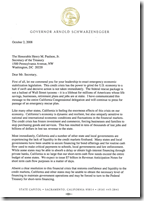
October 3, 2008 -- SACRAMENTO — California Gov. Arnold Schwarzenegger, alarmed by the ongoing national financial crisis, warned Treasury Secretary Henry M. Paulson on Thursday that the state might need an emergency loan of as much as $7 billion from the federal government within weeks.

The warning comes as California is close to running out of cash to fund day-to-day government operations and is unable to access routine short-term loans that it typically relies on to remain solvent.

image  The state of California is the biggest of several governments nationwide that are being locked out of the bond market by the global credit crunch. If the state is unable to access the cash, administration officials say, payments to schools and other government entities could quickly be suspended and state employees could be laid off.

Plans by several state and local governments to borrow in recent days have been upended by the credit freeze. New Mexico was forced to put off a $500-million bond sale, Massachusetts had to pull the plug halfway into a $400-million offering, and Maine is considering canceling road projects that were to be funded with bonds.

imageCalifornia finance experts say they know of no time in recent history when the state has sought an emergency loan of this magnitude from the federal government. The only other such rescue was in 1975, they said, when the federal government lent New York City money to avoid bankruptcy.

"Absent a clear resolution to this financial crisis," Schwarzenegger wrote in a letter Thursday evening e-mailed to Paulson, "California and other states may be unable to obtain the necessary level of financing to maintain government operations and may be forced to turn to the federal treasury for short-term financing."

The letter, obtained by The Times, came on the eve of a vote by the House of Representatives on a $700-billion rescue package, but it was too soon to know how the package would affect the nation's paralyzed credit markets. The Senate approved the so-called rescue bill Wednesday night.

A top Schwarzenegger aide followed up the letter with a call to the Treasury secretary Thursday night. Treasury Department officials could not be reached for comment.

It's customary for California to borrow billions of dollars at the start of the fiscal year to fill its coffers until the usual flood of sales tax receipts comes in after Christmas and income tax receipts arrive in the spring.

"California is so large that our short cash-flow needs exceed the entire budget of some states," Schwarzenegger wrote.

The cash needs to be in the state's bank account by Oct. 28 to be available to fund a scheduled $3-billion payment to more than 1,000 school districts.

Said Matt David, Schwarzenegger's communications director: "California faces the potential of a perfect storm created by the financial crisis' effect on liquidity, lower-than-anticipated revenues currently coming into the state, and our late budget. The governor is taking steps to prepare for this scenario to ensure that the state can make critical payments."

But those payments won't be forthcoming if the state can't do routine borrowing. For now, "the window is shut, and if it stays shut, we are in deep trouble," said an administration official, who asked not to be identified, citing the sensitive talks with Washington.

Quick passage of the rescue bill by the House of Representatives today and a signature by President Bush could inject more money into the international financial system and allow California to borrow at a reasonable interest rate, the official said.

But there are no guarantees that the economic recovery plan before Congress will succeed, said California Treasurer Bill Lockyer, who has been working with Schwarzenegger to keep the state solvent.

Asking the federal government for a loan "is one option on the table," said Tom Dresslar, a spokesman for Lockyer. The treasurer, he added, is working with outside financial advisors on a possible emergency plan to sell short-term debt notes to the U.S. government. Lockyer believes that such a plan is both feasible and legal, Dresslar said.

"I don't think we have ever gone to the feds," said Fred Silva, senior fiscal policy advisor with California Forward, a state budget think tank.

Silva said the closest California came may have been in the days after the 1994 Northridge earthquake, when at the request of the state, Washington sped up payment of federal funds that the state was owed.

State officials now fear they face a potential cash crisis worse than California confronted in 2003, in the final days of Schwarzenegger's predecessor, Gov. Gray Davis.

At that time, the precipitous decline of state revenue in the middle of a budget year forced officials to pay a syndicate of banks a premium of hundreds of millions of dollars for what amounted to an expensive "payday loan."

Even that option, administration officials say, would not be available during the current credit drought. They say if Congress does not approve a bailout plan -- and maybe even if it does -- there will be no lenders available to provide the state with the money it needs, regardless of the premium the state is willing to pay.

"We need to go as wide as possible to try to find buyers at reasonable rates," said Robert Fayer, an attorney advising the state on its planned $7-billion bond sale.

"Whether it could ultimately be the federal government, I have no idea. It is a fairly radical concept."

_____________________________

CALIFORNIA IS COUNTING ON BAILOUT TO END CREDIT CRUNCH

By Kerry Cavanaugh, Staff Writer | Daily News

October 3 - If the House rejects the $700 billion bailout plan today, California and local governments might have to postpone voter-approved road, school and other projects for lack of money.

Turmoil in the financial markets has made it difficult and expensive for government agencies to sell bonds that generate the cash needed to pay for large-scale construction projects.

In a letter to Congress, Gov. Arnold Schwarzenegger urged action on a bailout plan, warning that the state won't be able to fund highway, school, housing and water projects in the current financial climate.

"It's now very clear that the financial crisis on Wall Street is affecting California - its businesses, its citizens' daily lives and its state government's ability to obtain financing to pay for critical services," Schwarzenegger wrote.

California voters approved an unprecedented $42 billion in bonds in 2006 to pay for projects ranging from freeway upgrades to new schools to flood control levees. In addition, dozens of earlier bonds for parks, water projects and other public facilities still need to be sold. The state had been planning to sell an estimated $2billion in bonds in November.

Besides issuing bonds, the state also borrows short-term cash from Wall Street to meet normal operating needs before tax revenue starts flowing to state coffers.

But state Treasurer Bill Lockyer warned Thursday that state and local governments have been shut out of credit markets for the last 10 days.

"That means the state's cash reserves would be exhausted near the end of October," Lockyer said.

If that happens, it would be another blow to those who depend on state funding, only weeks after the end of a recordlong budget impasse that delayed state payments for 85 days.

In Los Angeles, government agencies hope that congressional approval of a bailout plan will stabilize shaky markets, encourage new lending and let them proceed with planned infrastructure projects.

With the tight credit markets, money for municipal bonds has dried up, said Edward De La Rosa, president of the investment banking firm De La Rosa & Co.

"A lot of people are waiting on the sidelines," he said.

The Los Angeles Department of Water and Power is planning to sell $550 million of bonds in November to upgrade its power system, including new power poles, circuits and transmission lines. Should the credit crunch continue, the utility would consider postponing the work.

"Our hope is that the market will regain its liquidity and will start to flow again by the time we issue our next set of revenue bonds," DWP General Manager H. David Nahai said. "But nobody has a crystal ball."

The Los Angeles Unified School District plans to sell bonds in November to pay for voter-approved school construction and maintenance projects, but Chief Financial Officer Megan Reilly said the district will delay if market conditions are poor.

Her bigger concern is that the state may run out of cash at the end of October - as the governor and state treasurer have warned - and be unable to borrow money for short-term cash flow.

That would cut funding for schools and force LAUSD to borrow money in the current frozen or expensive market to make payroll and other expenses.

"When we don't get cash from the state we have to cover it in market transactions, and that's not a good thing," Reilly said.

L.A. county officials said Thursday the county is well-positioned to withstand the financial crisis.

From Ron Kaye….

by ron kayE | ronkayela.com

Ron Kaye, former Daily News editor - a self-confessed anarchist who in the past seemed more wrong than right but now seems to be coming around (….or maybe 4LAKids is coming around …?) writes about his Saving LA Project (SLAP)/"Our LA": 

The effort to create a community-based movement to change the political culture of Los Angeles and reform City Hall is making steady progress.clip_image001

SLAP Town Hall Meeting, Saturday, Oct. 4, Charo Community Development Center at 4301 Valley Blvd
Los Angeles, CA 90032
(easy freeway access from anywhere in the city)


I'm happy to report several positive steps toward the Saving L.A. Project's goal of serving as a catalyst to bring every type of community group together

to support each other in their local agenda and to develop a citywide collective agenda that will create stronger democratic grassroots organizations

and restore government to its role as servant of the people.

First, SLAP is now an official non-profit corporation registered as such with the Secretary of State. This will enable us to seek nonprofit status for tax purposes

and to start to raise the money we need and other community groups need to be more effective.

Second, some community activists who spent a lot of time and money developing a dynamic website as an online newspaper but never got it off the ground havegenerously turned it over to us. It is being professionally redesigned to serve as center for community news, information and empowerment for all of Los Angeles.

We are calling it Our L.A. The website will be www.ourla.org and community groups of all types will be able to have their own pages, and the ability to post their information directly to the site. Individuals will be able to blog, create forums and discussion groups. It has video and podcasting capability and all the bells and whistles needed to create an all-inclusive public conversation that matters to us all.

Its success will depend on the degree of participation we get from everyone whether they now have their own website or want to utilize the resources of Our L.A.

Third, a large number of issues are coming to head in city government that offer community groups the chance to support each other and show City Hall just how much power activists have when the pull together all across the city.

On Tuesday, for instance, the DWP Commission has on its agenda a proposal to create a ratepayer's advocate -- a professional paid position who will be authorized to dig into the numbers and represent the interests of the ratepayers who have been socked with repeated rate increases and empty promises of service improvements even as DWP workers -- by far the city's highest paid -- are getting 6 percent pay raises on top of other raises while many people can't afford gas for their cars, $5 a gallon milk and their mortgages. The meeting starts at 1:30 p.m. at the DWP building, 111 N. Hope St.

It's critical that we mobilize the largest number of people to go to the commission meeting Tuesday to show the public solidarity behind the ratepayer advocate proposal and the public displeasure with DWP's sweetheart union contract.

Many other important issues are also coming to a head, including the protection of Griffith Park from development, the restoration of the Southwest Museum ss a living museum, a moratorium on billboards such as the giant flashing electronic signs causing visual blight everywhere, the cyclists Bill or Rights.

There are many others and it's SLAP's goal to identify them and bring pressure from every corner of the city on our elected officials, commissioners and bureaucrats so that they put the public interest ahead of the special interests.

There also is a lot we can do to effect the November elections that have five state bond issues on the ballot, the community college and LAUSD bond issues, the MTA half-cent sales tax measure and the parcel tax for gangs.

In the face of the nation's economic crisis and the recession, this is not the time to raise taxes or go on a spending spree with the public's money. Neither the city nor the state dealt seriously with the budget crises they created by overspending in the good economic years and the bills for that failure will be coming due in the months ahead, threatening services to the public.

I hope you will come to the meeting Saturday and step up your efforts to make Los Angeles a great city. The political system is weak and unable to provide the leadership we need. Now is the time to step up, get ourselves organized and moblilized. We can make a difference.

Best,


Ron
ronkayela.com
cell 818-621-8349
office 818-704-8418

There are NOT seven words you can’t say on the Internet

... and the video below has two of them!


So... Mr. Soapbox of Moral Righteousness, watchdog of public education is posting a video with a couple of naughty words - what's with that?

  • Because not voting in the coming election is offensive to the point of obscenity.
  • Because the message is targeted at folks eighteen and older.
  • Because there are candidates for national public office in this election who have suggested (but not advocated) that checking out offensive books from public libraries and never returning them might be an effective strategy for safeguarding public morality.
  • Because ignorance is the greatest enemy of a free people.
  • Because there are not 7 words you can't say on the Internet
  • Because October 20 is the last day to register to vote in California.

Onward! - smf

PS: Please pass this message along to five friends. If you can choose five friends who may not be registered to vote. You probably don't have five friends like that because you choose your friends wisely - but you probably do have five friends who aren't such good judges of character as you.

Thursday, October 02, 2008

LAUSD TO GET $165 MILLION MORE THAN EXPECTED FROM STATE

By George B. Sánchez, Staff Writer | LA Daily News

October 2 - Expecting huge cuts in funding from the new state budget, Los Angeles Unified officials recently learned they will get back about $165 million more than they anticipated.

The district is still facing a cut of $188 million from the budget signed by Gov. Arnold Schwarzenegger last week. But officials last month had expected to lose $353 million.

Now they have to figure out what programs to restore with the additional funds.

Most of the money is for special programming, such as small classes, but it remains unclear how much will go back to the classroom and when.

"That's a major question for dealing with negotiations and the budget shortfall we have," said Senior Deputy Superintendent Ray Cortines.

The president of the district's teachers union has a suggestion:

"They should spend it on their teachers and health-and-human-services employees," said A.J. Duffy, head of United Teachers Los Angeles.

The district's original plan for $353 million in cuts included work furloughs by district teachers and $140.6 million taken from categorical funding, which includes adult education, after-school programs, class- size reduction, and more than a dozen other programs.

"Categorical programs are usually directed to schools for helping poor kids," said Stephen Rhoads, a lobbyist for the LAUSD.

Schwarzenegger's earlier budget proposal had included a cut of 6.5 percent to categorical funds, but that money was restored in the final budget.

Now Cortines said district Chief Financial Officer Megan Reilly will look at how general funds can be redistributed.

Cortines is looking to relieve the unpaid days off expected of LAUSD staffers, which he called an unfair measure to balance the budget on the backs of employees.

The UTLA has assailed the district for its growth of administrator costs and the wage disparity between district bureaucrats and teachers.

"We're going to pursue an aggressive stance on how that money should be spent," Duffy said.

In a recent analysis, the Daily News found that the LAUSD's bureaucracy ballooned nearly 20 percent from 2001 to 2007. During that same period, 500 teaching positions were cut and enrollment dropped by 6 percent.

The district has approximately 4,000 administrators, managers and other nonschool-based employees, ex- cluding clerks and office workers, whose average salary is about $95,000.

About 2,400 administrators are among the 3,478 LAUSD employees who earn more than $100,000 annually. The average teacher salary is $63,000.

Though the unexpected funding provides some relief, Reilly said, it doesn't fully cover the cost of 20:1 class ratios in elementary and high schools.

Already, there are dire predictions for the next budget and Reilly said the small classes will not continue next year.

"In 2009, our classes are going from 20 to 29," she said, adding that no one expects a cost-of-living increase next year.

"The train wreck is in 2009-2010."

Wednesday, October 01, 2008

It’s about the money #1 - LOS ANGELES CHARTER SCHOOL GROUP HAS BIG PLANS FOR SOUTH L.A.: Inner City Education Foundation aims to expand from 13 campuses to 35 in eight years.

By Mitchell Landsberg | Los Angeles Times Staff Writer

October 1, 2008 -- On its face, it's an ambitious plan: Expand one of Southern California's biggest charter groups from 13 to 35 schools in eight years until it becomes, in effect, the second-largest district in South Los Angeles.

But that's just the beginning.

Mike Piscal, the hard-charging founder of the Inner City Education Foundation, has a far more audacious goal than that. As he sees it, the expansion plan he is announcing today will lead to nothing less than the transformation of South L.A. "into a stable, economically vibrant community."

"These students . . . are going to come back to the community and become the middle class and the leadership class," he said in an interview. "That's going to change everything! Where the Crips were born, where crack cocaine was invented and spread throughout the country, we're going to start spreading something good."

Piscal, whose View Park Preparatory High School in the Crenshaw area claims to graduate 100% of its seniors and send virtually all of them to college, plans to open seven more schools next year and continue until he has reached 35 in 2016, divided roughly equally among elementary, middle and high schools.

The schools will all be within a zone bordered by four freeways -- the 10, 110, 105 and 405 -- and will include some of the poorest and most crime-ridden neighborhoods in the nation. They will be in the Los Angeles Unified and the Inglewood school districts.

"They're doing some aggressive marketing," said L.A. Unified Supt. David Brewer, who said he didn't see the charter group's plan as a challenge to the traditional public schools. Those, he said, serve a much poorer, more troubled population than most charters. Still, he said, "We want to encourage them to be partners rather than us against them."

Charters are public schools that, in California, are typically authorized by districts but operate independent of them, using different curricula and, in the best of circumstances, making more efficient use of taxpayer dollars. Many charters, including Piscal's, are not unionized. They are intended to both challenge traditional schools and serve as petri dishes for reform and experimentation.

Los Angeles already is home to more charters than any other city in the country, with 145 operating under the loose supervision of the Los Angeles Unified School District. One of the largest operators, Green Dot Public Schools, began a new chapter in the charter movement this fall when it took over Locke High School, an L.A. Unified campus that was among the lowest-performing in the state. District officials are closely watching to see whether Green Dot can succeed.

"We're in a new phase," said Priscilla Wohlstetter, director of the Center on Educational Governance at USC, who has close ties to the charter school movement and is one of its leading researchers. "It used to be that charter schools were like fleas, or gnats -- you know, swat them away. Now that we know they're here to stay . . . the school district is becoming interested in what's happening inside the schools."

Green Dot founder Steve Barr said the Inner City Education Foundation announcement represented a new challenge to L.A. Unified. "I applaud it," he said. "I think it's awesome." Because many charters have long waiting lists, Barr said he would like to see 100 new ones open to "give every family a choice."

Piscal projected that, by the time his new schools are fully built and enrolled, his organization will be educating one of every four students in South L.A., and just over half of the high school students.

He also claimed -- and here, the math gets a little fuzzy -- that his schools will eventually produce more than four times as many college graduates as traditional public high schools in the area.

Piscal framed the expansion as the result of a failure by L.A. Unified to educate poor minority children, and called his group "a shark feeding on the carcass of a dead whale."

L.A. Unified, he said, is "like an airline where only one in 20 passengers arrive at the location where they're trying to go."

He singled out the four big L.A. Unified high schools in the area he has targeted: Crenshaw, Dorsey, Manual Arts and Washington Prep, as well as two Inglewood schools, Morningside and Inglewood High.

Piscal claimed that in 2005-06, the six schools graduated only 651 students who fulfilled the entry requirements for California State University and the University of California. Studies have shown that roughly 70% of the students who meet those requirements go on to graduate from a four-year college, according to the charter group.

Extrapolating from that, Piscal concluded that only 456 students a year from South L.A. -- an area with a population larger than Washington, D.C., or Seattle -- could be expected to graduate from college.

In fact, the numbers for South L.A. are somewhat larger than, if still quite low. Many college-bound students from the area attend public schools in other parts of the city, and the number of students who meet college requirements in South L.A. has risen significantly in the last two years.

Also, Piscal overlooked some schools in the area, including Inglewood's City Honors High and L.A. Unified's Foshay Learning Center, as well as Culver City High, that have good records of turning out college-ready students.

Two prominent members of the Crenshaw High community were skeptical of Piscal's proposal. Eunice Grigsby, a mother who is president of the Crenshaw Cougar Coalition, a parent-teacher group, said she suspected that charters stressed test-taking skills rather than "real-life skills." At Crenshaw, she said, "Our kids are doing well, and getting into the top schools."

Alex Caputo-Pearl, the lead teacher at Crenshaw's Social Justice and Law Academy and a teachers union board member, said Crenshaw -- which performed so poorly academically that it lost its accreditation temporarily in 2005 -- is now a model of reform as a member of L.A. Unified's Innovation Division, which gives schools greater autonomy from district rules.

"The reform that is really needed is happening in the LAUSD schools right now," he said.

●●smf's 2¢: Sometimes one doesn’t need to read between the lines, one needs only read the lines. Stories that contain the words “He also claimed -- and here, the math gets a little fuzzy … and “In fact, the numbers for South L.A. are somewhat larger…” should serve as warning to the reader: The truth is different than what is being told. The danger isn’t that the reader is being deceived with fuzzy math and suspect statistics – it is that the taxpayers are being deceived – and the very education of the South L.A. children being championed is being compromised.

It’s about the money #2 – TEACHERS HAVE LITTLE REASON TO CRY POOR

By Steven Rosenberg | Staff writer LA Daily News

October 1, 2008 -- With jobs like mortgage broker, investment banker, stock analyst and others that once looked solid - and profitable - suddenly looking not so good in the wake of America's looming financial difficulties, a Daily News Special Report revealed what most of us already know despite heavy doses of conventional wisdom to the contrary:

Teachers and other school employees do pretty darn well. Especially if they work for the Los Angeles Unified School District.

According to information provided to the Daily News by the LAUSD, the average salary for teachers is $63,000 - not too shabby that.

But more than 8,500 teachers pull in between $70,000 and $80,000 a year. Nearly 2,000 make salaries between $80,000 and $100,000, with a very lucky (and likely very experienced) 331 enjoying more than $100,000 in annual salary.

And then there's a benefits package that would be the envy of any worker not in the public sector. Medical, dental, pension - let's just say that anybody who puts in their time at the LAUSD won't be uncomfortable in their golden years.

Wait - there's more!

Let's say you enjoy management and administration. You know, running things? In the LAUSD, those valued employees even have their own administrators union. And it has 2,600 members. That's where the $100,000 Club really lives. According to our data, about 2,400 of these administrators top the $100,000 mark.

We're not denying that at least some of them are worth it. Maybe more than some. Or not. Who knows what's really going on at L.A. Unified? Nobody's calling the district a nationwide model of academic performance or educational innovation. Fiscal prudence? Will anybody make that case?

Even though administrators make more - often much more - than the classroom teachers they manage, it's pretty clear that the LAUSD is a great place to work if pay and benefits are important to you.

So kids, if you learn anything from your time in the classroom, remember that you could do a lot worse than toiling in the nation's second-largest school district.

Now that all this salary data is out in the open and under the light for all of us to see, it's up to Superintendent David Brewer III and his deep administrative bench to make the case for how much money is spent on salaries and how much goes for everything else.

And with a payroll like that, we can, should and will expect a whole lot less crying poor from the district itself - and a whole lot more for L.A.'s students.


●●smf's 2¢: The above doesn't make much of a case for the need for the pay raise UTLA President  A.J. Duffy ($99.325.08) is threatening a strike over. But perhaps if the Daily News shares their employees list, payroll data and job descriptions we could determine if there’s any difference between news reporters, editorial writers and columnists.