Thursday, January 29, 2015

Is ‘Smarter Balanced” an unfunded state mandate? …or just a brand of margarine?: 5 DISTRICTS+CSBA FILE $1 BILLION CLAIM OVER TEST COSTS

The LAO estimated earlier this month that the state owes schools between $4 billion and $5 billion in unpaid mandate claims.

by Tom Chorneau | SI&A Cabinet Report | http://bit.ly/1CEqydT

LEAs file $1b mandate test claim over assessment costs

January 29, 2015  ::  (Calif.) A coalition of school districts led by the California School Boards Association has filed an administrative challenge against the state, arguing schools are owed at least $1 billion more for costs tied to implementing new computer-based testing.

Following a legal process set out in the state Constitution, five school districts and CSBA’s Education Legal Alliance are seeking a ruling from the Commission on State Mandates to recover the full cost to schools for administrating assessments based on the Common Core State Standards that began last spring.

“When the state requires districts to take particular actions, then the Constitution says that the state has to pay for it,” said Josh Daniels, staff attorney at CSBA. “We are asking the state to follow its constitutional obligation.”

The administration is expected to argue that the requirement for all students to be tested annually is a centerpiece of the No Child Left Behind Act and that the state is simply carrying out federal law.

Key to the “test claim” filed by the school group in late December are requirements from a 2013 bill authorizing the new testing system – known as the California Assessment of Student Performance and Progress. Specifically, the legislation called on schools to buy new computer systems, train teachers and administrators to carry out the program, and comply with a whole host of reporting orders.

“In order to comply with the CAASPP requirements, districts have had no choice but to invest significant funds to expand their internet infrastructure, increase their software and hardware purchases, offer professional development and hire more staff,” Jesús M. Holguín, CSBA president and Moreno Valley Unified School District trustee, said in a statement.

An obscure and often misunderstood corner of state government, the local mandate program derives from a Constitutional provision that prevents the Legislature from imposing requirements on cities, counties, school districts and other local jurisdictions without also providing the funds needed to cover the costs.

There is a long history of disputes between the state and K-12 schools over education mandates as lawmakers – nearly every session – craft bills aimed at solving some problem while also trying to avoid creating any new cost to the state treasury.

The nonpartisan Legislative Analyst estimated earlier this month that the state owes schools between $4 billion and $5 billion in unpaid mandate claims.

The assessment test claim can be traced to the 2010 decision by former Gov. Arnold Schwarzenegger to embrace Common Core – classroom standards for what a student should know that have been updated to reflect college and career readiness goals.

As the school system began to implement the new standards, new tests aligned to Common Core also had to be created. A consortium of states, in which California is a leader, completed that task as well as field testing last spring of the Smarter Balanced Summative Assessments – the foundation of the CAASPP system. With an eye to the future, the Smarter Balanced tests are designed to be taken on computers.

Although Gov. Jerry Brown and legislative leaders have each of the past two years provided schools a large share of state revenue, money specifically earmarked for the cost of implementing Common Core has been limited.

The 2013-14 state budget provided $1.25 billion in one-time funding but there was just $427.2 million provided last year. Brown’s January spending plan for 2015-16 offers $1.1 billion for Common Core expenses, but schools have criticized that proposal because the governor is also using that money to pay down past mandate claims – in essence, double counting that funding.

The test claim filed with the Commission on Mandates specifically calls out a number of expenses which schools argue have not yet been addressed, including:

  • The cost to train and hire administrators, teachers and other personnel for test administration, reporting requirements and operation of the computer system.
  • The cost to evaluate a district’s technical needs and limitations; buying test materials and administering security protocol.
  • The cost of meeting new reporting requirements such as distributing test results to parents as well as state and federal officials and community stakeholders.
  • Finally, the cost of purchasing all the computers needed for each student to take the test, as well as peripheral devices and  necessary bandwidth improvements.

Combined, the test claim argues, the costs come out to be more than $1 billion statewide.

Dr. Rick Miller, superintendent of Santa Ana USD, said that his district’s combined costs last year and this year came close to $12 million.

“This new state assessment, which is part of CAASPP, requires a computer rather than a pencil,” Miller said in a statement. “As a result, we have had to spend millions of dollars in order to administer the test and we will need to continue to make additional expenditures in the future.”

The districts that have brought the test claim forward are Santa Ana, Plumas, Porterville and Vallejo as well as the Plumas County Office of Education.

STATES, FEDS FOCUS ON PARENT ENGAGEMENT


by Alisha Kirby|  SI&A Cabinet Report :: The Essential Resource for Superintendents and the Cabinet |  http://bit.ly/1Lf8YRz

January 27, 2015 (Fla.)  :: As debate in Washington appears to grow serious over reauthorization of No Child Left Behind, some states have already initiated new policies governing what many expect to be a key element of any update of the federal education law – parent engagement.

Florida, Michigan, California and Massachusetts have all recently enacted or strengthened requirements that districts undertake special efforts to better link families and schools either through the budget process or as an accountability measure.

Research consistently shows that students with involved families tend to have higher grades and test scores, better attendance, higher rates of homework completion, better social skills and behavior, often enroll in more challenging classes, and are more likely to graduate and go on to college.

“Through emphasis on developing successful partnerships with families, schools have improved the academic achievement of students and built lasting relationships with families,” said Cheryl Etters, spokeswoman for the Florida Department of Education.

Formal policies encouraging parent involvement with schools have been around in one form or another for decades. Section 118 of Title I, Part A spells out a clear mandate that LEAs receiving federal funds must involve parents; must have a written policy for parent involvement and must reserve 1 percent of the federal allocation to help carry out parent engagement requirements.

This requirement is separate from two other parent-related programs – Public School Choice and Supplemental Educational Services, both of which are tied to Program Improvement.

But there has been criticism that the current federal rules don’t go far enough and are too passive – prompting some state lawmakers to adopt stronger policies.

Florida, for instance, passed the Family and School Partnership for Student Achievement Act in 2003, which requires local school boards to adopt rules that promote family and community involvement. Under the law, LEAs are also required to develop and distribute a parent guide written in parent friendly language, develop and distribute a parent involvement self-assessment checklist and train teachers to partner with families.

“Effective partnership is realized when families, schools and communities engage in practices that foster an understanding of their specific rights and responsibilities regarding student success,” Etters said.

Massachusetts included family and community engagement as a standard in its teacher evaluation rubric, which includes indicators such as parent engagement, collaboration in student learning expectations and curriculum support, and both two-way and culturally proficient communication.

The rubric was developed by the state’s Department of Education in 2012 after it was awarded $75 million through the federal Race to the Top grant which required changes in states’ teacher evaluation systems. Districts have steadily been adopting the framework, but this is the first year that all educators across the state are to be evaluated under it.

In Michigan, one indicator of district accountability is parent involvement, and districts are required to adopt and implement plans designed to encourage parents to participate in school activities and meetings.

Detroit Public Schools, one of the state’s largest districts, also stands out as one of the most successful in meaningfully engaging parents. By 2011 authorities at the district said parental involvement had increased by 37 percent over the previous year through participation in its Parent and Community Engagement 2.0 initiative. The program is meant to keep kids in school by getting parents involved through its Parent Resource Centers, which offer workshops on parenting, help with homework and studying, and job skills training.

Last year, the education department released its District Improvement Framework 2.0 which included a number of suggestions that mirrored Detroit’s engagement methods.

In California Gov. Jerry Brown and legislative leaders sought to fundamentally change the relationship between schools and families with adoption in 2013 of the Local Control Funding Formula.

For the first time in the state, school districts were mandated to bring parents into the budget process:

  • Schools must consult with parents as a key stakeholder group and must seek their input in developing the Local Control Accountability Plan. (EC 52060[g])
  • Schools must promote parent participation. (EC 52060[d-3])
  • Schools must show evidence of how parents have been engaged and involved in developing, reviewing and supporting implementation of the LCFF. (EC 52066[3])
  • The Legislature took the further step of including parental outreach as one of the eight “state priority areas” (EC 52060) that LEAs are required to develop, as well as report performance measures that support student outcomes. Thus, parent engagement has equal status alongside implementing state content standards, providing a safe and functional learning environment and improving student academic outcomes.

Tuesday, January 27, 2015

SCHOOLS ENCOURAGING PARENTS TO IMMUNIZE STUDENTS + HOW TO SPOT MEASLES WHEN YOU SEE IT: Once easily recognized, signs of measles elude young doctors

  • 90% of persons who are unvaccinated or not immune from previously having measles will get sick if exposed to the virus – which is airborne.

  • If a school has a student with a confirmed case of measles, districts should send all unvaccinated students home.

By Jane Meredith Adams | EdSource | http://bit.ly/1zUyB6L

January 26, 2015 |The largest outbreak of measles in California in years is prompting school officials to redouble their efforts to convince parents to vaccinate their children.

Sheri Coburn, the president-elect of the California School Nurses Organization, said the push for immunization is “one positive thing” to come from the rash of cases – now at 73 statewide – of the highly contagious and sometimes serious illness. The majority of cases are linked to exposure to the measles virus at two Disney theme parks.

“We continue to advocate for people to be vaccinated,” Coburn said, noting that three-quarters of those who contracted measles were “not vaccinated at all,” referring to the Disney outbreak.

The push for immunization is ‘one positive thing’ to come from the measles outbreak, said Sheri Coburn, president-elect of the California School Nurses Organization.

State law requires children to be vaccinated for a variety of illnesses by the time they enter kindergarten. But parents may obtain “personal belief exemptions” from the required vaccinations, making their children more vulnerable to contracting potentially fatal illnesses and transmitting the viruses to others.

The proportion of parents seeking those exemptions varies greatly from district to district, and even from school to school, as noted in an earlier EdSource report.

The number of school-age children with confirmed cases of measles in California reached 13 on Monday. The outbreak has prompted many school districts to take action, including emailing measles alerts to parents, urging them to vaccinate their children if they haven’t already, and referring families to free immunization clinics.

In San Bernardino County, for example, public health and school officials collaborated on a letter that districts can send to parents or post on their websites. The letter recommends that children who have not had a measles vaccination “have that done,” said Dan Evans, spokesperson for the San Bernardino County Superintendent of Schools.

In the Santa Monica-Malibu Unified School District, where a freshman baseball coach contracted measles, school nurses and public health investigators last week quickly scrutinized the immunization records of baseball team members and found that all were up to date. Following advice from the Los Angeles County Public Health Department, the district did not exclude any students from school, regardless of their vaccination status, because exposure appeared to be limited.

However, parents have received letters from school nurses and the district superintendent, and in the case of Santa Monica High, a letter from principal Eva Mayoral urging that “all students be up to date with all immunizations.”

Los Angeles Unified’s District Nursing Communicable Disease Control Team has mobilized, with school nurses teaming up with county public health investigators to track suspected cases of measles; five cases have been investigated, but none of them has proved to be measles.

Nurses in the Laguna Beach Unified School District have sent letters to parents of unvaccinated students urging them to have their children immunized. And Oceanside Unified posted on its website a letter from the San Diego public health department encouraging vaccinations and thanking parents for taking steps to protect their families and the community from measles.

Even in Santa Clara Unified, far from Disneyland, the school district last week posted a message from the county’s public health department on its website that was both a call for calm and a call to action. Two cases of measles have been reported in Santa Clara County, both of them in adults.

“We want to reassure parents that there is no need to be alarmed,” the message on the website stated. “If your children have been vaccinated, they are protected from catching measles. However, a measles outbreak serves as an important reminder that everyone does need to make sure that they are either immune or have been vaccinated against measles.”


image


Dr. Gilberto F. Chávez, deputy director of the Center for Infectious Diseases at the California Department of Public Health, has made it clear that if a school has a student with a confirmed case of measles, districts should send unvaccinated students home.

“That is standard practice in this state,” Chávez said in a telephone press briefing. “If there is a child with measles in a school setting, the expectation is that the rest of the children who are not immunized need to be excluded from that school.”

So far, Huntington Beach High, with an enrollment of about 3,000 students, is the only known school where students have been sent home as a result of the disease.

A case of measles at the school came to light when a parent, whose unvaccinated daughter was sent home, appeared on a television news show to explain her child’s medical exemption to the measles vaccine.

Officials at the school initially notified 24 students that they would have to stay home because they were not vaccinated, but four of those students provided evidence of vaccination, said Pamela Kuhn, a certified school nurse and coordinator of health and wellness for the Orange County Department of Education.

News that the unvaccinated students were being kept at home has generated calls and emails overwhelmingly in favor of the decision to exclude unvaccinated children from attending classes, she said. “I’m getting more calls supporting our decision to exclude,” Kahn said.

The students will be out of school for 21 days, which is the length of time it takes before the measles could appear. They are scheduled to return to school on Friday.

Measles has been confirmed in patients from seven months to 70 years old by 11 county or local public health agencies: Alameda, Long Beach City, Los Angeles, Orange, Pasadena City, Riverside, San Bernardino, San Diego, San Mateo, Santa Clara and Ventura, according to the California Department of Public Health. Earlier last week, before the numbers increased, the department said that 25 percent of the cases required hospitalization.

The “great majority” of the cases involve unvaccinated people, Chávez said.

The highly contagious virus was declared eradicated in the U.S. in 2ooo, but an increase in the number of parents choosing not to vaccinate their children has led to outbreaks, Chávez said. Parents who say it is safer not to vaccinate their children are basing their decision on “pure misinformation,” he said.

Going Deeper


Jane Meredith Adams covers student health and well-being. Email her or Follow her on Twitter. Sign up here for a no-cost online subscription to EdSource Today for reports from the largest education reporting team in California


_________________________________________

Once easily recognized, signs of measles now elude young doctors

By Eryn Brown , Rong-Gong Lin II and Rosanna Xia | LA Times | http://lat.ms/18q7FAj

Measles case

A decades-long effort to immunize American children managed to wipe out the last homegrown measles cases in 2000. (Justin Sullivan, Getty Images)

27 January 2015  ::  Some medical experts worry that the battle against measles has become a victim of its own success

It was spring of 2014. Dr. Julia Shaklee Sammons looked around and saw trouble.

An infectious disease specialist at Children's Hospital of Philadelphia, she had read the headlines about new measles cases — including outbreaks in California and Ohio — and decided it was time to speak out.

Writing in the journal Annals of Internal Medicine, Sammons implored doctors to get more familiar with the disease. In two tightly packed pages, she described measles' potentially deadly effects and outlined how to diagnose it. She included archival photos to drive her point home: A tow-headed boy covered in an angry rash in 1963. A child's upper lip pulled back to display tiny white spots, an early sign of measles that sometimes can lurk unnoticed.

She knew how badly coaching was needed.

Like many younger physicians, Sammons, who graduated from medical school in 2006, trained when the disease was no longer an issue in the United States. "I have not cared for a patient with measles," she said. "I hope I never have to."

A decades-long effort to immunize American children managed to wipe out the last homegrown cases in 2000. But the virus still can arrive here from other countries and spread.

Today — as California faces its largest outbreak since the disease was declared eliminated — some worry that the battle against measles has become a victim of its own success.

The virus is now so rare that medical schools don't dwell on it at length. Lack of familiarity can make medical providers, the vast majority of whom have never seen a sickened patient, slow to recognize the potentially deadly, and highly contagious, disease.

"Doctors aren't thinking about measles because they haven't seen it before," said Dr. Mark Sawyer, a pediatrician and infectious disease specialist at UC San Diego and Rady Children's Hospital. "Diagnosis is delayed, the patient isn't isolated, and they end up managing to expose other people until somebody goes: 'Wait a minute — this is measles!'"

It's usually a senior doctor who sees it, Sawyer said.

The current outbreak began a week before Christmas and thus far has sickened at least 87 people in seven states and Mexico. About one in four of the 73 patients from California, who range in age from 7 months to 70 years, has required hospitalization. Most had visited Disneyland. Many were not immunized. A number initially were misdiagnosed.

One year before the introduction of the measles vaccine in 1962, there were 481,530 reported cases nationwide, according to the U.S. Centers for Disease Control and Prevention. In 2004, there were 37.

How to spot measles when you see it

Measles was declared eliminated in the U.S. in 2000, and many younger doctors have never seen an infected patient. The virus can lead to complications such as pneumonia, inflammation of the brain and even death. A delayed diagnosis can allow the highly contagious disease to spread.

  • Initial symptoms can be similar to other illnesses:A cough, runny nose, redness of eyes and a fever as high as 106 degrees.
  • White lesions called Koplik spots can appear in the cheek a day or two before the measles rash begins.
  • How to recognize measlesA rash appears about two to four days after the first symptoms, beginning at the head and spreading to the rest of the body. Health officials say patients are usually contagious during the four days before and the four days after the rash erupts.

Source: The U.S. Centers for Disease Control and Prevention, Annals of Internal Medicine

Aspiring physicians still learn about the virus in medical school, but they read up on its biology and symptoms at the same time as they're being introduced to a multitude of illnesses they're far more likely to encounter.

"It's not something you spend a great deal of time on at all, for obvious reasons," said Dr. William Schaffner, an infectious disease specialist at Vanderbilt University Medical Center in Nashville.

Schaffner said he thought the Disneyland outbreak — and the pockets of undervaccinated children that have fueled it — might lead medical schools to increase their emphasis on teaching measles. But the latest generation of doctors still won't get hands-on experience.

"In the bad old days, any grandmother could walk past a child with measles and say, 'That's a child with measles,'" Schaffner said. "It's pattern recognition. And if you haven't seen it before, it can be puzzling."

With measles in particular, which can resemble many other illnesses in its early stages, seeing is understanding, said doctors who had treated afflicted patients. Textbook pictures can't fully convey what the signature rash looks like. Infected kids are uniquely irritable.

"There's a miserableness quotient," said Dr. Paul Offit, a pediatrician and outspoken immunization proponent. "You can read about it, but there's nothing like seeing it."

Sawyer said he recently asked a group of pediatric residents whether they had ever seen measles. None raised their hands.

It's a problem, Sawyer said, because the virus is so contagious.

"There are a lot of infectious diseases physicians don't see in training, but most don't have the same consequences if you miss it for a little bit," he said. "The problem with measles is, if you miss it, you put people at risk."

More than 90% of people who don't have immunity to measles — either through vaccination or from having had the disease — will get sick if exposed to the virus, which can survive for up to two hours in the air.

Dr. James Cherry, a UCLA research professor and principal editor of the Textbook of Pediatric Infectious Diseases, said it was important for physicians to remember that fever, cough and runny nose are initial signs of measles. About two days after those symptoms begin, white lesions known as Koplik spots emerge inside the cheek. Only later does the rash appear.

Officials at the Orange County Health Care Agency and the California Department of Public Health said they were working hard to make sure doctors knew what to look for to make a measles diagnosis and to keep providers updated on the current outbreak.

This isn't the first time California physicians have had to educate themselves about measles, said Dr. James Watt, chief of the division of communicable disease control of the state public health agency.

Watt was a pediatrician in training during the outbreak of 1989-1991.

"What I remember very vividly was that all over the hospital there were signs that said, 'Think measles.' There were pictures of children with measles," he said, as well as placards reminding doctors of key symptoms.

Dr. Deborah Lehman, a pediatric epidemiologist at Cedars-Sinai Medical Center, said she first encountered the illness during the late 1980s outbreak, when she was in training at Children's Hospital Los Angeles.

Two sisters came to the hospital in the middle of the night suffering from symptoms that she and her colleagues thought must be meningitis.

"Measles was the furthest thing from my mind," she said.

A seasoned pediatrician arrived at the children's bedside in the morning. He made the correct diagnosis right away.

HELP+NCLB: FROM TESTING2TEACHERS & SENATOR (and former Education Secretary) LAMAR ALEXANDER - with guns a-blazin’!


FROM TESTING TO TEACHERS

By Caitlin Emma –in Politico Morning Ed | http://politi.co/1zUrb3l

1/27/2015 | 10:01 EST ::  The Senate HELP (Health, Education, Labor, and Pensions) Committee meets at 10 a.m. ET for its second hearing on reauthorizing No Child Left Behind, this one focused on teachers and school leaders. Sen. Patty Murray, the committee's ranking member, will lay out some priorities in her opening remarks: Educators need to be paid enough "to continue to attract the best and brightest," and they need professional development and opportunities to advance their careers. And Congress should consider "ways to recruit and retain strong and diverse educators and make sure the most successful teachers are working with the students who need them most," Murray plans to say.

Among those testifying:

  •  Dan Goldhaber, who directs the Center for Education Data and Research at the University of Washington. Goldhaber will argue for keeping annual tests on the grounds that they've "led to a revolution in the way that we think about the contribution that schools and teachers make to student achievement," he told Morning Education. Another key element of any NCLB rewrite, in his view, should be to spur innovation to improve the teaching workforce.
  • Christine Handy-Collins, a principal at Gaithersburg High School in Maryland, will testify about her experience with Montgomery County's mentoring program for school leaders. Handy-Collins believes it's crucial for the next NCLB to include dedicated funding for professional development for principals. Several groups representing school administrators already have taken issue with Alexander's discussion draft, arguing that it wouldn't maximize or sustain teacher quality. The American Federation of School Administrators, the National Association of Elementary School Principals and the National Association of Secondary School Principals note that the draft expands the use of Title II funds for purposes other than to support teachers and principals. Combined with the elimination of the maintenance of effort provision and other changes, the draft will "greatly reduce the chances that states will use those funds for anything but budget relief," the groups write.
  •  Rachelle Moore, a first grade teacher from Madrona K-8 school in Seattle will also testify. Moore has been a mentor in the Seattle Teacher Residency program, and she spoke about the experience on Capitol Hill last fall. More from the Seattle Times: http://bit.ly/1vPs2xi

_____________________________________________________

from Fitzwire +Real Clear Education: Committee Activity – by email  

1/27  ::  Sen. Lamar Alexander, the new chairman of the Senate committee on education, plans to take a revised version of No Child Left Behind to the Senate floor by the end of February, with hopes of pushing it through Congress "in the first half of this year."

But how Alexander and the Senate education committee ultimately come down on testing could fundamentally alter the way that public education works in this country.In a conversation with TIME, Alexander offered a peek into what he thinks might come next.


What the New Senate Education Chair Thinks About No Child Left Behind


Lamar Alexander, Patty Murray

Senate Health, Education, Labor and Pensions Committee Chairman Sen. Lamar Alexander, R-Tenn., right, and the committee's ranking member Sen. Patty Murray, D-Wash., arrive on Capitol Hill in Washington, Wednesday, Jan. 21, 2015, for the committee's hearing looking at ways to fix the No Child Left Behind law. Susan Walsh—AP

Jan. 25, 2015  ::  Sen. Lamar Alexander, the new chairman of the Senate committee on education, walked into Congress this month with guns a-blazin’.

Twelve years after the passage of George W. Bush’s signature education bill, No Child Left Behind, and eight years after that troubled law was supposed to be revised and updated, the Tennessee Republican says now is the time for its long-neglected makeover.

He plans to take a revised version of the law to the Senate floor by the end of February, with hopes of pushing it through Congress “in the first half of this year.”

What exactly that makeover will look like is now the subject of hot debate on Capitol Hill.

The primary issue at stake is testing. Under No Child Left Behind, students are required to take a raft of standardized exams, each of which are used to assess whether schools are succeeding or failing, and, increasingly, to hold individual teachers accountable for their performance in the classroom.

Critics of No Child Left Behind—and there are lots and lots of them—generally hate the testing mandate. Conservatives and Tea Party activists decry it as “government overreach,” while liberals, local teachers unions and parents lament the reliance on “high-stakes testing.” Even Secretary of Education Arne Duncan has said that too much testing can “rob school buildings of joy.”

So far, Alexander says that while he sees the benefits of aggregating and breaking down federal testing results, “the jury is still out” on whether an updated No Child Left Behind should require federal standardized tests at all, and if they do, whether the government should be barred from imposing consequences on schools with bad test scores.

How Alexander and the Senate education committee ultimately come down on this issue could fundamentally alter the way that public education works in this country.

In a conversation with TIME last week, Alexander offered a peek into what he thinks might come next.

This interview has been edited for length and clarity.

You’ve said you’re not sure how you stand on the testing issue, but what is your thinking at the moment?

The thing that worked with No Child Left Behind is to take tests results, break them down and aggregate them so that we know that children really aren’t being left behind—so you can’t have an overall average for a school that’s pretty good, but still leave all the Latino kids in a ditch somewhere. But what’s increasingly obvious to me is that the biggest failure of No Child Left Behind has been the federal accountability system—the effort to decide in Washington whether schools or teachers are succeeding or failing. That just doesn’t work. But I think the jury’s still out on the tests.

How so?

What I didn’t realize when we started was the large number of tests that are required by state and local governments. [Former Florida Gov.] Jeb Bush’s Foundation of Excellence in Education in Florida found that there are between eight and 200 additional tests required by state and local government in Florida. That is a lot more than the 17 tests that No Child Left Behind requires.

So you’re not necessarily opposed to keeping those 17 federally mandated tests?

Dr. [Martin] West at Harvard [who testified before the Senate Health, Education, Labor, and Pensions committee last week] suggested keeping the [17] tests but making the decision about success, failure and accountability part of a state’s system. … Dr. West argues that that’s the real culprit—trying to [design accountability systems] from Washington—and I think that’s a pretty persuasive argument. I mean, it may not be the federal tests so much as letting someone at such great a distance assign so much weight to a single test and such arbitrary consequences to it.

So there may still be a federal testing mandate in a revised No Child Left Behind?

Most of the controversy that exists today is the result of Washington getting involved [in state education policy] over the last six or seven years. People don’t like that. Teachers and their unions do not like being evaluated from Washington, and communities do not like being told what their academic standards are, i.e. Common Core, from Washington. They might adopt it for themselves, but they’re not going to be told what to do. … [Washington’s involvement] actually creates a backlash, making higher standards more difficult to hold onto and teacher evaluation systems more difficult to create because of all the anger. … It’s just not the way you make permanent improvements in 100,000 public schools. The community has to own the change. The teachers in the school have to own the evaluation system and believe it’s fair or it’ll never work.

So keep the federally mandated tests, but leave the consequences portion to the states.

That’s right. That’s what Dr. West argues: you have to have the annual test. You have to disaggregate it. You have to report it, so we know how schools and children and school districts are doing. But after that, it’s up to the states, who spend the money and have the children and take care of them and it’s their responsibility to devise what’s success, what’s failure and [what the] consequences [should be].

You’re saying that Dr. West’s position, but it sounds like you’re pretty sympathetic to it.

The jury’s still out for me. What I know is the biggest failure of No Child Left Behind is the idea that Washington should tell 100,000 public schools and their teachers whether they’re succeeding, whether they’re failing and what the consequences of that should be. That hasn’t worked.

CORTINES: UTLA’S ‘UNREALISTIC’ PAY DEMANDS WILL LEAD TO ‘CATASTROPHIC’ LAYOFFS

SEE: CORTINES’ NEGOTIATIONS UPDATE EMAIL TO EMPLOYEES & LABOR PARTNERS: |  http://bit.ly/15NeomP

L.A. Unified chief blasts teachers union's salary demands

By Teresa Watanabe | LA Times | http://lat.ms/1H5WWdI

Ramon Cortines

Los Angeles Unified Supt. Ramon Cortines blasted the teachers union Monday, warning it would force "catastrophic" layoffs. The union sharply rebutted his allegations. (Damian Dovarganes / Associated Press)

27 Jan 2015  ::  L.A. Unified Supt. Ramon Cortines blasted the teachers union's salary demands Monday, calling them an unrealistic proposal that would force "catastrophic" layoffs of other employees.

After 16 meetings and months of contract negotiations with United Teachers Los Angeles, Cortines issued a public letter sharply criticizing the union's demands for an 8.5% salary increase and other pay and earnings totaling 4.2% for the 2014-15 school year. He said the cost exceeded the district's offer by $833 million.

The district recently increased its offer to raise pay from 2% to 4%.

Cortines also said the union's demands to reduce class sizes would require the hiring of an additional 5,000 teachers and staff at an annual cost of $525 million. That proposal, Cortines said, would shift the burden of layoffs entirely onto other non-teaching school employees.

The union has failed to identify funding sources for its proposals or accept the district's invitation to review its financial books, Cortines wrote, while putting aside millions for a potential teachers strike.

"UTLA leadership's persistent demands, coupled with its strike plans, therefore raise serious ethical and equity issues," he wrote.

Union President Alex Caputo-Pearl sharply disputed Cortines' allegations. He asserted that the superintendent's cost estimates were inflated, and that the district had failed to provide numerous financial documents requested by the union.

He also said the district could redirect money being used for legal services, outside consultants and its attempt to repair the malfunctioning student information system known as MISIS.

Caputo-Pearl called Cortines' efforts to cast the union as selfish as a "fabrication." He said teachers have worked with other employees to support demands for more custodians, higher wages, immigrant rights and other issues.

"It's unfortunate that Cortines is trying to divide us," he said. "He is using scare tactics to respond to our very successful organizing effort."

In his letter, Cortines wrote that he had hoped the union's tough negotiating position was prompted in part by its feud with former Supt. John Deasy and that his departure last year would improve bargaining prospects. But he said he was troubled that no compromise appears in sight.

He called on the union to reexamine its demands and "their single-minded pursuit and organization of a disruptive strike against our students and the community."

Cortines breaks silence on teacher talks, lashes out at union

by Vanessa Romo | L.A. School Report |http://bit.ly/1zTMcLv

Ramon Cortines union

January 26, 2015 5:05 pm * UPDATED ::

A Unified Superintendent Ramon Cortines today for the first time publicly inserted himself into the district’s contract negotiations with the teachers union, calling its latest demands “entirely unrealistic” and asserting that they raise “serious ethical and equity issues” for the district.

Pointing out that all the district’s other unions have agreed to new contracts within the current economic landscape, he chided UTLA for its bargaining stance over 16 negotiating sessions, saying, “It is regrettable that the current UTLA leadership has gone in an entirely different direction.”

Alex Caputo-Pearl, the UTLA president, told LA School Report that he found Cortines’s two-page letter to “Employees and Labor Partners” “unfortunate” and “unacceptable” at a time he and other UTLA officials have been meeting with Cortines and district officials apart from the negotiations in a “problem-solving mode.”

“Unfortunately, the Superintendent is using scare tactics in response to our efforts to organize in our ‘school blitz’ campaign,” Caputo-Pearl said, adding that Cortines’s message comes as the state is putting more money into public K-through-12 education and the district is still finding money for huge legal settlements and the continuing array of technology problems.

“To say he can’t do this,” Caputo-Pearl said of meeting union demands, “is just unacceptable.”

Until now, Cortines had kept himself out of the spotlight except to encourage more dialogue between the two sides. But in his letter, he did not mince words, calling on UTLA leaders to “re-examine and reconsider their present demands and their single-minded pursuit and organization of a disruptive strike against our students and the community to achieve those demands.”

The strident tone of the message suggests that Cortines had a wider audience in mind.

The union, which has failed to win a raise for teacher for more than seven years, has been threatening a strike for many months. But mindful that any successful strike requires community support, the union has been drumming up for weeks as part of an “escalating actions” campaign. To this point, the district issued no district response, pointing to the disruptive nature of a work stoppage.

Cortines used his letter to paint a bleak financial picture for the district and its 650,000 students if the district were to satisfy current union demands.

“We must live within our means,” he wrote, insisting that meeting the union’s demands would bankrupt LA Unified and lead to the layoffs of thousands of employees, including many of UTLA’s own members. “[T]he sole funding source for UTLA’s persistent demands would be employee layoffs — in catastrophic numbers that would dwarf the impacts of the recent Recession,” he warned.

District officials calculate the cost of implementing the union’s latest bargaining proposals over two years would be about $833 million above LA Unified’s current offer despite a drop in UTLA’s salary demands from 10 percent a year.

Just last week, the union reduced its salary demand to an 8.5 percent raise, plus additional pay and earnings, as well as class size and staffing reductions that would add another 5,000 UTLA jobs. The district’s latest salary is for a 4 percent raise, plus pay for professional development days that the district says represents another 2 percent.

“There are no dollars in the 2014-2015 budget or layoff options to fund any additional increases,” he wrote.

“UTLA leadership’s persistent demands, coupled with its strike plans, therefore raise serious ethical and equity issues that must immediately be considered and addressed by all concerned parties,” he added. “I have been hoping that UTLA’s demands were simply reflective of future aspirations, or of their ongoing feud with the former Superintendent, so that as time passes they would be tempered by consideration of the reality of the District’s limited resources.”

Caputo-Pearl took special exception to Cortines’s contention that UTLA’s bargaining position would target workers in other unions for layoffs. The union president took that as an accusation UTLA was being selfish, and “nothing could be further from the truth,” he said.

He said UTLA meets with the district’s other labor partners monthly to work on such issues as living wages, immigration and training for teacher assistants.

“In the face of all that collaboration, for him to insinuate we’re being selfish smacks of ‘divide-and-conquer,” Caputo-Pearl said. “That is really not appreciated.”

From the Superintendent: GOVERNOR’S JANUARY BUDGET UPDATE MAIN HIGHLIGHTS

smf: lest there be any confusion: The Governor’s Budget Proposal is for NEXT TEAR (School year 2015-16); the pp2 Budget Update is for the CURRENT YEAR (SY 2014-15)

image image

Friday, January 23, 2015

THE EDUCATION WORDS THE PRESIDENT DIDN’T SAY IN THE STATE O’ TH’ UNION

Image of The Education Words President Obama Didn’t Say(Flickr/Penny Bentley/Creative Commons)

20585564220321188279652324534636269344n[1] Emily Richmond |EWA’s The Educated Reporter | http://bit.ly/15ylgnd

January 21, 2015 For the policy wonks and advocates hoping for more than a passing mention of K-12 education in President Obama’s State of the Union, it was a long 59 minutes.

There was a quick moment Tuesday night in which the president praised public schools for improving graduation rates, along with math and reading scores. He also highlighted the value of universal childcare (which is not the same as preschool), the importance of protecting student data, and expanding digital access to the nation’s classrooms.

On the higher education side, the focus was on a plan to make the first two years of community college free to most students, revising the tax code to provide more effective credits for education, and reducing the staggering burden of student loans. That wasn’t unexpected, given both proposals were recently rolled out.

“Whoever you are, this plan is your chance to graduate ready for the new economy, without a load of debt,” Obama said Tuesday. “Understand, you’ve got to earn it – you’ve got to keep your grades up and graduate on time.”

But there was no mention of academic standards (no one really expected him to use the words “Common Core”). And “teachers” doesn’t appear anywhere in the text. Some pundits had predicted mention of the federal push to upgrade the quality of the nation’s teacher preparation programs. That didn’t happen. The closest the president got to talking about testing, arguably one of the most pressing issues for educators, parents, and policymakers, was that reference to improved math and reading scores.

In the New York Times, columnist Frank Bruni offers a trenchant criticism of the free college proposal, noting that it won’t do much good unless more students are actually prepared for the academic challenges of higher education. That means improving the quality of K-12 instruction — through better teacher training and the use of higher academic standards, Bruni said. From his column Tuesday:

“We need to raise standards. That’s in fact what the Common Core is ideally about, and that’s why the education secretary, (U.S. Secretary of Education) Arne Duncan, under harsh attack, remains wedded to a certain amount of testing. High standards without monitoring and accountability are no standards at all.

“The goal is to lift children from all income groups up — and to maximize their chances of success with higher education. Their failure to complete higher education isn’t just a function of financial hardships and related stresses, though those are primary reasons. Academic readiness factors in.”

Indeed, K-12 education is the focus today on Capitol Hill, as lawmakers are holding hearings on the reauthorization of the Elementary and Secondary Education Act. It’s a long-overdue conversation: No Child Left Behind has been in place since 2002, and was due to be re-upped in 2007.

Michael Petrilli, president of the conservative Thomas B. Fordham Institute, a Washington, D.C.-based think tank, said he wasn’t surprised that the president didn’t mention ESEA. But he suggested that was a missed opportunity.

The president “avoided the one area of education policy where there is potential for bipartisan agreement,” Petrilli told me. “He’s playing politics instead of governing.”

I asked Anne Hyslop, a policy analyst for Bellwether Education Partners, a Washington, D.C.-based organization (who, incidentally, was the big winner of #EWABingo last night on Twitter) for her thoughts on the State of the Union.

She had anticipated a dearth of K-12 policy in the speech, given that early education and higher ed have taken the spotlight the past couple of years. That doesn’t mean the Obama Administration doesn’t have irons in those fires, however.

“Secretary Duncan laid out his priorities for reauthorization last week in an important policy speech, and there really isn’t anything more to say until Congress begins negotiating the bill and making changes through the amendment process,” Hyslop told me. “That said, the administration was largely absent from the last effort to reauthorize the law, so I consider those remarks a positive step in getting all of the key players to the negotiating table.”

In the long run, talking about education one night of the year isn’t an accurate barometer of a president’s priorities. Obama’s legacy will reflect the billions of dollars in stimulus money distributed to public schools through competitive grants, all of which “sparked significant change at the state level, despite a lack of progress on NCLB,” Hyslop said.

Those programs, coupled with the waivers Duncan has issued to the majority of states —  allowing them to escape the more onerous provisions of NCLB in exchange for making changes in key areas like teacher evaluations — make it clear that “Secretary Duncan has accomplished an enormous amount of work in K-12 over the course of six years,” Hyslop said.

The Department of Education might be better off focusing on the ambitious K-12 education initiatives already in play, rather than introducing a new program when its influence is diminishing and the Obama Administration’s time in office is winding down, Hyslop said.

And given a choice, Hyslop said, she would take “actual policy changes over proposals, like free community college, that are unlikely to pass a Republican Congress any day.

Thursday, January 22, 2015

EVERYBODY HATES PEARSON

f02-01-15_cover1[1]


by Jennifer Reingold | Fortune Magazine | http://for.tn/1yKJS8g

This story is from the February 2015 issue of Fortune.

January 21, 2015, 7:00 AM EST  ::  Okay, not everybody. The venerable publishing company is trying to reinvent itself for the Digital Age—­­in the most fraught, political, emotion-racked field there is: your children’s education. That’s stirring up a lot of anger.

John Fallon doesn’t look like the devil incarnate. With his ruddy cheeks and cheerful-but-not-too-posh English accent, Fallon, 52, seems more like a buddy from the local pub than the chief executive of a company with $8.2 billion in revenues that is trying to recast global education—and managing to upset a lot of people in the process.

Fallon, who succeeded longtime Pearson CEO Marjorie Scardino in January 2013, is at the helm of an ambitious quest to reinvent the 171-year-old publishing company, best known for its ownership of the Financial Times and its international textbook business, as a “global learning services company.” The goal is not merely to build a more successful and sustainable business—an imperative as Pearson’s traditional print operations shrivel—but also to improve the lives of millions of people throughout the world. “It doesn’t matter to us whether our customers are hundreds of thousands of individual students and their parents in China, or thousands of school districts in America,” says Fallon. “What we’re trying to do is the same thing—to help improve learning outcomes.”

Pearson CEO John Fallon | Photograph by Jason Larkin for Fortune Magazine

The problem is, legions of parents, teachers, and others see the new Pearson in a very different light. Many of them, particularly in North America, where the company does some 60% of its sales, think of it as the Godzilla of education. In their view, Pearson is bent on controlling every element of the process, from teacher qualifications to curriculums to the tests used to evaluate students to the grading of the tests to, increasingly, owning and operating its own learning institutions.

Liberals distrust Pearson’s profits: “Always earning,” snipes teacher Pamela Casey Nagler in a blog, mocking the company’s “always learning” slogan. Conservatives despise the idea of foreigners shaping U.S. education. “We feel like Pearson is an alien enemy and they are propagandizing our children,” says Chris Quackenbush of Stop Common Core Florida. Others malign Pearson’s competence, its “history of mistakes,” according to a recent letter signed by 47 New York City school principals.

Most of all, people fear the company’s reach. Alan Singer, a professor of secondary education at Hofstra University in New York who has written extensively about the company, calls Pearson a corporate “octopus.” Diane Ravitch, the former Department of Education official and author of the bestselling Death and Life of the Great American School System: How Testing and Choice Are Undermining Education, has derided what she calls “the Pearsonizing of the American mind.” The company’s name has penetrated far enough into popular culture that comedian Louis C.K., whose daughters attend public school, has blasted Pearson in tweets.

Education has always been a fraught field, of course. Few things are more emotional than shaping the minds of children, as Pearson learned during decades in the textbook business. But today standardized testing seems to many to have become the goal of education—as embodied in the No Child Left Behind program and the new Common Core ­standards—rather than a means of implementing it. Add in the increased use of technology to teach students, government cutbacks, and the private-sector-funded reform movement, and companies have more clout than ever when it comes to what and how kids are taught.

In the U.S., testing is the most searingly divisive issue. The business of assessing students through high school has grown 57% in just the past three years, to $2.5 billion, according to the Software & Information Industry Association. Some believe “high-stakes testing” is the best way to create accountability; others think it measures little and incentivizes the wrong things. Either way, it is now the largest segment within educational technology—and in little more than a decade, Pearson has gone from no presence to dominating the realm.

Fallon has gotten used to absorbing jeers aimed at Pearson. He emphasizes that the company’s goal is to help students succeed—and that the ultimate decisions remain in the hands of educators and government officials. Moreover, the company says its research indicates that among Americans who’ve heard of Pearson, 83% have a positive impression of it. “It’s inevitable in a field as important as education that feelings are strong,” Fallon says. “We are here to serve parents, governments, teachers, and most importantly students. We’re trying to take the right actions for the long term, rather than the most popular ones. And if sometimes that means we get both praise and criticism—hopefully that shows we are charting a sensible middle path.” He insists, “the more people engage with Pearson, the more they tend to say, ‘You’re not who we thought you were.’ ”

Pearson’s push into data-driven education has been a smart strategy. It began with Scardino, who expanded Pearson’s publishing and education brands far beyond Penguin and the FT during her 16-year tenure. And it has accelerated under Fallon, who has expanded further into emerging markets and who has spent the past two years trying to wrestle a hodgepodge of businesses into a more coherent whole.

PEA2-02.01.15

Fallon has restructured Pearson, cutting $215 million in costs and 4,000 jobs and acquiring digital and other education businesses overseas, most recently Brazil’s Grupo Multi chain of English-language school centers for $721 million. Net income has fallen some 18% since 2011, to $854 million in 2013, because of restructuring charges and the fact that the decline in the old businesses is outpacing the growth of new ones. But the company’s stock has stayed relatively flat, partly because Fallon has adroitly reduced expectations, likening Pearson’s reinvention to IBM’s move from hardware into services. He now says that the restructuring into what he calls a focused “One Pearson” is largely complete.

It sure hasn’t been easy. “John Fallon has had the most enormous baptism of fire,” says Tom Singlehurst, head of European media equity research at Citigroup. With the culture of standardized testing—which has been a cash cow for Pearson—under attack, Fallon has to convince the world that the company is truly a force for learning, and not just the executor of an approach that may soon fall out of fashion.

ЖЖЖ

Fallon imbibed the world of education, if only indirectly, growing up in Manchester, England:
His father was an elementary school principal. But Fallon didn’t initially go into the field. Instead he worked his way up through local government and then into Pearson’s communications and international divisions. A survivor of throat cancer, he has become the earnest and forthright ambassador-proselytizer for the company and its ambitions.

Pearson’s theoretician is Michael Barber, its chief education adviser. Barber, 59, may today be the single most influential educator on the face of the earth. A onetime professor at the University of London, he still has the distant, abstracted air of an academic. Barber was a key architect of England’s educational reform under then-Prime Minister Tony Blair, which involved closing underperforming schools and toughening national standards. Blair later asked Barber to apply the same approach to other services. (His work earned him a knighthood.) After leaving government, Barber became the head of McKinsey’s education practice, then moved to Pearson in 2011. In 2013 he published a report, “The Good News From Pakistan,” examining the positive results of his education philosophy—which has the uneuphonious name “deliverology”—in that country’s Punjab region.

Sir Michael Barber, Pearson’s chief education advisor, may be the most influential educator on earth.

The rumpled Barber downplays the company’s influence, then describes what to an American’s ears sounds like advocating global educational standards. “It’s not remotely true to say we are setting the global standards,” he says. “What is happening is a global economy and technological change and that affects every walk of life. It’s not caused by Pearson. It’s caused by globalization. Students are going to be part of a global labor market. Either the work moves or the people move. People who emerge into a labor market will struggle with employment, and we see that now across Europe and America. That’s just the way the world is changing. We want to make sure when we say someone is good at math they are good at math anywhere in the world.”

For all the breadth of Pearson’s education ambitions, it has been in the business for a relatively brief moment in the corporation’s long history. The S. Pearson & Son construction company was founded in Yorkshire in 1844. By the end of the century, Pearson had become a giant whose projects included the Sennar Dam in Egypt, railroads in China, and even a tunnel under the Hudson River in New York City.

In the 1920s, Pearson diversified, buying the Lazard investment bank as well as the Château Latour winery and the Madame Tussaud wax museum. It then expanded into newspapers and book publishing in the 1950s and ’60s. When conglomerates went out of fashion, Pearson concentrated on media and publishing, focusing on what was then a steady, high-cash-flow business. CEO Scardino doubled down, buying Simon & Schuster’s education division for $4.6 billion in 1998 and selling off Tussaud and Lazard. Pearson was now the largest education publisher worldwide.

The real goal was bigger still. Education around the world was moving toward greater testing and use of technology. So in 2000, Pearson spent $2.5 billion to acquire NCS, the largest American testing company, and began developing educational products that went beyond the textbook. “Content has been king,” Scardino told The Wall Street Journal at the time, “but now we’ll have the ability to put content and applications together, and that will really allow us to be king.”

The move coincided with the George W. Bush administration’s No Child Left Behind initiative, which required districts to measure student and school progress through increased testing. The viewpoint was clear: Schools were failing their students, and the best way to improve was to understand—and measure—what teachers and students were getting wrong.

The assessment push continued under President Obama, who required states to compete against one another for federal education funding—using testing as the metric—in the government’s Race to the Top. And then, in 2009, 46 states committed to tougher new standards under the rubric of the Common Core, in hopes of reversing the steep decline in the performance of American students relative to those in other countries. That meant new teaching materials, new technology, and, of course, new exams—and Pearson was perfectly positioned, having already bought up many testing businesses.

Today analysts think Pearson controls some 60% of the North American testing market. “From 30,000 feet, the strategy makes sense,” says Claudio Aspesi, senior research analyst at Sanford C. Bernstein. “If you believe in the societal pressure to drive improvement in educational outcomes and there’s not money to put more teachers against students, the next best strategy is to try to use technology.” Pearson was no longer a sleepy textbook publisher; it was now a powerful player in every corner of a burgeoning but more controversial industry, one that spurs deep anxiety in the lives of millions of families.

ЖЖЖ

It’s almost midnight, and my daughter is calling to me. She went to bed hours ago, but she is so stressed—at age 10—that she can’t sleep. She will do this nearly every night for two weeks until she finally takes the long-dreaded New York State English Language Arts exam.

Pearson is a palpable presence in her education at P.S. 41 in Manhattan. The company developed much of the school’s fourth-grade English curriculum as part of the Common Core standards. Pearson also designed the test for it.

All of this in an education world where tests increasingly are the be-all and end-all. “Mom,” she says, tears spilling onto her pillow, “why is one test so important?” She answers her own question with grim, distressing logic: “If I don’t do well on the fourth-grade test, I won’t get into a good middle school. If I don’t get into a good middle school, then I won’t get into a good high school, and if I don’t do that, I won’t get into a good college, and then I won’t get a good job.”

I cringe, feeling that I have failed as a parent if this is what she believes. And yet she has a point. In New York City, that test helps determine which middle school you get into. In her classroom, the pressure was so great that the teacher referred to the tests by aliases: the “waka-waka” and the “whablah.” They were the elementary-school equivalent, it seemed, of Harry Potter’s nemesis Voldemort, more commonly referred to as “he who must not be named.”

In a remarkably short time, the worthy notion of holding students and teachers accountable seems to have morphed into a system centered on “teaching to the test.” Parents who first welcomed higher standards now protest weeks of frantic test preparation; some principals have threatened to opt out of the exams altogether. Says Linda Darling-Hammond, a professor at Stanford’s Graduate School of Education (who worked with Pearson to develop a test, the EdTPA, for evaluating teachers): “Until about 2002, there was always an understanding that tests are prone to error, that they only measure a narrow slice, and that they should only be one piece of information among others. We’ve lost that perspective in policy.”

This is not Pearson’s fault, of course. State and local governments made the policy choices. Yet it is fully in the company’s interest for standardized testing to increase (a December 2014 company report trumpets the coming “renaissance in assessment”). Fallon is quick to defend the principle, saying that the rise of big data allows for the opportunity to improve learning by measuring exactly what is and isn’t working. “This idea of the shift from sort of inputs to outcomes, I think, is one that is now becoming all-pervasive in pretty much every area of public policy,” he says. “So why should education be any different?”

To be successful in measuring outcomes requires not only good intentions, but also competence. And here, Pearson has some explaining to do. Robert Schaeffer, public education director of FairTest, an advocacy organization that says it “works to end the misuses and flaws of standardized testing,” has kept a log of the company’s quality-control problems. The low lights include everything from printing errors to frozen screens at test time in 26 Florida counties.

FairTest says Pearson has made 13 significant errors from 2013 to today, including scoring mistakes that prevented 5,300 students from qualifying for gifted and talented programs in New York City. The company mis-scored questions on Virginia’s Alternative Assessment Program for students with learning disabilities—leading to 4,000 students being told they had passed the test when they had actually failed it. (In each instance Pearson rectified the problem once it came to light.) Argues Schaeffer: “There’s been a higher percentage of reported foul-ups by Pearson than by other companies.”

The company questions the findings. “We’ve never seen any methodology to suggest Pearson is less accurate than any other assessment company,” a spokesperson says. “In fact, we believe we are one of the most accurate.” He adds, “Any time mistakes occur, however rare, that’s unacceptable to us.”

Pearson’s behavior in winning lucrative contracts has also sometimes been troubling. The company used its nonprofit foundation—led primarily by Pearson executives—to pay for education leaders to take expensive trips to such places as Rio de Janeiro, Singapore, and Helsinki as they were contemplating hiring Pearson to develop the materials for their states’ version of the Common Core. In 2011, New York State attorney general Eric Schneiderman launched an investigation into such behavior. Pearson settled the case in 2013 without admitting wrongdoing, paying a $7.7 million fine and agreeing to separate its foundation’s efforts from those of the company. Said Pearson at the time: “We recognize there were times when the governance of the foundation and its relationship with Pearson could have been clearer and more transparent.” In November 2014, Pearson announced it was closing the foundation altogether. It appeared to have little further utility.

Another mess involves a partnership between Pearson, Apple, and the Los Angeles Unified School District, which in 2013 announced a $1.3 billion project to provide an iPad, loaded with Pearson educational material, to each of the 650,000 students in the district. The plan immediately bogged down in bureaucracy, technological problems (kids disabled controls and used the tablet to surf inappropriate sites), and accusations of influence buying by the winning bidders. Public radio station KPCC reported that the company’s foundation subsidized attendance by educators, including some members of the bid committee, at a Pearson conference. (The company denies providing subsidies.) At the conference, Pearson distributed iPads to the attendees. (The company says recipients agreed to use them only for district business.) All this took place before the bidding process had even begun. The FBI is investigating—it seized boxes of documents from the LAUSD offices in December—and the new schools supervisor terminated the contract last fall, announcing he would put it out to bid once more. Pearson says it has not been asked to provide information to investigators.

Common Core

Protesters demonstrate against the Common Core in which Pearson plays an extensive and vital role in Mississippi earlier this year.Rogelio V. Solis—AP

In other places, complaints about the state’s contract and oversight process could hurt the company. In Texas, for example, where Pearson has a $468 million contract to provide tests and educational materials, an audit found poor monitoring of the billing process at the Texas Education Agency. The same audit found that Pearson hired 11 staffers from the agency, two of them involved with the contract, shortly after it awarded the contract to the company (the agency waived rules delaying some of the employees from being hired by state vendors). As a result of that association—and complaints from school activists about how parts of U.S. history have been treated in its texts—some observers believe Pearson’s contract may not be renewed.

Fallon was not the CEO when those incidents occurred, but the task of improving the company’s reputation is falling to him. Adding to the pressure is the growing backlash against Common Core—which has been so beneficial to Pearson’s fortunes in recent years. Already three states have dropped out, and antipathy is mounting from both the left and the right. Schaeffer of FairTest thinks the movement may be rolled back now that Republicans are in charge of Congress. Even Fallon acknowledges that something has gone awry. “I do think as a wider community we have to put assessment and testing into context,” he says. “And I do think we have to be wary of layering too many different things onto one moment in time.”

That said, even if the standards are changed, they are likely to be replaced by new standards—and Pearson remains one of the only players with the size and scope to handle large testing or curriculum contracts. Pearson doesn’t enjoy the withering criticism from countless directions, but the truth is, it may not matter that much: Even if the curriculum changes drastically, the company may well still provide the means by which it is disseminated.

ЖЖЖ

Testing has helped Pearson reduce its dependence on old-fashioned publishing. Since 2008 its U.S. textbook revenues have fallen an estimated 17%; sales at the FT Group, despite recent improvements, have dropped 29% since 2005, in part because of divestitures. Meanwhile some 60% of Pearson’s revenues now come from what it calls “digital and services”—which basically includes every revenue source other than those from printed materials—compared with 37% in 2006.

PEA1-02.01.15

Online education is clearly a huge opportunity for Pearson. It’s cheap and accessible anywhere that has an Internet connection. E-learning was a $91 billion market in 2012, according to an estimate by IBIS Capital, and it’s growing fast.

So Fallon is now pushing Pearson toward direct-to-­consumer education, primarily overseas. There are millions of potential customers, mostly adults, who often don’t have access to top universities or vocational schools. It would allow the company to diversify out of North America, and needless to say, selling directly to adults is less emotionally charged than the K-12 market. It’s also a way for Pearson to put its outcome-based strategy in place with less interference, and—the company hopes—show that it works. Says Tamara Minick-Scokalo, head of international for Pearson: “Where we can really play a role is in doing more of the total education value chain.” Translated from management jargon into plain English, her statement seems to confirm every critic’s worst fears: Pearson wants to be involved at every stage of education.

Fallon listens to a student in Shanghai

Since 2010, Pearson has spent more than $2 billion on international adult education: The purchases include a 75% stake in CTI, a chain of computer-training schools in South Africa; Wall Street English, an English-language school business in China; and, as noted earlier, the Multi chain of English-language schools in Brazil, for $721 million. Pearson is also helping run and promote the online degree programs at schools such as Rutgers, the University of Florida, and Arizona State—which is likely to receive a windfall with Starbucks’ 2014 announcement that it will pay for full-time employees’ college studies, as long as they enroll at ASU Online. More than 1,000 students are already enrolled.

All of this change, including Fallon’s strong shift to centralization, has shaken Pearson itself, which was long a diffused, friendly, and somewhat sleepy organization. Morale has tumbled; reviews on the career site Glassdoor.com describe a scene of constant reorganizations and confusion, with only half saying they support the CEO. One typical comment, from a self-described VP: “ ‘One Pearson’ is a nice motto theoretically, but may not work operationally because aircraft carriers are hard to turn. John Fallon, your good intentions are getting lost in the botched handling of the most recent reorganizations. Get real and listen to the folks in the trenches.”

To his credit, Fallon is trying. He is making town halls and interactions with employees as central to his job as time with investors and clients. At a meeting with the Boston community college sales team—as well as at a later sit-down with students and faculty at Bunker Hill Community College—he responded to tough questions honestly and came across as authentic. “What are we not doing well?” he asked more than once and then listened intently. Employees weren’t shy, volunteering struggles with faulty technology and lamenting the large amount of turnover in the Boston offices.

Pearson Parcc test

A middle-school test-taker in Masachusetts gets help using an online Common Core exam managed by Pearson. Boston Globe via Getty Images

Fallon is also trying to make Pearson more accountable—only logical for a company that is helping to set the world’s educational standards. In late 2013 he announced that Pearson would, in effect, eat its own cooking. Much as it assesses others, it would assess its own performance, reporting the results in each business publicly by 2018 in what it calls “efficacy.” Pearson has developed specific criteria for the success of each business or initiative with more than $1 million in sales, says Barber, and promises that it will publish the results and hold itself to those standards.

The level of disclosure goes far beyond what most public companies are required to report. Fallon says that if Pearson’s programs are not having the desired outcome—if, say, English-language improvements in its Chinese schools do not meet the criteria—the company will abandon them. “If we say our purpose is to help people make progress in their lives through learning,” he says, “we’d better be able to demonstrate that.” The move requires guts—after all, few companies willingly put themselves under a microscope—but it’s worth noting that the company has given itself five years to get ready. That’s far more than many of its own customers receive.

Can Pearson make the grade? Fallon has the vision—and for a little while longer, at least, the apparent support of investors. Yet the internal challenges, not to mention the external opprobrium, mean the strategy’s success is not at all assured. “I think [Pearson] would be delighted to have as much clout as [the critics believe],” says Bernstein’s Aspesi. Fallon has set the timer; now he needs to pass the test.

Wednesday, January 21, 2015

LEGISLATIVE ANALYST’S OFFICE FAULTS LOCAL CONTROL ACCOUNTABILITY PLAN ROLL-OUTS

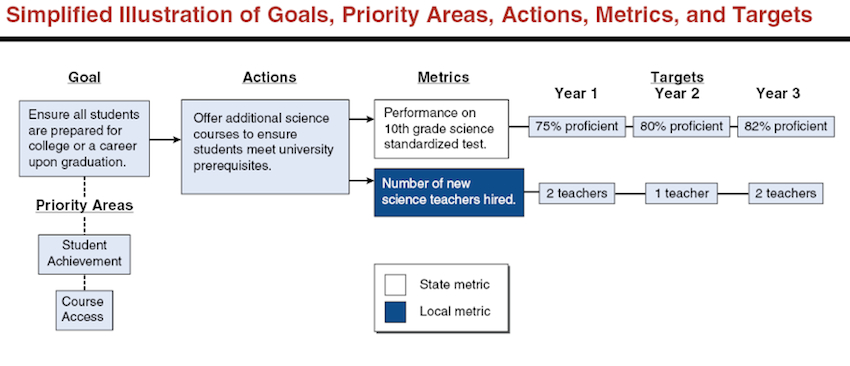
The LAO cites an example of how a district might approach one goal -- ensuring students are prepared for college or a career – with actions and metrics over three years.

Source: Legislative Analyst's Office The LAO cites an example of how a district might approach one goal – ensuring students are prepared for college or a career – with actions and metrics over three years.

Report says LCAPs need tighter focus

By John Fensterwald | http://bit.ly/1woPu1Z

Credit: Karla Scoon Reid / EdSource - Parents participate in setting priorities in an LCAP planning meeting at Correia Middle School in San Diego Unified in April 2014.

January 20, 2015   ::  Calling the new state-mandated local accountability plans “a daunting undertaking,” the Legislative Analyst’s Office called on the Legislature to allow school districts to write more focused annual plans for achievement.

The plans, called the Local Control and Accountability Plans, or LCAPS, will become more meaningful if districts can concentrate on “their highest-priority areas” rather than give equal attention to the eight priority areas that the Legislature wrote into law, the LAO said in a report released Monday. The nonpartisan, independent agency studied 50 LCAPs, including those of the 11 biggest districts. The others represent a cross-section of the state’s 1,000 school districts.

The LAO is urging lawmakers to require that districts be clearer in detailing how they will spend money to meet academic and other targets, especially additional funding mandated for “high-needs” students, including English learners and low-income students. The nonprofit advocacy group Education Trust-West made a similar recommendation in its study of districts’ LCAPs, issued last month. Children’s advocacy groups, such as Children Now and Public Advocates, are also recommending that approach.

Districts are required to address two dozen metrics and set goals for a dozen subgroups of students. They include not only English learners, low-income students and foster children, who get extra money under the new funding law, but also eight ethnic and racial groups and special education students.

Last year districts took their initial stab at the LCAP, a three-year planning document, updated annually, that’s required under the Local Control Funding Formula, the state’s new school financing system. The LCAP regulations require districts to set goals for improvement and describe actions they’ll take and money they’ll spend to achieve them in eight priority areas. Those areas include the rollout of the new state academic standards, parent involvement, school climate and academic achievement, which includes test scores, passage rates on Advanced Placement exams and the rate of redesignating English learners as proficient in English. County offices of education review districts’ LCAPs to verify that districts meet legal requirements and allocate enough money to pay for the districts’ commitments.

Districts followed temporary regulations last year. They faced a six-month deadline to reach out to parents and the community for their suggestions to complete their LCAPs by July 1. After months of hearing suggestions and complaints about the LCAP process, the State Board of Education strengthened the requirements for parental and student participation and updated the template for filling out the LCAP. The LAO acknowledged that the new template should help create a cleaner, more comprehensible document. But it won’t make the LCAP any less complex; only the Legislature can revise the basic requirements.

Districts are required to address two dozen metrics and set goals for a dozen subgroups of students. They include not only English learners, low-income students and foster children, who get extra money under the new funding law, but also eight ethnic and racial groups and special education students. None of the districts met every statutory requirement, the report said.

The LAO said that such ambitious requirements can lead districts to pay more attention to metrics and details than to larger strategies for improvement. The Legislature should let districts choose their highest priorities, the report said, as well as address critical areas needing improvement. The State Board of Education is developing a set of “evaluation rubrics” that will guide districts and county offices of education in identifying deficient areas in an LCAP; they may include statewide levels of achievement that schools and districts must meet over time. The board’s deadline for adopting the evaluation rubrics is Oct. 1.

Other LAO recommendations for the Legislature include:

  • Requiring districts to distinguish between ongoing and new actions. Many LCAPs didn’t do this, making it hard for the public to determine whether districts are using money to improve and increase services for high-needs students in proportion to the extra money districts received, as the LCAP law requires.
  • Replacing or clarifying some of the metrics the Legislature requires since there are no statewide measurements of parent involvement or access to courses. Also, the Legislature should add more metrics for elementary schools, the report said.
  • Directing the California Department of Education to publicize model LCAPs, including those that best describe and justify services for English learners and low-income children and those that concentrate on “overarching” goals, set clear targets and provide supporting data.
  • Monitoring how districts are using additional resources and taking actions to serve English learners and low-income children, the chief beneficiaries of the new funding system. The LAO said  many districts did not provide enough information in their LCAPs, often reiterating the same goals for English learners and low-income children as for all students. They also didn’t cite “clear or compelling rationales” for using supplemental dollars intended for high-needs students to pay districtwide and schoolwide expenses.

The LAO urges lawmakers to require LCAPs to cite all sources of funding that are going to English learners and low-income children, not just supplemental dollars under the funding formula. If, after a year of monitoring LCAPs, there is no improvement in the information provided, then the Legislature “could consider giving COEs (county offices of education) more authority to disapprove LCAPs that lack such detail.”

Reached for comment Tuesday, Brooks Allen, deputy policy director and assistant legal counsel for the state board, wrote, “We’ve only reviewed the report briefly so far, but remain very open to all suggestions for how to improve student outcomes through the (Local Control Funding Formula) and LCAPs. We appreciate that the LAO highlights the improved LCAP and Annual Update template that (districts) will use for the first time this year and are interested to see the results of the first full year of LCAP implementation.”

LAO education analysts Carolyn Chu and Edgar Cabral  wrote the report.

Review finds first batch of LCAP’s lacking

by Tom Chorneau + SI&A Cabinet Report | http://bit.ly/15tHYgo

January 21, 2015  (Calif.)  ::  The first comprehensive review of how school districts are meeting new reporting requirements tied to state aid for disadvantaged students found none that had complied with every statutory mandate.

As part of the restructuring of state support for schools adopted two years ago, local educational agencies have been required to develop plans that show how they will use the funds to improve services to low-income students, English learners and foster youth.

In a report released Tuesday, the non-partisan Legislative Analysts Office evaluated 50 Local Control Accountability Plans adopted last summer – the first year of the filing – in a pool that represented districts small-to-large, all of the geographic regions as well as the state’s 11 biggest LEAs.

The LCAP process, which many districts struggled to complete, called for a wide range of new activities and reporting demands. The Legislature set eight educational priorities and called on districts to set goals based on the priorities, describe actions they would take to reach the goals and track their progress. As part of the LCAP format, the state also outlined 24 performance metrics that fit within the priorities.

The measures were required across 12 student subgroups.

Districts were also required for the first time to formally engage parents and community groups in the process of building the school budget and the LCAP.

“Fulfilling all of these requirements is a challenging undertaking for districts to accomplish and accomplish well,” the LAO said in its report. “Though most of the LCAPs we reviewed attempted to comply with many of the statutory LCAP requirements, none complied with every statutory requirement.”

Another significant and common failing, the LAO said, was that most LCAPs did not distinguish between actions that had been ongoing and those initiatives just undertaken. Without some better description, “we could not determine whether districts were using the new funding generated under LCFF to pursue new actions to improve performance or to continue or expand prior activities,” the research team said.

The report also raised concerns that administrators were funding programs that benefitted all students at a certain school and not necessarily low-income, English learners and foster youth. Often, the LAO said, the LCAP indicated that actions taken on behalf of all students would also benefit the educationally disadvantaged.

The LAO said lawmakers should consider making some changes to the program:

  • Allow all districts to focus their plans on their highest-priority areas rather than require them to address all eight state-specified priority areas. Requiring districts to cover every priority area – regardless of local conditions – wasted time and energy, said the LAO. The emphasis should be on making the LCAP clear and strategic instead of detailed and comprehensive.
  • Require districts to indicate whether actions are new or ongoing. This distinction, the non-partisan analyst said, will provide clarity on where districts are making new investments and help identify which particular strategies may be affecting student outcomes.
  • Monitor quality of information regarding English learners and low income students.

The LAO said the state should monitor LCAP descriptions over the next few years for indications that services match expectations. As part of that process, they suggested the Legislature hold an informational hearing in the fall of 2016 – after another round of funding and reporting – to get feedback from schools and other stakeholders.