Friday, August 10, 2012

LAUSD CHIEF JOHN DEASY'S BACK-TO-SCHOOL PEP TALK INCLUDES PROMISE TO GET TEACHERS, STUDENTS COMPUTER TABLETS

By Barbara Jones, Staff Writer, LA Daily News | http://bit.ly/MGUKrO

LAUSD school administrators listen to Superintendent John Deasy during the Aug. 9. 2012 annual meeting held at Washington Prep High School in Los Angeles. (Brad Graverson/Staff Photographer)

LAUSD Superintendent John Deasy addresses school administrators during an annual meeting on Aug. 9, 2012 at Washington Prep High School in Los Angeles. (Brad Graverson/ Staff Photographer)

8/09/2012 9:02:33 PM PDT  ::  Setting an ambitious agenda for the new school year, Superintendent John Deasy urged Los Angeles Unified leaders Thursday to continue efforts to boost student achievement, and also vowed to get them the computers needed to get the job done.

Deasy outlined the district's accomplishments during a back-to-school pep talk, where he exhorted more than 1,000 principals and administrators to help the public understand the transformational work taking place in the nation's second-largest school district.

Deasy also said he is committed to supplying each of the 600,000-plus students, plus every teacher, with a tablet computer within the next 15 months -- a promise that drew enthusiastic applause from the crowd.

District officials previously have said that Deasy is trying to secure corporation donations for the technology.


LAUSD@LASchools    The 2012 Los Angeles Unified School District Superintendent's Annual Address will air on @KLCStv 8/9 6:30PM, 8/10 6:30AM, & 8/12 6:30AM

In touting the district's accomplishments, Deasy noted that record numbers of students passed the state high school exit exam last year, and more pupils enrolled in Advanced Placement classes and nailed the tests. And the number of student days lost to suspensions plummeted from 46,000 to 26,200, "smashing every goal we could have hoped for."

The district also exceeded its goal for helping its English-learners achieve proficiency while adding 5,000 youngsters to its gifted and talented programs.

"These aren't new initiatives. The power is sticking with them and being good at doing this work," he told the packed auditorium at Washington Preparatory High School, an 86-year-old campus under the flight path of nearby Los Angeles International Airport.

"We want to publicly make sense of this work so that people see a direct link between student achievement and the work that's taking place.

"It's really simple. We are mindful of who has the right to work with our youth. And we are mindful of how we run our business. And will continue to give parents and students high-quality public choice. The instructional core will deliver results."

Looking ahead to the school year that begins Tuesday, Deasy warned of hurdles that must be overcome as the district works to fulfill its promise of preparing every graduate for college or a job. That includes implementing a rigorous college-prep curriculum for every student, rolling out national instructional standards and improving intervention for English-learners.

"Leadership is the most powerful when we're consistent, and consistent about the work we said we're going to do," he said.

He cautioned, however, there are daunting challenges facing educators in the days ahead.

Chief among them is the dwindling amount of public money for education, he said, with California expected to withhold $1,500 of the $6,748 allocated this year for each LAUSD student.

"The state has all but given up on public education," Deasy said, as he urged employees to support a ballot initiative in November that would raise the state's sales tax to head off additional cuts in state money.

"There's going to be a lot of blood, sweat and tears, because there won't be a lot of supplies," he said.

Afterward, administrators said they were inspired by his statements and felt their efforts during the school year had been validated.

"He was upbeat and positive, which is a nice change for the district," said assistant principal Joe Hill, who works with special education students at three middle schools in the south part of the district.

Although Deasy's comments drew measured applause, he didn't get the standing ovation that greeted school board member Marguerite Poindexter LaMotte, who represents South Los Angeles.

At the start of the morning session, she related the story of a impoverished young girl who managed to succeed with the help of a teacher -- a tale she eventually confessed was about herself.

"I want to challenge you," she said. "Every student you have, look in their eyes. You're all they have."

By the numbers

67% -- 10th-graders who passed the high-school exit exam    …which tests what they learned in the 8th grade.

43% -- Drop in the days lost to student suspensions

86% -- Students who feel safe on campus. 

●●so 14% – or something like 3-4 kids in every classroom – don’t.

Wednesday, August 08, 2012

A SERIOUS DESIGN FLAW IN TEXAS STATE TESTS SUGGESTS THEY ARE VIRTUALLY USELESS AT MEASURING THE EFFECTS OF CLASSROOM INSTRUCTION

By MORGAN SMITH  The Texas Tribune| Inside the Numbers / The New York Times |http://nyti.ms/O5VSIq

The Texas Tribune

Expanded coverage of Texas in the New York Times is produced by The Texas Tribune, a nonprofit news organization.Inside the Numbers: This article is part of an occasional series that uses data to investigate the trends inside Texas classrooms. To join the conversation about this article, go to texastribune.org.

July 28, 2012  ::  In 2006, a math pilot program for middle school students in a Dallas-area district returned surprising results.

The students’ improved grasp of mathematical concepts stunned Walter Stroup, the University of Texas at Austin professor behind the program. But at the end of the year, students’ scores had increased only marginally on state standardized TAKS tests, unlike what Mr. Stroup had seen in the classroom.

A similar dynamic showed up in a comparison of the students’ scores on midyear benchmark tests and what they received on their end-of-year exams. Standardized test scores the previous year were better predictors of their scores the next year than the benchmark test they had taken a few months earlier.

Now, in studies that threaten to shake the foundation of high-stakes test-based accountability, Mr. Stroup and two other researchers said they believe they have found the reason: a glitch embedded in the DNA of the state exams that, as a result of a statistical method used to assemble them, suggests they are virtually useless at measuring the effects of classroom instruction.

Pearson, which has a five-year, $468 million contract to create the state’s tests through 2015, uses “item response theory” to devise standardized exams, as other testing companies do. Using I.R.T., developers select questions based on a model that correlates students’ ability with the probability that they will get a question right.

That produces a test that Mr. Stroup said is more sensitive to how it ranks students than to measuring what they have learned. That design flaw also explains why Richardson students’ scores on the previous year’s TAKS test were a better predictor of performance on the next year’s TAKS test than the benchmark exams were, he said. The benchmark exams were developed by the district, the TAKS by the testing company.

Mr. Stroup, who is preparing to submit the findings to multiple research journals, presented them in June at a meeting of the Texas House Public Education Committee. He said he was aware of their implications for a widely used and accepted method of developing tests, and for how the state evaluates public schools.

“I’ve thought about being wrong,” Mr. Stroup said. “I’d love if everyone could say, ‘You are wrong, everything’s fine,’ ” he said. “But these are hundreds and hundreds of numbers that we’ve run now.”

Gloria Zyskowski, the deputy associate commissioner who handles assessments at the Texas Education Agency, said in a statement that the agency needed more time to review the findings. But she said that Mr. Stroup’s comments in June reflected “fundamental misunderstandings” about test development and that there was no evidence of a flaw in the test.

After a lengthy back and forth at the meeting, the committee’s chairman, Rob Eissler, suggested a “battle of the bands” — a hearing where the test vendors and researchers traded questions. Mr. Eissler, Republican of The Woodlands, said recently that he found Mr. Stroup’s research “very interesting” and that he was weighing another hearing.

Mr. Stroup’s research comes as opposition to high-stakes standardized testing in Texas is creating an alliance between parents, educators and school leaders who wonder how the tests affect classroom instruction and small-government conservatives who question the expense and bureaucracy they impose.

This is not first time the use of standardized test scores in Texas has been questioned. In 2009, the state implemented the Texas Projection Measure, a formula that critics said allowed schools to count students as passing who did not. After outcry from lawmakers, the state dropped the measure in 2011.

State Representative Scott Hochberg, Democrat of Houston, led the charge against the measure and has since proposed legislation aimed at reforming the role of standardized testing because of data showing that a student’s test score on the first year highly predicted it for the next.

“I have for a long time said that the accountability system doesn’t give us all the information that the numbers are used to generate,” Mr. Hochberg said, adding that basing accountability “more on the kid’s history than the specifics of what happened in the classroom that year may make us feel good but it doesn’t give us any true information.”

A version of this article appeared in print on July 29, 2012, on page A25A of the National edition of the NYT with the headline: A Serious Design Flaw Is Suspected in State Tests.

LOS ANGELES BOWS TO PRESSURE TO KEEP CITY POOLS OPEN ‘TILL LABOR DAY

After an outcry, the city will keep pools open three weeks longer than planned

By Melissa Pamer and Michelle Valles, NBC Southern California http://bit.ly/Np2EqF

LA to Keep Pools Open Till Labor Day

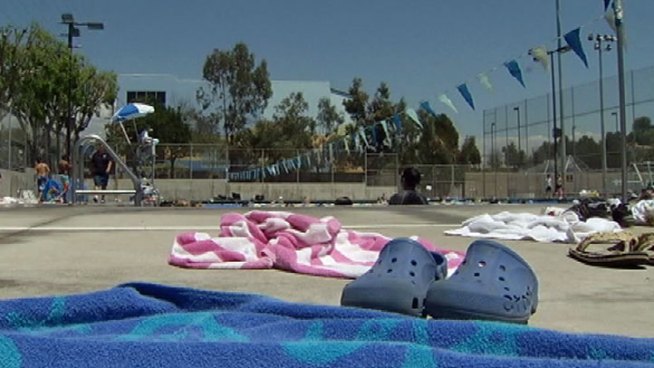
The impending closure of the Glassell Park Pool, which has remained open year-round for several years, has generated a community backlash. This week, the Los Angeles parks department moved to keep seaonal pools open an extra three weeks -- till Labor Day, when the Glassell Park facility will close as well.

Wednesday, Aug 8, 2012  |  Updated 4:38 PM PDT  ::  fter an outcry over an earlier-than-usual closure date for seasonal city pools, Los Angeles has decided to keep municipal aquatics facilities open till Labor Day.

Some 33 seasonal pools were slated to close Sunday, to coincide with the start Monday of the Los Angeles Unified School District academic year.

The city's Department of Recreation and Parks has long linked its pool closure date to LAUSD's calendar, but this year the school district is starting up classes earlier than it has in past.

That calendar change has meant a shock for fans of the city pools – especially since many families cool off at city pools during Southern California heat waves such as the one the region is currently experiencing.

The backlash from city residents prompted the postponed closure date, city officials said. The about-face was first reported by the Daily News.

"Because of the community, we will be open till Labor Day," said Andrea Epstein, a spokeswoman for the parks department.

Recreational swim and swim lessons will continue to be offered at pools, but hours will change, she said.

City pools will be open 3 to 7 p.m. Monday thought Friday, and 1 to 5 p.m. Saturday and Sunday. They'll be open 1 to 5 p.m. on Labor Day.

Meanwhile, three pools that have operated year-round in recent years are slated to return to seasonal status. That means the pools – in Glassell Park, Pacoima and San Pedro – will close Labor Day, which is Sept. 3.

That change has prompted its own backlash, including at the popular Glassell Park pool, which has been open year-round for the past six years.

Some 200 people came to a community meeting about the pool closure in recent weeks, and more were expected at a meeting Wednesday evening where parks officials were slated to speak about the need for the change.

It's easy to explain, Epstein said: Budget cuts mean there's not enough money.

The three year-round pools' status change was in the 2012-13 budget approved by the City Council and Mayor Antonio Villaraigosa, she noted.

"We wish we had the budget to keep all of our pools open," she said.

Maggie Darett-Quiroz, who created SaveGlassellPool.com and who has been gathering support for the pool, said there's fear the pool will be vandalized and crime will increase when it's closed.

"It's about unity, and the fact that we have a gem and right now it's at risk," she said.

Thirteen year-round pools – out of the city's total 46 facilities – will remain open after Labor Day, Epstein said.

She could not provide a figure for how much money the city is saving by closing the three year-round facilities, but Councilman Ed Reyes' office said it would cost $493,000 to keep Glassell Park pool open for an additional nine months.

NEW JERSEY’S FAIRER WAY TO FIRE TEACHERS

The LA Times Editorial Board says, parroting the Powers-That-Wanna-Be in Ed ®eform, Inc.,  that “Ousting teachers in California is protracted, expensive and nearly impossible. Here's a better way”.
#646 in the series: UNASKED-FOR SOLUTIONS TO PROBLEMS YOU PROBABLY DON’T REALLY HAVE.

●●smf: Firing bad teachers is yet another magic bullet in the Ed ®eform six-shooter, replacing each spent and failed round as they misfire.

  • If only the state lottery could fund education, we wouldn’t need these pesky property taxes.
  • If only we could be rid of these pesky union contracts.
  • If only we left no children behind.
  • If only the mayor ran the schools.
  • If only every child graduated college ready and career prepared.
  • If only there were college slots and good jobs out there.
  • If only parents/charter operators/education theorists could choose, they would always choose correctly.
  • If only my kid’s number in the lottery comes up.
  • If only schools would have done before what Eli and Bill believe now.
  • If only we could cut costs and improve test scores.
  • If only pizza and chicken nuggets and Mountain Dew were good for kids.
  • If only Superman….

Now it’s ‘if only there was a fairer way to fire teachers’. Which sounds an awful lot like like ‘If only there was a more humane and mistake-proof way to execute criminals..

There always have been folks in every profession that shouldn't be in that profession …and there’s no excuse for bad plumbers or waitresses or bank tellers. The teacher’s unions should be more like crafts guilds – making sure their brothers-and-sister teachers  are as good as they can be.  But it’s hard to be proud and competent and self-regulating with that target on your back.

I’m pretty sure of this: The answer isn’t to let Chris Christie decide who the good and bad teachers are. Any more than the LA Times should be the decider.

 Gov. Chris Christie

Tenure will be harder for New Jersey teachers to get and easier to lose under a law Gov. Chris Christie, center, signed Monday. (Rich Schultz / Associated Press / August 6, 2012)

Los Angeles Times Editorial | http://lat.ms/PG3aA6

August 8, 2012  ::  Every time a proposal to reform the hiring and firing of teachers is put forward in California, it's just as complicated and, in ways, as counterproductive as the current system. Ousting teachers here is ruinously protracted and expensive and, ultimately, nearly impossible. Legislation to fix this regularly fails, in part because the bills aren't well conceived, but mostly because of opposition from the California Teachers Assn. and reluctance by Democratic politicians who rely on the union for support. Yet just this week, the state of New Jersey proved that it doesn't have to be difficult to be fair to teachers while weeding the ineffective ones from the classroom.

Gov. Chris Christie signed legislation Monday that lengthens the time a teacher must work before receiving tenure from three years to four. It also makes that probationary period more meaningful by requiring a year of working with a mentor and two years of satisfactory evaluations before tenure can be granted. If a school wants to fire a low-performing teacher who already has tenure, it must first try to help the teacher improve. If the teacher challenges the termination, the case is submitted to binding arbitration. Teachers are given a little more than three months to contest a firing, and the cost, which is paid by the state, cannot exceed $7,500. Efforts to terminate teachers must be based on comprehensive and regular performance evaluations.

California's current teacher protection system is similar to how New Jersey had run things for decades, but is even more dysfunctional. Schools must make tenure decisions on new teachers within 18 months. Any termination attempt is subject to restrictions on when the teacher can even be notified that he or she has been targeted; appeals then go to an administrative law panel — whose makeup is slanted in favor of the teacher — that can take years to convene and decide a particular case. Legislation to streamline this ineffective process has gone too far in the other direction by making the appeals process advisory only.

Because New Jersey's new law ensures that struggling teachers receive help and due process before they can be fired, it won the support of the state teachers union and bipartisan approval from legislators. At the same time, the law replaces the costly and time-consuming quagmire that has allowed seriously problematic teachers to remain in the classroom.

Such reform requires a governor who is dedicated to the welfare of students; Christie has made education a cornerstone of his administration, while California Gov. Jerry Brown has yet to articulate a set of educational priorities. Also necessary was a teachers union that was willing to consider ending an unreasonable and increasingly unpopular system. It shouldn't be this hard to do the right thing by California's public school students.

47 LA CITY POOLS TO CLOSE MONDAY MAY GET REPRIEVE

The Associated Press, from the Sacramento Bee AP State Wire News | http://sacb.ee/Nk5nmx

Last Modified: Wednesday, Aug. 8, 2012 - 9:18 am  ::  LOS ANGELES -- A plan to close 47 Los Angeles public swimming pools on Monday may get a reprieve.

The closures were timed with the Aug. 14 start of school for students in the Los Angeles Unified School District.

The Los Angeles Daily News ( http://bit.ly/O3tx8C - FILLOWS) says protests from community groups have persuaded city parks officials to find a way to keep the pools open until Labor Day.

The flap comes as Southern California swelters in a heat wave with temperatures soaring into the 100s.

Recreation and Parks executive director Regina Adams says officials are working to keep the pools open, but she concedes it's unclear where the money will come from.

City pools have been closed for years when school district classes begin and pool attendance drops.


L.A.'s plan to close pools Monday meets with protests

By Dakota Smith, Staff Writer, LA Daily News | http://bit.ly/O3tx8C

Sebastian Chavez stands under a downpour of water while enjoying recreational swim hours at the Van Nuys Sherman Oaks Aquatic Center on Tuesday, Aug. 7, 2012. Temperatures soared into the triple digits across much of the San Fernando Valley as a heat wave continues to impact the region. (Andy Holzman/Staff Photographer)

Charlotte and Urban Hilding enjoy time in the pool with their daughters Elsa, Hannah and Linnea at the Van Nuys Sherman Oaks Aquatic Center Tuesday, Aug. 7, 2012. Temperatures soared into the triple digits across much of the San Fernando Valley as a heat wave continues to impact the region. (Andy Holzman/Staff Photographer)

Updated:   08/07/2012 10:19:46 PM PDT  ::  As temperatures are rising, so is anger over a city plan to shut 47 public pools next week.

Most of the city's public pools will close Monday under a move to save money timed to the start of the Los Angeles Unified School District calendar on Aug. 14.

But amid backlash from community groups, and hand-wringing from politicians, city parks officials Tuesday agreed to search for a way to keep the pools open until Labor Day. | See photo gallery.

"We are committed to trying to make this happen," said Regina Adams, executive director of the Department of Recreation and Parks.

She was unable to elaborate on where the department would find the funds to keep the pools in operation.

The dust-up over the pools reflects the latest tension between those wanting to continue popular city programs, and department heads who say they no longer have the funds to allow such offerings. The closures also highlight the City Council's habit of cutting key city services, only to question those budget cuts down the road.

The Department of Recreation and Parks has for years closed pools when LAUSD begins classes. Regardless of the temperatures, attendance at city pools drops significantly when the school year starts, park officials say. Three of the 47 used to be year-round pools that were changed to seasonal for budgetary reasons and scheduled for early closure next week, including Hubert Humphrey pool in Pacoima. An emergency meeting Monday night at the pool drew a standing room only crowd, said Edwin Ramirez, board member of the Pacoima Neighborhood Council.

The pool, he said, has greatly improved the area, drawing not only kids and swimmers, but polo teams. Gang members who used to hang out in the nearby park now volunteer at the pool. The city's 13 other year-round pools are expected to remain open.

Staffing the pools is the biggest issue for the Department of Recreation and Parks, which has seen 100 personnel laid off in the last three years. Also, some staff working on the pools are forced to take 26 furlough days, which cuts into their ability to do maintenance.

City Council members Tuesday also appeared caught off-guard by news of the early closures. The City Council didn't vote on the date of the pool closures, but had drastically cut hours at three pools, including the Pacoima one, under this year's budget.

"This really hurts me because kids aren't going to be able to have an experience, and it's warm in Los Angeles until October," said City Councilman Tom LaBonge, who suggested an emergency motion to keep the pools open.

Equally upset was City Councilman Richard Alarcón, who accused parks staff of failing to adequately explain the department's budget cuts. But others took a more level-headed view.

"Well, we are having 100 degree days, but we need to stay within the budget," said Nancy Sweeney, president of Revitalize Reseda, a neighborhood improvement group.

The pool in Reseda will stay open until Aug. 19, a concession that was allowed because of the pool's late open date this year.

"We can't blame (Recreation and Parks) for being fiscally responsible," Sweeney added, "considering the state of the city."

School Alert: LA COUNTY EMERGENCY HEAT ADVISORY CONTINUED THROUGH FRIDAY

Emergency Preparedness Advisory


To help keep you informed on school safety and emergency issues, the LACOE Communications Department is forwarding you this advisory/notice sent out to the 80 district superintendents of L.A. County by Supt. Arturo Delgado on Monday, August 8, 2012 at 9:17 a.m.

If you have any questions about this or any other advisory/notice, please contact us at: LACOE Communications or (562) 922-6360.

Frank Kwan

Director, Communications

_____________________________________________

Dear Colleagues,

I am passing along this hot weather update from the Los Angeles County Department of Public Health. Please see below.

Hot weather precautions and a list of cooling centers can be found here:

http://css.lacounty.gov/Data/Sites/1/FolderGalleries/Press/0000coolingcenterlist-july2012-kn.pdf

Arturo Delgado, Ed.D.

Superintendent

_______________________________________________________

Upgrade of Heat Advisory to Heat Alert for Los Angeles County

The Los Angeles County Health Officer has elevated the current Heat Advisory, dated Monday, August 6, 2012, to a Heat Alert for the effective dates of Tuesday, August 7, 2012 through Friday, August 10, 2012.  Areas of Los Angeles County affected by this Heat Alert include the San Fernando Valley, San Gabriel Valley, Pomona (East San Gabriel Valley), Santa Clarita Valley and Antelope Valley.

The Los Angeles County Department of Public Health will continue to monitor the heat indices throughout the week in order to determine whether or not to extend the heat alert past Friday, August 10, 2012. 

Additional information on air quality can be found on these sites:
Los Angeles County Department of Public Health
South Coast Air Quality Management District

Skelton on AB 1575: PROTECT CALIFORNIA’S STUDENTS FROM ILLEGAL FEES

"Access to public education is a right enjoyed by all - not a commodity for sale."

CA. Supreme Court, Hartzell v. Connell  (1984)

from the LA Times: Even though a California Supreme Court ruling should have guaranteed equal educational opportunity, some K-12 students are still being gouged by illegal fees. George Skelton writes in Monday's column (FOLLOWS) that new legislation and a lawsuit could help end that.

These fees can be charged for field trips, textbooks and art classes, and the American Civil Liberties Union of Southern California says the state hasn't done enough to protect students.

"The state Department of Education, a defendant in the suit, even last year prepared a detailed memo advising which fees are legal and which illegal," Skelton writes. "But it seems to have been widely ignored by many schools."

Assemblyman Ricardo Lara (D-Bell Gardens) is pushing legislation to create a complaint process that would allow parents to appeal school fees. But it's facing an uphill climb, and Gov. Jerry Brown vetoed a similar bill last year.

Kindergarten classroom

Photo: Kindergarten students listen to their teacher read them a story at the Bennett-Kew Elementary School in Inglewood. Credit: Genaro Molina / Los Angeles Times

"A new school year starts soon," Skelton writes. "The Legislature and the governor should unequivocally tell principals that the state Supreme Court had it right 28 years ago: They should look for money someplace besides students' pockets."


Lawsuit, bill aim to keep K-12 education free in California: Legislation and an ACLU lawsuit tackle the increasing use of fees at public schools, a trend that is unfair to low-income students and increases disparities.

Skelton hed

<George Skelton | Capitol Journal | http://lat.ms/QL741C

August 6, 2012  ::  SACRAMENTO — Not every proposed law is historic or sweeping. Some merely are pretty good ideas — perhaps even important for a low-income kid.

One such bill is among the hundreds awaiting action as the Legislature heads into its final month. The measure's goal is to stop schools from socking students with illegal fees.

Fees for sports and field trips and textbooks and art, for example.

They're being charged despite a guarantee in the California Constitution of a free K-12 education.

"Access to public education is a right enjoyed by all — not a commodity for sale," the California Supreme Court ruled in 1984. "Educational opportunities must be provided to all students without regard to their families' ability or willingness to pay fees….

"This fundamental feature of public education is not contingent upon the inevitably fluctuating financial health of local school districts. A solution to those financial difficulties must be found elsewhere."

Nevertheless, according to a pending lawsuit filed two years ago by the American Civil Liberties Union of Southern California, "the state has done nothing as its public school districts blatantly violate the free school guarantee by requiring students to pay fees and purchase assigned materials for credit courses."

"Basically," says ACLU chief counsel Mark Rosenbaum, "the state is balancing the budget on the backpacks of kids."

The state Department of Education, a defendant in the suit, even last year prepared a detailed memo advising which fees are legal and which illegal. But it seems to have been widely ignored by many schools.

"Some of these school districts, I understand they're in a difficult situation," says Assemblyman Ricardo Lara (D-Bell Gardens.) "God knows the state hasn't helped the school districts in terms of funding the education system.

"But what some schools are charging in fees is against the law."

And nobody apparently is enforcing the law.

"We find it perverse," says ACLU attorney Brooks Allen, "that the only mechanism to enforce the constitutional right of a student who can't afford a textbook is to go out and hire a lawyer.

"We want the state to have a role."

It's not just the principle of a free public education that is at stake. It's also the practical effect of stigmatizing and humiliating poor kids who can't afford the teacher's demand to kick in money for a program.

And if they're denied the same materials or participation granted better-off students, the children of struggling families are left behind in an academic disadvantage.

Lara is pushing a bill (AB 1575) that would create a formal complaint process for parents who thought their kids had been charged fees illegally. They could appeal to the school principal and, ultimately, the state Board of Education.

The state superintendent of public instruction also would be required to periodically advise schools about what's legal and what's not. And schools would need to update their fee policies.

Pretty mild stuff, it would seem. But this sort of thing invariably is resisted by administrators and bureaucrats leery of being forced to move out of their comfort zones.

Gov. Jerry Brown vetoed a similar Lara bill last year. He contended it went "too far."

It would have required the posting of a notice specifying legal and illegal fees in each classroom — like a workplace job safety notice — and mandated frequent auditing.

The current bill has been toned down. Negotiations are underway between the bill's sponsors and the governor's office. Brown has not taken a position on the new measure. Neither has state schools chief Tom Torlakson.

The bill, strongly backed by Assembly Speaker John A. Pérez (D-Los Angeles), passed the lower house and is awaiting a hearing in the Senate Appropriations Committee.

The immediate goal of both sides — the ACLU and the government, particularly education officials — is to enact legislation that would render the lawsuit moot.

The suit was filed after some parents complained to the ACLU. The organization then documented more than 50 school districts requiring pupils to cough up for textbooks, novels, science materials, P.E. uniforms, art classes, advanced placement exams and the like — for both classroom and extracurricular activities.

Plaintiff "Jane's Spanish teacher wrote her name on the class whiteboard because she could not pay for assigned workbooks," the ACLU complaint charged.

Also, her middle school "required that Jane [not her real name] pay more than $440 annually in course and uniform fees for her physical education class and musical instrument rental fees…

"In some classes, teachers made grades partially dependent on the students' payment of course fees or awarded extra credit to students who bought $20 T-shirts."

Some students who couldn't afford books were issued school copies, but they had to be read in the library and couldn't be marked up. No taking them home.

The defendants asked a judge to dismiss the case. He refused. Subpoenas have been issued to 25 school districts ordering them to appear in court and explain their fee practices. The hearing is expected to be delayed until after the legislative session ends.

A report produced last year by UCLA's Institute for Democracy, Education and Access found that "California's high schools increasingly are calling upon families to pay for services that had previously been covered by the school….

"As high schools shift costs to families, inequality between schools often grows."

A new school year starts soon. The Legislature and the governor should unequivocally tell principals that the state Supreme Court had it right 28 years ago: They should look for money someplace besides students' pockets.


2cents

smf:  This bill attempts to avoid the ACLU lawsuit and keep the administration of the state constitutional guarantee of a a free K-12 education and the enforcement of the 1984 Hartzell v. Connell decision out of the courts.  Either the state will oversee school funding or the courts will – on a district-by-district basis.

By not acting the legislature issues the challenge: “so sue the school districts”. 

If the intent is to bankrupt them, this accelerates that process.

Better they should rise to the constitutional challenge they are already avoiding: funding K-12 public education.

Tuesday, August 07, 2012

PRINCIPALS: OUR STRUGGLE TO BE HEARD ON REFORM

By Carol Burris and Harry Leonardatos from  Valerie Strauss’  The Answer Sheet - The Washington Post http://wapo.st/QJ1DjD

Burris is the principal of South Side High School in Rockville Centre, New York.  Leonadartos is the principal of Clarkstown High School North in Rockland County, New York. Carol is the co-author and Harry is an active supporter of the New York Principals letter of concern regarding the evaluation of teachers by student scores. Over 1,500 New York principals and more than 5,400 teachers, parents, professors, administrators and citizens have signed the letter which can be found here.

●● smf/4LAKids has been following and is signatory to the New York Principals’ Letter of Concern – their struggle is our struggle. ¡Please join us!


8:00 AM ET, 08/07/2012  ::  Several weeks ago, on Meet the Press, Michelle Rhee unveiled her new ad, designed to hammer away at how bad she believes American schools to be.  The ad likened public schools to an unfit male athlete competing unsuccessfully in a women’s sport.  Many found the ad to be offensive in its stereotypical portrayal of an overweight and effete man. But the true offense was that it took a moment of national pride, the Olympic Games, and used it to give American educators a kick in the pants.

It is reasonable to wonder why it is so important for Michelle Rhee and other “reformers” to constantly deride and disparage American public schools.  Although we should always seek to improve, why should those efforts be expected to follow from derision?  In truth, while we and others see daunting and unfilled needs in many schools, there has not been a sharp and sudden decline in student performance as is being implied, and in fact scores on the National Assessment of Educational Progress — sometimes referred to as the nation’s educational report card — are higher than ever before.

The answer is simple. School reform has generated a marketplace, and a profitable one at that.  Michelle Rhee’s standard fee is $50,000 an appearance, plus expenses. In Michigan, Clark Durrant is paid over half a million dollars a year to run five charter schools. Eva Moskowitz, Geoffrey Canada and Deborah Kenney all make between four and five hundred thousand a year running their New York City charter school organizations.

And these are the minor players. The real money is corporate.

Michelle Rhee's StudentsFirst video

Rupert Murdoch announced that public education is a $500 billion market waiting desperately to be transformed. He is creating the data systems and hiring the people to help him make that profitable transformation happen. All the while, the editorial departments of his newspapers hammer away at New York City’s schools and teachers.

Reformers’ financial successes, their careers and their celebrity rest on their ability to convince the public of the failures — real, perceived, and generated — of our nation’s public schools.  Yet in national polls the vast majority of Americans have continually awarded high marks to their own schools, even while giving substantially lower marks to public schools across the board. The poll results represent the disconnect between the judgment  that the public makes based on  day to day experience with their own neighborhood schools, and the perception the reformers and the press have created.

And this is all before the upcoming Parent Trigger advocacy movie, “Won’t Back Down.” There is now so much money and power backing market-driven reforms that it is nearly impossible for alternative views to break through.

We recently had our personal experience with how difficult it is to be heard. On July 26th, New York Governor Cuomo’s Education Commission held its only meeting in New York City. The purpose of the commission is to travel around the state in order to hear from stakeholders regarding suggestions for New York State school improvements.

Prior to the time and place of the meeting being posted, both of us sent a request to testify on the topic of teacher and principal quality. As high school principals, we are deeply concerned about the direction of the Regents reform agenda, especially in regard to evaluating teachers using test scores. We were joined by an outstanding New York City high school principal and two teachers from South Side High School. Both teachers had submitted requests to speak, one sending that request and her remarks weeks in advance.

We were not allowed to speak. That was certainly troubling, but even more troubling was the overall staging of the event to ensure that the weight of testimony would support the predetermined, favored policy agenda. The selected panelists on teacher and principal quality were not practicing educators. The first speaker, former CNN reporter Campbell Brown, spoke about sex abuse and arbitrators’ decisions.  Brown has no experience as an educator or public school parent, and she has been inconsistent in disclosing that her husband is on the board of Michelle Rhee’s StudentsFirst.

The other panelists were Jermima Bernard, the New York executive director of Teach for America; Lesley Guggenheim from The New Teacher Project; and Evan Stone, an 18-month sixth grade teacher who described himself as the CEO of Educators 4 Excellence, another group aligned with the favored policy agenda.

So, with the exception of Campbell Brown, they all represented organizations that embraced the governor’s policies, and they all advocated for the following three policies: state imposition of teacher evaluation systems if local negotiations are not successful, elimination of contractually guaranteed pay increases, and the use of test scores in educator evaluations.

We patiently waited through the testimony because the directions on the website stated that the final 30 minutes would be reserved for those who wished to speak, determined via a sign-in, first-come basis. Because we were among the first five to sign up, we believed we would have time to make brief remarks. We were stunned when the list in the lobby was not used. Instead, additional speakers were hand-picked. The speakers selected to comment on teacher and principal quality were a teacher who told the committee how she looked forward to being evaluated by test scores, and Anna Hall, the new head of StudentsFirst NY. Hall is a former principal from the Bronx, and she argued that teacher tenure should be abolished. 

After one of us (Harry) confronted the governor’s representative, he promised us that we would be allowed to speak at later hearings. We are hopeful that he will keep his word. The rules on the website regarding public comment have changed to now say that the speakers chosen would be the first to email rather than the first to sign in. You’ll excuse us for worrying that this might be one more attempt to control testimony at what is supposed to be an opportunity for the public to speak.

None of us who came to the Bronx on that sweltering July day believed that we would change the direction of the Governor’s reform agenda by our testimony. We were there to give testimony and witness to the teachers and principals across our state who know that the barrage of negative press and misguided solutions generated by the young “CEOs” of hundreds of Gates-, Broad- and Walton-sponsored reform centers is wrong. We were there to give testimony that by setting teachers up on a bell curve, you are creating the contrived headline — “Half of all New York teachers not effective when judged by test scores,” thus cynically undermining the faith of parents in their public school teachers and principals.

We hoped to speak for the teachers and principals who know that our students are being over-tested and that this is happening for purposes other than the assessment of their learning. We were there to represent the views of the 1,508 New York principals and the 5,400 teachers, parents, school board members, professors and administrators who have signed on to the principals letter in opposition to using student test scores in teachers evaluation. South Side High School teachers, Katie Burke and Debbie Tanklow were there to say how the evaluation system would undermine their relationship with their students. We also went to present our own ideas on how New York State schools can serve students better.

Ironically, across town on that same day, venture capitalists were eagerly searching to invest in companies that will sell the products to ‘fix the crisis.’ They were huddled in a private club in Manhattan to scope investment opportunities. As reported by Stephanie Simon of Reuters, the venture capitalists were told to “Think about the upcoming rollout of new national academic standards for public schools… If they’re as rigorous as advertised, a huge number of schools will suddenly look really bad, their students testing way behind in reading and math. They’ll want help, quick. And private, for-profit vendors selling lesson plans, educational software and student assessments will be right there to provide it.”

  These venture capitalists could stay in the club. They had no need to worry about their concerns being heard, and they had no need to attend the Governor’s hearing. They were well represented.

THOUSANDS OF L.A. STUDENTS STILL NEED WHOOPING COUGH VACCINE

Education Week

By Sammy Roth, Daily News, Los Angeles (MCT) from Education Week |  http://bit.ly/MMn79r

Published Online: August 7, 2012  :: Thousands of students in the Los Angeles Unified School District could be turned away from school next week if they haven't been vaccinated for the whooping cough.

A state law that went into effect last year requires all incoming seventh-graders to get a booster shot for the whooping cough vaccine. But with school set to start on Aug. 14, many students have yet to receive the required immunization, despite the school district's efforts to notify parents and the widespread availability of free vaccinations.

Registered nurse Jeanne Owens, a member of LAUSD's immunization team, said that as of Monday more than 8,000 students had not presented their schools with proof of vaccination. Some of those students may have had the required shot but haven't given their schools the proper paperwork. Many haven't gotten the shot.

"We're still standing here going, `Where is everybody?"' Owens said.

Whooping cough is a highly contagious, potentially fatal disease that can cause coughing fits for up to 10 weeks. In 2010, California was one of several states to see outbreaks.

Most children receive the whooping cough immunization at an early age, but the vaccine loses its effectiveness over time, necessitating the booster. Michelle Parra, the director of the Los Angeles County Department of Public Health's Immunization Program, said it's particularly important for students to be vaccinated because young people are most susceptible to the disease.

Students can also bring the disease home and infect younger siblings, and whooping cough is especially dangerous to infants under the age of three months. In 2010, nine of the 10 Californians to die of whooping cough were infants, four of them in Los Angeles County.

"The tiny little lungs can't take the disease, and essentially they don't get a cough at all," Parra said. "Their lungs stop functioning under the stress of the disease."

LAUSD has been trying since September to notify parents, via phone calls and letters, of the vaccination requirements, and with time running out before classes start, the school district has also hosted free booster shot clinics across the city over the last few weeks. Owens spent several hours on Monday at the Zelzah District Nursing Clinic in Reseda, administering about 20 shots.

Nancy Hernandez, whose son Eddie Garcia is a student at Burton Elementary in Panorama City, said she skipped work to take him to the free clinic. She speculated that many parents haven't read the school district's letters, and that others simply haven't been able to miss work to take their kids to get vaccinated.

"They have to do it," Hernandez said. "It's our kids. It's their health."

Last year, the state Legislature approved a 30-day extension to the immunization law, giving parents of students in grades 7-12 through the first month of the school year to get their children vaccinated.

But there isn't likely to be a similar extension this year. State Assemblyman Richard Pan, D-Sacramento, who has sponsored a bill that would make it harder for parents to opt their children out of immunizations, said that legislators only passed an extension last year because the requirement was brand-new.

"If you haven't gotten the vaccinations already, then you need to go ahead and get them over the summer," Pan said.

In 2010, Los Angeles County saw 1,303 cases of whooping cough, according to the California Department of Public Health. It's become much less of a problem since then - there were 607 cases in 2011, and only 60 cases between January 1 and July 27 of this year. But the disease is known to wax and wane, and it's still important that students get vaccinated, Parra said.

"There really are 8,000 names on that list," Owens said. "And I've been trying to call them all, one by one."

A SCHOOL FUNDING PRIMER: A IS FOR ALLIGATOR

By John Fensterwald, EdSource Today | http://bit.ly/MLnkJZ

August 6th, 2012  ::  It’s called “the alligator chart” because it looks like a reptile’s gaping maw. Nicknamed by its creator, the Sacramento-based education consulting firm School Services of California, it’s one graph that voters should clip on their refrigerators to remind them what’s at stake this November when they consider more money for K-12 schools. School Services shared an updated version with district officials recently during its annual budget management seminars around the state.

If the governor’s tax initiative fails, the gap between what is statutorily owed K-12 schools and what they will receive will be a record gap of $1,944 per student: a deficit factor of 28.8 percent. Source: School Services of California, Inc.

California’s school funding law, Proposition 98, is complex, and the Legislature has tortured the language to make it more abstruse. The alligator chart cuts through verbiage to visually capture  how much money has been cut since 2007-08, the last year that the Legislature funded schools without IOUs for lost cost-of-living increases or direct cuts. Since then, the difference between what schools were entitled to receive (tip of the snout of the alligator’s open mouth) and what they have gotten (the yawning bottom jaw) has grown ominously large.

The chart shows that the average unified district should receive $6,748 per student this year in its revenue limit allocation – unrestricted money that districts can use as they choose to keep the lights on and pay teachers. Instead, districts will receive 22.4 percent less, $5,245 – but only if the governor’s tax initiative, Proposition 30, raising the sales tax and income tax on the wealthy,  passes.

And if Prop 30 (or Prop 38, attorney Molly Munger’s tax proposal, promising even more money to schools) fails, then there will be an additional $441 cut – 6 percent more – midyear, lowering per-student revenue this year to $4,804. The deficit factor, the gap between what schools should get by law and what they will get, will be an all-time high of 28.8 percent: $1,944 per student. A little more than half of that is due to unappropriated cost-of-living increases statutorily guaranteed by Proposition 98. The other half is from actual cuts in spending over the past six years.

As the chart shows, schools were also cut dramatically in 2009-10, when the revenue limit per student shriveled to $4,981. But much of that blow was softened by an infusion of federal anti-recession dollars via the American Recovery and Reinvestment Act – money that’s no longer around.

The revenue limit constitutes 79 percent of unrestricted dollars that districts get; other sources include the state lottery, reimbursements for mandated costs, and local sources such as unrestricted parcel taxes.

And unrestricted dollars comprise 73 percent of total dollars that districts receive. The other 27 percent must be spent for designated purposes; they include federal Title I dollars for low-income children, special education money, and state categorical programs, which also have been cut 20 percent.

But revenue-limit dollars are the bread and butter of district spending – what will determine whether districts remain solvent.

The alligator chart will vary for elementary districts, which receive a smaller revenue limit than unified districts, and high school districts, which receive more. Thus, according to School Services, if Prop 30 fails, high school districts would lose $507 per student midyear, compared with $422 per student for elementary districts and $441 for unified districts.

Proposition 98 requires that the state accelerate repayment of IOUs to K-12 schools and community colleges when revenues increase. The  state Department of Finance is projecting that between extra revenues from higher taxes under Proposition 30 and a recovering economy, revenues to schools will increase $17 billion over the next four years, to $64 billion, and the deficit factor will be erased in seven years. But this assumes that the governor and Legislature will follow the spirit as well as the manipulable  requirements of Prop 98. A big “if,” perhaps.

LEGISLATURE TAKING NOTICE OF RISK SCHOOL INSOLVENCY POSES TO STATE: “For 20 years, we had seven districts in financial trouble, now we have 188.”

By Kimberly Beltran SI&A Cabinet Report – News & Resources http://bit.ly/O0tV7D


Monday, August 06, 2012  ::  With a record number of school districts facing the serious threat of insolvency and news of yet another seeking a state bankruptcy bailout, key members of the California Legislature are beginning to take a harder look at the fiscal risks failing schools pose to the state.

Burdened with upwards of $20 billion in funding cuts and payment deferrals over the past four years, 188 local educational agencies were placed on a state list this spring designating them at risk for not meeting their financial obligations either this year or next.

Topping that list is Inglewood Unified, whose trustees voted late last month to begin the formal process for a state takeover after being unable to close a $10 million budget deficit on their own.

This week, a special legislative oversight committee will conclude a series of informational hearings on the status of the state’s school takeover process – an exercise, a staffer suggested, in preparation for what might be on the horizon.

“For 20 years, we had seven districts in financial trouble, now we have 188 in either negative or qualified status,” said Teri Burns, senior policy director at the California School Boards Association, which advises its member districts on various issues, including fiscal.

“You’re talking about almost 20 percent of the school districts in the state looking at this and saying, ‘We don’t know where we’re going to get the money to continue educating these kids,’” Burns said.

CSBA, like many education supporters, is advocating passage of two tax measures on the November ballot as a way to hold the line on more districts going into insolvency.

One of the measures, Proposition 30 backed by Gov. Jerry Brown, would provide between $6.5 billion and $8.5 billion that would protect schools by maintaining current funding. Proposition 38, the other tax measure on the ballot, backed by attorney Molly Munger, would provide closer to $10 billion to schools.

The problem, fiscal officials say, is that if both fail and state revenues don’t improve, the financial situation for these already-struggling schools is likely to get much worse.

Inglewood, hurt by several years of budget cuts and drastically declining enrollment, becomes the ninth district in California since 1991 to lose local control to the state.

Five of those districts have since repaid their debt and reclaimed administrative power, but Vallejo, South Monterey (formerly King City) and Oakland are under state control until they repay their emergency loans, which total almost $125.6 million and are typically spread over 20 years.

The record number of financially-troubled districts, combined with the fact that five of the nine districts requesting a state bailout did so within the last nine-year period, has legislators sitting up and taking notice. 

Led by Oakland Assemblyman Sandré Swanson, the Select Committee on State School Financial Takeovers has met in Sacramento, Oakland and King City to hear from administrators and school board members who have either gone through the process or are teetering on the edge of it.

The committee meets for the fourth and final time this Friday in Gardena, where it will hear from representatives of several southern California districts, including Inglewood, San Diego, Los Angeles and Compton.

Swanson, whose 16th district includes Oakland Unified, did not respond to a request for an interview but a senior consultant in his office said the assemblyman is focused on finding ways to keep districts out of bankruptcy as well as returning them to solvency and local control as quickly as possible.

He has authored a bill, AB 2279, which would give the State Superintendent of Public Instruction discretionary power to remove a state appointed trustee and return full authority over a district to locally-elected school board members who have demonstrated their ability to maintain fiscal solvency.

But concerns remain about how the state would handle a sudden onslaught of districts needing financial help.

Emergency loans are made from the state’s Infrastructure Bank, or I-Bank, which sells tax exempt bonds on the capital public market to fund the loans. Districts repay the loans, plus state administration costs and interest, using their Prop. 98 funding.

The I-Bank’s Roma Cristia-Plant said it’s very difficult to say what the institution’s capacity is for issuing multiple school loans simultaneously because of so many varying factors.

She said no discussions have taken place about a possible “rush” on emergency loans and, for now, it has been “business as usual.”

As for California -- with its sluggish economy and near $17 billion budget deficit -- not being able to sell bonds for school loans, Cristia-Plant said, “The state has a proven track record of those kinds of bonds being repaid so I don’t see a problem with that in the future.”

AIG TO PAY LAUSD NEARLY $79 MILLION IN CLAIMS SETTLEMENT

L.A. Unified had sued insurer AIG over its refusal to pay claims on schools needing environmental cleanup.

By Howard Blume, Los Angeles Times http://lat.ms/QHmgwQ

A child plays at Park Avenue Elementary in Cudahy in 2000.

A child plays at Park Avenue Elementary in Cudahy in this file photo from 2000. The school, built atop a toxic dumpsite and opened in 1968, was a focus of contention between L.A. Unified and insurer AIG. (Los Angeles Times)

August 6, 2012  ::  Insurance giant AIG will pay nearly $79 million to the Los Angeles Unified School District to settle a lawsuit over its failure to pay claims on properties with environmental and pollution hazards, The Times has learned.

Although AIG admitted no wrongdoing, the $78.8-million settlement, combined with earlier payments under the policy, approach the full value of $100 million in coverage the district purchased in 1999.

"This is a gold medal, not a bronze, in terms of success, a lot of money," said David Tokofsky, a former member of the Board of Education that voted to purchase the policy and later sued to enforce it. "Sometimes the huge L.A. Unified is the little guy against such giants as AIG."

The district's goal at the time was to provide a financial hedge against any extraordinary cleanup costs incurred during its $20-billion school construction effort.

The move proved wise for L.A. Unified and a poor gamble for AIG, which is best known for its central role in helping trigger the nation's 2008 economic crisis.

The district paid about $7.5 million up front for the 20-year policy and also agreed to pay the first $100,000 on any claim. Even so, the claims quickly absorbed what the district put in, and AIG resisted paying more. L.A. Unified filed suit in 2006, beginning a protracted legal battle that consumed millions of dollars, according to people inside the district who were not authorized to disclose the information.

Both sides agreed to keep the settlement confidential, except as legally required. L.A. Unified disclosed the settlement terms in response to a public records request, but officials declined to comment.

"We're pleased that we were able to reach an amicable resolution with LAUSD and have no comment beyond that," said Frank Kaplan, an attorney who represented AIG and its affiliates.

According to court documents filed by L.A. Unified, AIG's intention "was, all along, to book the premium on the policy — and the business from a prominent public agency — and to resist subsequent claims payments they had promised to pay."

AIG, on the other hand, said in court filings that L.A. Unified was planning "to undertake an extensive program of environmental investigation and remediation … with the intent to deceive [AIG] and to induce it to provide coverage."

As part of this alleged scheme, the insurance company contended that L.A. Unified tried to avoid its own responsibility to pay for cleaning sites long known to contain toxins. Time after time, the district "concealed material information" and converted an insurance policy into a $100-million construction subsidy, according to AIG.

The decision to seek environmental insurance grew out of the district's experience with the Belmont Learning Complex — erected on property that was not fully investigated before its purchase. The eventual cost of that school ballooned to more than 10 times early estimates — for many reasons — and its completion was delayed more than a decade. Belmont became a symbol of the school system's dysfunction.

The policy specifically excluded Belmont, which finally opened in 2008 as the Edward R. Roybal Learning Center.

But an older hot spot, Park Avenue Elementary in Cudahy, became a focus of contention. Park Avenue, which opened in 1968, was built atop a toxic dumpsite; and before long, a chemical, tarry sludge seeped periodically to the playground. In 1989, the district closed the school for a year, performed an interim fix, then abandoned further efforts.

Years later, when new problems arose there, the district resumed work at Park Avenue and filed insurance claims with AIG for the costs. The insurer paid $6.3 million, but the claims soon exceeded $11.1 million, according to court documents. AIG refused to pay more and threatened to take back earlier payments.

Sites with problems known before the policy term, such as Park Avenue, were not eligible for claims, AIG insisted. The insurer also said the work was unnecessarily expensive and that AIG had the right to approve cleanup measures in advance.

The district contended that AIG failed to exclude Park Avenue from potential claims when it had the chance and that L.A. Unified performed work under the direction of state regulators. AIG had access to public officials and reports as well as to the district's environmental consultants and records, according to L.A. Unified. The situation at Park Avenue and some other properties also had been the subject of news reports.

The parties disputed claims arising from more than three dozen schools.

Under state rules, all or most settlement money is likely to go into construction and maintenance funds, according to the district.

By next year, the district will have completed about 140 new schools and hundreds of improvement and renovation projects.

AIG has been one of the largest investors in L.A. Unified's school-construction bonds. It also has provided investment accounts for teachers who want to put aside savings for retirement.

SUMMER ENDS EARLY FOR LAUSD STUDENTS, SCHOOL STARTS AUG. 14

By Barbara Jones, Staff Writer, LA Daily News | ContraCostaTimes.com http://bit.ly/MKS8dG

Graham Leibowitz and his children Trevor, 12, and Jacqueline, 10, shop for school supplies at Target in Woodland Hills on Aug. 3, 2012. School begins three weeks early for LAUSD schools. (Michael Owen Baker/Staff Photographer)

08/07/2012 06:18:32 AM PDT  ::  Los Angeles Unified students have just a few more days to hit the beach, ride their favorite roller coaster, chill poolside or veg out in front of the TV.

Come next Tuesday morning, they'll be back in the classroom.

After just seven weeks of summer vacation, school will begin Aug. 14. That's three weeks earlier than LAUSD's traditional post-Labor Day start, although classes will also end two weeks early, finishing up on May 31.

That's because Los Angeles Unified is implementing the so-called early-start calendar, which was tested last year on 18 campuses, most of them in the San Fernando Valley.

"This calendar lets students finish first semester at winter break," giving them a three-week vacation that previously was filled with reading or projects, said Cleveland High Principal Herman Clay, a veteran - and a fan - of the early-start schedule.

"Parents tell us their kids were happy because they don't have to study over that time."

Starting school before Labor Day has long been popular in other parts of the country and is becoming more common in Southern California. Burbank Unified is starting next Monday, for instance, while Glendale Unified begins on Aug. 20. Simi Valley and Las Virgenes Unified open Aug. 22.

And most of Los Angeles' charter schools are also starting next week.

That's why discount and department stores began erecting back-to-school displays in early July, and why parents are flocking to snap up the must-have notebooks and backpacks, denim and sneakers.

The National Retail Federation said parents of kids in K-12 will spend an average of $688 this year on back-to-school paraphernalia, compared with $603 in 2011.

"This is one of the busiest times of the year, and it really started to pick up during the last half of the week," said Brian Hardy, who manages the Target store in Woodland Hills.

A recent weekday found moms and dads loading their carts with brightly colored binders, pencils, notecards and lunch totes.

Graham Leibowitz had a list of school supplies on his iPad, while Diana Zamir and Revi Val simply bought what they thought their kids would like.

"I'm looking for the basics, and things can get pricey," said mom Barbara Drescher of Woodland Hills. "I shop the back-to-school sales, and figure I'm ahead of the game."

Stacy Mendelsohn of Calabasas took a long-term view as she shopped for her 11- and 16-year-old boys.

"There's a lot of variety by shopping early, and sometimes they'll need stuff at the end of the year when it's harder to find," she said.

LAUSD's plans for the early-start calendar have been in the works since late 2010, when officials announced the schedule would take effect the following school year. Parents' complaints that the calendar would disrupt family vacations and summer camp won them a one-year reprieve.

Last year, Superintendent John Deasy sought another delay because of the $1 million cost of implementing the plan. School board members decided in October to push ahead, saying the instructional benefits would outweigh any financial concerns.

That gave officials 10 months to notify students and get services in place - including buses and cafeteria meals - for the first day of school.

The shortened summer vacation did force the district's custodial staff to look for efficiencies, said Roger Finstad, who oversees LAUSD's Maintenance and Operations Bureau. That means the floors of thousands of classroom were simply mopped and polished - rather than stripped and re-waxed - as they have been during past summers.

"The floors won't look as good, but they'll be cleaned and buffed to give them that shine," he said.

Finstad also plans to have his crews working this week - many on overtime - to make sure that schools' air-conditioning systems are in good working order.

Hot summer temperatures - especially in hot pockets of the Valley - were among the concerns voiced when the early-start calendar was approved.

Officials note, however, the district has a 10-page policy for dealing with excessive heat, such as making water available, adjusting programs to take advantage of cool mornings and holding p.e. classes indoors.

That policy is likely to come into play next week, when the National Weather Service predicts afternoon highs will hit the 90s and will hover around 100 degrees in Valley.

"Be prepared for the warmth," said meteorologist Ryan Kittell. "It's going to be toasty."

LAUSD EMPLOYEE FILES SEXUAL HARASSMENT CLAIM

by Howard Blume | latimes.com http://lat.ms/RZB0lA

August 5, 2012 |  7:04 pm  ::  A Los Angeles Unified School District employee who has accused former Supt. Ramon C. Cortines of sexually harassing him is seeking more than $10 million from the district in connection with the alleged harassment and subsequent unraveling of a proposed settlement of the matter.

Leasing and asset manager Scot Graham filed his claim against the nation’s second-largest school system June 8; the claim was released late Friday in response to a Times public-records request.

Cortines has denied harassing Graham but said he used poor judgment by engaging in spontaneous, consensual “adult behavior” with Graham at Cortines’ Kern County ranch in July 2010. Cortines, 80, retired in April, 2011.

In May, Graham, 56, agreed to a tentative settlement under which L.A. Unified would have paid him $200,000 and provided lifetime health benefits. Under it, Graham also was going to leave his $150,000-a-year job. But Graham refused to sign the pact after the school system publicly released its terms of the proposed agreement. Graham continues to work at L.A. Unified.

In his claim, Graham asserts that L.A. Unified violated his “right to privacy, placed him in a false light and defamed him by publicly disclosing his identity, the nature of his allegations of sexual harassment and discrimination, and the fact and terms of a settlement proposal, all in violation of LAUSD’s policies.”

The claim is submitted on a standard district form. In response to a question about the employees responsible for “injury or damage,” the claim cites Cortines and district general counsel David Holmquist.

The district has denied any wrongdoing, noting that it cannot, by law, keep settlements secret. The district also asserts that, early on, officials honored Graham’s request to take no action regarding the alleged incident between Graham and Cortines.

In addition to the claim, Graham sued Cortines personally last week, with a filing that contained graphic allegations of alleged unwanted encounters with Cortines.

The claim is signed by Arnold Peter, an attorney representing Graham. Claims against government entities are frequently precursors to a lawsuit.

Monday, August 06, 2012

LOCAL CONTROL OF PUBLIC EDUCATION IS A NECESSITY

blogged/reblogged by  former LAUSD principal and principal’s union mucky-muck Dan  Basalone, retired but not retiring in the Boise suburbs:

Here is the latest post on ThomasPaineLives regarding public education.  Comments welcomed | http://bit.ly/OYA9EW

Monday Aug 6th ::  For the past twenty years in the United States, public education has been vilified and reformed.  Unfortunately, the vilification has been based on one size fits all standardized test data using tests that by their very nature do not allow more than 50% of the test takers to be highly successful.  This skewed test data has then been used to justify the establishment of state and federal test standards that are impossible to attain.  So called reform then further exacerbates teaching and learning by using the carrot and stick approach to public school funding.  So, we now have a situation created by political reformers where the one size fits all standards approach created by politicians is used to compare school districts, individual schools and now individual classroom teachers and most unfortunately individual students.  The United States has always had a gatekeeper mentality when it comes to educational success because our colleges and universities through their restrictive entrance requirements dictate who gets in or doesn't get into their schools, especially the most prestigious schools.  For over 50 years until the politicizing of education in the 1990's, educators believed in comprehensive high schools where students could take college preparatory courses or get a degree that could lead to a technical specialty such as auto mechanics.  We also had a community college system that allowed a student after high school regardless of level of success or interest to pursue a college degree of their choosing.  Of course, this was all done when funding was basically from local property taxes with most decisions made by local boards of education.  When funding switched to the state and federal levels primarily, state and federal politicians started dictating every aspect of education and made the local boards relatively meaningless.  The state and federal mandates were compounded by grossly underfunding the very mandates that were imposed.  While recognizing that their were funding inequities between rich and poor districts by use of local property tax revenue; by not supplementing the underfunded districts by the state instead of outright state control of education, we lost local control.  So, what is the solution to educational dysfunction?  How about returning local control to individual school districts by having federal and state governments allowing local school districts to allocate funds without mandated restrictions?  How about allowing school districts to develop pre and post course and grade level tests that truly test what is being taught in classrooms instead of using standardized instruments that condemn 50% of the students to failure by their very nature?  How about funding true comprehensive high schools so that we can train plumbers and electricians as well as college entrance students?  How about establishing meaningful teacher evaluation systems that recognize that teaching challenges vary from classroom to classroom?  How about recognizing that public schools are the backbone of our democracy and as such should be praised and not vilified?  How about bringing control of public schools back to every community in this country by allowing their elected Boards to truly make decisions based on the Constitutional guarantees of fairness for all students?  Isn't this just common sense?

Hope that everyone is having a most enjoyable summer.

Best wishes always,

Dan, ThomasPaineLives

Friday, August 03, 2012

TWAIN MIDDLE SCHOOL'S BELL RINGERS BOUND FOR LONDON OLYMPICS

by  Howard Blume LA Times/LA Now | http://lat.ms/N3DHEu

August 1, 2012 |  5:39 pm  ::  A student bell-ringing chorus from Mark Twain Middle School departed to London Wednesday for a series of concerts during Olympics festivities.

The 7th and 8th graders, under the guidance of music director Ron Theile, have five scheduled performances. And they also have a blog on which to record the experience.

“Although the academic year finished on June 19th, the Bellringers have not had their summer break yet,” begins the blog entry for Wednesday. “They have been meeting regularly during July in order to plan, rehearse and make all the necessary arrangements for the trip.”

Fundraising was spearheaded by Theile and Twain principal Rex Patton.

Bell ringing is an ancient art form, but this 17-member ensemble incorporates some modern twists.

“Trust me, they are not your grandmother’s bell ringers,” wrote school board member Steve Zimmer in a tribute to the venture. “In addition to their classical material, they rang adaptations of Adele and Katy Perry.”

Zimmer noted that participating students from the Venice neighborhood school must maintain a grade-point average of at least 3.5.

“Mr. Theile and the Bell Ringers are local celebrities in Venice,” said Zimmer, “but starting on Wednesday they will be international stars.”

 Twain bell ringers

Photo: A cake from a celebration just before the bell ringers' departure.  Credit: marktwainringers.blogspot.com

HuffPo continues the mis/disinformation: LAUSD+UTLA AGREE TO INCLUDE STUDENT TEST SCORES IN TEACHER EVALUATIONS

uncredited story in the huffington post | http://huff.to/RpNmTR

John Deasy

Updated: 07/26/2012 12:43 am  ::  An agreement between the Los Angeles Unified School District and the Los Angeles teachers' union has been reached that would for the first time include student test scores in teacher evaluations, the L.A. Times reports.

2cents smf stopped reading here, because he had read the following tweets:

2 Aug UTLAUTLA@UTLAnow

#latimes gets it wrong again. #UTLA President sets the record straight on test scores & evaluations. http://bit.ly/ReOP3H #lausd

27 Jul UTLA UTLA@UTLAnow

Diane Ravitch clarifies LA Times reporting on teacher evaluation and test scores in LAUSD: http://wp.me/p2odLa-14h

26 Jul UTLA UTLA@UTLAnow

RT @davidlyell: Once again, the LA Times got it wrong. UTLA agreed that a teacher eval system must be negotiated: http://wp.me/p2odLa-141


Obviously HuffPo doesn’t subscribe to the UTLANow twitterfeed

The new system is to be implemented for the coming school year, contingent upon a further agreement between the district and United Teachers Los Angeles on how, specifically, the student test scores will factor into evaluations.

The agreement comes one month after Los Angeles County Superior Court Judge James C. Chalfant ruled in favor of a group of unidentified parents that claimed the district had violated the Stull Act, a 41-year-old state law that mandates student achievement measures -- like test scores -- be used in gauging teacher performance. The parents’ attorneys successfully argued that L.A. Unified’s lack of an evaluation system that effectively identities teacher weaknesses deprives students of their constitutional right to educational equality.

On Tuesday, attorneys for the district and the unions representing teachers and administrations decided on a Dec. 4 deadline to implement a system for including student test scores in performance reviews. On Sept. 4, all parties will return to court with a progress update to ensure the district is on pace to meet the deadline.

The Contra Costa Times reports that UTLA attorney Jesus Quinonez said the union and district will meet this week to work out details regarding the evaluation system.

According to the Times, about 700 teachers and principals representing 100 schools are currently participating in a voluntary evaluation program that takes into account “academic growth over time,” a measure based on student test scores.

UTLA has opposed the voluntary program -- spearheaded by district superintendent John Deasy -- claiming that test scores are too unreliable to incorporate in decisions regarding firing, tenure and merit pay.

In 2010, a report by the Los Angeles Times published the names of more than 6,000 teachers tied to their value-added ratings. But researchers at the University of Colorado found that more than a third of Los Angeles Unified teachers would have had different scores if a slightly different formula had been used to calculate those ratings.

A similar situation occurred in New York in February, when a lengthy battle waged by the local teachers' union ended in the release of more than 12,000 individual New York City teacher ratings, amid great controversy. In question: the ratings' use of value-added analysis, which calculates teacher effectiveness in improving student performance on standardized tests -- based on past test scores. The forecast figure is compared to the student's actual scores, and the difference is considered the "value added," or subtracted, by the teachers. UTLA had previously proposed a similar evaluation system for its teachers.

In both New York and LA, some saw the release as a step forward in using student data and improving transparency and accountability by giving parents access to information on teacher effectiveness. The court ruling that granted public access to the ratings states, "the reports concern information of a type that is of compelling interest to the public, namely, the proficiency of public employees in the performance of their job duties."

But to others, the move was misguided, and signaled an over-reliance on incomplete or inaccurate data that publicly shames or praises educators, whether deserving or not. Value-added models generally don't control for demographic factors like poverty, race, or English-learner or special education status, which some say are crucial to evaluating teachers. Some believe that ratings will undermine overall education reform by negatively affecting teacher morale and teacher recruitment, as well as by reinforcing the false notion that testing is everything. New York's ratings, which were developed as a means for internal assessment, were also based on small amounts of data and have large margins of error.

Under a new Ohio law, public school districts will be required to give each teacher a grade by the 2013-14 academic year. Half of each educator’s score will be based on how much students learn, as determined by their test scores. Decisions regarding salary, promotions and firings will then be based on these results.

In Florida, it will be mandatory by 2014 to use student scores on standardized exams to help evaluate teachers and set their pay under a new state law.

Meanwhile, protests by parents, teachers and administrators have been organized nationwide in response to a perceived overreliance on test scores in gauging student achievement and evaluating teachers.

Wednesday, August 01, 2012

Aug 14 is Back to School: LAUSD CALENDAR FOR THE NEW SCHOOL YEAR

Take note of important dates that affect your children in 2012-13.

By Eagle Rock Patch Staffhttp://bit.ly/MzCn9m 

1 August 2012  | 2:33 pm  ::  School starts Tuesday, Aug. 14, across the Los Angeles Unified School District, and Eagle Rock Patch wants to help you and your students get ready for the upcoming academic year.

Part of that preparation revolves around being aware of the key dates and holidays in the LAUSD calendar, so that you can plan family vacations or make childcare arrangements when the kids are out of school.

Visit the LAUSD website to review the District's 2012-13 calendar or click on the PDF attached to this article.


image