Tuesday, March 25, 2008

FORD AND “EXTREME MAKEOVER: HOME EDITION” PARTNER IN ECO-FRIENDLY SCHOOL MAKEOVER CAMPAIGN

 Ford will Makeover One Lucky School with Its Educate to Escape Contest Launching in March: Accepting Nominations Now

  • Ford Motor Company and Paige Hemmis from ABC’s “Extreme Makeover: Home Edition,” is calling for entries in its Educate to Escape green school makeover contest.
  • Students, parents, community members, school staff, and teachers are encouraged to nominate a school for the green school makeover by submitting an online survey to www.educatetoescape.com.
  • Consumers will also have a chance to win a 2008 Ford Escape Hybrid in the Educate to Escape sweepstakes.

DEARBORN, Mich., March 14, 2008 – Schools looking to go green can now enlist Ford Motor Company’s help in welcoming sustainability into the classroom. The automaker is joining forces with ABC’s “Extreme Makeover: Home Edition” on Educate to Escape—a green school makeover campaign. As part of the campaign, Ford is sponsoring a nationwide contest that awards one lucky K-12 school with an eco-friendly makeover up to $250,000. Ford’s Educate to Escape initiative launched earlier this month, and schools will have their shot at the makeover until May 18, 2008.

Students, parents, community members, school staff, and teachers are encouraged to nominate schools for Ford’s Educate to Escape contest by submitting an online survey to www.educatetoescape.com. Entrants will be asked a series of essay questions about why their school deserves an eco-friendly makeover. The winner will be announced in June 2008, and the makeover completed later in the summer. In addition to the Educate to Escape green school makeover contest, entrants will have the opportunity to win a 2008 Ford Escape Hybrid in the Educate to Escape sweepstakes. To enter and for more information on the contest and sweepstakes, including official rules, go to www.educatetoescape.com

“We integrated eco-friendly renovations into our entire season of makeovers on Extreme Makeover: Home Edition,” said Paige Hemmis of ABC’s “Extreme Makeover: Home Edition.” “In the long run, thinking green reduces the amount of energy used as well as the costs associated with running old or inefficient appliances. Schools minding their money due to budget cuts may find that integrating eco-friendly renovations will cut their costs dramatically over time.”

While green improvements made to the winning school will be largely contingent upon the winning essay and specific school needs, some eco-friendly solutions may include energy-efficient appliances, athletic fields made of organic/sustainable materials, vegetation roofing, solar paneling, Energy Star lighting and insulation, programmable thermostat and triple-pane windows.

“Ford maintains a commitment to lessen our overall impact on the planet with our products and our manufacturing plants,” said Connie Fontaine, Multicultural and Experiential Marketing Manager, Ford Motor Company. “Our hope is the Educate to Escape campaign will encourage schools to think about what ‘green’ additions or changes can be made to their own campuses.”

“This campaign is a wonderful extension of our on-going partnership with Ford. Our Extreme Home families have benefited from Ford's generosity, now so will a larger community," said John Sadler, SVP, Integrated Marketing and Sales, ABC.

4LAKids opines: OK, it's a shameless marketing promotion - but it's a good SMP! In the interest of full disclosure I am a shareholder in the Disney Co., which owns ABC and and is one of the shameless promoters. If somehow this self serving do-goodery profits Ford, ABC. Disney and me (please - although - drat! - I'm not allowed to win the car !) I am unashamed - it's about doing well by doing good.  And I will be forwarding this to the high school in Houston I visited last year that was contemplating putting up a wind turbine on a particularly windblown corner of the campus!

- smf

Paige Hemmis
Paige may be an unlikely vision on a construction site, but this statuesque beauty is an accomplished carpenter and skilled homebuilder. Paige is self-taught, with no formal carpentry training, and is rarely to be found without a tool of some kind in her purse. This dynamic and confident Wisconsin-born dynamo considers her role on "Extreme Makeover: Home Edition" a blessing and feels extremely fortunate to make her living helping others. In between extreme makeovers, Paige volunteers her time to Keep America Beautiful's “Great American Cleanup” and Habitat For Humanity.

Extreme Makeover: Home Edition (Sundays, 8 - 9 p.m., ET)

Put together one very run-down house, a deserving family, several opinionated designers, seven days and what do you get? The answer is “Extreme Makeover: Home Edition.” The show has won two Emmy Awards for Outstanding Reality Program, as well as the People’s Choice Award for Favorite Reality Show/Makeover and the Family Television Award for Best Alternative/Reality Program.

For the fifth straight season, ABC’s “Extreme Makeover: Home Edition” ranks No. 1 in its Sunday 8 o’clock time period in the key Adult 18-49 sales demographic. During the 2007-08 TV Season, “Home Edition” beat its nearest competition in the time period by 6% in Total Viewers and by 10% in Adults 18-49. The broad appealing ABC unscripted series also leads its time slot among Adults 25-54 and across all key women demographics (W18-34/W18-49/W25-54).

Beginning this season, “Extreme Makeover: Home Edition” began featuring green elements on every episode with eco-friendly, low energy and recyclable sources being incorporated into the builds. Concluding the show’s two-year, 50-state tour, will be a two-hour Season Finale on May 18 featuring three homes for a family (all on the same lot) and a church in Louisiana. In a first-ever effort to put together a coalition of past builders from all over the country, the show has called on the Building Industry to join forces and help with what might be the toughest challenge yet.

“Extreme Makeover: Home Edition” is produced by Endemol USA, a division of Endemol Holding. David Goldberg is President of Endemol USA. The series is executive-produced by Denise Cramsey and premiered December 3, 2003. The design team includes team leader Ty Pennington, with designers Paul DiMeo, Paige Hemmis, Michael Moloney, Ed Sanders, Tracy Hutson, Tanya McQueen, Eduardo Xol and John Littlefield. New designers this season are Rib Hillis and Didiayer. The show airs Sundays (8:00-9:00 p.m. ET), on the ABC Television Network.

Ford Motor Company

Ford Motor Company, a global automotive industry leader based in Dearborn, Mich., manufactures or distributes automobiles in 200 markets across six continents. With about 260,000 employees and about 100 plants worldwide, the company’s core and affiliated automotive brands include Ford, Jaguar, Land Rover, Lincoln, Mercury, Volvo and Mazda. The company provides financial services through Ford Motor Credit Company. For more information regarding Ford’s products, please visit www.fordvehicles.com.

Press Release Detail - Ford

Monday, March 24, 2008

ROMER & MEHLMAN JOIN FORCES ON EDUCATION REFORM


csmonitor.com - The Christian Science Monitor Online

from the March 21, 2008 edition

The Former Democrat and Republican party chairs want education to be a bigger part of the 2008 campaign.

(Photograph)

Former Gov. Roy Romer, chairman of Strong American Schools - ED in 08, left, Ken Mehlman, right, a spokesman with Strong American Schools - ED in 08, were the guests at the Christian Science Monitor breakfast March 20, 2008 in Washington, DC. - Andy Nelson

by

David Cook | Staff writer of The Christian Science Monitor

Washington - The former chairmen of the Republican and Democratic parties have come together in a bipartisan effort to push education reform to center stage in the 2008 presidential campaign.

Former Democratic National Committee Chairman and Colorado Governor Roy Romer and former Republican National Committee Chairman and Bush White House political affairs director Ken Mehlman were the guests at Thursday's Monitor breakfast. Mr. Romer is chairman and Mr. Mehlman is a trustee of Strong American Schools. The organization describes itself as a nonpartisan campaign to make education a top national priority by making the subject a centerpiece of the 2008 election.

Washington bureau chief David Cook recaps Thursday's Monitor Breakfast with Ken Mehlman and Roy Romer, former chairmen of the Republican and Democratic National Committees, respectively.


"This nation has been drifting back in comparison with the rest of the world for the last 20 years in education," Romer said. After serving as governor, Romer was superintendent of the Los Angeles Unified School District from 2001 to 2006. "Where we used to be No. 1 or No. 2, we are now, if you compare 15-year-olds," 21st among 30 industrial nations in science, he said. "The rest of the world has advanced very rapidly in education, and we have been making some advances but not nearly at the same pace," he argued.

In a front page story Thursday, The New York Times reported on what it called a "dropout epidemic" so pronounced that only about 70 percent of the 1 million American students who start ninth grade each year graduate four years later.

Mehlman and Romer described both economic and moral reasons why Americans should focus more intensely on improving education.

"In my opinion, this is the justice and competitiveness issue of our time," Mehlman said. "If you stop and think about our history, one of the reasons we had an American century and there is an American dream was because at key points in our history we made very bold decisions about making sure that there was very broad, universal access to quality education."

The US would profit economically if our educational system improved, Romer said. "There is an entirely different economic future that we are going to be living in and education is the key to that future," he said. If US students improved to where their test scores matched the midpoint of European student achievement, the US gross domestic product would grow an additional 5 percent over the next 30 years, producing trillions of dollars of added resources for the US, he said.

While there are clear benefits to improving the US education system, making the issue a centerpiece of a campaign will not be easy. "Part of our challenge is the eventful nature of 2007-2008. You have got a war. You've got real economic concerns, economic challenges that are unique at the moment. That all happening makes it hard to cut through on the education issue," Mehlman said.

A USA Today/Gallup poll released in February found education ranked as the third most important issue out of 14 in selecting a president. Education trailed the economy and Iraq but came in ahead of healthcare, government corruption, and energy prices.

To maintain its bipartisan stance, Strong American Schools carefully avoids many of the hot button issues in education that divide along party lines, including school vouchers and the fate of President Bush's "No Child Left Behind" legislation.

Despite potential political minefields, there is a pressing need for greater national coherence on education, Romer said. "I don't see any other industrial nation in the world that has left their education as decentralized as we have. Now I'm not trying to federalize education but you simply put yourself in the position of the next president. You cannot move this nation into the next century unless you get more coherence and national unity on what we are going to do with education, how we are going to measure it, how we are going to get the right kind of teachers in the classroom, and how we are going to measure our success," he said. "There is a need for us to have a national understanding about where we are going."

When the conversation turned to politics, Romer was closely questioned as he is one of the Democratic Party's uncommitted superdelegates who could tip the balance in the party's tight nomination battle. He was co-chairman of President Clinton's reelection campaign and Bill Clinton was in the White House when Romer was head of the Democratic Party.

His comments will probably give more comfort to the Obama campaign than the Clinton team. "Any decision that goes against the delegate count is a difficult decision," Romer said. At the moment, Barack Obama leads Hillary Rodham Clinton in the number of elected delegates. The "math is very compelling."

Romer and Mehlman join forces on education reform | csmonitor.com

FUN ON THE INTERNET - Find who your elected representatives are

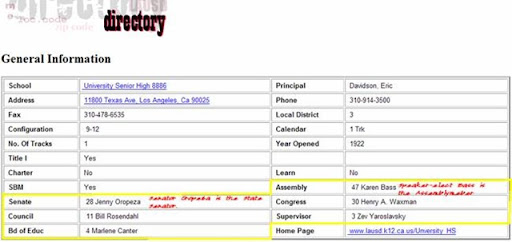
HOW TO FIND OUT WHO A SCHOOL IN LAUSD'S ELECTED OFFICIALS ARE :

  1. Go to this website: http://notebook.lausd.net/schoolsearch/search.jsp
  2. Click on the name of your school. (I have arbitrarily chosen University High School)
  3. On the page that loads click: Detailed Information (Right side of Screen, more than halfway down.
  4. The screen that loads should look like this:

clip_image002The numbers in front of the official's names are their district numbers. Both US Senators (Boxer & Feinstein) represent all of California.

Remember: Often schools draw kids from neighboring assembly, senatorial, congressional, city council, county supervisorial or school board districts.


HOW TO FIND OUT WHO YOUR ELECTED OFFICIALS ARE:

Go the The League of Women Voters Guide to Government @ http://guidetogov.org/ca/state/

  1. The page that loads should look like this. clip_image004
  2. Put in your street address.
  3. Put in your zip code.
  4. Click GO!
  5. Voila!

ACRONYMS 101 - or - EPC

Eduspeak for the Parentally Challenged

You've been there ...you don't have a clue what they're talking about. How can you be sure they know what they're talking about if you don't even know what language they're speaking in?

Courtesy Taking Center Stage - Act II | Ca Dept of Education

Acronym Description
AB 430 (Formerly Assembly Bill 75) Training for administrators in state-adopted ELA/math curriculum
AB 472 (Formerly Assembly Bill 466) Training for teachers in state-adopted ELA/Math instruction
ACSA Association of California School Administrators
AIR American Institutes for Research
AMAO annual measurable achievement objective
API Academic Performance Index
Aprenda 3 Aprenda, La prueba de logros en español, Tercera edición (part of the California Assessment System)
APS Academic Program Survey
ASCD Association for Supervision and Curriculum Development
ASL American Sign Language
AUP Acceptable use policy
AVID Advancement Via Individual Determination
AYP Adequate Yearly Progress (required under the federal No Child Left Behind Act of 2001)
BICS Basic Interpersonal Communicative Skills
BTSA Beginning Teacher Support and Assessment
CAC Comprehensive Assistance Center (California Comprehensive Center at WestEd)
CAHSEE California High School Exit Examination
CAL The Center for Applied Linguistics
CALP Cognitive Academic Language Proficiency
CalSTAT California Services for Technical Assistance and Training
CAPA California Alternate Performance Assessment
CASBO California Association of School Business Officials
CASC California Association of School Counselors
CASEMIS California Special Education Management Information System
CAST Center for Advanced Spatial Technology
CAT/6 Survey California Achievement Tests, Sixth Edition Survey
CBM Curriculum-based measurement
CCSESA California County Superintendents Educational Services Association
CCTC California Commission on Teacher Credentialing
CDE California Department of Education
CDE acronyms California Department of Education page on acronyms
CELDT California English Language Development Test
CEPTA California Educational Technology Professionals Association
CHKS California Healthy Kids Survey
CIF California Interscholastic Federation
CIPA Children’s Internet Protection Act
CISC Curriculum and Instruction Steering Committee
CLMS California League of Middle Schools
CLRN California Learning Resource Network
CMA California Modified Assessment
CMGA California Middle Grades Alliance
CMGPN California Middle Grades Partnership Network
COE County Office of Education
COMET California Online Mathematics Education Times
CPM Categorical Program Monitoring
CPS Child Protective Services
CRL California Reading List
CSBA California School Boards Association
CSPV Center for the Study and Prevention of Violence
CSR Comprehensive School Reform
CSRQ Comprehensive School Reform Quality Center
CST California Standards Test
CSU California State University
CTA California Teachers Association
CTAP California Technology Assistance Project
CTE Career Technical Education
CTEL California Teachers of English Learners Examination
DAIT District Assistance and Intervention Team
DAS District Assistance Survey
DASH Division of Adolescent School Health
DPLT Designated Primary Language Test (currently the Aprenda 3)
DSLT District and School Leadership Team
EAP Early Assessment Program
EAST Environmental and Spatial Technology
EBS Effective Behavior Support
EL English learner
ELA English language arts
ELAC English Language Advisory Committee
ELAP English Language Acquisition Program
ELD English Language Development
ELL English Language Learners
ELM Entry Level Mathematics (CSU placement test)
ELSSA English Learner Subgroup Self Assessment
EPA Environmental Protection Agency
EPCs Essential Program Components
EPT English Placement Test (CSU placement test)
FAPE Free and Appropriate Public Education
FMTA Focused Monitoring and Technical Assistance
GATE Gifted and Talented Education
GEAR UP Gaining Early Awareness and Readiness for Undergraduate Programs
GEODE Geographic Data in Education
GIS Geographic Information Systems
GPS Global Positioning System
HPSG High Priority Schools Grant
HQT Highly qualified teacher
IAQ Indoor Air Quality
IDEA Individuals with Disabilities Education Act
IEP Individualized Education Program
II/USP Immediate Intervention for Underperforming Schools
IRA International Reading Association
ISTE International Society for Technology in Education
KPIs key performance indicators
LEA Local Educational Agency
LEAP Local Educational Agency Plan
LRE least restrictive environment
LRS Library Research Services
NABE National Association for Bilingual Education
NAEP National Assessment of Educational Progress
NAGC National Association of Gifted Children
NBPTS National Board for Professional Teaching Standards
NCES National Center for Education Statistics
NCLB No Child Left Behind Act of 2001
NCLR National Council of La Raza
NCREL North Central Regional Educational Laboratory
NCSS National Council for the Social Studies
NCTE National Council of Teachers of English
NCTM National Council of Teachers of Mathematics
NMSA National Middle School Association
NSTA National Science Teachers Association
NTAC National Threat Assessment Center
NTC New Teacher Center
OPSETS On-Going Program Self-Assessment Tools
OSEP Office of Special Education Programs
PAL Peer Assistance and Leadership
PALMS Postsecondary Access for Latino Middle-Grades Students
PDF Portable Document Format
PFT Physical Fitness Testing
PI Program Improvement
PLC Professional Learning Community
PSAA Public Schools Accountability Act of 1999
PSRS Procedural Safeguards Referral Service
PTSA Parent Teacher Student Association
QAP Quality Assurance Process
RSDSS Regional System of District and School Support
RSP resource specialist program
RtI Response to Intervention
S4 Statewide System of School Support
SAIT School Assistance and Intervention Team
SAMHSA Substance Abuse and Mental Health Service Administration
SARB School Attendance Review Board
SARC School Accountability Report Card
SBE California State Board of Education
SDAIE Specially designed academic instruction in English
SED Special Education Division
SES Supplemental Educational Services
SIG State Improvement Grant
SLC Small Learning Communities
SPARC Support Personnel Accountability Report Card
SPSA Single Plan for Student Achievement
SSC School Site Council
SST Student Success Teams
STAR Program Standardized Testing and Reporting Program
STS Standards-based Tests in Spanish
STW-TCS Schools to Watch™—Taking Center Stage
TA technical assistance
TICAL Technology Information Center for Administrative Leadership
URL Uniform Resource Locator
WISER Wireless Information System for Emergency Responders

New Prop. 39 rules OK’d; affect charter facility requests for 2009-10

from the csba/California School Boards association website

March 2008 - Rejecting objections from CSBA and other members of the education community, the Office of Administrative Law has approved new Proposition 39 rules that significantly diminish school districts’ discretion over how facilities are allocated.

The new rules, issued Feb. 28, are contained in amendments to the state Board of Education’s Proposition 39 Title 5 regulations. Proposition 39 was the ballot measure approved by voters in 2000 that, in part, requires districts to provide local charter schools with facilities that are “sufficient” and “reasonably equivalent” to other buildings, classrooms or facilities in the district.

“Many of these proposed revisions are detrimental to school districts,” said Stephanie Farland, senior policy consultant for CSBA. “For example, the district will not be able to move a charter school from a district site without approval of the charter itself or a state board waiver. We believe that the state board has exceeded its authority in such a way that districts no longer have the necessary discretion to act in the best interests of their students. “

The regulations will take effect on March 29, so they will apply to facilities requests received by districts this fall for the 2009-10 school year.

CSBA has led opposition to the new rules on grounds that the regulations go well beyond what Proposition 39 requires and will create hardships for school districts and students. CSBA’s Education Legal Alliance is contemplating legal action against the state board this spring to overturn the regulations.

Farland outlined some of the most troubling and potentially serious requirements in the new rules. They include:

· Reasonably equivalent furnishings and equipment: Proposition 39 specifies that charter school facilities provided by districts must be “furnished and equipped.” The amended regulations state that a facility will be “furnished and equipped” if it includes “reasonably equivalent” furnishings and equipment such as are found in the comparison group schools. However, the new regulations greatly expand the definition of “furnished and equipped” to include furniture, vehicles, machinery, motion picture film, videotape and intangible assets such as major software programs. The regulations allow a district to exclude furnishings and equipment paid for through non-district resources, such as donations or PTA-sponsored items, when determining reasonable equivalence, but the new language goes well beyond what was contemplated when Proposition 39 took effect and is contradictory to other sections of the regulations that specify that districts are not required to use general funds for facilities given to charters.

· Conversion charters: Conversion charter schools are those charters that are created when a district school’s parents or faculty submit a petition to convert a district-operated school into a charter school or those charters created as a remedy for poor performance under the state’s Public School Accountability Act. Currently, Proposition 39 provides that a school district may not move a charter school to another site “unnecessarily”. Under the new regulations, a conversion charter school will be entitled to remain at the school site where it was operating before it became a charter school as long as the charter school requests the site from the school district on an annual basis. In addition, the amended regulations will require a school district to obtain a waiver from the SBE in order to move a conversion charter away from the previous location. Given that the regulations were approved by the SBE, it is unlikely that many such waivers would be approved.

· Revised timelines for responding to facilities requests: The amended regulations shorten the time period for districts to respond to charter school facilities requests and impose deadlines for each action to be taken during consideration of the request. In addition, the amendments impose consequences for missed deadlines. Charter schools must submit facilities requests for the next school year to districts by Nov. 1. Districts then have until Dec. 1 to review a charter school’s enrollment projections, express any objections in writing, and calculate the enrollment projections that the district considers reasonable. If the district misses this deadline, the charter school’s enrollment projections stand and the district must base its facilities offer on those projections. For districts that receive more than one facilities request, or for districts with small administrative office staffs, the new timeline will require significant staff time and resources.

· Reporting of a school district’s facilities charges: Under Proposition 39, a district can charge a charter school a pro-rata share of its facilities costs. When the new regulations go into effect, each charter school will have to report to the California Department of Education, by June 1 of each school year, the charge per square foot it is paying in the current fiscal year. School districts will have an opportunity to provide explanatory information regarding the square-foot charge. The CDE will post the per-square-foot amounts and any explanatory information on its Web site.

The regulations contain many other troublesome changes, Farland said. CSBA will provide continuing updates on any litigation its Education Legal Alliance undertakes, and will issue advisories to school districts as needed. Please contact Farland for additional information at 800-266-3382.

Related link:

A copy of the regulations can be found @ http://www.cde.ca.gov/re/lr/rr/charterschools.asp

New Prop. 39 rules OK’d; affect charter facility requests for 2009-10

PUSH FOR CHARTER SCHOOL DIVIDES PALOS VERDES: Some parents want an alternative to schools they say focus on drills. Others fear the loss of state funds to existing schools.


By Seema Mehta, Los Angeles Times Staff Writer

March 24, 2008 - Public schools on the Palos Verdes Peninsula are among the state's highest achieving, and two of the wealthy enclave's high schools are ranked in the nation's top 100.

But to a small band of parents, that's not enough. 

"In public school districts, even as good as Palos Verdes, test results are hugely important and people are inordinately concerned with the results of various tests," said Michael Schwerdtfeger, father of three Palos Verdes students and the lead petitioner to create the first publicly funded charter school within the district.

In the area's schools, he said, "the curriculum is geared to doing well on the test, not necessarily to giving children the opportunity to learn to love to learn."

The efforts of Schwerdtfeger and his allies to create an alternative have agitated the peninsula, with opponents charging that pulling students -- and the state money that pays for their education -- out of district schools and into an independent charter school would drain resources from high-functioning schools and harm the students who attend them.

"This should not be done at the expense of or at detriment to every other child in our school district," said Lynne Starr, librarian at Ridgecrest Intermediate School and a former PTA president.

The debate over the proposed Theory into Practice (TIP) Academy is the most bitter fight in the 12,000-student Palos Verdes Peninsula Unified School District since the early 1990s, when declining enrollment forced the district to close several schools.

A meeting held last Tuesday to discuss the proposal had to be moved from district headquarters to a high school gymnasium to accommodate the 500 parents, teachers and others who turned out. A majority wore black to symbolize their opposition to the proposal. Public comment, which typically lasts 15 minutes at board meetings, lasted for three hours.
"This charter school proposal has deeply divided our community," said Kelly Young, an emergency room physician and mother of three children.
Some critics have accused charter supporters of simply wanting a private-school setting without hefty tuition bills.

"This is a small group of parents who want to have complete control over the curriculum and daily activities of a school, but they'd like the rest of us to pay for it," said Tracey Lyons Tozier, whose dyslexic daughter and autistic son attend Mira Catalina Elementary.

But Schwerdtfeger said the effort was about creating an alternative to schools too focused on rigid drilling.

"These experiences might teach children facts and methods on how to take tests, but not the types of lessons that teach children how to be critical thinkers, how to be creative thinkers, things that are required to be successful in the 21st century," he said.

The school proposed by Schwerdtfeger and others would be modeled on the TIP Academy, a charter school in Encinitas.

Although students still take standardized tests and study a curriculum that is aligned with state standards, TIP uses "differentiated instruction," which recognizes that different children learn best in different ways, and values interdisciplinary and real-world studies, according to a petition the parents submitted to the district in February.

Trustees will vote on whether to grant the charter on April 21.

If the school is approved, its supporters would try to enroll 220 students in grades K through eight for the 2008-09 school year. The children of the founding families would be guaranteed admission, but other slots would be granted by lottery if too many students apply.

Last week's meeting aroused passions on both sides.

When Lyons Tozier and her husband were planning to leave New Jersey and move to California last year, she said they specifically moved to the peninsula because of its schools.

"What we have right now is pretty terrific," she told trustees Tuesday. "I would not have settled for anything less than a proven track record of excellence. . . . The proposed TIP Academy could be the fix that could break our high-performing school district."

Palos Verdes schools receive about $5,800 per child annually. If the charter is approved and meets its 220-student enrollment target, nearly $1.3 million would follow students out of district schools and into TIP, and the hit would come at a time when state education spending is declining.

Under Gov. Arnold Schwarzenegger's proposed budget for the upcoming fiscal year, the district expects to lose $3.7 million, and has already issued tentative layoff notices to nearly 60 teachers, Supt. Walker Williams said.
Charter supporters say financial worries are overstated, because an anticipated one-third of the student body would come from outside the district.

Petitioning families note that the state's education code specifically allows the creation of charter schools, and that they are merely exercising their right to seek out an education better suited to their children.

Lisa Rehrig has four children -- one each in fifth and third grades, kindergarten and preschool. Traditional school has not been a good fit for her older children, she said.

"My kids are a little bit different, a little bit weird," she said at the meeting Tuesday. "They learn differently, not by reading a textbook, filling out a work sheet, reading another textbook, filling out another work sheet. . . . They sit around and read a biography of Julius Caesar for fun on the weekend. They're not nerds, they're happy."

Trustees are limited by the education code as to which factors they can consider when granting or denying the charter. The effect on district finances can't be considered, nor can community opposition.

So critics are focusing much of their effort on the founder of TIP Education Inc., a nonprofit company that the proposed charter school plans to contract with for hundreds of thousands of dollars of curriculum and other assistance.

Anti-charter parents said Michael Hazelton, chief operating officer of the Encinitas TIP school, has been involved with prior charter schools that ran into financial problems or other troubles.

Relations between the Hazeltons -- his wife, Deborah Hazelton, is the principal at Encinitas -- and some founding families in Encinitas have grown strained, with at least one former board member filing a complaint with the state Department of Education. Additionally, an independent audit of another charter that Hazelton helped found, Cortez Hill Academy in San Diego, found that he gave himself an $18,350 raise without board approval.

Several phone calls to Michael Hazelton seeking comment were not returned.

Schwerdtfeger said Hazelton would not receive money from the Palos Verdes charter, which would be wholly independent from TIP Encinitas. Charter supporters cite the waiting list of students to enroll in the Encinitas campus as a sign of its success, but critics say that its standardized test scores are middling among Encinitas schools.
As supporters and opponents bicker about the charter's value, the debate has grown increasingly acrimonious in this tight-knit, wealthy community.

Nasty comments have been posted on community websites, and there are reports of children being ostracized because of their parents' position on the proposed school. All of which led one of the founding families to issue a plea for civility at the crowded board meeting.

"It's OK to disagree, it's great to disagree, it's American," Jason Sarner said. "It's not OK to slander and defame your neighbor's character. Neighbors, let's disagree, let's debate, but let's be nice to each other."


4LAKids is poised to mount our high horse and ride off half-cocked into the quagmire here. Palos Verdes is not LAUSD - but it is Greater LA so I feel somewhat empowered to make some general LA generalizations.

PV is an enclave of wealth and privilege,but like all such it is not as rich and privileged (or white) as we first believe. Like "The O.C." not everyone has a BMW 7 series or even granite countertops and a doublewide SubZero in the kitchen.

The public schools in PV are good, there are always those who say "not good enough" …because "good enough" never is.

However there is real danger here that the micro-managers-for-excellence will destroy a small program of excellent public schools in a bit of lily gilding for their own gain.

The Charter School Law guarantees that Founding Parents - those who sign the original petition get into the schools they create by entitlement; I believe that this guarantee extends to the siblings of Founding Students. Every other applicant from there on out is subject to lottery.

Charters rely on Self-Selection/Opt In Choice (parents need to apply, just like at Harvard Westlake or Archer) and then on the luck of the draw. Special Education students (8%+ of PVPUSD) …or English Language Learners (7%+)? They can apply if they want to …but why would they?

Lotteries have the appearance of being fair and equitable, no special privilege is given based on income or make of car or immigration status or shoe size; you apply and take your chance.

The same can be said of Vegas slot machines. And I propose that our children: Your children, my children, the kids from the culs de sac of Palos Verdes and on the dead end streets of Central LA deserve a better chance than the luck o' th' draw.

Heads you get to go to the good school.

Tails you get to go to the other school with all the other kids so unfortunate.

If you even knew drawing was being held.

The charter proponents in PV are proposing to fix what's not broke by amputation rather than rolling up their sleeves and making a difference one child, one classroom, one school at a time.

And I don't have to look hard to see the same mindset in other enclaves of LA, including in West LA. - smf

Push for charter school divides Palos Verdes - Los Angeles Times

SAT SUBJECT TESTS ARE A VALUABLE TOOL: Particularly in the case of recent immigrants, they can spotlight students' academic strengths.


LA Times Opinion by Van Tran

March 24, 2008  - For the many of us who treasure the University of California's tradition of academic excellence, opportunity and diversity, it is disappointing to learn that the UC system is proposing a move that could diminish opportunities for tens of thousands of UC applicants from minority, immigrant and disadvantaged families.


The UC Board of Admissions and Relations with Schools wants to end its requirement of SAT subject tests as a factor in admissions. Unlike the much broader SAT, subject tests measure a student's knowledge of specific subject areas covering 20 different topics, from advanced mathematics and science to fine art and language skills. Critics say the tests contribute little to predicting college success and may hurt the chances of minority students.


Yet the facts strongly show otherwise. Subject tests can play a big part in helping students succeed once they enter college. The freshman year is often the most difficult, and subject tests help determine appropriate course selection and placement, giving students a better chance at finishing college.


Subject tests are also valuable in identifying students with exceptional skills who might not score as well on the SAT. This is especially important for students whose first language isn't English. Thousands of bright students who might otherwise be denied admission can get their chance at the quality education they deserve because of subject tests.


In 2007, there were 10,010 UC applicants who scored below 550 on the SAT yet scored more than 700 on one or more subject tests, showing tremendous knowledge and aptitude in particular areas of study. Among this group of applicants, more than 3,700 were Asian, Asian American or Pacific Island students. An additional 3,350 were Mexican or Mexican American, and more than 1,500 were other Latino students.


As a whole, these students represented about 7.5% of all applicants to the University of California last year.

 
Why would a system dedicated to diversity and opportunity even consider such a move? Some argue that subject tests are a financial burden on poor families. However, the College Board, which administers the SAT subject tests, provides fee waivers to every eligible student. For low-income students, the expense is eliminated at no cost to the UC system or California taxpayers.


Others claim that eliminating the subject test requirement from the admissions process helps maintain high academic standards. But considering that English is not the first language for thousands of students, subject tests may actually identify bright students who have not yet mastered the English language.


I recall my own circumstances as a 10-year-old immigrant from Vietnam who arrived in the U.S. with little more than the clothes on my back and an English vocabulary of two words. It took time and hard work, but eventually I attended UC Irvine and graduated in 1989. This was the fulfillment of a dream for me and my family, and it forever altered the course of my life.


There are many stories like mine in California. Subject tests are an important means by which thousands of students can get their chance at a UC education. Let's not take away a tool so many minority and immigrant students need to achieve their dream of a college education.


Van Tran (R-Garden Grove) was first elected to the Assembly in 2004, representing the 68th District. He is the highest-ranking Vietnamese elected official in the nation.

SAT subject tests are a valuable tool - Los Angeles Times

Certifying Parents


WALL STREET JOURNAL: REVIEW & OUTLOOK

March 22, 2008; Page A24

In the annals of judicial imperialism, we have arrived at a strange new chapter. A California court ruled this month that parents cannot "home school" their children without government certification. No teaching credential, no teaching. Parents "do not have a constitutional right to home school their children," wrote California appellate Justice Walter Croskey.

The 166,000 families in the state that now choose to educate their children at home must be stunned. But at least one political lobby likes the ruling. "We're happy," the California Teachers Association's Lloyd Porter told the San Francisco Chronicle. He says the union believes all students should be taught only by "credentialed" teachers, who will in due course belong to unions.

California law requires children between six and 18 to attend a full-time day school. Failure to comply means falling afoul of the state's truancy laws, which say kids can't play hooky without an excuse. But kids who are taught at home are less likely to be truants. Their parents choose to spend their time teaching English, math and science precisely because they don't think the public schools do a good enough job.

The case was initiated by the Los Angeles Department of Children and Family Services after a home-schooled child reportedly complained of physical abuse by his father. A lawyer assigned to two of the family's eight children invoked the truancy law to get the children enrolled in a public school and away from their parents. So a single case of parental abuse is being used to promote the registration of all parents who crack a book for their kids. If this strikes some readers as a tad East German, we know how you feel.

That so many families turn to home schooling is a market solution to a market failure -- namely the dismal performance of the local education monopoly. According to the Home School Legal Defense Association, the majority of states have low to moderate levels of regulation for home schools, an environment that has allowed the option to flourish, especially in the South and Western U.S. Between 1999 and 2003, the rate of home-schooling increased by 29%.

For some parents, the motive for home schooling is religious; others want to protect their kids from gangs and drugs. But the most-cited reason is to ensure a good education. Home-schooled students are routinely high performers on standardized academic tests, beating their public school peers on average by as much as 30 percentile points, regardless of subject. They perform well on tests like the SAT -- and colleges actively recruit them both for their high scores and the diversity they bring to campus.

In 1994, a federal attempt to require certification of parent-teachers went down in flames as hundreds of thousands of calls lit up phone banks on Capitol Hill. The movement has since only grown larger and better organized, now conservatively estimated at well over a million nationwide. But what they can't accomplish legislatively, unions are now trying to achieve by diktat from the courts.

If John McCain wants an issue to endear him to cultural conservatives, this would be it. Hillary Clinton and Barack Obama rarely stray from the preferences of the teachers unions, but we'd like to know whether they really favor the certification of parents who dare to believe they know best how to teach their children.

Certifying Parents - WSJ.com

Sunday, March 23, 2008

PUT TEACHERS TO THE TEST: Educators should be evaluated based on their students' exam scores + LETTERS TO THE EDITOR

LA Times Opinion by Camille Esch

March 23, 2008 - In recent years, reformers have sought to improve our failing public education system by tightening and standardizing the measures we use to judge performance. From the numerical requirements of the No Child Left Behind Act to California's increased focus on assessment and accountability, there's been a conscious attempt to use hard data to measure success at every level of the education system.

But one group does not have its performance measured this way: teachers. Determining the effectiveness of individual teachers -- are they helping our kids learn or not? -- remains a mostly subjective judgment. Yet there's no reason why teachers shouldn't also be evaluated against objective measures of student performance just as are schools, districts and states.

Teacher evaluations focus on what they do in the classroom -- the input of the learning process. In most school districts, principals show up at prearranged times to observe teachers' work, and then write their observations. In doing this, they typically use a checklist to guide their assessments. Evaluations usually consist of one or two written observations.

This superficial and largely subjective approach to evaluating teachers is something of a farce. In many instances, principals can only rate teachers "satisfactory" or "unsatisfactory." Multiple unsatisfactory evaluations can lead to dismissal. But faced with the prospect of battling the local teachers union to prove that a teacher's unsatisfactory evaluation is valid, most principals capitulate and rate virtually all teachers as satisfactory.

This rubber-stamp routine may make things easier for administrators, but not for the kids. Several researchers, among them Eric Hanushek of the Hoover Institution of Stanford University and Jonah Rockoff of Columbia University, have shown that teachers are not interchangeable when it comes to student learning. Given a year with an effective teacher -- one whose pupils previously showed test-score gains -- students can advance their learning by a grade level or more, according to research done by William L. Sanders while he was at the University of Tennessee. He also found that under a weak teacher, kids' progress can stall, and they can fall behind.

So why not include student test scores -- the output of the learning process -- in teachers' evaluations? Besides giving the evaluation process a much-needed shot of objectivity and rigor, this change could help administrators target assistance for struggling teachers and recognize those who are most effective in the classroom.

In its report this month, Gov. Arnold Schwarzenegger's nonpartisan committee of education experts agreed. Among other things, it recommended that teacher evaluations should be based in part on student achievement.

Teachers unions object to using student test scores to evaluate teachers. They argue that these scores are influenced by many factors beyond a teacher's control -- students' home environments, language abilities, whether they ate breakfast on the morning of a test. True enough, but this is not a reason to ignore student achievement altogether.

Of course, student test-score data should not be the sole measure of a teacher's performance. It should be combined with other factors to produce a well-rounded assessment, including more rigorous and more frequent classroom observations by principals, announced and unannounced, as well as reviews of teachers' lesson plans and homework assignments by principals or peers.

And incorporating student test data into teachers' evaluations should be done in a way that ensures fairness. For starters, not just absolute student test performance should be taken into account, but also how much students grow over the course of a year. For instance, a teacher could make phenomenal progress with struggling students but still not get them to a high achievement. In this case, the teacher should be rewarded, not penalized. This approach would prevent teachers from fleeing low-performing schools or classes.

Second, evaluation must consider extenuating circumstances. For instance, if a first-year English teacher is assigned to teach chemistry, he shouldn't be blamed for less-than-stellar test scores.

Finally, any attempt to use test scores to help evaluate teachers should not be done on the cheap. Policymakers may be tempted to co-opt existing assessments like California's STAR tests for the purposes of teacher evaluation. But these standardized tests are designed to give information about how a school, district or state is performing, and they don't cover all subject areas. To build a better system of evaluating teachers, it is worth the investment to design tests that measure how much individual students learn over the course of a year on the material the teacher is expected to teach.

There's no question that teachers have tough jobs. But the old evaluation system that ignores student achievement and finds virtually all teachers "satisfactory" simply sets the bar too low, lacks objectivity and does not address whether students are actually learning. If we want to give students the best chance at success, we need to do a better job of determining whether their teachers are helping them. Evaluating teachers with no hard evidence about their primary responsibility is just plain irresponsible.

Camille Esch is an Irvine fellow at the New America Foundation. She specializes in education policy.

From Wikipedia, the free encyclopedia: The New America Foundation is a non-profit public policy institute and think tank located in Washington, D.C. that promotes innovative political solutions transcending conventional party lines—what they call radical centrist politics. Founded by Ted Halstead, the foundation aims to be non-partisan, and its board includes people with a range of political beliefs. Well-known board members include political commentator and Newsweek columnist Fareed Zakaria, former Republican governor of New Jersey and former head of the United States Environmental Protection Agency Christine Todd Whitman, conservative philosopher and historian Francis Fukuyama, author and Atlantic Monthly correspondent James Fallows, and liberal economist and professor Laura D'Andrea Tyson.

LETTERS TO THE EDITOR (3/29): Teach first, suggest later

Re "Put teachers to the test," Opinion, March 23

Despite Camille Esch's suggestion that teacher evaluations be linked to improved test scores, teachers are being put to the test every day and in every classroom across this state. I have 36 to 40 middle-school students in each of my classes. They come from a wide variety of abilities and backgrounds. Our state is facing a $16-billion deficit. The result will be even larger class sizes.
I would like to extend an invitation to Esch: Trade places with me for two weeks. If she has the proper credentials and meets the myriad requirements to teach, she can teach my 190 8th-grade students history, and I can be a specialist in education policy.
John L. Uelmen
Newbury Park

Esch presents a balanced case for including students' standardized test scores in a teacher's performance evaluation. However, it's important to guard against putting too much weight on test results. Making students' exam scores a major factor in evaluations would create a classroom atmosphere that encourages teaching to the test -- an uninspired approach leaving students unengaged -- and would give teachers an incentive to help students cheat to raise their scores. I assume most teachers would not succumb to the temptation to artificially inflate the academic performance of their students; nevertheless, the incentive would exist and could potentially poison the learning environment.
Teacher evaluations should promote effective teaching by examining to what extent a teacher connects with students and inspires a love of learning. Too much focus on testing would undermine that goal.
Joseph Kaufman
Mission Viejo

Oh, why do I even bother to respond? Yet another non-teacher (Esch works at a "foundation") knows how to rate teachers -- by student test scores. I'll allow that as one element. But what about this: On the last round of report cards issued by my school, I entered a written request for parent conferences on 27 of the report cards. Want to guess how many responses I got? One. Factor that in, Ms. Esch, before you rate my performance. And let me know when you begin teaching five classes and a total of 180 students a day, as my colleagues and I do; then we can talk.
The situation is far more complex than Esch describes.
Ann Bourman
Los Angeles

In this rush to hold teachers responsible for their students' standardized test scores, there is one vital component missing: student accountability. Nowhere in this equation are students held accountable for their own test scores. Except for exit exams, standardized tests are no-stake tests; there are no consequences for low scores or rewards for excellent ones. Until students see the connection between test scores and their academic progress, many of them will continue to perform in a mediocre manner.
Francine Buschel-Gomez
Burbank

Esch leaves out what to do with the test data. Under current rules, it is difficult to get rid of ineffective teachers. It is also difficult to reward exceptional teachers because remuneration is based on seniority and other extraneous issues.
Roy Krausen
Oakland

Los Angeles Times: Put teachers to the test

Friday, March 21, 2008

The news that didn't fit from March 21st!

THE DIFFERENCES BETWEEN GOVERNOR SCHWARZENEGGER ON THE BUDGET AND THE DISTRICT I REPRESENT IN THE STATE ASSEMBLY

by Mark DeSaulnier, Member - California State Assembly

March 21 - Contra Costa County was home to contrasting press conferences this week. Though both focused on the budget, they were very different events that evidenced very different understandings of the impact of the state’s budget crisis on Californians.

On Monday, Senate President pro Tem Don Perata, Senator Torlakson, Democratic legislators and I joined educators, parents, students and community activists. We discussed what a $4.8 billion dollar cut to education will look like for kids and teachers. The press conference was held on the front lawn of a local school, open to all.

On Thursday, Gov. Arnold Schwarzenegger had a “discussion” with a hand-selected crowd of mostly business leaders. It largely ignored the pain this budget crisis will inflict on working Californians. (more)

SCHOOL HAZE: COULD FREEWAYS HOLD THE ANSWER TO LOS ANGELES SCHOOLS’ POLLUTION PROBLEM?

by Suzanne LaBarre • Metropolis Magazine

March 19 - Los Angeles public schools are in a bind. Overcrowding has reached such levels that teachers have had to share their classrooms, cutting the overall academic calendar by up to 17 days while forcing students to sit through school in shifts year-round. One middle school squeezes 2,700 students into a facility designed for 800. The most obvious remedy, building more space, is complicated by a 2003 state health-and-safety law that bans most school construction within 500 feet of a freeway. Los Angeles has 24 freeways, covering 250 miles. That’s like telling Venice not to build by water.

A partial solution is emerging in the least likely place: the freeways themselves. (more)

The Daily News payroll rant o' th' week:

DON'T PUT MUCH HOPE IN LAUSD PAYROLL SYSTEM

LA Daily News editorial

March 19, 2008 - You would be forgiven for forgetting, what with massive cost overruns and all, that the purpose of the Los Angeles Unified School District's disastrous new payroll system was to save money. Really!

That flawed system - which underpaid and overpaid teachers for two years - has cost taxpayers $40 million so far. And that's on top of the $95million the LAUSD shelled out to buy the accursed thing. But, amazingly, district officials still maintain that, somehow, the people of L.A. will come out on top in this deal. (more)

Other stories from the UCLA/IDEA Just Schools newsfeed:

CALIFORNIANS UPSET BY SCHOOL FUNDING CUT PLAN

By Nanette Asimov/San Francisco Chronicle

A hundred garbage cans line the streets of Alameda. Each holds a student, a teacher, a custodian - or another expendable soul from a local school. "If they trash the schools, kids would be trashed too," said Ben Holmes, 7, explaining with a first-grader's clarity why he was standing in a gray trash bin on the corner of Park and Central earlier this week. For drama, it's hard to beat a child in a garbage can. And drama is what educators say they need to show their outrage at Gov. Arnold Schwarzenegger's proposal to cut $5.5 billion from schools and colleges. The cuts would wipe out nearly 70 percent of the state's remaining $8 billion budget gap and wipe out school quality as well, they say.

EDUCATION BUDGET CUTS ARE NOT IN CALIFORNIA'S INTEREST

Opinion by Carlos Garcia,Mark Sanchez/San Francisco Chronicle
Carlos Garcia is the superintendent, and Mark Sanchez is board president, of the
San Francisco Unified School District.

How is it that we have become so comfortable with the fact that our schools are woefully under-funded? And now Gov. Arnold Schwarzenegger has announced that California is in a fiscal crisis, and proposed several spending cuts, including $4.8 billion budgeted for public education. All of us who have been in California for some time are veterans of fiscal crises. Although attempts were made in the past to save public schools from sudden crises by the passage of Proposition 98 - a clear statement from voters that they support public education, no matter what the economic state of the state - our legislators seem to be taking the easy way out in the face of hard times.

EDUCATION CUTS CAN DO GREAT HARM

Staff Report/Marin Independent Journal

GOV. ARNOLD Schwarzenegger says the state budget process is broken and dysfunctional and needs a radical overhaul. He is right. He also is using the $16 billion deficit to make his point, originally calling for a 10 percent across-the-board cut in spending - including for public schools. The outcry has been loud and predictable - and in many ways justified. School districts in Marin and throughout the state have started sending out notices warning teachers and other staff that they may be laid off. State law requires those notices be sent out by March 15 if layoffs are to occur in the fall. It is a depressing process that creates uncertainty and anxiety among teachers, parents and students.

STATES’ DATA OBSCURE HOW FEW FINISH HIGH SCHOOL

By Sam Dillon/New York Times

When it comes to high school graduation rates, Mississippi keeps two sets of books. One team of statisticians working at the state education headquarters here recently calculated the official graduation rate at a respectable 87 percent, which Mississippi reported to Washington. But in another office piled with computer printouts, a second team of number crunchers came up with a different rate: a more sobering 63 percent. The state schools superintendent, Hank Bounds, says the lower rate is more accurate and uses it in a campaign to combat a dropout crisis.

BANDAGING NO CHILD LEFT BEHIND

The education secretary is right to bend, if not break, the law, rather than drop the accountability movement.
Editorial/
Los Angeles Times

Once again, Margaret Spellings is doing the right thing for schools by bending, if not actually breaking, the law. The No Child Left Behind Act was so poorly conceived that occasionally the secretary of Education has to disobey it to make it work. In 2006, Spellings allowed some states to measure student growth each year instead of measuring only the number who test as proficient. The law itself gives schools no credit for raising achievement from the basement to the first floor and encourages them to ignore their failing students.

PARENTS VOICE CONCERNS OVER SCHOOL BUDGETS

Belmont-Redwood Shores School District may have to lay off employees
By Neil Gonzales/San Mateo County Times

Potential budget cuts could force the Belmont-Redwood Shores School District to lay off all of its librarians But a local education foundation made up of concerned parents is trying to raise enough money to save the six librarians, teachers and other school employees facing layoffs, given the district's projected shortfall of up to $870,000 in the 2008-09 academic year. Tuesday night, parents and other community members aired their budget frustrations during a packed town hall meeting with state Sen. Leland Yee, D-San Francisco, at Central Elementary. "Education is clearly cut to the bone," parent Patrick Wheeler told Yee during the meeting that drew about 200 people. "Other areas may have more money sloshing around. Maybe they should be cut more."

Don't put much hope in LAUSD payroll system

Editorial/LA Daily News

You would be forgiven for forgetting, what with massive cost overruns and all, that the purpose of the Los Angeles Unified School District's disastrous new payroll system was to save money. Really! That flawed system - which underpaid and overpaid teachers for two years - has cost taxpayers $40 million so far. And that's on top of the $95million the LAUSD shelled out to buy the accursed thing. But, amazingly, district officials still maintain that, somehow, the people of L.A. will come out on top in this deal. It's just a matter of time, they say. As soon as the district rolls out the third phase of the computerized system - which covers districtwide purchasing - next year, big-time savings will start pouring in.

FIGHTING THE WAR ON HOMEWORK

Commentary by Uma G. Gupta/AsianWeek

For a moment, let’s pretend to be an elementary school teacher. You earn a salary low enough to afford maybe one or two meals at McDonald’s once a month; you have volumes of paperwork to fill out to satisfy your school’s bureaucratic systems and local, state and federal regulations; you have little or no resources, and that includes chalk, pens, pencils and books; you get a barrage of free advice and relentless complaints from parents who are teachers in absentia; and you have a class full of children, many hungry and sleepy. This scenario may not fit the affluent schools, but it aptly fits many schools in this country, especially those in low-income neighborhoods. It is within this context that the debate about too much homework and its detrimental effects rages today.

ACLU SUES PBC OVER LOW GRADUATION RATES FOR BLACKS

By Christine DeNardo/Palm Beach Post

ACLU sues PBC over low graduation rates for blacks The American Civil Liberties Union today filed a first-of-its kind lawsuit against the Palm Beach County School District over its low graduation rates for black students. In the past, the ACLU and other organizations have sued school districts for not distributing resources equally but no organization has pursued legal actions for not achieving equal results. While more than 80 percent of white students graduated on time in the county, only about 55 percent of blacks did.