Saturday, April 04, 2015

TIME TO COOL IT WITH BASHING SCHOOLS


by Lee Funk :: SI&A Cabinet Report :: The Essential Resource for Superintendents and the Cabinet  | http://bit.ly/1IyYl98

April 01, 2015  ::  Before the upcoming presidential race’s political climate gets too warm, let’s moderate the heated rhetoric about the dismal state of American education with some cold facts and careful analysis.

The leading Republican candidate, Jeb Bush (despite lack of a formal declaration to date), is being touted as a potential education reformer.  Meanwhile, Lily Eskelsen GarcĂ­a, president of the National Education Association, has already announced NEA’s commitment to influencing poll results.

No real surprise. Ever since “A Nation at Risk” was published in the early ’80s, our schools have been tossed around like a slippery sphere in a game of beach volley ball for the sake of grandstanding. But the facts have repeatedly been lost in the sand so here are three informational points that should be tallied when keeping score.

Contrary to claims of many politicians and policy makers, U.S. students do well in international competition.

Shortly after taking his position as Secretary of Education, Arne Duncan commented on results of testing from the Organization for Economic Cooperation and Development (OECD) saying “American students are poorly prepared to compete in today’s knowledge economy….”

But that comment and others like it completely ignore the democratic structure of the American student body and, in so doing, overlooks the essential requirement for valid comparative evaluation –making sure samples are similar in nature.

In our country there is limited tracking and no stratified transfers as pupils progress through the system. It is completely the opposite in many other industrialized countries. Among nations participating in the Programme for International Student Assessment – the measure frequently used to gauge academic achievement throughout the international community – 26 engage in some form of tracking for students between the ages of 10-16.

The result is that, as test takers increase in age, all American students – regardless of scholastic ability – compete with top performers from other nations. Since rankings are based on mean scores, the results for the United States will inevitably be driven downward.

Comparisons are also skewed by a similar phenomenon associated with socio-economic status. “Because in every country, students at the bottom of the social class distribution perform worse than students higher in that distribution, U.S. average performance appears to be relatively low partly because we have so many more test takers from the bottom of the social class distribution,” the Economic Policy Institute has noted.

Besides, a highly relevant factor, in terms of the economic and cultural well-being of a society, is the proportion of high performing students; in that regard, the United States is doing very well indeed. When examining results from the PISA and the Trends in International Mathematics and Science Study, researchers in “Nature,” a weekly journal of science, reported “[E]ducation testing shows formidable US strength as the largest producer of top-scoring students.” That’s in sheer numbers, of course, but even when population differences are considered, “[T]he United States has a higher percentage of top-performing students than 5 of the 14 others in the top-ranked group of countries with high average scores.” This rate places America in the top 10 among nations with the highest achieving test takers.

We spend more per capita on education than any other country in the world and – again, despite a common partisan slant – it’s paying off pretty well.

According to University of Southern California Rossier staff, when considered in relation to 11 other industrialized nations, in 2011 we averaged $7,743 per student. The United Kingdom was second highest at $5,834.

That’s the price we pay for a literacy rate of 99 percent (third in comparison to the same group of nations).

It’s also the cost for diversity.

“The US ranks 7th highest among OECD countries in the percentage of immigrant students enrolled,” the NEA asserted in a recent paper.

And we should never forget that universal schooling in the U.S. includes not only those who are disadvantaged, from another country or who speak another language, but also every single person through the age of 21 with a disability – no matter how severe.

Local control works. As a matter of fact, it works extremely well.

The most comprehensive intrusion by the federal government into education was the No Child Left Behind Act, which, within 10 years of its passage had virtually every educator, advocate, and knowledgeable family member calling for its repeal, and today has resulted in over 80 percent of the states operating under waivers from its main provisions.

In a comprehensive study of public opinion polls from 1970 to 2010, research from the University of Michigan determined that those surveyed favored local boards for making decisions in multiple areas: daily operations, improving quality, and deciding what is taught. The percentage of respondents who would prefer more federal involvement has remained relatively stable but those interested in less influence have continued to rise.

“As education governance shifted away from local control and toward state and federal authorities, the trends outlined here demonstrate that the public is less quick than are education policy leaders to endorse the abandonment of locally controlled public education. Though we find some growth in the percentage of the public favoring state and federal involvement on specific issues … in many cases we find that a significant portion of the public has actually grown more tentative about trusting state and federal officials….,” the investigators concluded.

Be wary of populists asserting that our educational system is failing and the solution is more involvement, control, or legislative mandates by the federal government. That initial premise is decidedly false and even if it were true, the solution does not reside in Washington D.C.

“GROUP FOUNDED BY MICHELLE RHEE…” FILES FEDERAL LAWSUIT AGAINST TEACHERS UNIONS IN SUPPORT OF TEACHERS

 ‏tweeted by @howardblume

StudentsFirst, group founded by Michelle Rhee, says it's filed suit in Calif over union dues being used for political purposes.

12:58 PM - 3 Apr 2015

_______________

Teachers File Lawsuit Against Their Unions To Protect Their First Amendment Rights: StudentsFirst Supports Effort To Secure Teachers' Rights

StudentsFirst Press Release | http://bit.ly/1avcJof

FOR IMMEDIATE RELEASE | April 3, 2015

Contact:

Kellen Arno

916-710-1573

karno@studentsfirst.org

Los Angeles, April 3, 2015 - A lawsuit filed today in the U.S. District Court for the Central District of California seeks to protect the First Amendment rights of more than 295,000 California public school teachers.  The complaint explains that California teachers who wish to exercise their well-established First Amendment right to refrain from contributing to their unions' political agenda "are stripped of important employment-related benefits and denied the right to vote in employment-related matters."

"Across California, public school teachers are being forced to choose between important employment benefits like paid maternity leave and their own political values," said plaintiff Bhavini Bhakta. "It's unfair. I appreciate my union and want to stay a member. But I don't want to be forced to fund political activities that contradict my core beliefs about education."

The plaintiffs are California teachers who are members of their national, state and local unions. They support their unions' collective bargaining activities and wish to remain union members, but they do not want to fund their unions' political activities, as is their First Amendment right. Under California law, teachers are unable to exercise this right without being forced to abandon union membership and the significant employment-related benefits that members receive.  The plaintiffs have sued to remedy this injustice.

The teachers are being represented by Gibson, Dunn & Crutcher LLP. "The California system unconstitutionally punishes teachers for choosing not to pay the political portion of their dues, depriving them of important employment-related benefits and voting rights," said Theodore J. Boutrous, Jr. of Gibson Dunn, the lead attorney for the plaintiffs in the case and a First Amendment expert. "The First Amendment does not tolerate this unequal treatment based on a teacher's political views."

The suit is supported by StudentsFirst, a bipartisan advocacy group working to improve America's schools. "This case is about fairness," said Jim Blew, President of StudentsFirst. "If the plaintiffs prevail, teachers will still be able to voluntarily contribute to their unions' political activities. But teachers who do not want to pay for those activities will no longer be treated as second-class citizens."

Union dues for California teachers are divided into two categories. The first category covers the cost of unions' collective bargaining activities, such as negotiating with school districts for higher wages. All California teachers must pay this portion of their dues, and the teachers involved in this suit have no objection to doing so.

In addition to these collective bargaining dues, however, unions also collect a second category of dues. These dues finance the unions' political and ideological activities, including lobbying efforts and contributions to candidates and ballot measures. California teachers unions collect and spend millions of dollars each year on such political activities.

The U.S. Supreme Court has repeatedly declared that teachers have the right to opt out of paying these political dues. But under the current California system, they are deprived of union membership in order to do so. This means they are stripped of their right to vote on the terms of their own employment and denied access to members-only benefits, including certain maternity leave benefits, disability insurance, and legal representation.

California teachers thus face an untenable choice -- they must either financially support political speech against their will or lose important employment-related benefits. Punishing the exercise of First Amendment rights in this manner violates the U.S. Constitution.

The plaintiffs are asking the Court to safeguard their right to free speech by declaring the current system unconstitutional and enjoining its enforcement. If they succeed, teachers in California will be able to remain union members and enjoy members-only benefits without being coerced into sponsoring the unions' political agenda.

Many legal precedents support the teachers' claims. In the 1977 case Abood v. Detroit Board of Education, the Supreme Court held that requiring teachers to pay dues to support unions' ideological and political activities violates teachers' First Amendment rights. In addition, the Court cautioned that unions may not punish teachers who exercise their First Amendment rights by treating them differently from other teachers. Many subsequent Supreme Court decisions, including Knox v. Service Employees International Union, Local 1000, decided in 2012, have extended and elaborated on this ruling.

_______________

Suit alleges coercion in teachers unions’ using dues for politics

By John Diaz Editorial Page Editor, The San Francisco Chronicle | http://bit.ly/1FaKbrG

April 3, 2015 3:01pm  ::  Bhavini Bhakta, 33, is an award-winning teacher, a lifelong Democrat and a “100 percent believer in my union” — her local union, that is, in the Los Angeles suburb of Arcadia. She is, however, appalled at the way its statewide affiliate, the California Teachers Association, has consistently and successfully worked against reforms that would have improved life and learning in the classroom.

Bhakta saw her union dues working against her in spring 2013 when she went to Sacramento to testify in support of Senate Bill 441, which would have changed teacher evaluations in much of the state from a binary “satisfactory” or “unsatisfactory” rating to a four-tiered system that would provide more feedback and accountability. She was more than a little stunned and annoyed to hear a CTA lobbyist testify that teachers “don’t want this” and would find such evaluations “degrading.” The bill died when six senators failed to vote.

“That’s where it hit me: There is a big, big change that needs to happen,” Bhakta said. “We have a very monetarily equipped organization that is fighting for the exact opposite of what I and many other teachers are fighting for.”

Worse yet, that lobbying effort came out of dues deducted from the paychecks of Bhakta and other teachers.

“Monetarily equipped” is an understatement. The CTA spent more than $211 million in political endeavors between 2000 and 2009, which is more than the oil, tobacco and pharmaceutical industries combined. Its choke chain on the ruling Democrats in the State Capitol is indisputable, blocking reforms on everything from rigid seniority rules to the process for firing teachers who abuse our children.

Bhakta is one of four teacher plaintiffs in a lawsuit filed Friday in U.S. District Court in Los Angeles. It challenges the tactics of California teachers’ unions in effectively coercing members to help bankroll political campaigns and lobbying efforts with which they may vigorously disagree. The lawsuit is being funded by Students First, a Sacramento-based organization founded by reform advocate Michelle Rhee, the former Washington, D.C., schools chancellor.

This lawsuit is very different from other attempts to constrain the ability of unions to use dues for political purposes — the “paycheck protection” measures that are thinly veiled attempts to defund Democratic campaigns — because it is carefully crafted to address the hardball tactics that most any reasonable person would regard as unfair.

It’s not enough that the CTA and other unions force teachers to leave the union and lose all voting rights — from approval of contracts to election of leadership — if they exercise their legal right to opt out of allowing a portion of their dues to go for political purposes.

As the lawsuit spells out, teachers who refuse to allow their unions to spend their dues on candidates, ballot measures or lobbying activities are denied significant benefits otherwise available to members: from maternity and disability coverage to life insurance to legal representation (see chart below).

Keep in mind, these teachers may be conscientious objectors to the unions’ political activities, but they are not freeloaders: They still are required, as a condition of employment, to cover the cost of the unions’ collective bargaining activities on their behalf.

There is something terribly wrong when a union can deny a teacher’s access to maternity benefits while providing up to $35,000 to another teacher’s criminal defense simply on the basis of whether the teacher contributes to the union’s political and lobbying causes. It’s unfair, undemocratic — and, as the lawsuit alleges, most likely unconstitutional on free-speech grounds.

CTA had not been served with the lawsuit Friday and thus could not comment, spokesman Mike Myslinski said. It seems to me that the union could reclaim the high ground — at least in the court of public opinion — by ensuring that all fee-paying teachers, union and nonunion alike, receive equal benefits.

For Bhakta, who remains a union member despite her objections to the CTA, the issue is not lost benefits, but lost opportunities to preserve and nurture quality in the classroom.

She was the first teacher to testify in the Vergara vs. California case, which tested state law that made seniority the primary factor in layoffs. Bhakta knew well the effect of such union dogma. She repeatedly received layoff notices in her first nine years of teaching, even after being honored as 2009 teacher of the year at Broadoaks Elementary School in Monrovia.

At trial’s end last June , Judge Rolf Treu of Los Angeles said the evidence that the state’s teacher-tenure laws disproportionately deprived low-income and minority students of their right to a quality education “shocks the conscience.” The state has appealed.

Now comes another lawsuit that may shock a system that is patently unfair to teachers who are coerced into contributing a slice of their paychecks for efforts that may be at odds with their classroom mission, their political beliefs and, in some cases, their own job security.


Definition of coercion

Unions make life difficult for teachers who do not want a portion of their dues going to political contributions. Among the egregious examples:

Maternity leave

A teacher who takes a maternity leave of absence or goes on disability is guaranteed full pay only for the number of sick days she or he has available. Once sick pay is exhausted, teachers in most districts can continue to receive the difference between her or his full-time pay and the cost of a substitute for up to five months.

The union offers an insurance program that makes up the difference with a disability benefit to its members — but not to teachers who have opted out of political contributions.

Legal expenses

Teachers are provided with legal representation in employment disputes and up to $1 million in liability insurance for their legal defense in civil suits “arising out of education employment activities.” They also are eligible for up to $35,000 in legal costs arising out of “employment-related criminal proceedings.”

The California Teachers Association provides this benefit without cost to its members — but not for teachers who have opted out of political contributions.

Life and disaster insurance

Members of the CTA, National Education Association and American Federation of Teachers all receive varying levels of a life-insurance benefit. The CTA also provides financial assistance to members who have experienced “significant losses due to disasters in California.“

The unions provide these benefits to their members — but not for teachers who have opted out of political contributions.

Source: Lawsuit against teacher unions filed in U.S. District Court last week.

_______________________

smf 2cents


Bhavini Bhakta is a Common Core coach in Arcadia Unified School District and was the lead teacher witness for the plaintiffs in Vergara v. California. John Deasy was the lead superintendent witness for the plaintiffs.

PARENT REVOLUTION STARTS ‘PARENT TRIGGER’ DRIVE AT 20th STREET ELEMENTARY

On the day Sarah Brady dies P-Rev takes aim+reloads the gun metaphor

Parents launch petition to take control at 20th Street Elementary

By Howard Blume | L.A. Times |  http://lat.ms/1xNtTrt

Weigand Avenue Elementary

Principal Irma Cobian, shown hugging two students at Weigand Avenue Elementary, had to leave the school after a group of parents petitioned for her removal. The school's faculty eventually left the school in protest. (Gary Friedman / Los Angeles Times)

April 3, 2015  - 9 AM  ::  Under a state law allowing families such power, a parents group has launched a petition drive to force changes at a Los Angeles elementary school.

The effort, at 20th Street Elementary south of downtown, was organized with the help of the locally based nonprofit Parent Revolution, which also has worked with parents at other schools, with mixed success.

The parents announced their intent to use the state law in a letter Friday to L.A. schools Supt. Ramon C. Cortines.

"Our children are not well-prepared to go to middle school or the next grade level,” said parent Omar Calvillo in an interview.

Many of the school’s teachers are excellent, but some are not doing the job, said Calvillo, one of two parents to sign the letter. The less effective teachers either need to be replaced or to receive more training, he said.

And all teachers should commit to turning around campus academic results, said Calvillo, who has boys in first and fourth grades.

If parents collect signatures representing a majority of students, they can call an election to determine how the school will be run in the future. Their options include shutting down the existing school and replacing it with an independently operated charter school. Charters are exempt from the district’s union contracts and from some provisions of state law.

In this instance, parents say they want a district-managed pilot school, which would incorporate some of the freedoms of a charter school. Those campuses typically operate under a simpler union contract and teachers must opt in to the school’s new efforts. If they don’t prove a good fit, they can be forced to transfer to another campus.

“We think the local autonomy and staffing flexibility given to pilot schools will open the door to the sort of changes and increased accountability we need at 20th Street Elementary,”  the letter signed by parents said. “We are always willing to consider other credible plans the district might put forward to meet our objectives.”

Calvillo said that the parents are willing to work with the school’s current principal.

The district already operates pilot schools nearby that serve middle schoolers and high school students.

A plan put together by parents has many proposals. These include more involvement for them in key decisions; improved communication; training for parents in how to help their children academically; and instructional strategies that rely on assigning projects that draw from “real life experiences.”

California was the first state to give parents control over a campus through the trigger process. The idea has generated controversy nationwide, in part because trigger laws have been promoted by foundations that are frequently at odds with teacher unions. The unions and other critics have called these laws divisive.

Los Angeles Unified officials had no immediate comment. The district is on spring break this week.

L.A. Unified has been more receptive to parent petitions under the parent trigger law than some other school systems.

At 24th Street Elementary, a 2013 petition drive led to the campus being split between a charter and a reconfigured traditional school. At Haddon Elementary, that same year, parents halted their signature gathering when the district committed to working with them. At Weigand Avenue Elementary, organizing parents sought to remove the principal in 2013. The faculty rallied behind the principal and left as well.


_______________________


‘Parent trigger’ may be pulled at 20th Street Elementary 

by Craig Clough, L.A. School Report | http://bit.ly/1C1n2ag

Parent-Revolution

Members of Parent Revolution, which supports the “parent trigger” law in California

Posted on April 3, 2015 11:25 am ::  Parents have launched a petition at 20th Street Elementary to take over the school, force major changes and win the right to replace its staff and teachers, the Los Angeles Times reported today.

If a majority of parents sign the petition, it will be the latest effort in the state to use the so-called “Parent Trigger” law, and it would be the first time it has been enacted at LA Unified this school year.

Former LA Unified Superintendent John Deasy had previously argued that the district was exempt from the Parent Trigger this school year by a federal waiver from the No Child Left Behind law. But Deasy resigned in October, and interim Superintendent Ramon Cortines lifted the ban in November.

Before Deasy’s ban, the Parent Trigger law had been implemented in LAUSD at only a handful of schools. The parents at 20th Street announced their intent to use the state law in a letter Friday Cortines.

“Our children are not well-prepared to go to middle school or the next grade level,” said parent Omar Calvillo, according to the LA Times.

The Parent Trigger law was passed in 2010, and the the action at 20th Street comes as movements are underway statewide to increase the law’s reach. However, other experts are saying the law has run its course, according to Ed Source.

John Rogers, an associate professor in UCLA’s Graduate School of Education and Information Studies and co-author of a research paper about the law, said it was a byproduct of the 2008 recession, but the state’s new Local Control Funding Formula law requires parental input, making the Parent Trigger unnecessary.

Rodgers (LASR spelled it right the first time)  said the law “taps into a real frustration at the core of many parents’ experiences, but it deflects from the real cause of that frustration,” according to Ed Source.

Friday, April 03, 2015

ON HELEN BERNSTEIN: for Eastover, a bit of Hebrew for the Gentiles

by smf

April 3, 2015 :: Today, starting a sundown, is the first day of Passover, in Hebrew: PESACH - The Festival of Freedom.

Today is also, for Gentiles: Good Friday – the most solemn of days.

HFB Plaque Today, also marks the eighteenth anniversary of the death of Helen Bernstein - who was a lot of things to a lot of people. Teacher. Mother. Friend. Union leader. Maven – a Yiddish word meaning ‘accumulator of knowledge’.

In Judaic Numerology (Gematria) the number 18 (or actually the total of 1 and 8) equals "CHAI", Hebrew for LIFE. Hence 18 is a blessed+meaningful number.

Today at noon a small and very unorthodox MINYAN (the smallest number of believers that can form a congregation) met on the steps of Helen Bernstein’s namesake high school at noon and told small stories and remembered the teacher and the mother and the friend and the union leader and the maven. The world was not changed by what we said, it already had been and continues to be.

L’Chiam.

LOS ANGELES UNIFIED CONSIDERS KILLING PRESCHOOL PROGRAM

Deepa Fernandes, KPCC 89.3 | http://bit.ly/1D0ltgE

Audio from this story  1:17 Listen
smf 2cents EXTRA CREDIT/Compare+Contrast:
LITERACY GAP BETWEEN LATINO AND WHITE TODDLERS STARTS EARLY, STUDY SHOWS | http://lat.ms/1CBRXMP


LAUSD proposes to cut a popular preschool program angering parents, teachers and early education advocates.

LAUSD proposes to cut a popular preschool program angering parents, teachers and early education advocates. Photo by Andre Pan via Flickr Creative Commons

3 April 2015  ::  A proposal to save money by eliminating a popular Los Angeles Unified School District free preschool program for low-income families drew the ire of more than 100 parents, teachers and tiny students Thursday as a school board committee considered the cuts.

"There’s already 87,000 kids who don’t have seats just within the geographic boundaries who are preschool eligible, many of whom are low-income," Kim Pattillo Brownson, of the Advancement Project and a member of the district’s Early Education Ad-Hoc committee, said during the afternoon meeting. "Adding 10,000 more kids to that number is an astonishing move for an educational institution."

The committee, which includes school board members Bennett Kayser and George McKenna, providers and advocates, vets issues before they reach the full board.

Celia Ayala, CEO of Los Angeles Universal Preschool and another member of the committee, said she was thrilled last year when the district added $34 million to early education.

“I saw that as a step forward - and now it seems as if we are taking 5 steps backwards,” she said.

The audience in front of them contained a sea of bright yellow t-shirts bearing the slogan “College Begins in Pre-K." A change.org petition to save the program has gathered over 1,800 signatures.

Superintendent Ramon Cortinez's proposal, announced last month, calls for laying off 140 preschool teachers next school year for a savings of $16 million out of the district's $7.3 billion budget. That will result in the loss of 5,040 half-day preschool spots in the Student Readiness and Language Development Program.

The plan calls for cutting the program's remaining teachers and 5,000 preschool slots in the 2016-17 school year, shaving another $20 million off the district's massive budget.

The cuts aren’t final. The full school board still has to approve superintendent's budget. They'll vote on it in the coming months. The new budget year begins July 1.

Even if the Student Readiness and Language Development Program is ultimately shut down, that doesn't mean the district will be completely out of the preschool business. It will continue to offer 15,000 slots under programs that are funded in part by the state and federal government, according to Maureen Diekmann, who heads early childhood programs for the district. L.A. Unified also provides Transitional Kindergarten to an additional 10,000 kids.

Still, the proposal comes as an internal district memo shows “alarming statistics” of Kindergarten- 3rd graders reading well below grade level. Forty nine percent of kindergarteners began the current school year below expectations for basic literacy.

"I cannot afford $800, $900 or $1,000 for my daughter to go to preschool," said Alexandra Hernandez, whose daughter currently attends preschool at Robert Hill Lane elementary school in Monterey Park, one of the schools set to lose preschool in the fall under the proposal.

In a report to the Board that outlined the proposed cuts, the program's value was described as “minimal”  because kids are only there 2-3 hours per day.

Diekmann told the committee Thursday that the program is under the axe because it's completely funded by the district's general funds, a rarity in public school budgets.

The district has run the Student Readiness and Language Development Program for 35 years - but it's been battered by cuts since it hit a peak in 2002, serving 16,000 kids.

It's currently at just over 10,000.

Deikman tried to be encouraging during the meeting.

“Who gave up one day of their Spring Break to be here?” she asked, eliciting loud applause.

But she was at a loss to explain how the district would help low-income kids who would lose access to preschool.

She started to suggest children could attend other district preschools but stopped and added:  “Honestly, there are not that many seats left in Early Ed centers.”

When pushed for numbers of open seats that might absorb seats to be cut, Diekmann responded “Honestly, I do not have a good answer for that."

LITERACY GAP BETWEEN LATINO AND WHITE TODDLERS STARTS EARLY, STUDY SHOWS

By Teresa Watanabe | LA TIMES | http://lat.ms/1CBRXMP

smf 2cents

EXTRA CREDIT/Compare+Contrast:
LOS ANGELES UNIFIED CONSIDERS KILLING PRESCHOOL PROGRAM | http://bit.ly/1D0ltgE

Latino literacy

Children play music at Ramona's Day Care in Long Beach. (Christina House / For The Times)

2 April 2015  ::  Latino toddlers whose language comprehension is roughly similar to white peers at 9 months old fall significantly behind by the time they are 2, according to a study released Thursday.

image The UC Berkeley study found that four-fifths of the nation's Mexican American toddlers lagged three to five months behind whites in preliteracy skills, oral language and familiarity with print materials.

<CLICK to download study

Although earlier studies have shown that Latino children are raised with emotional warmth and develop social skills on par with others when they enter kindergarten, the new research found they are not receiving sufficient language and literacy skills at home, said Bruce Fuller, a UC Berkeley professor of education and public policy and co-author of the study.

"For many Latinos, the home is a nurturing and supportive environment, but it's not necessarily infused with rich language and cognitive challenges," Fuller said. "Being warm and fuzzy may lead to well-behaved youngsters but it doesn't necessarily advance a young child's cognitive agility."

Mothers of toddlers who fell behind were more likely to be foreign-born, low-income and less educated. They were also less likely to read to their children daily or give them as much praise and encouragement as those whose children kept pace with white peers.

The study found, for instance, that only 18% of Mexican American mothers who spoke Spanish at home read to their children daily, compared with 59% of white mothers. Among Mexican American mothers who spoke English at home, 28% read daily.

In addition, other research has found that parents with more education limit television, ask their children more questions, give them more opportunities to articulate their feelings and have them show off their skills -- counting to 10 for grandma, for instance.

Latino mothers also have been found to issue more commands -- set the table, turn off the TV -- which may stem from the need to maintain order in larger families, Fuller said. And Latino mothers tend to believe that children should wait for kindergarten to learn to read, compared with white mothers who see age 2 as the appropriate age for such learning, according to a UCLA study. Fuller said that difference may stem from the traditional Mexican respect for teachers.

Less than half of all Latino 4-year-olds attend preschool, compared with 70% of whites.

Among Mexican-Americans, greater growth was recorded among toddlers whose mothers worked outside the home than those who didn't, even controlling for parent education levels. Fuller said the reason is still "a bit mysterious" but may be connected to greater acculturation and exposure to different parenting practices among working mothers. 

The study tracked a nationally representative sample of 4,550 children from birth to 30 months.

The findings underscore the need for widespread parent education and renewal of federal funding for such programs as home visits to train families on effective parenting practices, Fuller said. Most funding is focused on preschool but "we've got to start earlier because "the disparities open up far sooner," he said.

"The good news is that we know what works," he said. "The question is how do we get mom and dad to understand the need to nurture stronger language skills by age 1 and 2 and that parents play a large role in that development?"

Thursday, April 02, 2015

Dr. John: DID LAUSD GET ITS MONEY’S WORTH?

image smf: OK, there’s no Associated Administrators of Los Angeles Weekly Update this week because it’s spring break – so the following is ripped from the pages of last week’s issue …though the issue it itself is from the past four years!   Last week’s issue was a particularly tasty edition of the Update (…even the want-ads for the six Local District Superintendent vacancies) and I recommend it in it’s entirety!

6957256810_fed250a5ef[1]

                                            …but can one get service in Indiana?

Associated Administrators of Los Angeles Weekly Update, week of 3/30/2015 | http://bit.ly/1HQtWTj

 image

The Atlantic: THE DECONSTRUCTION OF A K-12 TEACHER - When kids can get their lessons from the Internet, what's left for classroom instructors to do?

Michael Godsey | The Atlantic | http://theatln.tc/1DA5J4C

Mar 25 2015, 8:30 AM ET  ::  Whenever a college student asks me, a veteran high-school English educator, about the prospects of becoming a public-school teacher, I never think it’s enough to say that the role is shifting from "content expert" to "curriculum facilitator." Instead, I describe what I think the public-school classroom will look like in 20 years, with a large, fantastic computer screen at the front, streaming one of the nation’s most engaging, informative lessons available on a particular topic. The "virtual class" will be introduced, guided, and curated by one of the country’s best teachers (a.k.a. a "super-teacher"), and it will include professionally produced footage of current events, relevant excerpts from powerful TedTalks, interactive games students can play against other students nationwide, and a formal assessment that the computer will immediately score and record.

<< Shutterstock/The Atlantic

I tell this college student that in each classroom, there will be a local teacher-facilitator (called a "tech") to make sure that the equipment works and the students behave. Since the "tech" won’t require the extensive education and training of today’s teachers, the teacher’s union will fall apart, and that "tech" will earn about $15 an hour to facilitate a class of what could include over 50 students. This new progressive system will be justified and supported by the American public for several reasons: Each lesson will be among the most interesting and efficient lessons in the world; millions of dollars will be saved in reduced teacher salaries; the "techs" can specialize in classroom management; performance data will be standardized and immediately produced (and therefore "individualized"); and the country will finally achieve equity in its public school system.

"So if you want to be a teacher," I tell the college student, "you better be a super-teacher."

"We’re at the point where the Internet pretty much supplies everything we need. We don’t really need teachers in the same way anymore."

I used to think I was kidding, or at least exaggerating. Now I’m not so sure. When I consulted a local career counselor who is on the brink of retirement after a lifetime in the public schools, he said I was wrong about my prediction—but only about it taking 20 years. "Try five or 10," he said.

I smiled and laughed, and then suddenly stopped. I thought about how many times I had heard the phrase "teacher as facilitator" over the past year. I recalled a veteran teacher who recently said with anguish, "we used to be appreciated as experts in our field." I thought about the last time I walked into a local bookstore, when the employee asked if she could order a book for me from Amazon. Are teachers going the way of local bookstores? Suddenly I felt like the frog in the pot of water, feeling a little warm, wondering if I was going to have to jump before I retire in 20 years. Try five or 10.

I started reflecting. A decade and a half ago, I dedicated two years toward earning a master’s degree in English literature; this training included a couple of pedagogy courses, and it focused on classic literature, the nature of reading and writing, and the best ways to teach it. A decade ago, my school sent me to an Advanced Placement English conference at which I studied literary analysis for three days. As with the graduate program, I don’t remember the conference involving technology—it was simply the teacher, students, and a lot of books. Now, I don’t remember the last time I’ve attended, or even heard of, any professional-development training focused on my specific subject matter. Instead, these experiences concentrate on incorporating technology in the classroom, utilizing assessment data, or new ways of becoming a school facilitator.

* * *

When I did some research to see if it was just me sensing this transformation taking place, I was overwhelmed by the number of articles all confirming what I had suspected: The relatively recent emergence of the Internet, and the ever-increasing ease of access to web, has unmistakably usurped the teacher from the former role as dictator of subject content. These days, teachers are expected to concentrate on the "facilitation" of factual knowledge that is suddenly widely accessible.

In 2012, for example, MindShift’s Aran Levasseur wrote that "all computing devices—from laptops to tablets to smartphones—are dismantling knowledge silos and are therefore transforming the role of a teacher into something that is more of a facilitator and coach." Joshua Starr, a nationally prominent superintendent, recently told NPR, "I ask teachers all the time, if you can Google it, why teach it?" And it’s already become a cliche that the teacher should transfer from being a "sage on the stage" to being "a guide on the side."

I started looking around me. Teachers like me are uploading onto the web tens of thousands of lesson plans and videos that are then being consolidated and curated by various organizations. In other words, the intellectual property that once belonged to teachers is now openly available on the Internet.

And the teachers unions don’t seem to be stopping this crowdsourcing; in fact, the American Federation of Teachers created sharemylesson.com ("By teachers, for teachers"), which says it offers more than 300,000 free resources for educators. And even though its partner, TES Connect, often charges money for its materials, the private company claims that nearly 5 million resources are downloaded from its sites weekly. Meanwhile, TeachersPayTeachers.com, an open marketplace for lesson plans and resources that launched in 2006, says it has more than 3 million users, including 1 million who signed up in the past year. Close to 1 million educators have purchased lesson plans from the site, while several other teachers are earning six figures for creating the site’s top-selling materials.

The relatively recent emergence of the Internet, and the ever-increasing ease of access to web, has unmistakably usurped the teacher from the former role as dictator of subject content.

I think it used to be taboo for teachers to borrow or buy plans written by other professionals, but it seems that times are changing. Just last week, I spoke with a history teacher from Santa Maria, California, who bluntly said, "I don’t ever write my own lesson plans anymore. I just give credit to the person who did." He explained, rather reasonably, that the materials are usually inexpensive or free; are extremely well made; and often include worksheets, videos, assessments, and links to other resources. Just as his administrators request, he can focus on being a facilitator, specializing in individualized instruction.

I’ve started recognizing a common thread to the latest trends in teaching. Flipped learning, blending learning, student-centered learning, project-based learning, and even self-organized learning—they all marginalize the teacher’s expertise. Or, to put it more euphemistically, they all transform the teacher into a more facilitative role.

In "flipped learning," the student is expected to absorb the core knowledge at home by watching videos and then engage in projects, problem-solving, and critical-thinking activities at school, as facilitated by his or her teacher. Project Tomorrow’s nationwide 2013 survey found that 41 percent of administrators say "pre-service teachers should learn how to set up a flipped class model before getting a teaching credential," while 66 percent of principals say "pre-service teachers should learn to create and use video and other digital media." And once again, when the teacher relies on digital media to provide the core knowledge, his or her role will inherently shift to that of a facilitator. The University of Washington’s Center for Teaching and Learning, for example, explicitly describes "flipped learning" as a way for students to "gain control of the learning process" while "the instructors become facilitators … the instructor is there to coach and guide them."

Likewise, "blended learning"—in which students take at least part of a class online while supervised by adults—is now offered by about 70 percent of K-12 public-school districts. According the Clayton Christensen Institute—a nonprofit, nonpartisan think tank that touts "disruptive innovation"—the number of K-12 students who took an online course increased from roughly 45,000 in 2000, to more than 3 million in 2009. The institute also projects that half of all high-school classes will be delivered online by 2019.

I asked a longtime friend of mine—a high-school principal in northern California—to tell me candidly what he thought about blended learning. He said, "we’re at the point where the Internet pretty much supplies everything we need. We don’t really need teachers in the same way anymore. I mean, sure, my daughter gets some help from her teachers, but basically everything she learns—from math to band—she can get from her computer better than her teachers."

At a seminar about project-based learning, I told the presenter with an increasing sense of desperation, "You know, some of us English teachers still believe that teaching literature is still our primary job." He smirked and put his pointer finger near his thumb and said, "A very little part of your job." And I recently watched the TedTalk that won the $1 million prize at Ted2013, the one in which Sugata Mitra stated that "schools as we know them are obsolete" because the country no longer needs teachers. Here's how he envisions the classroom:
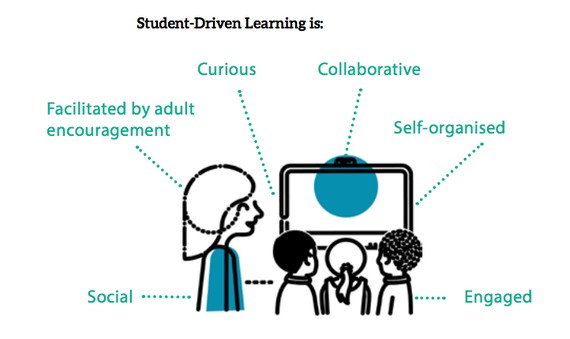
Sugata Mitra

In the original idea of the "flipped classroom," it seems that the teacher was responsible for recording the lecture and posting the video online, but it’s now becoming more efficient to link to a professional video. And there are now thousands of videos from which to choose. The Kahn Academy—a nonprofit that claims to provide "a free, world-class education for anyone, anywhere"—features more than 6,500 free videos and advertises over 100,000 interactive lessons on various subjects. According to Forbes, more than 500,000 teachers worldwide use these videos, which also have over 500 million views on YouTube. Meanwhile, YouTube’s own education channel ("Where anyone, anywhere can learn or teach anything") has 1 million-plus subscribers. And about 2,000 TED talks are available to view for free online and have been seen more than 1 billion times total. The list goes on.

I recently spoke with Monica Brady-Myerov, the CEO and founder of Listen Current, a website that curates the best of public radio, including current events, and offers the three- to five-minute clips alongside a full set of lesson plans and worksheets. When I asked her about the recent boom in lesson-plan production, she said, "It’s like the wild west right now, both in terms of online resources and educational technology. It’s why I quit my job [as a veteran award-winning public radio journalist], so I could ride out west."

Here's what Listen Current looks like:

Listen Current

I found brief solace in the idea that I could still be the professional teacher that compiles all these resources—and then I found Edmodo. Branding itself as the "Facebook for schools," Edmodo started in just 2008 and now has more than 48 million members. I signed up just to see what it was all about. Within five minutes, I found a great lesson on Romeo and Juliet by John Green (a favorite author among teens, and on the list of Time’s "100 most influential people"), a Kahn Academy video, immediate access to 100 famous speeches, and a somewhat fun interactive game based on Lord of the Flies. According to EdSurge, the Edmodo CEO earlier this month said, "We want to do for teacher resources what Netflix does for movies."

Well then. At least I can organize the video lessons and put them together in a sensible order—except that Activate Instruction is already creating a free and open online tool that is "similar to Wikipedia" and will "help put resources and curriculum in one place that any teacher can use." The company even put these materials in logical "playlists"; the first one I looked at contained 11 different professional resources for teaching a specific skill, including printable worksheets, an engaging video, an essay prompt, and a final assessment.

And again, this company is just getting started—Activate Instruction was announced in 2013:
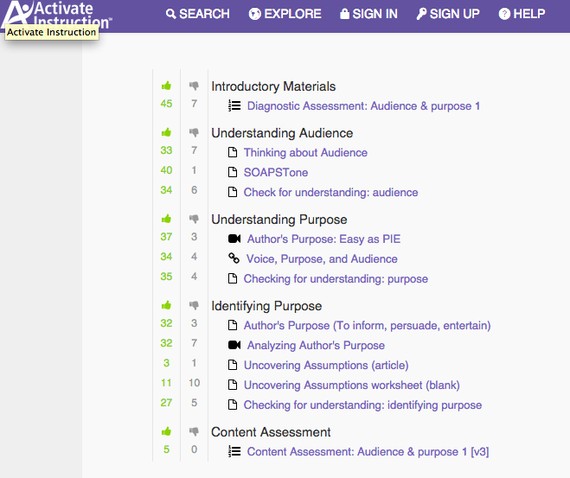
Activate Instruction

I measured myself against these websites and Internet companies. It seems clear that they already have a distinct advantage over me as an individual teacher. They have more resources, more money, an entire staff of professionals, and they get to concentrate on producing their specialized content, while the teacher is—almost by default—inherently encouraged to transform into a facilitator. Some people might cringe at a "Netflix for teachers," but it’s almost impossible to deny the inherent advantages Netflix has over a local DVD store, and it’s easy to imagine the potential improvements that could happen to these modern services.

For how many more years can I compete? A dozen years ago, I proudly worked for about 20 hours to create a lesson plan that taught poetic meter through the analysis of a rap song (I remember continually rewinding the cassette in my walkman). Last week, the first lesson I saw on sharemylesson.com was a thoroughly analyzed song by Katy Perry, with a printable worksheet that featured at least 10 literary devices, along with a link to her video. ListenCurrent.com gives me immediate access to public-radio clips that took me hours to accumulate just a few months ago. I may not use Edmodo or anything like it this year, but I also didn’t use Facebook in its first few years—or Amazon, or cell phones, or even ATM machines. Isn’t it probable that this educational technology is going to be overwhelmingly awesome in 20 years? I hear the career counselor’s voice: "Try five or 10."

* * *

I think to myself: These resources are already good for education, and they’re only getting better. Part of me is really excited that in two decades, the giant interactive classroom computer screen that I foresaw is going to be far more sophisticated than I can possibly imagine. Why should I stand in the way of crowdsourced lesson plans and professionally edited video tutorials? Shouldn’t I stop trying to compete as an individual "sage on the stage," appreciate the modern efficiency of today’s resources, and re-invest my time as their enthusiastic "guide on the side"?

When I told the school’s golf coach about flipped learning, I explained that it would be as if he asked the kids to go home and watch YouTube videos that teach proper mechanics and then practice those skills under his supervision on the course. He laughed and answered, "Oh, we should absolutely do that. Hank Haney’s video’s are way better than anything I can show them."

And if I can compete with Hank Haney, shouldn’t I be Hank Haney? In other words, if I think my lesson plans or video tutorials rival some of the best on the Internet (for now), shouldn’t I be trying to make six figures on the open marketplace at teacherspayteachers.com or as a curriculum designer for a private company? The dilemma intensifies when I suspect that un-credentialed "techs" might bust the teacher unions in 20 years ("try five or 10").

I looked through the current trends for some sign that the future classroom I envisioned won’t be realized within 20 years. I read Terrance Ross’s analysis of the Bridge International Academies and how their "scripted instruction," combined with technology and statistical feedback, has efficiently earned revenue while improving education in Kenya. Fast Company put the company on the list of "The World’s Top 10 Innovative Companies in Education," citing the fact that it’s already serving over 110,000 students, is significantly outperforming neighboring schools in both reading and math, and plans on educating 10 million students by 2025.

In a similar vein, live-streaming and other technology are also allowing some modern churches to move toward a "multisite" format, one in which a single pastor can broadcast his sermons to satellite churches guided by pastors who—this might sound familiar—concentrate on the facilitation of a common itinerary. Ed Stetzer recently wrote on ChristianityToday.com that "multisite is the new normal," and later explained, "it's easier to create another extension site than it is to create another faithful pastor who is a great communicator … it's easier to start a campus and beam my sermons to other locales than it is to raise up leaders and laypeople."

And as I mentioned earlier, last night I watched Sugata Mitra earn a standing ovation, $1 million, and a partnership with Microsoft for his TedTalk that declared that the "future of learning" is a "school built in the cloud"—one that doesn’t require teachers. It seems fitting that I watched the speech from my laptop, and that Mitra is a former computer-science teacher. Last November, Newcastle University opened the first "global hub" based on Mitra’s research, which suggests that children in self-organized learning environments "can learn almost anything by themselves" (and a computer).

This morning I spoke with a well-respected high-school teacher who supervises a blended course in digital photography. The course is mostly taught online, but students meet once every two weeks in the classroom. "So in five years, if a student has five teachers using this blended-learning style, they can just stay home the entire semester?" I asked. Apparently they could. And that, it seems, is homeschooling—with the high school’s resources.

I wonder why larger discussions related to these trends aren’t happening with greater urgency, if they’re happening at all. How hot does the water have to get before the best teachers start jumping for jobs in the private sector? As local communities and school districts nationwide commit to blended-learning programs, are they considering the long-term ramifications to the nature of their classrooms? Does the American Federation of Teachers know that, as its teachers upload their lesson plans into the cloud, they might be helping build an entirely different school, ones with self-organized learning environments instead of teachers?

I don’t have many answers in this brave new world, but I feel like I can draw one firm line. There is a profound difference between a local expert teacher using the Internet and all its resources to supplement and improve his or her lessons, and a teacher facilitating the educational plans of massive organizations. Why isn’t this line being publicly and sharply delineated, or even generally discussed? This line should be rigorously guarded by those who want to keep education professionals in the center of each classroom. Those calling for teachers to "transform their roles," regardless of motive or intentionality, are quietly erasing this line—effectively deconstructing the role of the teacher as it’s always been known.

Meanwhile, back on my campus, I wonder about the advice I should give a new teacher. Should I encourage this aspiring educator to fight for his or her role as the local expert, or simply get good at facilitating the best lessons available? Should I assure this person about my union and the notion of tenure, or should I urgently encourage him or her to create a back-up plan?

And when I think back to the original discussion, I wonder what I’m supposed to tell the college graduates who ask about earning a teaching credential. Because while I used to think I was scaring the youngster with my 20-year predictions, now I’m afraid I’m giving them false hope.

Wednesday, April 01, 2015

EDUCATORS CONVICTED OF RACKETEERING IN ATLANTA PUBLIC SCHOOLS TEST CHEATING SCANDAL

By ALAN BLINDER, NY Times | http://nyti.ms/1Cap1rD

see also:

RICO a powerful tool in APS test-cheating case | http://on-ajc.com/1ak3ZkV || Atlanta Journal Constitution‎ – 4:30pm EDT


Donald Bullock, left, a former testing coordinator, after being found guilty on Wednesday. Credit Pool photo by Kent D. Johnson

APRIL 1, 2015  ::  ATLANTA — In a major victory for prosecutors, a number of Atlanta educators were found guilty on Wednesday for their roles in public schools cheating scandal, bringing a close to a half-decade drama that tarnished a major school district’s reputation and raised questions nationwide about the wisdom of pushing educators to improve students’ standardized test scores.

On their eighth day of deliberations, the jurors convicted 11 of the 12 defendants of racketeering, a felony that could put them in prison for decades. Many of the defendants — a mixture of teachers, testing coordinators and administrators — were also convicted of lesser charges, such as making false statements.

Judge Jerry W. Baxter of the Fulton County Superior Court ordered most of the educators to be taken into custody immediately, and they were led from the courtroom in handcuffs. Judge Baxter, who presided over a trial that started with opening statements more than six months ago, will begin sentencing hearings next week.

Sharon Davis Williams, a former research team director, was led to a holding cell after the verdict. Credit Pool photo by Kent D. Johnson

“Our entire effort in this case was simply to get our community to stop and take a look at our educational system,” District Attorney Paul L. Howard Jr. said. “I think because of the decision of this jury today that people will stop. I think people will stop and they will make an assessment of our educational system.”

Defense lawyers emerged from the courthouse holding their clients’ personal effects, including purses, ties and scarves. One lawyer, George Lawson, who represented Michael Pitts, said the defendants were convicted primarily on the testimony of admitted liars and criminals — people who had already pleaded guilty.

The dozen educators who stood trial, including five teachers and a principal, were indicted in March 2013 after years of questions about how Atlanta students had substantially improved their scores on the Criterion-Referenced Competency Test, a standardized examination given throughout Georgia.

In 2009, The Atlanta Journal-Constitution started a series of articles that sowed suspicion about the veracity of the test scores, and Gov. Sonny Perdue ultimately ordered an investigation.

The findings, which were completed in June 2011, were unsparing: Investigators concluded that cheating had occurred in at least 44 of Atlanta’s schools and that the district had been troubled by “organized and systemic misconduct.” Nearly 180 employees, including 38 principals, were accused of wrongdoing.

The investigators wrote that cheating was commonplace in individual schools — at one, for instance, a principal wore gloves while she altered answer sheets — but they also said that the district’s top officials, including Superintendent Beverly L. Hall, bore some responsibility.

Investigators wrote in the report that Dr. Hall and her aides had “created a culture of fear, intimidation and retaliation” that had permitted “cheating — at all levels — to go unchecked for years.”

Officials said the cheating allowed employees to collect bonuses and helped improve the reputations of both Dr. Hall, a former administrator in New York City and New Jersey, and the perpetually troubled school district she had led since 1999.

Beverly L. Hall, the former superintendent of Atlanta Public Schools. Investigators said Dr. Hall, who died on March 2, “created a culture of fear, intimidation and retaliation.” Credit Kendrick Brinson for The New York Times

Dr. Hall, who died on March 2, insisted that she had done nothing wrong and that her approach to education, which emphasized data, was not to blame.

“I can’t accept that there is a culture of cheating,” Dr. Hall said in 2011. “What these 178 are accused of is horrific, but we have over 3,000 teachers.”

But in March 2013, a Fulton County grand jury accused Dr. Hall and 34 other district employees of being complicit in the cheating. The indictment accused them of racketeering and other crimes that together carried decades in prison.

Twenty-one of the educators reached plea agreements and detailed their transgressions before Judge Jerry W. Baxter of the Fulton County Superior Court in exchange for lesser punishments, including probation. (Two defendants, including Dr. Hall, died before they could stand trial.)

But 12 defendants chose to go before a jury, and opening statements began in late September. Testimony did not conclude until near the end of February, and jurors began their deliberations on March 19.

On the first of three days of closing arguments, defense lawyers complained that prosecutors had used witnesses who were not reliable. They also told jurors that the state wanted them to use an inappropriately broad interpretation of Georgia’s Racketeer Influenced and Corruption Organizations law, often referred to as a RICO statute.

“This case is garbage,” said Keith E. Adams, a lawyer for a former teacher at Dobbs Elementary School. “It’s a garbage case. It’s a RICO case that means nothing.”

But a prosecutor, Clinton K. Rucker, pleaded with jurors to convict the dozen educators seated across Courtroom 1C.

“We’re not saying these defendants are devils or Satan or anything like that,” he said. “They did a bad thing that affected a whole lot of people.”

FOUR GARFIELD HIGH STUDENTS ARE IN NATIONAL ACADEMIC DECATHLON FINALS AS INDIVIDUALS

By Howard Blume  | LA Times | http://lat.ms/1yABNiM

750x422[1]

Garfield High School students Joey Nabor, left to right, Wendy Olvera, Alfonso Caballero and Brian Rios are competing in the national academic decathlon. (Gina Ferazzi / Los Angeles Times)

1 April 2015  ::  Four Garfield High students will participate this month in the final round of the national Academic Decathlon, the first ever to compete as individuals — rather than as a school team — from the Los Angeles Unified School District.

They are among 14 students in California invited to participate, after their school teams didn't win the state competition.

“I'm pretty nervous, I guess, because this is uncharted territory for Garfield in general and even more so for me. It's a little bit scary.”

- Joey Nabor, a 17-year-old junior

The Academic Decathlon, a grueling academic challenge, is known as a team event. The contest for individuals, which has several rounds, was set up to provide opportunities for students who are home-schooled, who aren't on their school squad or whose school doesn't have a team. After the state finals, however, organizers also opened up slots for the highest-scoring individuals on a team that made it to the state round.

Garfield, which serves mostly low-income minority students from East L.A., finished seventh in the state competition, which was held in Sacramento in March. Only the state's top team, Granada Hills, moved on to the nationals, which will be held in Garden Grove from April 16 to 18. The second place team, El Camino Real in Woodland Hills, will compete in a national online competition for large high schools.

After the state matchup, the Garfield students thought they were done. But then came the invitation from the decathlon organization.

The students were excited, but their first concern was a fee of $250 required from each individual participant, said coach Kevin Murchie. L.A. Unified agreed to pick up the cost, and all four — Wendy Olvera, Alfonso Caballero, Joseph Nabor and Brian Rios — will take part.

Garfield became known nationally because of the late Jaime Escalante, who taught Advanced Placement calculus there from 1978 to 1991, a success story dramatized in the movie "Stand and Deliver." But the campus also has been long associated with poor overall academic results.

Still, its most recent graduation rate has improved to 88%, with 35% of graduates qualifying to apply to a University of California or Cal State campus, according to state data.

A typical decathlon team has nine members: three A students, three B students and three C students. Coaches are always on the lookout for underachieving students who can fill the latter categories, Murchie said. Garfield's qualifying students competed in the B and C categories.

"I'm pretty nervous, I guess, because this is uncharted territory for Garfield in general and even more so for me," said Joey Nabor, a 17-year-old junior. "It's a little bit scary."

Entering high school, Joey said he had never read an entire book, was known to show up late to class and received poor grades. He considered dropping out, as his two older brothers had done. He was placed in a low-level English course, but the teacher noticed his score on a reading test and ordered him to Murchie's honors class.

When he realized he'd have to put in a lot of effort, he called home at lunch the first day, asking his mother to get him out of the class. She told him to stick with it, he recalled.

Joey quickly warmed to Murchie's animated teaching style, but he refused to read Charles Dickens' "Great Expectations" — too long, too inaccessible, he decided. Joey wouldn't read Shakespeare either, the poetic language was "too pompous," he said he felt at the time.

But Murchie kept pushing and directed him to "The Sun Also Rises" by Ernest Hemingway.

Something about the unadorned, straight-ahead prose caught Joey, made him want to keep going. That was the beginning. He soon progressed to the comparatively obscure styles of William Faulkner and James Joyce.

"Now this kid can't stop reading," Murchie said. "He saw all this wealth of knowledge out there."

"I'm cursed because I have a passion for literature," Joey said. "My dream would be to be a full-time writer. I also wouldn't mind teaching, like being a professor."

Murchie successfully recruited Joey to the decathlon team as a 10th-grader; he committed to studying about 35 extra hours a week, even through the summer. And there's more work ahead.

"There's no downside to that," he said. "Studying is always good. I just hoard the knowledge."

L.A. Unified schools have dominated the team competition of the national decathlon, earning 15 national titles since 1986. L.A. Unified also has won 21 state contests. California schools have won 12 consecutive national titles.

This year's theme was new alternatives in energy. The competition has 10 parts, including interviews and speeches and tests in economics, literature and music. On Tuesday, the Garfield four completed the online portion, which is composed of an art exam and essay writing.

Six teachers help train the decathletes. Murchie and biology teacher Lucille Romero are the head coaches.

Traditional academic powerhouse South Pasadena High has six students in the individual competition: Elise Matsusaka, Rebecca Bao, John Dullaghan, Matthew Brogdon, Jacob Chun and Oscar Garcia.

The other California qualifiers are: Mary (Seo Yeon) Yoo and Douglas Wu from Beverly Hills High, Molly (Hyun-sun) Kim from West High in Torrance and Conor Broderick from Mountain Oaks Charter in Calaveras County, east of Stockton.

NEW LAUSD ARTS ED DATA ‘CONFIRMED MY WORST FEARS,’ BOARD MEMBER SAYS

Mary Plummer | KPCC | http://bit.ly/1bPC38P

Audio from this story  |  1:03 Listen

102004 full

File photo: Eighth-grader Trinity Marquez and the Brenda (¿Berendo?) Middle School dance team perform on Wednesday, March 18, 2015, at Rosalyn S. Heyman Auditorium. Maya Sugarman/KPCC


March 26 2015  ::  For years, Los Angeles Unified School District officials have known they have a problem when it comes to teaching the arts.

There aren't enough art teachers and thousands of district students are making their way through school without instruction in the arts, a violation of state law.

How to fix it? School board member Steve Zimmer came up with an idea to look at what was being taught but also to whom and where; poverty would also be a measure. Thus was born the Arts Equity Index – a tool that gives each school a grade for its arts education, from nonexistent to excelling.

After many months in the making, the arts index data rolled out to school board members Tuesday, giving them their first look at how well LAUSD schools provide education in the arts.

"It confirmed my worst fears," Zimmer said, "that we had decimated arts education in this district and that access to arts education had really become not a right, but a privilege for the affluent or the lucky."

As district officials sort through the data from more than 600 schools, they are developing a plan to increase art classes, with priority going to those schools with the greatest need.

Officials say they would require around $45 million in arts funding for the 2015-2016 school year to fully fund a strong arts program. The current budget is less than half of that.

Zimmer said the district can’t afford to fully fund the arts, but it can start to move in that direction.

"We had damned well better be sure that we are placing this district and our budget priorities on a trajectory to meet the aspirations of the plan," he said. "Our kids deserve no less and our kids have been getting less than they deserve," he said.

The Arts Equity Index comes on the heels of several ongoing attempts to improve arts education in the district. In October 2012, the board passed a resolution to make the arts a core subject, on par with subjects like math and science. But the district hasn't achieved that goal, and district officials have flip-flopped on plans. Funding has been on ongoing obstacle.

School board member Monica Ratliff, who has also been a vocal advocate of arts education, called the disparities between arts-rich and arts-poor schools "shocking."

In a written statement on the release of the index, Ratliff said: "We must identify sustainable sources of funding and encourage schools to think outside the box in terms of scheduling arts classes."

Multiple stories + amended application :: NCLB/ESEA WAIVER DEADLINE TODAY: LAUSD meets it – kinda/sort-of

also see: BLIZZARD O’ TWEETS FROM @HowardBlume RE: LAUSD’s #COREdistricts NCLB WAIVER APPLICATION | http://bit.ly/1xVbidp

LA Unified files for NCLB waiver without teacher evaluation deal

by Vanessa Romo | LA School Report | http://bit.ly/19EXhVz

teacher_evaluation_satisfactoryMarch 31, 2015 4:11 pm  ::  LA Unified met today’s deadline and filed an application for a No Child Left Behind waiver without one of the key requirements of the U.S. Department of Education — an agreement with the teachers union on a three-level teacher evaluation system.

If approved, the California Office to Reform Education (CORE) Waiver would clear the way for LA Unified to receive $171 million in federal funding.

While the absence of agreement with the union, UTLA, does not automatically disqualify the district or make it ineligible for federal dollars, Rick Miller, Executive Director of CORE, suggested today that the district’s incomplete proposal could jeopardize the district’s application.

“Non-compliance with this commitment, or any other commitment made in the School Quality Improvement plan, puts approval of the Waiver at risk,” he said in a statement.

In fact, Washington will not make final decisions on waivers for several more months, leaving open the possibility that LA Unified and UTLA could reach agreement within that time frame.

The union recognized as much today, issuing a statement late this afternoon saying, “UTLA is in continuing negotiations with the District and we see the CORE Waiver as one of many issues to be addressed in bargaining.”

Teacher evaluations have been part of the current contract negotiations between the district and the union, which are now in the hands of a federal mediator who is not scheduled to meet with the sides again until April 6 and April 15.

UTLA argues that a three-level evaluation system, one that would distinguish a “highly effective” teacher from those who merely meet standards or are below standard, paves the way for merit pay. The union is fighting to keep a two-level system in place.

LA Unified Superintendent Ramon Cortines addressed the issue in a letter to U.S. Department of Education Secretary Arne Duncan earlier this month, writing that the “only obstacle to full compliance…is the long-standing contractual agreement with UTLA that provides only two levels of overall final performance evaluation.”

Cortines offered to fly to Washington D.C. with the president of the teachers union, Alex Caputo-Pearl, to discuss the matter with Duncan in person. It is unclear if Duncan responded to Cortines’ request.

But LA Unified is not unique in failing to meet the administration’s waiver requirements. Georgia’s State Superintendent is asking the feds for an extension to review the application while the state decides on the length of its renewal request. Idaho is also seeking an extension.

And it’s possible Louisiana will ask for a delay as the state’s legislative session conflicts with the waiver renewal timeline.

Closer to home, Santa Ana Unified skirted around the teacher evaluation issue by implementing a three-level system at a single pilot school, according to Deidra Powell, chief communications officer for the southern California district.

“We’re on board for trying it but it’s much easier to see if it works in one school than applying it all over the district,” she told LA School Report.

“This lets us comply with everything and get our application in on time,” she said.

______________

from politico Morning Ed |http://politi.co/1NBAUxt

CORE DISTRICTS ADDRESS CONCERNS:

1 April ::  Six districts in California have applied for a three-year extension of their No Child Left Behind waiver, which is on high-risk status. The Education Department told the California CORE districts last fall [http://politico.pro/1vZsYwf ] that their waiver was at risk because they had to finalize plans for a new school quality improvement system and guidance for new teacher evaluation systems. Eight districts originally received the waiver in 2013, but two have since dropped out. The California CORE districts are now trying to address the feds' concerns, finalizing accountability system metrics and updating educator effectiveness guidelines. But the application is missing an important component, LA School Report writes [above ] - an agreement with United Teachers Los Angeles on a three-level teacher evaluation system.

- Nebraska, which doesn't have a waiver from NCLB, also applied for one. But the state's application probably won't meet the Education Department's standards because its teacher evaluation framework is voluntary for districts. More in the Omaha World-Herald: http://bit.ly/1BKPps1

Fritzwire backgrounder:

ESEA Waiver Renewals

April 1  ::  Most states looking to renew their No Child Left Behind waivers must file applications with the Education Department by today. Most states want a three-year renewal and that the department will be a better partner. Education Secretary Arne Duncan has heard them, saying [ http://politico.pro/1F9Pfiu ] the agency wants to focus on supporting states while they get deeper into implementation. But it remains to be seen how the agency will deal with states looking for wiggle room. For example, the feds allowed states a one-year delay to incorporate student test scores into teacher evaluations. But Connecticut wants [ http://1.usa.gov/1Nzj3ZG] to extend that for another year, into 2016-17. Federal law requires a 95 percent participation threshold in testing, but Colorado wants [ http://bit.ly/1Dl9LPI ] to ensure that schools aren't penalized no matter how many parents opt children out of testing.
One exception to the three-year renewal trend is Utah, where the state board of education voted [ http://politico.pro/1GH77TX] earlier this month to apply for a one-year renewal - and scrap the application altogether if the state legislature can provide more money. A few states are likely to ask for more time to apply. Georgia wants an extension because the state is still figuring out the length of its renewal request and new state Superintendent Richard Woods wants time to review the application, a state education official said. Idaho is also seeking [ http://bit.ly/1IgOzYX] an extension. Louisiana could ask for a delay, too. The state's legislative session conflicts with the waiver renewal timeline, complicating the application.
Four states going through an expedited waiver renewal process expect to hear from the Education Department. Kentucky, New Mexico, North Carolina and Virginia, are each eligible for a renewal of up to four years. They were able to fast-track their renewal requests because they implemented their waiver provisions on time, including more rigorous teacher evaluations.
The feds pulled Washington state's waiver last year after lawmakers failed to pass a bill requiring the use of student test scores in teacher evaluations. A new legislative fix has passed the state Senate and a House panel is considering it. Hundreds of teachers lined up to testify against the bill on Monday, The Olympian reports:
http://bit.ly/1CEWWgW . The House panel hasn't scheduled a vote, though Wednesday is the deadline to pass bills out of policy committees. The bill could still go directly to the House floor later this session. Still, it'll likely face a tough road in the Democrat-controlled chamber.
Politico Morning Education

_____________________

CORE 2014-15 Amendments - March renewal request (v release to USED 3.31.15) by smf 4LAKids

_________________

COVERPAGE OF FULL AMENDED REQUEST (492 pp.)  complete doc is available at  http://bit.ly/1xVuGa8

image

FMR REP. GEORGE MILLER - AUTHOR OF NCLB - TO TEAM UP WITH VERGARA PROPONENTS TO “REIMAGINE CALIFORNIA’S EDUCATION SYSTEM”

Fritzwire Header Top Image

from Fritzwire by email

Former Rep. George Miller will team up with Students Matter, the group behind the landmark Vergara lawsuit, to develop recommendations for "reimagining California's education system."

April 1  ::  Miller, a longtime leader on education policy in D.C., will host roundtable talks across the state, starting with an event today in Sacramento where he'll be joined by teachers, parents, elected officials and others.

California lawmakers aren't waiting for Miller's recommendations. Republicans have already introduced a half-dozen bills that would create rules for hiring, firing and evaluating teachers in the wake of the Vergara ruling, which struck down the state's tenure and job protection laws for teachers. One bill [ http://bit.ly/1ytOfRx] would abolish the "last-in, first-out" policy of laying off teachers in reverse order of seniority. Another [ http://bit.ly/1BFmqWL ] would lengthen the probationary period from two years to three before teachers could earn tenure.


The teachers unions, meanwhile, have until mid-April to file additional briefs in their appeal of the Vergara ruling. No decision is expected until late summer at the earliest.  Politico Morning Education