Thursday, November 29, 2012

CALIFORNIA STATE AUDIT FAULTS L.A. UNIFIED’S ABUSE REPORTING + Audit Report

By CHRISTINA HOAG Associated Press, from the San Jose Mercury News http://bit.ly/TtShVC

11/29/2012 10:19:10 AM PST/Updated: 11/29/2012 12:19:49 PM PST  ::  LOS ANGELES—The Los Angeles Unified School District frequently failed to report teacher misconduct to state credentialing authorities and took too long to investigate and punish teachers, according to a report by the California state auditor released Thursday.

The 57-page audit made four main recommendations to the nation's second-largest school district. But it noted that state laws governing teacher dismissal contribute to the problem of prolonged investigations and expense in firing teachers.

Superintendent John Deasy said the district already has addressed the deficiencies outlined in the audit.

"We completely agree and more," he said.

The audit was sparked by a case earlier this year in which a former South Los Angeles third-grade teacher was arrested on lewdness charges over allegations he fed students semen-laced cookies over several years. Mark Berndt has pleaded not guilty.

The case attracted international headlines and prompted numerous teacher sexual abuse cases across the state.

It also drew attention to how the district handles complaints of teacher misconduct and discipline when it emerged that students had complained years before about Berndt's alleged behavior, but no action was taken.

It was also revealed that the district never had reported his case to the state Commission on Teacher Credentialing, as required by state law. Additionally, the district had to pay Berndt $40,000 to retire rather than go through a lengthy dismissal process.

Deasy said the district has taken numerous steps to tighten procedures since then. It has formed new employee investigation unit to expedite cases, revamped teacher misconduct reporting procedures to require multiple layers of review so cases will not go overlooked, and adopted a 72-hour parental notification policy when teachers are accused of misconduct.

Additionally, it has stepped up teacher and parent training in signs of child sex abuse and implemented a district-wide tracking system to monitor disciplinary actions against employees.

Although the state audit said that laws made firing teachers a labyrinthine process, it noted several cases where district officials simply failed to act. In one case, it took a principal eight months to write a memo to an employee after an abuse investigation was concluded.

It also noted that the district pays the salaries of teachers under investigation even though they are not working in a classroom, a status known as being "housed."

The audit said that as of mid-September, the district had paid $3 million in salaries to 20 non-working teachers accused of misconduct with students. One such case has dragged on for more than four years, the audit said.

Deasy said teachers are housed an average of 127 days and the district is moving more aggressively to fire them. In the 2011-2012 school year, 96 teachers were fired for misconduct, up from 63 the previous year. It costs an average $300,000 to dismiss a teacher.

It currently has 298 teachers being housed, 54 of whom are not being paid.

Warren Fletcher, president of teachers union United Teachers Los Angeles, did not have an immediate statement on the report, a spokeswoman said.

Deasy said the school board will be advocating efforts to change teacher dismissal laws, especially in cases of sexual misconduct, although one previous bill was defeated earlier this year.

The audit also recommended the Legislature create a statewide tracking system of dismissed school support employees, such as custodians and cafeteria workers, to prevent their rehiring by other districts.


Additional coverage | 1pm 11/29

Calif audit faults LA Unified's reporting of teacher abuse cases, lengthy ...

The Republic - ‎2 hours ago‎

... ANGELES — California's state auditor has criticized the Los Angeles Unified School District for failing to report some 150 cases of teacher misconduct to state credentialing authorities and for taking too long to investigate allegations of teacher malfeasance.

Audit faults LAUSD for not reporting charges of sexual misconduct

Los Angeles Times - ‎1 hour ago‎

The review, released Thursday, was conducted by the California state auditor at the behest of the Legislature's audit committee. It was commissioned in response to fallout from the arrest of a veteran Miramonte Elementary School teacher on 23 counts of lewd ...

Calif. audit faults LA Unified's abuse reporting

San Francisco Chronicle - ‎29 minutes ago‎

LOS ANGELES (AP) — The Los Angeles Unified School District frequently failed to report teacher misconduct to state credentialing authorities and took too long to investigate and punish teachers, according to a report by the California state auditor released ...

LAUSD teacher misconduct audit results to be released

abc7.com - ‎4 hours ago‎

The California State Auditor's Office looked into how the district and schools respond once the claim is filed. The audit looked at six sample schools in the district to see if they were following procedures. The audit was requested after two teachers from ...


REPORT 2012-103 SUMMARY - NOVEMBER 2012 

http://bit.ly/WxpOyR

Los Angeles Unified School District: It Could Do More to Improve Its Handling of Child Abuse Allegations

HIGHLIGHTS

Our review of the Los Angeles Unified School District's (district) handling of allegations of employee abuse against students highlighted the following:

  • The district often did not properly notify the Commission on Teacher Credentialing (commission) when required to do so. After reviewing past practices, the district reported about 600 cases to the commission in a span of three months.
    • At least 144 of these cases—including cases involving employee misconduct against students—were submitted a year or more late.
    • Of the 144 cases, 31 were more than three years late when reported to the commission.
  • There is no statewide mechanism to communicate among school districts when a classified employee at any school district separates by dismissal, resignation, or settlement during the course of an investigation involving misconduct with students.
  • Although it appears the district generally followed state law when reporting suspected child abuse and generally followed its policies, it did not always act in a timely manner on some allegations during the investigation process—one case did not move forward for almost 14 of the more than 18 months the case was open.
  • The district could not adequately explain some delays in disciplining or dismissing certain employees suspected of child abuse—we noted an eight-month delay in one case between the time the district's investigations unit issued a report concerning the allegation and when the principal took action.
  • The district paid $3 million in salaries to 20 employees whom the district has housed—relocated away from school sites—the longest for allegations of misconduct against students, including one employee who has been housed for 4.5 years.
RESULTS IN BRIEF

In terms of student enrollment, the Los Angeles Unified School District (district) is the largest school district in California. During the 2011-12 school year, it was responsible for 659,246 enrolled kindergarten through 12th-grade (K-12) students receiving educational instruction at 759 school sites and 198 charter schools. The district employed approximately 27,000 certificated K-12 classroom teachers and more than 4,600 substitute teachers. Additionally, it employed more than 5,100 teacher assistants who do not hold a certificate to teach from the Commission on Teacher Credentialing (commission). The district also employed nearly 30,400 classified employees, who are not required to have a teaching certificate, in positions such as campus aide, food service worker, and clerk. Because most students attending district schools are under the age of 18, employee misconduct against students generally entails child abuse. Examples of child abuse include physical abuse and sexual abuse or exploitation.

State law requires that school employees report suspected child abuse immediately or as soon as practically possible by calling a law enforcement entity and filing a suspected child abuse report within 36 hours. District policies have detailed reporting and investigative processes for allegations of suspected child abuse, including allegations of employee abuse against students.

Moreover, state regulations require school districts to report to the commission within 30 days cases of a certificated employee's change of employment status, such as a dismissal or other termination, as a result of an allegation of misconduct or while an allegation of misconduct is pending. Further, state law requires the commission be notified within 10 days when a certificated employee is put on a compulsory leave of absence because of charges for certain sex offenses or controlled substance crimes. However, the district often did not properly notify the commission when required to do so, such as when employees were dismissed while allegations of misconduct were pending. The district did not realize it had failed to report many of these cases until a high-profile incident that went unreported for more than six months led the district to review its past reporting practices. The commission uses these reports to review an employee's case and to suspend or revoke his or her teaching credential if necessary.

The superintendent of schools directed district officials and principals to undertake two separate projects intended to improve district reporting processes. One of the projects—the commission reporting project—led to about 600 cases being reported to the commission in a span of three months. However, this large increase in the number of cases reported included many not requiring reporting and caused a needless increase in workload for the commission. Our review of the information the district provided to the commission found that the district failed to report as required at least 144 cases—including cases involving employee misconduct against students—and they were submitted a year or more late when the district finally did report them. Of the 144 cases, 31 were more than three years late when they were reported to the commission. This lack of reporting resulted from systematic problems within the district, such as inconsistent office processes. As a result of the delays in reporting these cases, the commission was not able to determine promptly whether it was appropriate to revoke the teachers' certificates and thus prevent the individuals from working in other school districts. The district has yet to complete the second project, which involves a review of employee files by school principals, and the district will not know the project's full effect until all files are reviewed by its central office and it determines how many cases were investigated and whether disciplinary actions were taken.

Further, California has no statewide mechanism to communicate among school districts when a classified employee at any school district separates by dismissal, resignation, or settlement during the course of an investigation involving misconduct with students. Thus, a classified employee who has separated from his or her district might be able to find employment with other school districts without those school districts knowing the circumstances under which the employee left a previous position.

The district has made improvements to its policies and procedures related to reporting, investigating, and tracking suspected child abuse over time. For example, the district implemented two tracking systems that allow improved reporting and tracking of suspected child abuse and created a unit that investigates complex cases of suspected child abuse. In addition, although independent charter schools are largely autonomous and are not required to follow the district's policies and procedures regarding child abuse reporting, the information we reviewed at two charter management organizations indicated that adequate processes are in place to report child abuse. District-required charter language also obligates charter schools to inform the district about notices of investigations by outside regulatory agencies, lawsuits, or other formal complaints within one week of the school's receipt of such notices.

Available documentation related to our review of 24 personnel files containing child abuse allegations indicate that the district generally followed state law when reporting suspected child abuse and generally followed its own policies and procedures related to investigating child abuse allegations and to removing a suspected employee from a school site after an allegation was reported. However, we found that the district did not always act in a timely manner on some allegations during the investigation process. Although a criminal investigation conducted by law enforcement might cause the district to delay or put on hold an administrative investigation by the district, we found some delays in the investigation process that the district was unable to justify. For example, until the district's investigations unit took it, one case we reviewed did not move forward for almost 14 of the more than 18 months that it was open. The local district was unable to explain what occurred during that 14-month time period.

In addition, the district follows a progressive discipline process and state laws related to dismissing employees, both of which increase the time for the district to see a case to its conclusion. Nonetheless, for cases we reviewed, the district could not adequately explain some delays in disciplining or dismissing certain employees suspected of child abuse. For example, in one case, we noted an eight-month delay between the time that the district's investigations unit released a report concerning a child abuse allegation and the date on which the school's principal issued a memo to the employee about the incident, with no indication of anything occurring in the interim. According to district staff, the principal struggled to write the memo.

The district is responsible for keeping an employee who is being investigated for misconduct away from the school site during the investigation. The district's policy for addressing this responsibility is to house the employee—to relocate him or her away from its school sites. Since its creation in 2008, a database that tracks housed employees reports that the district has housed more than 700 employees for various reasons. The length of time that the employee is housed can range from a day to years, depending on the time it takes to make a determination on the case. During this time, the district continues paying the employee's salary. In fact, as of mid-September 2012, the district had paid $3 million in salaries to 20 employees whom the district had housed the longest for allegations of misconduct against students, including one employee who has been housed for 4.5 years.

Our review found that the length of time and the expense of the process for dismissing the district's certificated employees suspected of child abuse contribute to the district's entering into settlement agreements rather than continuing with attempts to dismiss the employees. State law outlines the dismissal process that must be used for certificated and classified employees. The dismissal of classified employees and substitute teachers is effective immediately, regardless of whether the employees challenge the district's decisions. In contrast, the process for dismissing certificated employees is more lengthy and expensive for the district. Certificated employees who appeal their dismissals are each entitled to a hearing before the Commission of Professional Competence. As a result, the district may decide to reach a settlement agreement with certificated employees rather than attempt to continue with this lengthy process. The district has made some efforts to track settlement agreements; however, none of its tracking efforts provides the total cost of the settlement or complete information on the nature of the misconduct. Having one division within the district maintain a districtwide tracking mechanism for issued settlements could ensure that the district has complete and readily accessible information. We believe this information could help the district identify and analyze patterns and trends associated with providing settlements, which could help streamline and make the process less expensive.

RECOMMENDATIONS

To ensure that the commission is made aware of certificated employees who need to be reviewed to determine whether the employees' teaching credentials should be suspended or revoked, the district should adhere to state requirements for reporting cases to the commission.

The Legislature should consider establishing a mechanism to monitor classified employees who have separated from a school district by dismissal, resignation, or settlement during the course of an investigation for misconduct involving students, similar to the oversight provided by the commission for certificated employees. If such a mechanism existed, school districts throughout the State could be notified before hiring these classified employees.

To ensure that investigations proceed in a timely manner and that the district disciplines employees promptly, the district should increase its oversight of open allegations of employee abuse against students.

To ensure that it does not duplicate efforts and that its information is complete, the district should identify one division to maintain a districtwide tracking mechanism for settlements that includes the total amounts paid and descriptions of the misconduct.

AGENCY COMMENTS

The district agreed with our recommendations and outlined the steps it has taken or plans to take to implement the recommendations we directed to it.

CA State Auditor: Los Angeles Unified School DistrictIt Could Do More to Improve Its Handling of Child Abuse AllegationsNovember 2012 Report 2012‑103

WHAT HAPPENED TO PUBLIC EDUCATION ON ELECTION NIGHT?

By Joanne Barkan – Dissent Magazine blog | http://bit.ly/Uei2tP

November 26, 2012   ::  Barack Obama’s K-12 “reform” policies have brought misery to public schools across the country: more standardized testing, faulty evaluations for teachers based on student test scores, more public schools shut down rather than improved, more privately managed and for-profit charter schools soaking up tax dollars but providing little improvement, more money wasted on unproven computer-based instruction, and more opportunities for private foundations to steer public policy. Obama’s agenda has also fortified a crazy-quilt political coalition on education that stretches from centrist ed-reform functionaries to conservatives aiming to undermine unions and privatize public schools to right-wingers seeking tax dollars for religious charters. Mitt Romney’s education program was worse in only one significant way: Romney also supported vouchers that allow parents to take their per-child public-education funding to private schools, including religious schools.

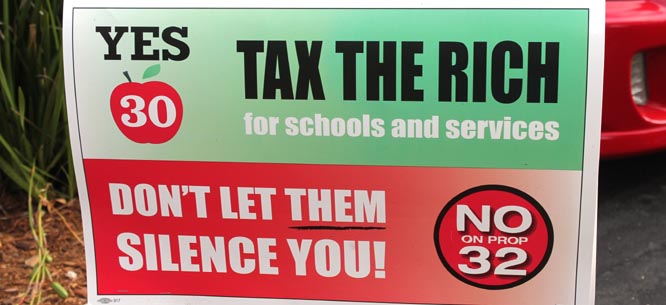
Photo of California Prop 30 campaign banner by Quinn Dombrowski, via Wikimedia Commons>>

After the November 6 elections, public school supporters speculated about (hoped for) a change in direction in Obama’s second term. Unfortunately, there’s no reason to expect a shift. By the time Obama launched his first presidential campaign in 2007, he had embraced reform-think. His longtime basketball buddy, über-reformer Arne Duncan, undoubtedly influenced his views. The two met on the court more than twenty years ago. Once Duncan took over as CEO of Chicago Public Schools in 2001, he became Obama’s sounding board on education policy and escort on school visits. It made perfect sense from Obama’s perspective to appoint Duncan Secretary of Education in 2008. And the administration’s signature education program, Race to the Top, perfectly embodies reform-think: it gives states (all of them resource-starved) a chance to compete for grants only if they pledge to adopt a full reform program.

Rumors that Obama might replace Duncan with ultra-extreme reformer Michelle Rhee caused some panic but needn’t have. Obama and Duncan are a team. Duncan announced his desire to stay for a second term in September 2012. Just ten days after the election, in prepared remarks to the Council of Chief State School Officers, he stated that his department’s second-term job would be “to support the bold and transformational reforms at the state and local level that so many of you have pursued during the last four years.” There was also talk that Obama-Duncan might focus more on preschool and higher education, both less controversial than their K-12 agenda. But even if this does pan out, Race to the Top has given the administration’s suite of ill-conceived reforms a life of its own. As seen on election night and as indicated in Duncan’s speech, the main action has moved to the state and local arenas.

The rescue of public education must come from the grassroots, from a coalition led by parents and teachers. Such a movement has been taking shape gradually and gained visibility during the 2012 election cycle. The number of education-related campaigns has increased as ed reformers try to entrench their policies in law. In addition to the familiar battles over school funding, there are votes on charter schools, the content of teacher contracts, vouchers, and union rights (the four largest unions in the United States represent teachers and other public sector workers). Disregarded in the past, elections for school boards and superintendents have become major battles. This year’s education votes were high-profile within individual states, fiercely fought, and outlandishly expensive; some attracted national attention. Public education supporters won some impressive victories and suffered several bitter disappointments. Here is a review of some pivotal votes, who supported what, and why:

Alabama: Voters defeated Amendment 4 (64.6 to 35.4 percent)*, which would have deleted from the 1901 state constitution language that validated the poll tax and school segregation by race. Counterintuitively, opposition to the amendment came from black leaders, the state teachers union, and Democrats because it left intact this clause: “…nothing in this Constitution shall be construed as creating or recognizing any right to education or training at public expense….” The language was inserted in 1956 to enable the state to dismantle public education rather than integrate schools. Business groups interested in limiting public expenditure on education supported the amendment. Opponents argued that eliminating the racist language but leaving the no-right-to-public-education clause effectively legitimated the latter, putting public education at risk. The amendment as written, they argued, would change nothing in practice for the black community since federal law prohibits de jure school segregation and poll taxes.

*All the results reported here are final figures or the latest available as of November 19, 2012.

Arizona: Voters defeated Proposition 204 (58 to 42 percent), which would have made permanent a 2010 one-cent sales tax to fund education, vocational training, and college scholarships.

Voters approved Proposition 118 (54.9 to 45.1 percent), which creates a more stable source of revenue for public education by changing the formula for distributing the earnings of a state trust fund until 2021. The money in the trust fund comes from the sale and lease of state lands. The Arizona Education Association, the state’s main teachers union, supported the proposition.

California: Voters approved Proposition 30 (54.7 to 45.3 percent), a constitutional amendment to raise income taxes by 1 to 3 percent on incomes over $250,000 for the next seven years and the sales tax by a quarter cent for four years to fund public schools and universities. Overcoming public aversion to tax increases in favor of public education marks a milestone in recent California history; higher taxes are also the only way to deal with the crisis in state education funding.

Voters defeated Proposition 32 (56.4 to 43.6 percent), which would have prevented unions from deducting political contributions from employee paychecks. This is a crucial win for the labor movement.

Voters defeated Proposition 38 (72.2 to 27.8 percent), a second tax increase for funding public schools and early childhood programs that competed with Proposition 30. Prop. 38, a state statute, would have raised everyone’s income taxes on a sliding scale for twelve years and allocated 30 percent of the revenue to repaying state debt for four years. Molly Munger—a wealthy Los Angeles lawyer and public education advocate—provided the impetus for the measure and more than $44 million of the nearly $48 million raised for the campaign. Munger came under strong pressure to withdraw Prop. 38 because both polls and conventional wisdom held that two tax increase propositions for education would split the yes vote, and both would lose. The California State Parent Teacher Association supported Prop. 38. Prop. 30 had much broader support, including Governor Jerry Brown, the Democratic Party, and the major unions.

Colorado: Denver voters approved Ballot Issue 3A (69 to 31 percent), a property tax increase that will raise $49 million for early childhood education and “enrichment programs” such as art, music, and physical education (these were once considered an integral part of a standard curriculum). Voters also approved Ballot Issue 3B (63.5 to 36.5 percent), a bond issue to raise $466 million for facility maintenance, renovations, and four new schools. Jeannie Kaplan, a Denver Board of Education member who opposes the in-vogue reform agenda, endorsed the ballot issues only after ensuring there would be public accountability and due consideration for opening new district-run schools and not just charters. The Denver Classroom Teachers Association contributed $13,000 to support the ballot issues. Michael Bloomberg—New York City mayor, multibillionaire, and nationwide ed-reform financier—gave $75,000. This was a rare instance when Bloomberg and a teachers union found themselves on the same side.

Connecticut: Voters in Bridgeport defeated a charter revision (53.3 to 46.7 percent) that would have replaced the elected Board of Education with one appointed by the mayor. The Democrats, including the mayor, supported the charter revision. Michael Bloomberg, who exercises “mayoral control” over NYC’s schools, contributed $20,000 to the charter revision. The pro-labor, left-liberal Working Families Party led the campaign against it and also won three seats on the board.

Florida: Voters defeated Amendment 8 (55.5 to 44.5 percent), which would have repealed the constitutional ban on public funding for a religion or religious institution. The amendment would have cleared the way for a statewide voucher system. Under a statewide voucher system, every child receives the same sum and can apply to any school; schools compete for the money. In a 1955 article called “The Role of Government in Education,” free-market proselytizer Milton Friedman proposed vouchers as the best way to provide K-12 education in a democracy. Only the private market, he argued, can provide quality goods efficiently at the best price for consumers, but there might not be a market incentive to educate every child; since the state has an interest in a literate citizenry, the government would provide a voucher to every child to be used at any accredited school. Such a system unavoidably exacerbates inequalities: the price of sought-after schools rises above the value of the voucher; wealthy parents don’t need vouchers but get them anyway; middle-class parents supplement the voucher with whatever they can afford, driving up prices. As Friedman admitted, there might not be an incentive for “sellers” to provide enough voucher-priced schools. In that case, the government would run schools for whomever couldn’t afford to shop in the market. The goal of many conservative ed-reformers is a system like Friedman’s.

Georgia: Voters approved constitutional Amendment One (58.6 to 41.4 percent) to allow the state government to accept charter school applications, bypassing local school districts. Until the vote, local school boards reviewed applications, and applicants could appeal rejections to the State Board of Education. The amendment authorizes a new type of school: state charter schools. The campaign turned into a cause célèbre for charter proponents, who raised over $2 million to support the amendment. They included Arkansas Wal-Mart heiress and Walton Family Foundation board member Alice Walton ($600,000), Michelle Rhee’s StudentsFirst ($250,000), Home Depot co-founder Bernie Marcus ($250,000), the Virginia-based cyber school company K12 ($100,000), charter school operator J.C. Huizenga ($75,000), and Florida-based for-profit school operator Charter Schools USA ($50,000). The out-of-state money overwhelmed opponents of the amendment; they raised only $123,243, mostly from Georgia public school officials.

Another wrinkle in the Georgia amendment story is the wording on the ballot: “Shall the Constitution of Georgia be amended to allow state or local approval of public charter schools upon the request of local communities? YES ( ) NO ( ).” This obfuscates what the amendment does. Citizens could find the full text of the amendment—dense language that revises three paragraphs in two different sections of Article VIII—on the Secretary of State’s website or at the offices of county probate courts. Summaries were published in the “official legal organ” of each county. Not surprisingly, most voters relied on the ballot language, and some were angry about being misled. There’s no likely recourse: the politicians in power (in this case, Republicans) control the wording, and Georgia’s courts have refused to review ballot language. Had the intent of the amendment been described clearly on the ballot, it’s possible that voters would have said no—not necessarily because they dislike charter schools but because they wanted decision-making to remain in the districts where they live.

Idaho: Voters defeated Proposition 1 (57.29 to 42.71 percent), which would have phased out renewable contracts for teachers, abolished formal review for anyone fired, allowed school boards to reduce the salaries of staff with renewable contracts without due process, limited collective bargaining to salaries and benefits, eliminated provisions for fact finding in professional negotiations, and more.

Voters defeated Proposition 2 (57.98 to 42.02 percent), which would have instituted a merit bonus program for teachers based on student scores on state-mandated tests, other measures of student performance, leadership, or taking a hard-to-fill position.

Voters defeated Proposition 3 (66.71 to 33.29 percent), which would have mandated two online courses for high-school graduation (a great boon to software companies) and shifted $14.8 million annually from teacher salaries to reform programs, including providing a laptop computer for every high-school student and teacher.

The propositions were actually a referendum on three laws passed in 2011, dubbed the “Luna Laws” after State Superintendent of Public Instruction Tom Luna. A total of $6.4 million was spent on the campaign. Proponents of the laws collected $2.8 million, including $1.6 million from conservative billionaire Frank VanderSloot, $250,000 from supermarket heir Joe Scott, $200,00 from NYC Mayor Michael Bloomberg, and $100,000 from Michelle Rhee’s StudentsFirst. Opponents raised even more—about $3.6 million, including $2.8 million from the National Education Association, the nation’s largest union and chief architect of the victory. The defeat of Proposition 3 automatically canceled the state’s $182-million contract with Hewlett-Packard Co., signed two weeks before the vote. The deal was yet another reform-generated corporate windfall: the state would have rented the computers and also paid for all loss, theft, and damage.

Indiana: Voters elected Democrat Glenda Ritz as Superintendent of Public Instruction over incumbent Republican Tony Bennett (53 to 47 percent). Bennett, a hero among ed reformers, implemented what is considered the most aggressive program in the nation. It includes every item on the reform agenda as well as the largest voucher program and the only one not limited to low-income students and students from low-performing schools. Allowing middle-class parents to take their per-child allotment of tax dollars to private schools speeds up privatization of the entire system. Bennett raised almost $1.7 million for his campaign, including contributions from Wal-Mart heiress Alice Walton ($200,000), NYC Mayor Michael Bloomberg ($80,000), and Los Angeles billionaire Eli Broad, whose foundation trains ed-reform school administrators ($100,000).

Glenda Ritz—a veteran educator who achieved the highest teaching credential, National Board Certification—will be the first Democratic state superintendent in forty-two years. She raised $327,000, less than one-fifth of Bennett’s total. It was a stunning victory for critics of Indiana’s reforms, but immediately after the election, state Republican leaders claimed that nothing would change: they considered the vote a repudiation of Bennett, not his policies. “The consensus and the momentum for reform and change in Indiana is rock solid,” outgoing Governor Mitch Daniels said. Ritz’s difficulty will be dealing with the Indiana State Legislature: the Republicans have supermajorities in both houses. Meanwhile, Bennett is now on the short-list for Florida Commissioner of Education, an appointed position.

Michigan: Voters defeated Proposal 1 (52.7 to 47.3 percent) and thereby repealed a 2011 law (Public Act 4) that allowed the governor to appoint “emergency managers” to take control of financially distressed cities and school districts. Emergency managers had the power to scrap or amend collective bargaining agreements, change pension agreements, sell public assets, and enact and repeal laws. The primary funder of the repeal campaign was the American Federation of State, County and Municipal Employees. At the time of the vote, three school districts, including Detroit’s, and five municipalities were under emergency management. This meant that over half of the state’s African-American population lived under the authority of an emergency manager or consent agreement (which grants emergency powers to local officials).

At the same time, Michigan voters defeated Proposal 2 (57.4 to 42.6 percent), a constitutional amendment that would have guaranteed public and private-sector employees the right to organize, bargain collectively, enforce agreements, and collect dues. This was a major defeat for labor. The mind-boggling cost of the campaign shows how much was at stake for the labor movement and its opponents. The unions raised about $23 million for the campaign. Opponents raised about $31 million, mostly through pro-business campaign groups. Immediately after the vote, Republicans began considering a right-to-work law to bar union membership or fee payments as a condition of employment. Once a union state par excellence, Michigan could become a right-to-work state.

Missouri: Voters defeated Proposition B (50.8 to 49.2 percent), which would have raised the excise tax on a pack of cigarettes from 17 cents (the lowest in the nation) to 90 cents. Fifty percent of the revenue would have gone to K-12 education, 30 percent to higher education, and 20 percent to curbing smoking. Proposal 2’s most prominent opponent was Ron Leone, head of the Missouri Petroleum Marketers and Convenience Store Association. Given the close vote and worries over cuts to the education budget, the tax will likely be on the ballot again.

Ohio: Cleveland voters approved Issue 107 (56.5 to 43.5 percent), which creates a new four-year property tax to improve the city’s schools. For the first time, local levy money will go to charter schools. The levy will bring in a maximum of $85 million annually (the city currently has a 79 percent collection rate) with $5.7 million going to charter schools that partner with the school district. The Ohio Federation of Teachers fought the charter share but ultimately supported the levy. Republican Governor John Kasich, an ed-reform devotee, wants to make the Cleveland levy a model for the rest of the state.

Oregon: Voters approved Measure 85 (59.9 to 40.1 percent), a constitutional amendment that reallocates a tax rebate for corporations to K-12 education. Funding for the campaign came from three major public employee unions: the Oregon Education Association, the Service Employees International Union, and the American Federation of State, County and Municipal Employees. The vote deals with an oddity in Oregon’s income tax system: if tax revenues for a budget cycle exceed earlier projections by more than 2 percent, the “surplus” is returned to individual and corporate taxpayers rather than saved or used for other public purposes. Most of the corporations getting the rebate—called the “kicker”—have headquarters outside Oregon. The popular individual kicker remains in place, but state economists don’t expect there to be one until 2017.

South Dakota: In a veto referendum, voters defeated Referred Law 16 (67.23 to 32.77 percent), a reform package that shifted power from local school boards to the state, phased out continuing contracts and job protections for teachers, and mandated a statewide evaluation system and merit bonuses, both based largely on student test scores. The bill—some twenty-five pages long and, critics said, cobbled together—was unfunded when lawmakers passed it. The South Dakota Education Association led the campaign to put the law on the ballot and defeat it.

Washington: Voters approved Initiative 1240 (50.73 to 49.27 percent), which will allow up to forty charter schools to open in the next five years. Until the vote, Washington was one of only nine states not to permit charters (the other eight are Alabama, Kentucky, Montana, Nebraska, North Dakota, South Dakota, Vermont, and West Virginia). Two aspects of this referendum stand out. First, Washingtonians defeated charter schools in three previous votes: 1996, 2000, and 2004. Second, charter proponents had to raise $10.9 million dollars this time to eek out their 1.5 percent win. Donors included some of the usual ed-reform hawkers: Bill Gates ($3 million), Alice Walton ($1.7 million), and Eli Broad ($200,000). Other top backers were Microsoft cofounder Paul Allen ($1.6), Jackie and Mike Bezos (parents of Amazon founder Jeff Bezos, $1 million), Seattle-based venture capitalist Nick Hanauer ($1 million), and Connie Ballmer (wife of Microsoft CEO Steve Ballmer, $500,000). Opponents of the initiative raised $708,871, just one-fifteenth of the winners’ total. Bill Gates also contributed $1 million to the signature drive to put the initiative on the ballot. Spending about $2.1 million and paying workers nearly $6 per signature, charter patrons amassed about 350,000 signatures in eighteen days.

The controversy in Washington might continue because State Superintendent of Public Instruction Randy Dorn is considering a legal challenge. The Constitution requires all public schools to be under his department’s jurisdiction, but charter schools, which are defined in the initiative as public schools, will be under the authority of a government-appointed commission. Dorn—a former teacher, principal, and executive director of the Public School Employees of Washington (SEIU Local 1948)—was elected to a second term as superintendent the same night that the charter school initiative squeaked through. He ran unopposed. The struggle for and against corporate-style ed reform is a complex tale.


Joanne Barkan is a writer who lives in Manhattan and Truro, Massachusetts. She grew up on the South Side of Chicago where she attended public elementary and high schools.

HOW CHARTER SCHOOLS FLEECE TAXPAYERS

Arizona Charter School Officials Are Enriching Themselves With Public Funds 

by Timothy Noah , senior editor| The New Republic http://bit.ly/11kSzTP

November 20, 2012 | 2:10 pm  ::  In government, if I help myself to taxpayer dollars, we call that embezzlement and I go to jail. In the private sector, if I help myself to taxpayer dollars, we call that innovation and I get hailed as a visionary exponent of public-private partnership. That’s the lesson of a Nov. 17 investigation by Anne Ryman of the Arizona Republic [follows] into the state’s charter schools.

<<Christopher Furlong/Getty Images

In her examination of Arizona’s 50 largest nonprofit charter schools and all of Arizona's nonprofit charter schools with assets exceeding $10 million, Ryman found “at least 17 contracts or arrangements, totaling more than $70 million over five years and involving about 40 school sites, in which money from the non-profit charter school went to for-profit or non-profit companies run by board members, executives or their relatives.” That says to me that in Arizona, at least, charter-school corruption isn’t the exception. It’s the rule. And that’s just in the nonprofit charter schools. Documentation for the for-profit schools is not publicly available. What are the odds that charter-school proprietors operating in the dark are less inclined to enrich themselves at public expense?

The self-dealing is entirely legal. All you have to do is get yourself an exemption from state laws requiring that goods and services be bid competitively. Clearly these exemptions aren’t difficult to acquire, because 90 percent of Arizona’s charter holders—not 90 percent of the charter schools surveyed by the Arizona Republic, but 90 percent of all the state's charter schools—have acquired permanent exemptions from state competitive bidding requirements. No exemption has ever been withdrawn by the state. If you are a charter-school officer and you stand to benefit personally from some financial transaction with the school, you may not vote on whether to make the purchase. But that’s about the only rule.

The result? “The schools’ purchases from their own officials,” Ryman writes, “range from curriculum and business consulting to land leases and transportation services. A handful of non-profit schools outsource most of their operations to a board member’s for-profit company.” A nonprofit called Great Hearts Academies runs 15 Arizona charter schools. Since 2009, according to Ryman, the schools have purchased $987,995 in books from Educational Sales Co., whose chairman, Daniel Sauer, is a Great Hearts officer. And that doesn’t count additional book purchases made directly by parents. Six of the Great Hearts schools have links on their Web sites for parents who wish to make such purchases. The links are, of course, to Educational Sales Co. Since 2007 Sauer has donated $50,400 to Great Hearts. You can call that philanthropy, or you can call that an investment on which Sauer’s company received a return of more than 1800 percent. I’m not sure even Russian oligarchs typically get that much on the back end.

It's happening in other states, too. In 2011 Christopher Magan and Margo Rutledge Kissell told a strikingly similar story about Dayton’s Richard Allen Schools in the Dayton Daily News. That article led to an investigation by Ohio’s state auditor and, in this instance, the recovery of some funds. This past May, a San Bernardino County school district shut down the Adalanto Charter Academy because (according to the San Bernardino County Sentinal) “much of the academy’s academic imperative was suborned to the mercenary intent of those involved at the school.” (Details here.) A 2008 Washington Post investigation by David S. Fallis and April Witt “found conflicts of interest involving almost $200 million worth of business deals, typically real estate transactions, at more than a third of the District's 60 charter schools.”

Arizona is perhaps extreme in the amount of latitude it grants charter school officials to enrich themselves, but indifferent enforcement of more strict legal prohibitions has the same effect. In D.C., for instance, a city official told Fallis and Witt that the relevant statute was enforced “on a case-by-case basis,” i.e., hardly ever. A Nov. 18 Post story further reported that private schools participating in the city’s voucher program—which in many cases are indistinguishable from charter schools—don’t even have to report to the city how many publicly funded students they have, or how well they’re performing. So in addition to providing ample opportunities for self-enrichment, at least some public-private experiments in K-12 education are free of any tedious public obligation to demonstrate that anybody on the premises is learning anything at all. The more doctrinaire education reform advocates, one senses, would just as soon not know.


Insiders benefiting in charter deals

Board members, school officials did more than $70 mil in business

Career Success

Career Success Schools has contracted with board members for goods and services. Patrick Breen/The Arizona Republic

By Anne Ryman,  The Arizona Republic | http://bit.ly/UeggJf

Sat Nov 17, 2012 11:53 PM  ::  Board members and administrators from more than a dozen state-funded charter schools are profiting from their affiliations by doing business with schools they oversee.

The deals, worth more than $70 million over the last five years, are legal, but critics of the arrangements say they can lead to conflicts of interest. Charter executives, on the other hand, say they are able to help the schools get better deals on services and goods ranging from air-conditioners to textbooks and thus save taxpayers money.

The Arizona Republic reviewed thousands of pages of federal tax returns, audits, corporate filings, and records filed with the Arizona State Board for Charter Schools. The analysis looked at the 50 largest non-profit charter schools in the state as well as schools with assets of more than $10 million. For-profit schools were not analyzed because their tax records are not public.

The Republic’s analysis found at least 17 contracts or arrangements, totaling more than $70 million over five years and involving about 40 school sites, in which money from the non-profit charter school went to for-profit or non-profit companies run by board members, executives or their relatives.

Arizona has 535 charter schools that enrolled about 144,800 students this school year, or about 14 percent of students in public schools.


RELATED NEWS


Arizona’s regulations on charter schools are relatively lax. The state allows charters to seek exemptions from state laws that require schools to obtain competitive bids for goods or services. Nearly 90 percent of the state’s charter holders have gotten permanent exemptions from the state Board for Charter Schools, according to the state’s database.

The schools’ purchases from their own officials range from curriculum and business consulting to land leases and transportation services. A handful of non-profit schools outsource most of their operations to a board member’s for-profit company. The transactions are legal provided schools report the relationships on their federal tax forms and board members abstain from voting on their own contracts.

In one case, school officials in Phoenix thought they were exempt from purchasing laws and failed to put a contract out to bid for non-academic services that were worth hundreds of thousands of dollars. In another case, a Glendale school purchased a van for almost twice its value and had to get the money refunded.

It’s impossible to know whether any money was potentially diverted from classrooms through insider transactions or lack of competitive bidding. Several charters said they saved money but were unable to provide specifics; others did not respond to interview requests. Some said they contracted with a school official’s company because the quality of the product or service was better than what was on the market.

Educators and ethicists say the arrangements raise questions about whether the schools are being used partly for personal gain.

“This is crony capitalism,” said Alex Molnar, an education professor at the University of Colorado-Boulder who has studied charter schools. “This is greasing the palms of special-interest and favored individuals.”

A for-profit company paid by a charter school, even a company that operates most of the school, does not have to disclose spending details or how much profit it makes. Some board members who did business with their schools told The Republic they made a profit on the transactions. Others said they lost money. Some refused to comment.

Charter-school leaders say most executives and board members operate with good intentions when they conduct business transactions with their schools. The schools want to stretch their funding, and school leaders who own businesses can give the schools a good deal on products or services.

Being exempt from purchasing laws gives schools more flexibility, allowing them to focus more on the classroom and less on red tape, charter-school officials say.

“I see a lot of my schools really using thrifty, cost-effective methods,” said Eileen Sigmund, president and CEO of the Arizona Charter Schools Association, a non-profit group that provides support services for charter schools.

For example, she said, one charter-school leader picked through Northern Arizona University’s surplus equipment to get desks for classrooms.

Because Arizona charter schools receive on average $1,700 less in annual state funding per child than district schools, charters “really have to be efficient,” she said.

Charter schools are public schools that are independently run by non-profits, for-profits, school districts or state universities.

Charters get less funding on average largely because, unlike school districts, they can’t ask voters in their surrounding areas to pass bonds and overrides to bring in more money. About 96 percent of charter schools operating now are authorized by the state and the rest by school districts or state universities.

Molnar, the education professor, said because charters are publicly funded, they should be subject to state procurement laws. Board members shouldn’t be allowed to do business with their own schools, either.

“Do you want to be a charter-school board member or do you want to be in the business of selling things to a charter school?” he said.

A book-sales edge

The 15 schools under the non-profit Great Hearts Academies offer a college-preparatory curriculum that stresses classic literature. That means students get an intensive reading regimen.

To supply the books, the schools have been making regular purchases for at least the last three years from a Tempe-based textbook company called Educational Sales Co. Daniel Sauer, the company’s president and CEO and a shareholder, is also an unpaid officer of the Great Hearts Academies non-profit.

Since July 2009, the schools have made $987,995 in purchases from the company.

Great Hearts also gives parents the option of buying books directly from the company. Six of the Great Hearts school websites feature links only to Educational Sales’ website for parents who want to buy a second set of books for use at home.

Great Hearts CEO Dan Scoggin said he doesn’t believe there is a conflict of interest because Great Hearts has no mandates on where its schools buy books. Many Great Hearts schools use several vendors based on pricing, service and availability, he said.

Great Hearts schools are exempt from state purchasing laws. Scoggin said Great Hearts doesn’t have a contract with Educational Sales because schools have choices on where they make textbook purchases.

Scoggin said Sauer has been a generous donor to Great Hearts schools. Sauer has donated $50,400 since December 2007, according to Great Hearts. He also lent the non-profit $300,000 in February 2011 to buy an empty office building in Phoenix that was converted into schools. The loan, with monthly interest-only payments of $1,042 at 6.25 percent, was repaid in January 2012, Scoggin said.

“He’s just a great gentleman,” Scoggin said of Sauer. “All of our board members give to the schools.”

Sauer did not return a call seeking comment.

Exempt from laws

School districts in Arizona must follow state purchasing laws.

That means they must get three oral quotes for purchases between $5,000 and less than $25,000 and three written quotes for purchases between $25,000 and $50,000. Above $50,000, other provisions kick in, including using competitive sealed solicitations. In narrow circumstances, they can bypass the rules, including a health or safety emergency in which the district needs to procure services quickly.

The rules are designed to ensure that schools get the best prices and competition is fair.

Charter schools also have to follow procurement laws with slightly different thresholds, but unlike districts, they can seek exemptions from their authorizing body, most often the Arizona State Board for Charter Schools, whose members are largely appointed by the governor.

The exemption becomes part of the school’s contract with the charter board. If the board wants to cancel an exemption, the charter holder has to agree. The board has never withdrawn an exemption, said DeAnna Rowe, the charter board’s executive director.

Schools seeking exemptions must adopt a policy that purchases must be made in the best interest of the school. The school “shall not” purchase any goods or services from a board member or a member’s immediate family unless the board authorizes the purchase and potential benefits are fully disclosed, the policy says.

Rowe, the board’s executive director, said while the board could change the policy, “at this point in time the policy, if implemented with fidelity, is appropriate.”

The exemptions concern some legislators. Sen. Linda Lopez, D-Tucson, who is on the Senate’s Education Committee, said the charter board is handing out too many and charters shouldn’t be exempt from state purchasing laws.

Charter schools weren’t set up with this in mind, she said, but rather “to provide an educational setting that may meet specific needs or try out non-traditional methods of educating students,” she said.

Schools without exemptions are required to have a systematic review of their purchasing practices in annual audits required by the state. Schools with exemptions don’t get as much scrutiny of purchasing in the audits.

Family ties

The Gaddie family reflects how family ties can run deep at charter schools.

Happy Valley School in Peoria has a three-member non-profit board made up entirely of Gaddie family members, according to the most recent federal tax return. Ernest Gaddie is president. His wife, Delite Gaddie, is secretary, and their son, Glen Gaddie, is a board member. Glen also serves on the school’s governing board along with three other people.

For several years, the school has contracted with Gaddie Curriculum & Education Consulting, a business owned by Ernest and Delite Gaddie. The company provides business consulting, maintenance and operations services and licenses curriculum to the school, according to tax returns and audits. Ernest and Delite created the curriculum while at a private, back-to-basics school they ran in Mesa in the 1970s. They own the copyrights and update the materials from time to time, according to an audit.

From fiscal 2007 through 2011, Gaddie Curriculum was paid $475,433 for various services, tax returns say. In 2011, the non-profit also began contracting with a landscaping service owned by the son and grandson of the board members, paying $21,600 that year.

The school has been exempt from purchasing laws since 2004, according to the state charter board, but the school has its own procurement policy. Three oral bids are required for purchases of more than $5,000 and three written bids for purchases of more than $15,000. Purchases of more than $50,000 require three sealed bids.

In 2010, the school’s auditor in the annual audit began questioning the contracted services with the Gaddies’ company, and said the value of the agreements “were not supported by documentation that provides the method and/or rationale for how such fees for services were determined to be at fair value.” The auditor recommended that the school document that the amounts paid were at fair value. School officials said they would try to find out the current costs of curriculum sold to similar schools.

The 2011 audit expressed the same concerns. Glen Gaddie told auditors he would provide documentation. The school declined to provide documentation about the fair value of the agreements to The Arizona Republic, and the Gaddies declined comment.

The audit findings in fiscal 2011 did not rise to the level of requiring a corrective-action plan by the state Board for Charter Schools, said Rowe, the board’s executive director. A corrective-action plan would have required the school to make changes to correct the issue by a specified date.

No board restrictions

Nothing prohibits a school’s board from being all family members.

The state doesn’t set limits on the number of family members. The Internal Revenue Service doesn’t restrict board membership, but in recent years it has required non-profits to disclose more information about their boards.

Beginning in 2008, the federal tax return asked for the number of independent board members, those who are unrelated and with no financial transactions with the non-profit, as a way of finding potential conflicts of interest.

Charter officials say it’s common for family to be involved in the same charter school. When a new school opens, the founder is essentially starting a business from scratch, said Frank Riggs, president and CEO of Charter Schools Development Corp., a non-profit that helps charter schools finance buildings.

“The old rule is you rely on family and friends to help you get started. It’s a passion. It’s a cause,” he said.

As a school grows, Riggs said, it’s important for the charter to have a representative board that goes beyond mainly family members. Too much family creates a potential conflict of interest.

“You have family members who could vote as a bloc,” he said. “Or worse yet, there is a disagreement between family members that could paralyze the operations of that school board.”

Typically, a board should have at least five and no more than 10 people, he said, with an odd number of members to prevent a tie when voting.

Outsourcing a school

Basis Inc. charter schools are nationally recognized for their rigorous curriculum.

The schools are the brainchild of Michael and Olga Block, who envisioned a college-prep curriculum that would rival the best countries. The first school opened in 1998 in Tucson. A second followed in 2003 in Scottsdale.

For years, the Blocks worked for and were paid by the non-profit schools. Michael was the chief operating officer and treasurer, Olga the chief executive officer.

The Blocks later formed a separate, for-profit company and in 2009 signed a service agreement with the non-profit that provides Basis’ six schools with most everything they need to operate: school directors, teachers, accounting, technology, human resources, public relations and Michael and Olga Block.

The non-profit signed a 10-year agreement with the Blocks’ company. Michael remained on the non-profit’s board as an unpaid director while Olga resigned from the board.

Michael Block said the company, now employing about 500, was originally formed as a way around the state retirement system so employees would receive 401(k) accounts instead.

In fiscal 2011, the non-profit paid the Blocks’ company $9.8million out of $13.7 million in total spending.

Although playing dual roles, Block said as a board member, he refrains from voting on any matters related to his and his wife’s company. He feels his presence on the board is valuable. As co-founder of Basis schools, he brings a unique perspective to board discussions, he said.

The management company that the Blocks operate is an approach that for-profit schools have used for years. Now, management companies are becoming common among non-profit schools as they seek to open new locations.

Benefits include the ability to centralize services for all the schools, charter leaders say. A curriculum director may serve eight schools, rather than each school having to hire a similar expert. Each school is then charged a fee for services.

While management companies have advantages, some educators are critical of them because as private companies, less information about the use of taxpayer money is publicly available.

The lack of transparency is a real issue, said Gary Miron, an education professor at Western Michigan University who publishes an annual report on education management companies. States need to have better laws that spell out what must be disclosed, he said, including how much the companies are paying administrators and teachers.

Basis Inc. denied a request from The Arizona Republic to review a copy of its agreement with the Blocks’ company.

The state also is limited in what it can find out about management companies. The state charter board can audit only the charter school, not the private company hired to run the school’s operations.

Salary information is more limited. As employees of the non-profit, the Blocks had their salaries disclosed in federal tax returns.

A few of the Blocks’ relatives also received money for work performed for the schools, including a relative who performed accounting services for the schools in the Czech Republic, as recently as fiscal 2009.

The tax returns no longer include these details because the Blocks work for the privately held company, not the non-profit. Michael Block said the company is a private business and declined to discuss salaries or whether family members are performing work for the schools.

“We’re not mediocre, so I don’t feel embarrassed by saying, ‘Judge us by our results,’” he said.

Craig Barrett, former Intel chairman and CEO and president of Basis’ non-profit board, said that Basis produces fantastic academic results at a lower cost than comparable public schools, since charters get less per-pupil funding, on average, than district schools.

As a result, Barrett has no problem if the Blocks can make a profit.

“I don’t think anyone should be bothered by that,” he said. “The results are really the only metric people should look at.”

Barrett said the non-profit board had an independent analysis of the agreement with the Blocks’ company to make sure costs were fair and appropriate.

Public trust at issue

An ethics expert says it’s generally problematic to have board members also doing business with the schools they govern. The transactions — even if well-intentioned, as many are — can erode public trust when people find out, said Judy Nadler, a senior fellow in government ethics at Santa Clara University. The perception may be that the board members received the contract because of insider knowledge or relationships with their colleagues, she said.

“It really is best to err on the side of caution and really try to avoid these types of mixing of your policy and your profession,” she said.

Nadler said board members can often easily justify the transactions because they know the board member and often trust the person. But the board needs to look at the transaction from the public’s perspective, realizing that the purchase can plant seeds of doubt in people’s minds.

In the end, a board member needs to differentiate between being a businessperson from being a policy maker, she said. Boards that oversee non-profit schools are there to serve the public, she said.

If you’re tempted to get involved in the business end of the deal, you have to really look at which one of these will you give up,” she said.

Arizona charter leaders say charter schools, by their nature, are different from district schools. Charters use public funds to independently run schools to achieve academic results. The key word, they say, is “independent.” Unlike school districts, whose board members are elected by voters within a geographic area, the people involved in starting a non-profit charter school are often the ones who also maintain a presence on the boards. They have sometimes invested their own money into the venture.

Some parents also realize that charter schools are different from district schools when it comes to their operations. Laurel Durham’s daughter, Julie, went to Veritas Preparatory Academy, a Great Hearts school, for three years and graduated in 2008. Durham said she was unaware that many of the schools purchased books from a company owned by an officer of Great Hearts. She said she isn’t bothered by the transactions, but “certainly that would be suspect in any other educational system.”

Some changes could be coming.

Rowe, the charter board’s executive director, said the board is expected to vote soon on new guidelines for schools that may change the criteria schools need to meet if they want to get procurement exemptions. Rowe said it’s possible the board may also look at whether to place a school with repeated procurement violations on a corrective-action plan requiring steps to correct the issue by a specified date. Another place the state board can address procurement violations is as part of a school’s 15-year contract renewal. A report to the board includes any procurement issues.

Ultimately, though, the state is looking broadly at whether a school is accomplishing what it was founded to do.

“Are they educating kids? We’re looking at that first,” Rowe said

LURKING IN THE BUSHES: Is the “Florida Education Miracle just another “Texas Education Miracle”?

…and who do you have to sleep with around here to avoid the next miracle?

Julian Vasquez Heilig, Ph.D is an Associate Professor of Educational Policy and Planning at the University of Texas, Austin, TX


In Lurking in the Bushes: Peeking at Florida Education Miracle [http://bit.ly/VgQXee] in Cloaking Inequity - Dr. Heilig’s Education and Public Policy Blog  - he writes:

November 28, 2012  ::  There is another education presidential candidate lurking in the Bushes with an education “miracle” being discussed extensively in the media and elsewhere. Critics have pointed out that the miracle in Florida is no more real than the education miracle in Texas that spawned No Child Left Behind a decade ago— another elegant illusion of numbers? Some say the skeptics are wrong in their analyses of recent educational success in Florida. So what is the real story?

As we were preparing the Education: Texas vs. California vs. New York vs. Nation policy report, we also concurrently gathered data for Florida that ultimately ended up on the cutting floor. For your educational policy and descriptive statistical pleasure I have now included the data from the past decade for Florida below. I won’t extensively discuss the Texas, California and New York results or detail the methodology because we have already done so here.

Note: Florida did not give the NAEP in 2000. If you know why, please pass that along.  smf: The Florida Dept of Ed says: “Florida has participated every year in state NAEP since 1990 except for 2000 (the year the FCAT was expanded to include Grades 3–10)” http://bit.ly/Uecm2W

The 4th grade NAEP scores is where Jeb gained his educational policy credentials. Reuters stated:

Former Florida Governor Jeb Bush soared to rock star status in the education world on the strength of a chart. A simple graph, it tracked fourth-grade reading scores. In 1998, when Bush was elected governor, Florida kids scored far below the national average. By the end of his second term, in 2007, they were far ahead, with especially impressive gains for low-income and minority students.

So let’s get to it.

4th Grade NAEP Read
State 2002 2009 CHANGE
California 205.9 209.8 3.8
New York 222.4 224.4 1.9
Texas 216.9 218.9 1.9
Florida 214.4 225.7 11.3
National Rank: 4th Grade NAEP Read
State 2002 2009 CHANGE
California 41.0 48.0 -7
New York 12.0 15.0 -3
Texas 29.0 33.0 -4
Florida 31.0 10.0 21
4th Grade NAEP Math
State 2000 2009 CHANGE
California 213.6 231.7 18.1
New York 226.6 240.6 14.1
Texas 232.7 240.5 7.8
Florida N/A 241.9 N/A
National Rank: 4th Grade NAEP Math
State 2000 2009 CHANGE
California 40.0 45.0 -5
New York 22.0 26.0 -4
Texas 6.0 27.0 -21
Florida N/A 10.0 N/A

In reading, Florida outperformed California, but lagged behind Texas and New York. Florida increased their ranking from 31st in the nation to 10th in the nation. In math you see a similar trend in 4th grade. Florida showed the highest scores in 2009 of the most populous states and were again ranked 10th in the nation.

Of course there is criticism of these data. As noted above, Dr. Walt Haney who debunked the Texas miracle attributes the Florida miracle scores in 4th grade to retention in 3rd grade. Others have argued that the NAEP scores are valid in Florida regardless of the ~10% of students that are held back in the Sunshine State. So lets move on and see if we observe these stupendous 4th grade results elsewhere in the Florida data.

8th Grade NAEP Read
State 2002 2009 CHANGE
California 250.5 252.6 2.2
New York 263.9 264.3 0.3
Texas 262.1 260.4 -1.7
Florida 261.1 264.4 3.3
National Rank: 8th Grade NAEP Read
State 2002 2009 CHANGE
California 41.0 49.0 -8
New York 22.0 31.0 -9
Texas 26.0 34.0 -8
Florida 29.0 30.0 1
8th Grade NAEP Math
State 2000 2009 CHANGE
California 262.2 270.4 8.3
New York 276.3 282.6 6.3
Texas 274.8 286.7 11.8
Florida N/A 279.3 N/A
National Rank: 8th Grade NAEP Math
State 2000 2009 CHANGE
California 34.0 46.0 -12
New York 19.0 31.0 -12
Texas 22.0 18.0 4
Florida N/A 34.0 N/A

In 8th grade reading, Florida performed above Texas and California and on par with New York and was ranked at 30th in the nation. In 8th grade math, Florida lagged behind New York and Texas, but outperformed California. Florida was ranked 34th in the nation in 2009 for 8th grade math. The 8th grade results are positive, but not outstanding like we observed in the 4th grade as the state falls below the halfway point at 30th and 34th in the nation.

Haney argued that NAEP scores are less important than understanding student progression through school. Thus, graduation is a more important measure of a state’s success. As a result, the analysis of data will now turn to U.S. Department of Education data that examines the number of high school graduates via the Averaged Freshman Graduation Rate (AFGR) for public schools in each of the most populous states.

Averaged Freshman Graduation Rate (AFGR)
2001-2002 2008-2009 CHANGE
California 72.7 71.0 -2
Florida 63.4 68.9 5
New York 60.5 73.5 13
Texas 73.5 75.4 2
National Rank: Averaged Freshman Graduation Rate (AFGR)
2001-2002 2008-2009 CHANGE
California 34 42 -8
Florida 45 44 1
New York 49 39 10
Texas 31 29 2

At the outset, the news appears to be good for Florida in the graduation data as they increased about 5% between 2001 and 2009. However, their graduation rate was the lowest of the most populous states and Florida remained 44th in the nation. Ouch!

Composite ACT
2000 2010 CHANGE
California 21.4 22.2 0.8
New York 22.2 23.3 1.1
Texas 20.3 20.8 0.5
Florida 20.6 19.5 -1.1
National Rank: Composite ACT
2000 2010 CHANGE
California 23 15 8
New York 4 4 0
Texas 39 33 6
Florida 36 49 -13

Does the news get better on the ACT? Um. No. Florida’s overall composite ACT scores decreased between 2000 and 2010. They were the lowest of the most populous states. They were ranked 49th in the nation.

Composite SAT
2000 2010 CHANGE
California 1015 1017 2
New York 1000 983 -17
Texas 993 989 -4
Florida 998 994 -4
National Rank: Composite SAT
2000 2010 CHANGE
California 36 35 1
New York 42 47 -5
Texas 47 44 3
Florida 45 41 4

How about the news on the SAT? Florida’s overall composite scores SAT scores also decreased. They outperform Texas and New York, but lagged behind California. Florida ranked 41st in the nation in composite SAT scores. (I know someone lurking out there is thinking that the SAT and ACT scores are dependent on composition of the sample, of course it does. But the data is the data)

In sum, NAEP scores seemed positive (with caveats). However, do NAEP scores determine the future of Florida’s students? When we consider the measures that actually matter for many kids’ lives: Graduation rates, ACT and SAT… It is only a peek— but you be the judge of the Florida miracle.

Charter organization apologia+fugue in C minus: THE OFFICIAL PRESS RELEASE

from NACSA | http://bit.ly/UusHCY

see also:

  • CHARTER SCHOOL PROPONENTS TO ANNOUNCE MAJOR FOCUS ON SHUTTING DOWN FAILING SCHOOLS: http://bit.ly/V21xSi +
  • National Charter Group: 1-in-5 CHARTER SCHOOLS NOT DOING WELL ENOUGH TO STAY OPEN + USAToday + smf’s 2¢: http://bit.ly/TsNjbd
The National Association of Charter School Authorizers “One Million Lives” ; Press Release 11/28/1...

National Charter Group: 1-in-5 CHARTER SCHOOLS NOT DOING WELL ENOUGH TO STAY OPEN + USAToday + smf’s 2¢

A group that oversees more than half of the nation's 5,600 charter schools said as many as one in five U.S. charter schools should be shut down because of poor academic performance.

“As the E-trade baby would say:

‘Here's my shocked face’.”

comment in the Seattle Times 11/28/12 by hmaurice

By John Hechinger, Bloomberg News – from The Seattle Times | http://bit.ly/Wx4SZ1

November 28, 2012 at 8:04 PM | Updated at 10:41 PM BOSTON — As many as one in five U.S. charter schools should be shut down because of poor academic performance, according to a group representing states, districts and universities that grant them permission to operate.

The National Association of Charter School Authorizers said 900 to 1,300 of the privately run, publicly financed schools should close because they are in the bottom 15 percent of public schools in their states. The Chicago-based group's members — such as the Los Angeles Unified School District and the State University of New York — oversee more than half of the nation's 5,600 charter schools.

The announcement represents a challenge to the fast-growing charter-school movement, created as an alternative to conventional districts and operating without many of their rules. To hold the organizations accountable, states must pass new laws that would shut down poor performers, said Greg Richmond, president of the charter-school organization.

"For all the excellent charter schools, there are also many not serving students well," Richmond said from Washington, D.C., in a briefing with reporters. "That's unacceptable."

The call for closing poor performers carries special weight because it comes from an organization funded by charter-school advocates such as the Bill & Melinda Gates Foundation and the Walton Family Foundation.

In November, voters in Washington state narrowly approved Initiative 1240, which will allow 40 charter schools to open in the state over five years. The approval came after state voters three times before — in 1996, 2000 and 2004 — rejected charter schools.

Washington state's charter-school law has a provision meant to keep low performers from staying open here. Barring exceptional circumstances, the law says that a charter's contract should not be renewed if its performance ranks in the bottom 20 percent of Washington's public schools.

Washington is one of the few states with such clauses in their charter-school laws.

But it remains to be seen how the law will play out in practice. The decision will be up to a new statewide charter commission or any school boards that are authorized to approve charter schools. The first charter schools aren't expected to open here until fall 2013 at the earliest, and more likely fall 2014.

About 2 million children, who make up 4 percent of public-school enrollment, attend charter schools, more than three times the number 10 years ago, according to the National Alliance for Public Charter Schools, a Washington-based nonprofit group.

After Hurricane Katrina in 2005, New Orleans turned to charter schools to overhaul public education. The schools now enroll three-quarters of the city's students, a larger share than in any other U.S. district, according to the alliance. Charter schools in Detroit and Washington, D.C., educate more than 40 percent of students.

A 2010 survey by the consulting company Mathematica Policy Research compared students enrolled at charters with those who applied but weren't admitted. It found that performance was similar in reading and in math, though there were wide variations across schools. A 2009 Stanford University study found that charter students fared worse.

Poor and low-achieving students at charters showed significant gains over peers at traditional public schools, the Mathematica study found. Charters in large urban areas helped students' math achievement. Outside those regions, they had a negative effect.

In California, more students are being educated in the best charter schools than in those that should be closed, Jed Wallace, president of the California Charter Schools Association, said at the briefing.

The announcement follows debate about whether charter schools are weakening the finances of traditional districts, siphoning off students from the most committed families, promoting racial and economic segregation in public education and failing to provide equal access to students with disabilities. Those are all arguments that opponents of Washington's charter-school measure, including state and local teachers unions, made during the campaign.

The authorizers' group is trying to police against practices that weed out lower-performing students, which can also make charter-school achievement look better than it is, Richmond said.

"We want to know if games are being played," he said.

Seattle Times staff reporter Linda Shaw contributed to this report


Charter school group calls for tougher laws

by Greg Toppo, USA TODAY |http://usat.ly/SswU9x

●●smf: OK: This story is a shameless rewrite of yesterday’s HuffPo story. Didn’t we kinda know that about HuffPo+USA Today?

Story Highlights

  • About 2 million students attend charter schools
  • As many as 1,300 charter schools are in the lowest 15% of schools statewide
  • Association says it's time to rein in growth and focus on quality

7:24PM EST November 28. 2012 - In what may be a wake-up call to many of the USA's 6,000 charter schools, an influential group called Wednesday for tougher standards for these independently run public schools, saying lawmakers should have more power to close down underperforming schools.

Since the first charter school opened in 1992, their rise has been meteoric – about 2 million students attend charter schools, and many top schools have helped to reinvigorate urban education. Others haven't always outperformed traditional neighborhood schools.

The National Association of Charter School Authorizers (NACSA) — which represents the largest number of officials who authorize charter schools in the USA — estimates that as many as 1,300 charter schools are in the lowest 15% of schools statewide, but that fewer than one in seven schools seeking renewal of their charters, or operating agreements, failed to get it last year. That's about double the previous year's rate, but the group says it's still too low, considering recent research showing that many charter schools underperform.

We didn't start the charter school movement in order to create more underperforming schools.

-- Greg Richmond, National Association of Charter School Authorizers

Wednesday the group said it's time to rein in growth and focus on quality. "Charter schools are not the only solution in public education, but we didn't start the charter school movement in order to create more underperforming schools," said Greg Richmond, the association's head. The group said it would push state legislatures to rewrite laws, in effect requiring states to close bad charter schools.

Caprice Young, a former Los Angeles Unified School District board member and onetime head of the California Charter School Association, said the move was "long overdue." She said, "We need to do more of what's working and less of what's not in order to fix public education on a national scale."

Young directs education for the Laura and John Arnold Foundation, which invests in charter schools in post-Katrina New Orleans, where more than three-fourths of students attend a charter school, according to the National Alliance for Public Charter Schools, an advocacy group. Nationwide, more than 100 school districts enroll at least 10% of students in charter schools, the alliance says.

"The charter school idea is predicated on the notion that in exchange for autonomy and freedom from bureaucratic rules, schools would face closure if they fail to meet their academic goals," said Nina Rees, who heads the alliance. She said she supports authorizers' efforts "to get it right, whatever the numbers may be."


2cents smf

•• Caprice Young has been saying what she’s been quoted twice in the past 24 hours for about five years:  There are bad charter schools out there and they must go. Jed Wallace, who replaced Caprice at the California Charter School Association (maybe because Caprice was a little too outspoken?) argued for Crescendo Charter School – caught in an egregious cheating scandal – keeping their charter  …before he quietly changed his mind.

But if you read a little deeper you will see the National Association of Charter School Authorizers, like CCSA, only represents a portion of charter schools in the nation and/or California. They are not an umbrella organizations of all charter interests; they are advocates for some member entities.

Caprice once told me that she didn’t believe charter schools could maintain much more than a 10% share of the public education market.

Has the market reached saturation?

Is this maybe a tactic to eliminate the competition in the guise of cleaning up their act?  Did you ever see the Scottish movie Comfort and Joy? – about warring Scots-Italian families trying to corner the ice cream market in Glasgow?  Like that. 

Am I letting my cynicism get in the way of my skepticism?  ….or vice versa?