Monday, September 07, 2015

Learn From LA Unified: WHAT NOT TO DO WHEN ROLLING OUT TECHNOLOGY The AIR Report, LAUSD’s response + smf’s 2¢

Regular tony wan beanie 1422643706 1422653859 1422676496 1428741638 1428750054 by Tony Wan, EdSurge | http://bit.ly/1NdV3g1

Learn From LA Unified: What NOT to Do When Rolling Out Technology

Flickr user Ronnie Macdonald

Sep 7, 2015  ::  A journey of a thousand miles begins with a single step—and almost always involves a few major stumbles. In the past couple years, Los Angeles Unified School District’s missteps has offered plenty of cautionary tales about what can go wrong when it comes to education technology adoption.

Despite scrapping a $1.3 billion plan to provide every student with iPads, the second largest district in the US isn’t out of the spotlight yet. A new report on the district’s instructional technology initiative offers plenty more lessons on what not to do when rolling out technology and devices across a large school district. (Here’s the executive summary.)

The study, conducted by the American Institutes of Research, found the district made improvements in technology infrastructure such as increased bandwidth to support devices. But overall “the district has not yet arrived at a solution” when it comes to “deploying devices in a timely manner, communicating with schools, coordinating efforts with other instructional initiatives, and clarifying a vision for technology use in instruction.”

In 2014-15, LA Unified delivered 46,660 iPads to 66 schools across different phases. Device usage increased from the previous year, finds the report’s authors, but:

“What did not seem to change was the way in which teachers and students were using technology. In both years, teachers primarily used technology for whole-class instruction (e.g., projecting an assignment on a screen in front of class); this did not take advantage of the 1:1 device availability for students.”

In addition, use of the Pearson’s digital curriculum that was pre-bundled on the devices “was generally low.”

Coordination and communication were often lackluster, resulting in delayed deployments as IT staff struggled with issues like assigning Apple IDs to students. Professional development was provided in the form of five centralized workshops, but these were “not sufficient to prepare teachers to use technology for instruction.”

Still, the authors found “several pockets of promises.” In particular, the 28 “virtual learning complex facilitators” trained by the district to provide on-site technology integration support “became true partners to teachers and school leaders in some schools.” Many schools also offered digital citizenship lessons that addressed Internet safety and cyberbullying.

Curiously, some of the schools found to be furthest along in tech implementation and were those where device deployment was delayed.

Many of the report’s recommendations emphasized the need for vision and leadership, noting that “a lack of alignment with instructional initiatives, curricula, and other professional development in the district (particularly in the local districts) seemed to be a key barrier” to help educators maximize the use of technology. Creating plans for other platforms and devices should also be a priority, since most of the district’s technology plans and resources were designed with Apple products in mind.

According to the Los Angeles Times, the district paid AIR $340,000—or the equivalent of 850 iPad Airs—to conduct the evaluation. In a prepared response, (follows) LA Unified Superintendent Ramon C. Cortines says the report “points out areas of needed improvement that I have been aware of since my return to the District last October.” (John Deasy, his predecessor and architect of the iPad plan, resigned in October 2014.)

One of the new rules that the district has set in place requires every school to have “an approved strategic plan that details how the computers will be used as an instructional tool and how parents will be involved in the process.”

That might sound like a no-brainer. But as LA Unified has shown, common sense may not always be so common when it comes to adopting and implementing education technology. At the very least, the district now seems to be heeding a motto that Bob Wise, president of the Alliance for Excellent Education and former governor of West Virginia, often shares in public: “Plan before you purchase. Don’t purchase and plan.”

________________________

LAUSD Releases Follow-Up Report On Instructional Technology Initiative

LAUSDlogohighres.jpg

L.A. Unified has made steady program in implementing its technology program

LOS ANGELES (Sept. 2, 2015) – The Los Angeles Unified School District has made steady progress in implementing its technology program, but still faces significant challenges, according to a new report from an outside evaluator.

The analysis from the American Institutes for Research, made public on Wednesday, follows-up a report issued a year ago on the first phase of a program that has been rebranded as the Instructional Technology Initiative. A total of 101 schools participate in the program to provide a device – an iPad, Chromebook or laptop – to every student and teacher on campus.

The latest report covers the period from August 2014 through June 2015, corresponding with the second year of the District’s technology program. Challenges cited include the deployment of devices to students, communication with schools, integrating the technology initiative with the instructional program and a clear vision for technology use.

The District followed through on the research firm’s previous recommendations that called for beefing up its technical and instructional supports, resolve security issues and teach students how to be good “digital citizens” in a 21st century world, the report said. In addition, all schools in the one-to-one program now have Wi-Fi capability to support the network.

“Although the desire is for positive change to be immediate, the reality is that educational settings are complex and implementation processes take time,” according to the authors.

Over the last three months, the District has addressed some of the recommendations made in the 181-page report. Most of the 70,000 devices were delivered to the so-called “one-to-one” schools by the time school started mid-August, and the rest are expected to be distributed by mid-September. This compares with the months-long process of deploying about 47,000 devices during the 2014-15 school year.

The District has also tapped a staff member at each school to track the devices, which includes their repair and replacement. In addition, the District is expanding professional development opportunities so that teachers not only become adept but comfortable when using technology in the classroom.

“The AIR evaluation points out areas of needed improvement that I have been aware of since my return to the District last October,” said Superintendent Ramon C. Cortines.

“Many of the recommendations in the report have already been addressed or are being addressed. We have improved the deployment of devices at schools sites. We have made changes in the ITI team for better integration with the Division of Instruction. Our ITI Task Force is developing a plan and vision for moving forward.

“It is unfortunate that Dr. Judy Burton has been unable to continue in her leadership role on the Task Force,” Mr. Cortines said. “I have appointed Dr. Frances Gipson, who is the superintendent of Local District East, to fill her seat, and am confident that the good work will continue.”

Before devices can be distributed to students, a school must have an approved strategic plan that details how the computers will be used as an instructional tool and how parents will be involved in the process. Plans for two schools have been approved, and more are expected to be OK’d in the coming weeks.

Each school in the technology program has a staff member to track the devices and oversee training, as well as access to new support teams that provide technical and instructional supports. A new math curriculum was purchased this year for all grades, which includes access to a digital version of the textbooks, besides supplemental material. The District is also working to expand professional development options for local school faculty.

In addition, the District is working to support schools not in the technology program, where an estimated 160,000 devices are in use.

“When we see teachers clamoring for technology in the classroom, and volunteering for training, we realize just how important this is,” said Bill Wherritt, a Facilities Division executive who has been tapped by Cortines to oversee device deployment to schools. “Our goal now is to build on our investment and do the best we can for our students.”

The District should continue to use computers as an instructional tool, according to the study.

“We have made mid-course corrections and we are not giving up on the idea of providing all of our students with access to technology,” Mr. Cortines said. “As I have stated before, we remain committed to the use of classroom technology by our teachers and students.”


                                                                    ###
Contact the Office of Communications for a copy of the report and executive summary.

Contact: Shannon Haber (213) 241-6766

Attached Files

________________________


2cents_thumb “’The AIR evaluation points out areas of needed improvement that I have been aware of since my return to the District last October,’ said Superintendent Ramon C. Cortines.”

smf: So the District paid $340.000  to confirm what the superintendent has known since October and which has been reported by numerous other studies, reports+investigations, internal+external – from the Board of Ed’s Technology Committee to the U.S. Department of Education?

Saturday, September 05, 2015

LAUSD FACES A TOUGH CHOICE AFTER DEASY: PLAY IT SAFE OR TAKE A RISK? The records show that at moments of tumult Deasy was simply not in town

By Zahira Torres and Howard Blume, LA Times | http://lat.ms/1IQPgXe

John Deasy

John Deasy, shown in 2013, was considered a bold choice when he was hired as Los Angeles Unified School District superintendent in 2011.  (Luis Sinco / Los Angeles Times)

Sept 5, 2015 |  2PM  ::  When the school board chose John Deasy as superintendent of the Los Angeles Unified School District in 2011, it knew what it was getting: an outsized personality with a national reputation as an advocate for school reform.

And in his 31/2 turbulent years at the helm, Deasy proved to be just that. He courted wealthy donors who helped subsidize a robust travel schedule, and he spent about 200 days on the road as he attempted to raise the district's profile and promote his agenda.

A close look at Deasy's tenure clearly shows the challenge of juggling the responsibilities of running a sprawling, often-dysfunctional district while serving as a leading voice in the national movement to overhaul schools.

At key moments of tumult in the district, the records show, Deasy was simply not in town.

Deasy's expenses

Now, as the Los Angeles Board of Education begins to search for a new superintendent, it faces an important choice: Should it take a chance on a nontraditional candidate? Or should it take the safer route and turn to a conventional educator?

In Deasy's case, his critics argue, his national role came to subsume his home-base responsibilities.

The beginning of the end came a year ago, just before the school year started. Deasy was in New York to discuss challenges threatening education reform.

Back at home, the city's public schools were in disarray. By the time Deasy returned for the first day of classes, a malfunctioning scheduling system had forced students into gyms and auditoriums to await assignments. Some of them ended up in the wrong courses, putting their path to graduation in jeopardy.

Two months later, in October, a Superior Court judge ordered state education officials to meet with Deasy to fix the scheduling problems that he said deprived students of their right to an education. But Deasy flew to South Korea the next morning to visit schools and meet government officials. A week later, he resigned, under pressure, as head of the nation's second-largest school system.

Deasy's tenure has become a lesson for the board in an era when urban school chiefs must navigate a minefield of political interests — including unions, politicians and foundations — all seeking greater influence.

Jeffrey Henig, professor of political science and education at Teachers College, Columbia University, said strong ties to the foundation world and national education leaders can draw additional revenue for superintendents who want special initiatives at cash-strapped districts.

But, he added, "the time that they're out traveling, they're not meeting with parent groups at schools. They're becoming familiar with what's happening in Newark, Detroit, New York and Chicago but they're not necessarily as well-versed in what's happening in particular neighborhoods or among ethnic groups in their own communities."

Deasy's travels

Deasy was a bold choice nearly five years ago, an outsider with a background in educational foundations but also earlier experience as a public school administrator. He soon surprised union leaders and school board members with his aggressive and sometimes polarizing actions.

He sought to weaken the power of the teachers union, advocated using student test scores in performance evaluations and supported the growth of charter schools — all of which were part of a larger reform agenda.

And he represented a culture shift for Los Angeles Unified. He came from the Gates Foundation after stints as head of the Santa Monica-Malibu school system and the district in Maryland's Prince George's County. He was a hard-charging and well-connected leader, as comfortable on wonky education panels as he was riffing with celebrities about school lunches on "Jimmy Kimmel Live!"

He also was a frequent traveler.

Deasy, who was paid $350,000 a year as superintendent, took more than 100 trips, spent generously on meals as he lobbied state and national lawmakers and wooed unions, foundations and educational leaders, according to credit card receipts, calendars and emails obtained under the California Public Records Act.

Deasy spent about $167,000 on airfare, hotels, meals and entertainment during his tenure; half paid by philanthropists and foundations, and the other half by the district. Private foundations often make contributions to school districts, and the LAUSD’s position is that those funds can be used for the superintendent’s expenses.

Among the philanthropists who subsidized his expenses, according to district records, were entertainment executive Casey Wasserman and Eli Broad, both of whom support education causes through their foundations.

Deasy attended conferences and held meetings in cities including Boston, New York City, Washington, D.C., and Seattle. The tab for an evening with teachers union officers at Drago Centro in Los Angeles ran to more than $1,000. During a one-night stay at the Four Seasons hotel in New York, for which he spent $900, he met, among others, Laurene Powell Jobs, the widow of Apple co-founder Steve Jobs and president of the Emerson Collective, which awards grants and invests in education initiatives.

Deasy contends his trips and expenses greatly benefited Los Angeles Unified. In one case, he said, he persuaded the federal government to give the district control over the spending of millions of dollars. And he said his attendance at national conferences helped him develop some of his policies on student discipline, which attracted attention for reducing the number of suspensions.

"What happens in Los Angeles affects the nation and the state of California profoundly," Deasy said in an interview. "It is important that the superintendent of the Los Angeles Unified School District have a national voice that speaks to the issues of equity, justice and state and federal funding."

Deasy, who now works for the Broad Center, which offers a training program for senior school district leaders, said the time he spent away from the district never hampered his work. "I think people would describe me as being hands-on," he said. "I would know what was happening in the district at all times and respond if there was an issue."

Deasy left a mixed legacy.

Test scores and graduation rates rose incrementally, and dropout rates fell during his tenure. While total enrollment decreased at Los Angeles Unified during his term, enrollment in charter schools grew from about 70,000 students to more than 101,000.

Yet Deasy's signature effort to provide iPads to all students failed, and the cost of untangling the troubled student records system has now topped $200 million.

The school board is trying to find a different balance in the next schools leader. It's looking for a leader with a more grounded ambition and hands-on management. And, board members said they may need to keep the new superintendent on a tighter leash.

Influential philanthropists — along with former Mayor Antonio Villaraigosa — leaned on school board members to bypass a national search and hire Deasy because they believed that then-Supt. Ramon C. Cortines was not moving fast enough. (Cortines was coaxed out of retirement to return when Deasy left; Cortines has said he wants to leave by year's end.)

Villaraigosa left office two years ago, and Mayor Eric Garcetti so far has shown less interest in playing a major role in the district.

Some fear the district could backslide without a forceful leader.

"Deasy was brought in to do the hard stuff," said Frederick M. Hess, an education analyst with the conservative American Enterprise Institute in Washington, D.C. "You can try to be nice, but at the end of the day, doing some of the stuff Deasy was brought in to do is generally confrontational."

However, board President Steve Zimmer said Deasy's confrontational approach reached a breaking point for him when the superintendent became a star witness for the plaintiffs in Vergara vs. California.

That case, now on appeal, was heralded by national school reformers for making it easier to fire teachers and ending the current practice of layoffs based on seniority. It angered teachers who believed that they were under constant attack from the superintendent, who did not consult the board about the litigation.

"Once he chose to do what he did in the way that he did it, I knew I could no longer support his superintendency," Zimmer said. "There was no reason he had to be on that stand."

In many ways, Deasy's determination to be a different type of superintendent reflected the changing landscape of education.

He courted foundations that support reform efforts, which traditionally have ignored Los Angeles Unified and instead invested in publicly funded but privately run charter schools.

Groups with ties to Silicon Valley and Wall Street have played growing roles in the education reform movement by donating to school board candidates. The Emerson Collective, along with Broad and others, put hundreds of thousands of dollars into campaigns for board members who supported Deasy's goals.

Board member Monica Ratliff said Deasy's travel initially did not raise red flags. But his absence during the school-records troubles deepened concerns about his leadership. She also said he failed to alert board members on numerous occasions when he was on the road.

"You don't leave town when there's a significant problem occurring," Ratliff said.

Some board members said they also worried that by requesting and accepting reimbursement for travel from Wasserman, Broad and others who supported his reform efforts, Deasy was creating the perception that he might give a special hearing to those donors.

In an email, for example, Deasy sought a "scholarship" from Broad to attend a dinner in New York honoring two education leaders who shared his vision for turning around troubled school districts.

"Would Eli support my attendance at an event?" Deasy wrote in October 2011 to Gregory McGinity, a senior official with the Broad Foundation. "I do not have such means to buy the ticket myself…. Do you think he would 'scholarship' me?"

The Broad Foundation reimbursed the district $1,400 for Deasy's airfare and hotel. A board member of the Aspen Institute, a nonpartisan think tank hosting the event, covered the superintendent's $1,500 ticket for the dinner, according to the email.

Deasy denies that the donations influenced him.

Broad has criticized the pace of change at traditional public school systems and started a multimillion-dollar effort to expand charter schools in Los Angeles. His foundation, which also supports the Broad Center, said it has contributed more than $2 million since 2011 to benefit Los Angeles students, including funds to outside organizations that run local public schools.

When Deasy resigned, Broad said that "there has never been a better, more effective superintendent."

Wasserman offered a more nuanced assessment of Deasy's tenure.

"No question he was driving hard, pushing the agenda, pushing reform to achieve better results for the students," said Wasserman, whose foundation has given about $7 million to the district in the past six years, including $56,000 to pay for Deasy's expenses. "But because of certain things — some of his own doing and some not of his doing — [he] probably didn't achieve all that he wanted to during his leadership."

Eleven months after his departure, Deasy's legacy is still passionately debated.

"He was interested in making a splash in the media and nationally, but he really faltered on implementation," said United Teachers Los Angeles President Alex Caputo-Pearl, whose union clashed with Deasy over funding decisions, performance evaluations and job protections.

Others say he might have simply aimed too high, especially with his ill-fated $1.3-billion effort to give all students iPads.

"It's possible that L.A. tried to run before it could walk under John Deasy," said Michael Petrilli, president of the Thomas B. Fordham Institute, a Washington, D.C., education policy organization. "There is an important lesson learned. You've got to start with the basics and then move on from there."

Excerpts from the expense account: JOHN DEASY’S BUSINESS DINNERS …w/footnotes

from the Los Angeles Times | http://lat.ms/1JKFEBg

4 Sept 2015  9:50PM

The following are excerpts from the (former) superintendent's expense account:

Donors¹ and the L.A. Unified School District paid about $167,000 to cover travel and meals, usually at high-end restaurants here and elsewhere, for former L.A. schools Supt. John Deasy, related to his local and national education agenda.

Here are some examples:

Date: Jan. 8, 2013

Place: Craft, Los Angeles

Cost: $248.37

Purpose: Dinner with Newark schools Supt. Cami Anderson, an ideological ally, and two others.

----------

Date: June 19, 2013

Place: Piccolo Ristorante, Venice, Calif.

Cost: $227.91

Purpose: Dinner with Pearson executives Sherry King and Judy Codding, the day after approval of iPads-for-all contract that included Pearson as curriculum provider.²

----------

Date: Oct. 22, 2013

Place: Drago Centro, Los Angeles

Cost: $1,014.45

Purpose: Dinner with midlevel teachers union leaders; Deasy wasn't speaking to then-union president Warren Fletcher at the time.

----------

Date: Dec. 9, 2013

Place: Bouchon Bistro, Beverly Hills

Cost: $183.60

Purpose: Dinner with board members Tamar Galatzan and Monica Garcia.

----------

Date: June 18, 2014

Place: Water Grill, Los Angeles

Cost: $221.84

Purpose: Dinner with Tommy Chang and Donna Muncey ³, two senior staff members.

----------

Date: July 23, 2014

Place: Vincenti Ristorante, Brentwood

Cost: $311.96

Purpose: Dinner with philanthropist Megan Chernin, head of L.A. Fund for Public Education, and fund manager Melissa Infusino.⁴

----------

Source: L.A. Unified records and interviews.

____________________

2cents_thumb Footnotes:

¹ Casey Wasserman of the Wasserman Foundation picked up much of Deasy’s  entertainment+travel expenses, per employment arrangement w/Deasy and LAUSD. Deasy continued to charge expenses this account after he left the District in Oct 2014..

² The Apple/LAUSD/iPads contract is the subject of an ongoing FBI/US Dept of Justice investigation; The District has a pending lawsuit with Apple over Pearson’s performance (or failure to perform) under the contract.

³ Chang and Muncey both left LAUSD for Boston after Deasy’s downfall; Muncey had been with Deasy since he was a superintendent in Rhode Island. Rumor/Speculation is that Deasy was instrumental in Chang’s appointment as Boston superintendent.

⁴The LA Fund’s role in LAUSD’s Cafeteria Fund/Breakfast in the Classroom funding irregularities is the subject of multiple ongoing investigations by the LAUSD Inspector General, District Attorney and FBI.

Friday, September 04, 2015

LA Times Ed Matte®$: HOW A DUMPY LOS ANGELES HOTEL ROOM BECAME A METAPHOR FOR SCHOOL CHOICE + smf’s 2¢

By Joy Resmovits, LA Times | http://lat.ms/1fZCEq3

Shavar Jeffries

Shavar Jeffries, the new head of Democrats for Education Reform, visited Los Angeles to get to know his West Coast staff. Above, he talks to supporters in Newark, N.J., in 2014.(Julio Cortez / Associated Press)

4 September 2015  ::  Shavar Jeffries, the new president of Democrats for Education Reform, used a hotel in Los Angeles this week to explain how school choice could work.

He arrived here Tuesday night, one of his first stops on a tour of the group's 14 state affiliates. The place was a "dump," so he checked into the Omni in downtown Los Angeles.

The ability to choose a new hotel, Jeffries says, is a privilege — as is the ability for parents to choose a new school when they believe they're in the educational equivalent of a hotel in squalor. Similarly, just like hotels, schools should work to keep their clientele, he said.

The new face of Democrats who support education reform

The new face of Democrats who support education reform >

"I know it's not the best metaphor, but I believe school choice is the same thing," Jeffries said, speaking from a couch in the Omni's glossy lobby. "You should have to work hard for babies. You should be changing babies' lives."

That's how Jeffries describes the need for alternatives to low-performing public schools, such as charter schools, which are publicly funded but can be privately run. Enrollment at independent charter schools in Los Angeles has grown dramatically from 60,643 in the 2009-10 school year to 101,060 in 2015-16, and philanthropists have embarked on a new effort to accelerate their growth.

Jeffries is taking the helm of Democrats for Education Reform, a politically influential group that has emerged as a counter to teacher unions, a historical stalwart of the Democratic Party. The group's California affiliate has sparred with the party. DFER has backed many successful candidates who have boosted the group's agenda, which includes expanding charter schools and evaluating teachers in a tougher way.

Mayors from Los Angeles to New York have embraced the group's priorities, but recent occurrences show that the pendulum is moving: In New York, much of Mayor Bill de Blasio's campaign hinged on bashing former Mayor Michael R. Bloomberg — an education reform philanthropist — for his schools agenda. In Los Angeles, after the tenure of Supt. John Deasy, much of current Supt. Ramon Cortines' rhetoric has focused on repairing the district and rebuilding trust with the community.

So far, on the 2016 presidential campaign trail, Democratic candidates have steered away from discussing K-12 education, which can be divisive. Instead, they have focused on the softer issues of preschool and higher education.

In tapping Jeffries, reform advocates sought a fresh voice, one that is more in sync with the children it aims to uplift. Jeffries is black, raised by his grandmother in Newark, N.J., after his mother was murdered. After attending Newark public schools, he went to a private, preparatory school on a scholarship, and then Duke University, Columbia Law School and a series of prestigious law firms.

Jeffries said he is ready to jump back into the fray. Schools that don't serve parents well, Jeffries said, don't deserve to be in business. The process of creating better options, though, is "going to be painful," he said. And he would know.

He was talking about the pain communities feel when low-performing schools are shuttered and teachers lose their jobs to make way for charter schools. But he too has scars from that process. Jeffries is a civil rights attorney who lost the 2014 race to become Newark's mayor to Ras Baraka, a critic of reform policies. Baraka won with the support of unions, which ran ads such as: "They're coming. From Wall Street. From Trenton. To sell us Shavar Jeffries."

As a result, he is aware of the mistakes his own movement has made. Distrust crops up, he said, "when you have a bunch of white folks who aren't in these communities who are disconnected, coming in, out of the blue, announcing what they're going to do, and then just starting to do it." Approaches like this, in addition to a lack of diversity, he said, have caused "unforced errors."

As Jeffries continues fighting for DFER's priorities, the unions are ready to swing back. In response to his appointment, American Federation of Teachers President Randi Weingarten released a statement that called out "East Coast DFERs" for promoting "ideological policies" that "have not helped all kids succeed."

Jeffries succeeds Joe Williams, who guided the organization through the election of Barack Obama and his appointment of Secretary of Education Arne Duncan. Williams left DFER this summer to do political work related to education for members of the Walton family, which controls Wal-Mart.

DFER board member Mary L. Landrieu, a former U.S. senator from Louisiana, recently met Jeffries at a fundraiser at political consultant James Carville's house. "As an African American leader, he brings a very authentic voice to this debate," she said. "It's clear that the passion he has for equity isn't something he read in a book somewhere. It was written on his own heart.

_____________

2cents_thumb DFER is an Astroturf (as opposed to grassroots)  Political Action Committee that supports the School ®eform Inc. Agenda  and is supported by the (un)usual suspect billionaires + their foundations – and generally is pro charter, anti union and pro-mayoral control. DINO: Democrat In Name Only.

There is no visionary but Bill Gates, and Arne Duncan is his prophet.

DFER has three arms – Democrats for Education Reform, a political action committee; Education Reform Now, a nonpartisan 501(c) 3; and Education Reform Now-Advocacy, a 501(c) 4.- a politically partisan non-profit.  Though finances are separate, the staff members are shared among the three organizations. 

Mr. Jeffries, not a product of public schools, traveling on the company dime,  didn’t like the hotel he was booked into, upgraded to the Omni – and turned his room upgrade into a metaphor for public school choice!

Really?  Somebody paid for his hotel choice. Was it Mr.Gates or Mr Broad or a Walton? I suppose if he charged it on the Ed Reform Now – or the Ed Reform Now-Advocacy credit card - it might be the taxpayers.

But hey …it’s only a metaphor – and it’s for the kids!

STATE AUDIT GIVES L.A. UNIFIED BETTER MARKS IN HANDLING ABUSE CASES + Audit Report

By Howard Blume, LA Times | http://lat.ms/1JHEzu7

et-hobart

A state audit praises Los Angeles Unified for improving its handling of teacher misconduct cases, but supporters of Rafe Esquith, right, remain critical. Esquith, a widely admired instructor shown in 2005, was pulled from class in April. (Anne Cusack / Los Angeles Times)

4 Sept 2015  ::  Judging by the chorus of critics, the Los Angeles Unified School District does almost nothing right when it comes to allegations of teacher misconduct. And things never seem to improve.

One voice in that chorus, the state auditor, offered a different view in a just-released analysis: L.A. Unified is doing better, the auditor concluded. It’s even doing well.

The nation’s second-largest school system made “dramatic improvements” in conducting faster investigations, properly notified the state regarding allegations against teachers and managed legal claims and litigation more effectively, auditors wrote.

“The district is pleased with the state auditor’s findings,” said general counsel David Holmquist. “This district remains committed to the safety of all students.”

One area of improvement was in notifying the state of misconduct allegations. This notice allows the state to consider suspending or revoking a teaching credential and to provide notice to other potential employers of an instructor.

State law requires school districts to report within 30 days any case of a teacher’s change in employment status, such as a dismissal or other termination, as a result of an allegation of misconduct. Rules also require the district to notify the state within 10 days when a district puts a teacher on a mandatory leave of absence because of criminal charges or allegations of sexual misconduct involving a minor.

According to a 2012 audit, L.A. Unified failed to provide proper notice to the state in at least 144 of 429 cases reviewed. The most recent review, which looked at instances of possible employee misconduct from April 2013 to May of this year, found the district handled 89 of 92 necessary reports without a mistake. The district also sharply reduced the number of unnecessary reports filed with the state.

In addition, a sample of cases reviewed also showed that L.A. Unified had reduced the time needed to conduct an investigation by half — to about five months.

The praise is far from unanimous, however.

Continuing critics include attorneys representing teacher Rafe Esquith, who was pulled from Hobart Boulevard Elementary School in April, as part of an investigation that began over a brief classroom literary reference to nudity.

Esquith, who has sued L.A. Unified, remains out of class and the probe has broadened to include a review of his education-related nonprofit and “serious allegations of highly inappropriate conduct involving touching of minors before and during Mr. Esquith's time at the School District," according to a letter from the district to Esquith’s attorneys.

Esquith supporters have called the district probe a farce or worse and likened the school system to the mafia.

At another extreme, attorneys representing alleged victims of former Miramonte Elementary teacher Mark Berndt have repeatedly questioned whether the district is doing enough to keep students safe from potential predators.

Just this week, the district agreed to pay $4.5 million more to former Miramonte students, bringing settlements in those cases to nearly $175 million.

“Any improvement is welcome,” said attorney John Manly, who represented some Miramonte families. But the district still makes it difficult to unearth information about accused teachers and the number of students making allegations, he said.

Manly cited the district’s ongoing attempt to limit its liability in the case of a 14-year-old abused by a teacher.

“That position is repugnant and brings into sharp focus their institutional hypocrisy when it comes to really protecting kids from predators,” Manly said.

Holmquist said the key issue in that case was not whether the girl bore any responsibility for her abuse, but whether the district knew or should have known that the teacher was abusing her. 

___________________

Report 2015-510 Summary - September 2015

California State Auditor - Report 2015-510 Summary - September 2015 http://bit.ly/1EFtnio

Follow-Up—Los Angeles Unified School District:

It Has Improved Its Investigations and Reporting of Misconduct Allegations Against District Employees
HIGHLIGHTS

Our follow-up audit of the Los Angeles Unified School District (district) revealed that the district implemented our previous recommendations related to the reporting, investigation, and settlement of allegations of misconduct by district employees.

  • It properly notified the Commission on Teacher Credentialing when necessary and within the time frames outlined in state law in 89 of the 92 instances we reviewed.
  • It made dramatic improvements in the time it takes to investigate an allegation and is now completing its investigations within an average of five months, or 50 percent faster than the amount of time that the district took for investigations that we analyzed during the 2012 audit.
  • It revised its procedures and repaired the flawed data in its settlement-tracking mechanism system that we identified during the course of our fieldwork.
Results in Brief

Our follow-up audit found that the Los Angeles Unified School District (district) has fully implemented our previous recommendations related to the reporting, investigation, and settlement of allegations of misconduct by district employees. In November 2012 we issued a report titled Los Angeles Unified School District: It Could Do More to Improve Its Handling of Child Abuse Allegations, Report 2012-103 (2012 audit), in which we reported that the district often failed to properly notify the Commission on Teacher Credentialing (commission) when required to do so, such as in instances when employees resigned or entered into settlement agreements while allegations of misconduct were pending. We recommended that the district adhere to state requirements for reporting cases to the commission. Our follow-up audit found that the district failed to send notifications to the commission when necessary—and within the time frames outlined in state law—in only three of the 92 instances we reviewed. In contrast, our prior report showed that in at least 144 of 429 cases, the district failed to notify the commission in a timely manner. In making this improvement, the district has fully implemented our recommendation to report to the commission, as required.

Our 2012 audit also found that the district did not promptly investigate some allegations in a timely manner, and we recommended that the district increase its oversight of open allegations. In response, the district created the Student Safety Investigation Team (investigation team) in its central office to investigate all allegations of abuse and sexual misconduct and to assist administrators with conducting other types of investigations thoroughly and in a timely manner. Our 2015 review of the district's new policies and procedures and of 12 allegations handled by the investigation team showed that the district has made improvements in the time it takes to investigate an allegation. The district is now completing its investigations within an average of five months, or 50 percent faster than the amount of time that the district took for investigations that we analyzed during the 2012 audit. For the 12 cases we reviewed in 2015, the investigation team complied with the district's policy of completing investigations within 120 working days, or approximately six months.

Finally, the district has designated one division to track settlements entered into with employees, in accordance with our 2012 audit recommendation. Although we initially identified some deficiencies in its settlement-tracking mechanism, however, the district revised its procedures and repaired the flawed data in its system during the course of our fieldwork. Upon further review, the settlement data were reasonably accurate, given their intended purpose, and we believe that the revised procedures should help the district ensure that the data will remain reliable in the future. In general, by fully implementing our recommendations, the district has improved its ability to investigate and report employees alleged to have committed misconduct, and it has also better tracked and monitored settlements with some of those same employees.

Agency Comments

We met with the district's management on July 22, 2015, to discuss our report's conclusions and provided a copy of the draft report on August 6, 2015. Since our report had no findings or recommendations, we did not ask that the district formally respond to the audit. The district did provide some verbal comments that were technical in nature and we considered those comments when preparing this public report.

Thursday, September 03, 2015

LINDA DARLING HAMMOND AIMS TO SHAPE CALIFORNIA + NATIONAL K-12 POLICY AT NEW THINK TANK

By John Fensterwald | EdSource | http://bit.ly/1XlCivI


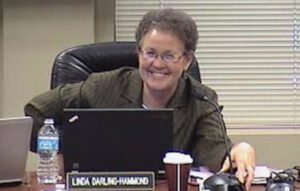
Source: California Commission on Teacher Credentialing webcast Linda Darling-Hammond shares a light moment during a meeting of the California Commission on Teacher Credentialing.

Sep 2, 2015  ::  A prominent scholar from Stanford University will direct a new education institute in Palo Alto whose mission is to influence K-12 policies in both California and the nation.

Linda Darling-Hammond, an emeritus professor at the Stanford University Graduate School of Education, is the president and CEO of the Learning Policy Institute, which formally announced its opening Wednesday. Along with headquarters in the San Francisco Bay Area, the institute has an office in Washington, D.C., an initial budget of $5 million and a staff of 30 that may grow to 50 within a year.

The new position will take most of Darling-Hammond’s time, although she will continue to teach occasionally as an emeritus professor at Stanford and to serve as chair of the California Commission on Teacher Credentialing. Patrick Shields, who managed research at SRI Education for two decades with a focus on California’s teaching force, will be the new institute’s executive director.

The San Francisco-based Sandler Foundation is the lead funder with the Atlantic Philanthropies, the S.D. Bechtel, Jr. Foundation, the Ford Foundation, the William and Flora Hewlett Foundation and the Stuart Foundation also providing initial support for the institute.

The institute has opened during a critical period for education policy nationwide and in California. Along with implementing the Common Core State Standards, California is transitioning to a new school accountability system and a financing system that targets substantially more money to high-needs students and shifts control over spending from the state to local school districts.

In Washington, Republicans and Democrats are struggling with aspects of the rewrite of the No Child Left Behind law. But their overall compromise would return more authority over education policy and accountability to the states. That will make it all the more important, Darling-Hammond said, for communities “to know what works and act based on that knowledge. States and the federal government need to be in the knowledge-sharing business,” and the institute will be a forum and conduit for that information, she said.

Independent and nonpartisan, the Learning Policy Institute will differ from most research institutions, Darling-Hammond said, in that it will combine original and existing research to focus on “pressing policy questions” and then will translate the findings so that federal, state and local policymakers and practitioners can adopt the recommendations and bring them to scale. A large focus of  the institute’s work will be on California, she said.

She said the institute’s policy agenda will include:

  • Examining effective designs for new schools with structures, curriculum and types of learning that young people will need to thrive in a “radically different, knowledge-based world economy.”
  • Sharing early education programs with strong outcomes so that they can be brought to scale. There is an emerging bipartisan recognition nationally of the importance of early education, she said.
  • Making recommendations and sharing research on how to attract, train and effectively retain the next generation of teachers; California and other states are already experiencing a diminishing supply of prospective teachers.
  • Helping to shape an “equity agenda” that draws attention to the United States’ high rates of child poverty and homelessness and unequal school funding and staffing, compared with other industrialized nations.

The timing may be right for a new institute focusing on these issues and for Darling-Hammond. An early education adviser to President Obama, who considered naming her secretary of education, she has been a critic of the standardized test-based school sanctions and federally prescribed options for turning around low-performing schools under the No Child Left Behind law. She also has criticized the federal government’s pressure for states to use standardized test scores to evaluate teachers.

As California, under Gov. Jerry Brown, rejected federal initiatives like the Race to the Top funding competition and went its own way, education leaders have turned to Darling-Hammond. Brown appointed her to the Commission on Teacher Credentialing, where she and the commission have been rewriting requirements for training and credentialing teachers and principals. Superintendent of Public Instruction Tom Torlakson asked her to co-lead the task force that produced his Blueprint for Great Schools in 2011. The State Board of Education has turned to her for advice on creating a new school accountability system based on a collaborative process of improvement and a dashboard of measures of student and school performance. She gave a lengthy presentation of her ideas at the board’s May meeting.

While an advocate for many of these policies and viewed as an ally of the nation’s teachers unions, Darling-Hammond said that the institute is committed to evidence-based, high-quality research that “addresses the complex realities facing public schools and their communities.”

An author of 20 books and 500 publications, she has frequently testified before Congress and was an advisor to the Smarter Balanced Assessment Consortium, which has produced the standardized tests for the Common Core State Standards for California and other member states. While not involved in the creation and adoption of the Common Core – she has criticized its timeline for implementation – she has championed the standards’ goals of deeper learning and problem solving.

Along with researchers, the institute will employ educators, policy experts and communicators who will hold briefings, seminars and debates and do extensive communications outreach and networking, the institute said in a press release.

But David Plank, executive director of Policy Analysis for California Education, or PACE, a research center, said the institute’s “biggest asset will be Linda.”

“All of us say we want our research to influence policy,” he said. “Linda is uniquely engaged at the highest levels of California and Washington, with a direct line to those making policy decisions so she is in a unique position to make research matter.”

Susan Sandler, a trustee of the Sandler Foundation, will chair the board of directors. Other members are Henry Louis Gates, Jr., director of the W. E. B. Du Bois Institute for African and African American Research at Harvard University; Kris Gutiérrez, professor of Language, Literacy and Culture at UC Berkeley and former president of the American Education Research Association; David Lyon, founding president emeritus of the Public Policy Institute of California; David Rattray, executive vice president of the Los Angeles Chamber of Commerce; and Stephan Turnipseed, chairman of the Partnership for 21st Century Skills.


____________________

image image image image

Because test scores are the most important things in the whole world: AP+SAT SCORES ARE DOWN NATIONWIDE …BUT CALIFORNIA IS HOLDING ITS OWN!

Black and Latino students in California score better on AP tests than peers elsewhere

By Sonali Kohli, LA Times | http://lat.ms/1L7LF98

California SAT scores show 41% of test-takers are ready for college


By Joy Resmovits , LA Times | http://lat.ms/1ECFZqK

Dulce Penuelas

Dulce Penuelas, 17, raises her hand during leadership class at Bell High School, in Bell, Calif. Latino and black students who passed their Advanced Placement tests outperformed their peers, new exam scores show. (Allen J. Schaben / Los Angeles Times)

3 September 2015  ::  Black and Latino students in California who passed Advanced Placement exams outperformed their peers elsewhere, but a gap persists between them and their white and Asian counterparts, according to new test score results.

In addition, the number of underrepresented minorities — black, Latino and Native American students — who took the tests is higher in California than elsewhere: 38.9% of test takers in the state compared with 26.2% of all test takers, according to 2015 results from the College Board.

The AP program allows high school students to take high-level classes for college credit. It also provides a boost for college admission and can help students more quickly place in advanced classes in college.

Black students in California performed significantly better than their counterparts outside the state: Nearly 43% in California had a passing score of 3 or higher out of 5 on at least one exam, compared with 32.3% elsewhere. California Latinos also did better: 53.1% received a 3 or higher on at least one test, compared with 50% elsewhere.

White students in the state also outperformed their peers elsewhere: 73% had a score of 3 or higher on a test, compared with 66% outside the state.

About 71.5% of Asians in the state scored a 3 or higher on a test, compared with 72.2% elsewhere.

The number of students, particularly minorities, taking AP classes and tests is growing, both in California and the country. Districts are removing stringent entrance requirements such as grades, admission tests and teacher recommendations that disproportionately keep students of color out of these classes.

In L.A. Unified, pass rates have decreased from 41.5% in 2008 to 38.7% this year. (Unlike the College Board, the district considers all the tests taken rather than the number of students who passed at least one test. Many students take more than one exam.)

But more students are taking the tests, district data show.

Equity is not just about opening the door to the classroom. But thinking about, 'What do we need to do to offer them the support they need once they get there?' - Nicole Mirra, the University of Texas at El Paso

Making these classes available to more minority students is a positive move despite the fact that scores may decrease when that happens, said Nicole Mirra, an assistant professor in English education at the University of Texas at El Paso who has studied disparities among California high schools.

Whether or not they pass the test, the students are exposed to higher academic standards and classrooms in which college is considered a viable option for them, she said.

To ensure that these students succeed, however, districts should start preparing low-income students and students of color for AP classes as early as elementary school and continue that support in AP classrooms, Mirra said.

“Equity is not just about opening the door to the classroom,” she said. “But thinking about ‘What do we need to do to offer them the support they need once they get there?'”

The racial makeup of AP classes in L.A. Unified has changed from 60% Latino in 2007-2008, to 68% in 2014-2015, while the white and Asian populations have decreased. Black students continue to represent only 7% of AP students, even though they are 10% of the student population.

In L.A. Unified, the pass rate was lower for black and Latino students: 21.7% and 33.5%, respectively.

It's difficult to explain the discrepancies without more data, said Patricia Gandara, an education professor and co-director of the Civil Rights Project at UCLA.

Gandara said she would like to see data that show the income levels of the racial groups taking the tests; the College Board said that information will be available next month.

“We have tremendous wealth and we have tremendous poverty” in California, Gandara said.

Students from higher-income black and Latino families could account for the better results because the number of those students taking AP classes remains relatively low. Additionally, Gandara said, they may have the parental support to encourage them to enroll in AP classes.

L.A. Unified's performance might rely on a number of factors, Gandara said. The district has a much higher poor population than the state: three-fourths of L.A. Unified students are on free or reduced-price lunch, a poverty indicator, compared with 59% in the
state.

Additionally, the L.A. Unified numbers don't include results from independent charter high schools, which had nearly 43,000 students last year and are growing. Those independently run campuses have been shown to take better-performing students from low-income and minority communities, Gandara said, adding that that trend could skew the district's results downward.

SAT scores

Adam Greene participates in an SAT preparation class taught by Justine Borer, right, in Westwood in 2006.(Mel Melcon / Los Angeles Times)

3 September 2105  ::  California students continued to perform at about the same level as their peers across the country on the SAT college entrance exam, according to newly released scores.

In California, 241,553 students — 60.4% from the graduating class of 2015 — took the test, and, on average, they scored 1,492 out of 2,400 points. Nationally, the nearly 1.7 million test takers scored an average of 1,490.

California's average score is about 28 points down from 1,520 in 2006. The newer scores reflect what College Board President David Coleman called a "larger and more diverse group of students than ever before."

The overall decrease in average scores shows that more students are getting the chance to apply for college, but according to Christina Theokas, director of research at the Education Trust advocacy group, that's not enough.

"The focus on opportunity is great, but we need to shift the focus to mastery," she said. "If we want to create opportunity for all students, we need to make sure all students are actually prepared for the test."

The College Board, the private nonprofit company that owns the SAT, asserts that scoring a 1,550 or higher means that a student is ready for college. Across the country, nearly 42% of students met that benchmark, compared with 41% in California.

"We know we absolutely must do better in the future," said Cynthia Schmeiser, the College Board's chief of assessment.

SAT results over time

The chart compares the California average SAT score to the national average out of a maximum score of 2,400.(Los Angeles Times)

As seen on other exams, the scores reflect achievement gaps between various ethnic groups: 20.2% of Latino test takers and 21.4% of African Americans in the state reached the readiness target, compared with 41% of students statewide. The College Board did not break down that statistic for Asian or white students.

The 1,550 benchmark represents a 65% likelihood of getting a B- or higher during the first year at a four-year college, according to the College Board.

The SAT tests students on critical reading, math and writing. Each section has a maximum score of 800 points.

The newly released scores reflect the last complete set of results from the current version of the SAT. Beginning in March 2016, the test will reflect a major overhaul.

Although the College Board has not said so explicitly, its description of the new exam — more critical thinking, less rote memorization — mirrors that of the Common Core State Standards, a set of learning goals that Coleman helped create. While the next round of results will reflect many students who took the current exam, 2015 was the last year in which students could only take the current version.

The new SAT will focus more on testing the mastery of academic words rather than the obscure vocabulary for which the test had become notorious. There will be no penalties for wrong answers, and the essay section will be optional — though some California colleges, such as University of California schools, are expected to continue to require it for admission.

“SERIOUS PROBLEMS PERSIST…?” or “STEADY PROGRESS…?”: Just what does the latest report on LAUSD’s Instructional Technology Initiative (a/k/a ‘iPads for All’) say?

New report finds ongoing iPad and technology problems at L.A. Unified

By Howard Blume , LA Times | http://lat.ms/1LXJUkI

LA Unified moving slowly toward goals of technology in the classroom

Posted on LA School Report by Mike Szymanski | http://bit.ly/1JEk2q9

2435760_ME_0813_School_Open_IK

Valley Academy of Arts and Sciences students, from left, Jordann Ventura, 14, Karyna Mills, 15, Guillermo Romero, 15, and Dayanara Trujillo, 15, receive iPads before the start of the school year.  (Irfan Khan / Los Angeles Times)

3 September 2015  ::  Had things gone according to plan, every public school student in Los Angeles would be working on his or her own iPad by now and textbooks would be largely a thing of the past.

What ensued instead was a costly debacle, and, in its wake, a fledgling, problematic recovery, described in a new report released Wednesday.

The analysis shows that serious challenges have persisted with technology in the L.A. Unified School District, including limited classroom use of iPads and other computers, inadequate support for teachers and partial or inconsistent access to the Internet.

The researchers also found limited use of online curriculum provided by Pearson, for which the district purchased a three-year license, at the added cost of about $200 per device.

The results were sobering but not altogether surprising. District officials have acknowledged difficulties with technology. The school system abandoned a $1.3-billion effort to provide an iPad to every student, teacher and campus administrator as too expensive and unsustainable. And Supt. Ramon C. Cortines has characterized the district as lacking an instructional plan for the use of technology.

Cortines took over last October, after former Supt. John Deasy resigned under pressure. The iPad effort had been a signature initiative of Deasy’s, but he, too, had accepted a scaled-back program by the time he left.

On Wednesday, officials said measures to respond to the latest findings were well underway. That’s also what they said last year after the same researchers raised similar issues in their initial report.

But the district also offered evidence of progress. For example, the report, based on a review completed several months ago, estimated that 40% of elementary schools, more than 200, still lacked adequate wireless Internet service.

As of this week, the number of schools with substandard Wi-Fi stood at 19, said Bill Wherritt, a deputy facilities director. Work on those should be completed by early next year, he added.

The review was conducted by Washington, D.C.-based American Institutes for Research, which the school system hired at a cost of $340,000 to conduct the evaluation.

Although there have been steps forward, “the district has not yet arrived at a solution for several organizational and technical challenges,” the researchers concluded. “Ongoing challenges and areas where less progress occurred included: deploying devices in a timely manner, communicating with schools, coordinating efforts with other instructional initiatives and clarifying a vision for technology use in instruction.”

On the plus side, the district has developed a procedure to make sure schools are ready to make good use of computers. But so far, only one school, Valley Academy of Arts and Sciences in Granada Hills, has satisfied this requirement and distributed iPads. Five others are close, about a week away, said Sophia Mendoza, interim director for instructional technology.

Last year, some schools were not able to hand out devices until February.

The district also has developed more training for schools and provided more technical support.

Initially, all schools were supposed to send the iPads home, but that ended after students quickly figured out how to delete security filters intended to limit Internet browsing.

The Internet filter is stronger now, and teachers have used “digital citizenship” units to encourage responsible computer use; 26 schools sent iPads home with students last year and reported no major problems.

The district has enough computers for every student at about 100 schools, in a district with about 1,000 campuses.

Under the initial plan, all teachers were expected to shift to Pearson online curriculum. Instead, the district has demanded a refund for the curriculum from Apple, for whom Pearson was a subcontractor.

Few teachers took advantage of the Pearson materials, according to the report.

The Pearson content was used mostly for elementary math instruction; those teachers already were familiar with Pearson math textbooks at those grade levels. The researchers found no use of the curriculum in a sample of middle and high school classrooms.

This year, the district bought new math textbooks, using publishers other than Pearson. All the new texts include an online version.

Pearson has consistently defended the quality of its materials, noting that other districts have continued to use both traditional and online products.

The awarding of the Apple/Pearson contract became the subject of an ongoing FBI investigation last year. Current and former district officials have denied any wrongdoing.

The district has not set aside money for any further independent review.

students use ipads

3 September 2015  ::  This morning, 350 students at Valley Academy of Arts and Sciences in Granada Hills are getting computer devices. The rest of the school’s 800 students already have theirs.

And, by next week five schools will receive iPads, laptops and Chromebooks. Another 30 schools are in line for their devices, 19,000 of them, said Sophia Mendoza, the interim director of the Instructional Technology Initiative at LAUSD.

This is all part of the steady progress that the district is making in expanding the use of technology in the classrooms in the aftermath of a botched $1.3 billion iPad program that effectively delayed the accelerated use of technology in classrooms by more than a year.

A report released yesterday by the American Institutes of Research revealed how a litany of problems with hardware, software, distribution, internet connectivity and training denied district students devices and the new approach to learning that district officials had promised. The effort was so plagued by challenges that one of the first things Ramon Cortines did when he replaced John Deasy as superintendent a year ago was rebrand the “Common Core Technology Project” to call it the “Instructional Technology Initiative.”

Change — and improvements – are coming. But slowly.

Cortines said in a statement that the 181-page report “points out areas of needed improvement that I have been aware of since my return to the district last October. Many of the recommendations in the report have already been addressed or are being addressed. We have improved the deployment at the school sites.”

For example, most of the 70,000 tech devices have been delivered to the “one-to-one” schools designated for a device for every student by the time school started in mid-August. By the middle of this month they should all be distributed. That’s quite a bit faster than the months-long process it took to hand out 47,000 devices in the entire 2014-2015 school year.

At a press briefing on Wednesday afternoon with new and longtime leaders in the the district’s technology departments, administrators described some of the progress, as well as the remaining issues facing the district in completing the project. So far, 101 schools are participating in the program to get an iPad, Chromebook or laptop to every student and teacher on campus, and allow them to take the devices home.

The students and teachers are going through a rigorous training (which was previously recommended by the report) to teach them to become responsible “digital citizens.”

“We are showing the students how to take pride and responsibility over the use of these devices, so no, they won’t be using them as Frisbees,” said Bill Wherritt, a Facilities Division official who is overseeing the device deployment to the schools.

Mendoza said that schools next month will have a Citizen Action Week which “is a big kickoff for students, teachers and staff to train them in the behaviors we want to continue to instill in our students, not just for one week, but for the entire year.”

Before a school can get these devices, they have to have a strategic plan showing how the computers will be used for instruction, how parents will be involved and have a person assigned to track the devices and oversee training.

Mendoza and Linda Del Cueto, chief of Professional Learning and Leadership Development, were among the tech executives who attended a principal’s meeting yesterday to explain some of the procedures. Principals were surprised that the process could be so quick.

“We are improving and expanding to not just a one-to-one device school but expanding technology district wide,” Del Cueto said. “We are very deliberately making connections with local district staffs, speaking at principal meetings and making everyone aware of what we are doing.”

In the two years since the tech program has begun, 150,000 devices have been bought by the district, and schools have purchased another 85,000 outside of the program through local fundraising, grants and donations.

“Technology is growing very, very quickly right now,” Wherritt said. “When we see teachers clamoring for technology in the classroom, and volunteering for training, we realize just how important this is. Our goal now is to build on our investment and do the best we can for our students.”

At the moment, they have to get WiFi for all the schools. Some Internet connections are spotty, if at all. The school board approved high-speed wireless networks for every school district wide, and the report showed challenges remain. As one example, the report found that 40 percent of the elementary schools did not meet the district’s bandwith specifications, and many schools had trouble getting online.

Wherritt said that only 19 schools still have internet issues, and “those remaining schools are scheduled to be finished between now and the first quarter of the next calendar year.”

Meanwhile, there’s no prediction about when and whether every child in LAUSD will have a device, as previously envisioned. That decision, and that plan, will come from the Instructional Technology Initiative Task Force formed in April. Their first meeting is scheduled for Sept. 10.

Cortines said, “As I have stated before, we remain committed to the use of classroom technology by our teachers and students.”

AIR

Evaluation of LAUSD’s InstructionalTechnology Initiative: Year 2 Report
Executive Summary July 2015

Wednesday, September 02, 2015

JUDY BURTON STEPS DOWN AS CHAIR OF LAUSD TECHNOLOGY INITIATIVE TASK FORCE + smf’s 2¢

Posted on LA School Report  by Craig Clough | http://bit.ly/1KHW67t

Judy Burton

Judy Burton

September 1, 2015 12:45 pm  ::  LA Unified has announced that Judy Burton has stepped down as chair of the Instructional Technology Initiative Taskforce, which is guiding the district’s tech objectives in the wake of the cancelled iPad program.

Burton resigned as CEO and president of Alliance College-Ready Public Schools in January, the same month she was named to head up the new taskforce, but her chairmanship was on a volunteer basis and she stepped down for personal reasons, the district said.

Burton, who could not be reached for comment, will be replaced by as chair by Frances Marie Gipson, who also serves as superintendent for LA Unified’s Local District East.

“I want to thank Dr. Burton for giving her time to propel this incredibly important work forward,” Superintendent Ramon Cortines said in a statement. “She is truly an outstanding individual who does so much for the students of Los Angeles and surrounding areas. I am pleased she will be passing the torch to Dr. Gipson, who is experienced as a teacher, a scholar, and, most importantly, a leader.”

The district’s $1.3 billion Common Core Technology Project had the ambitious agenda of getting a computer tablet in the hand of every student and teacher in the district. But the project stumbled at nearly level as it experienced a problematic rollout, ineffective Pearson educational software and increased scrutiny of the bidding process.

After the FBI seized files in December related to the bidding process as part of a federal grand jury investigation, Cortines canceled the Common Core Technology Project. In January, he announced the project was being rebranded and redirected under the Instructional Technology Initiative. Cortines also announced that a 1-to-1 tablet project was no longer the goal, and the taskforce was asked to provide recommendations for a three-year strategic plan for the tech/computer programs, which will be presented to the school board in December.

The taskforce is meeting for the first time in the current school year on Sept. 10 under Cortines before he turns it over to Gipson.


  • 2cents_thumb Judy Burton is one of the best instructional leaders I have ever met and should be on everyone’s office-pool bracket for the job of next LAUSD Superintendent.
  • That said, while she was CEO and President of Alliance College-Ready, Alliance signed onto the Apple-Pearson i-Pad  deal at the same terms after LAUSD did – probably disqualifying her for the gig as chair of the Instructional Technology Initiative Taskforce.

FIRM SELECTED TO SEARCH FOR L.A. UNIFIED’S NEXT SUPERINTENDENT

This firm will search for L.A. Unified's new superintendent

By Howard Blume, LA Times | http://lat.ms/1NNjBhd

Ramon Cortines

L.A. Unified is looking for a candidate to replace Supt. Ramon C. Cortines, left. (Irfan Khan / Los Angeles Times)


2 Sept 2015  ::  e search for a new Los Angeles school district chief moved into the open Tuesday, but it's not clear how long the effort will remain public.

The Board of Education selected an executive search firm that emphasized the need to keep the applicants secret until the choice is made.

"The more confidential a search, the better the candidates," said William Attea of Hazard, Young, Attea & Associates, based in Rosemont, Ill.

Any activity that potentially exposes candidates would affect who is willing to apply, Attea said. That's because individuals could damage their status in their current positions if they sought the L.A. Unified post and didn't get the job.

"We want a transparent search, except for identity of candidates," Attea said.

Hazard got the job after a presentation to the board that also emphasized its national reach and the need for members to be as clear as possible in deciding what they wanted. The firm also presented a well-known local face to the board as a key advisor, veteran administrator Darline Robles, former superintendent of the Los Angeles County Office of Education.

School board President Steve Zimmer has said the board needed to select a search firm no later than Sept. 15, but officials clearly were ready to act 10 hours into a day of private and public meetings.

The board has set aside $250,000 plus expenses for the contract.

Hiring a schools chief is one of the most important duties of an elected board of education. The next schools chief will provide direction for the nation's second-largest school system — one beset by declining enrollment, financial hurdles, disappointing student achievement and broad public skepticism.

"This is singularly the most important search that is happening in our nation," Zimmer said. "I would argue to you that this is the single most important job in public education in America."

Board members made their choice two days after selecting two firms to interview, following a lengthy and unusual Sunday meeting, most of it in private.

The board is under pressure to find a successor to Supt. Ramon C. Cortines. His contract runs through June 2016, but Cortines, 83, said he would prefer to leave by the end of the year. He came out of retirement to take the top job in October after John Deasy resigned under pressure.

On Tuesday, board members heard presentations and asked questions of two search firms, Hazard and Leadership Associates, based in La Quinta: Both firms had at least 45 minutes in open session with the board.

In brief deliberations, the strongest opinion was offered by Richard Vladovic on behalf of Leadership Associates. He said his endorsement was partly based on working with the firm when, earlier in his career, he was chosen as superintendent of West Covina Unified.

Vladovic also criticized Hazard's handling of the superintendent search in Boston, which became a protracted process. The effort ended with the selection of senior Los Angeles district administrator Tommy Chang. Vladovic said he was not faulting the choice of Chang but rather the public and political maneuvering involved.

Board member George McKenna said that the problems in Boston probably had more to do with how city officials managed the selection. He said he believed either company was capable.

Board members made a point to praise the presentations of both firms before settling on Hazard with little elaboration.

Even Vladovic ultimately voted for Hazard in the interest of making the choice unanimous. Five firms has applied to conduct the search.

Attea said his push for secrecy was not meant to exclude public input. He said there could be numerous public forums and surveys, with a large role for an appointed committee that represents the community. Such a committee could even help screen candidates, but at a potential risk to confidentiality, he said.

Tuesday, September 01, 2015

TWO FIRMS MEETING LAUSD BOARD TODAY TO START SUPERINTENDENT SEARCH

Posted on LA School Report by Mike Szymanski | http://bit.ly/1Vu8T0w

superintendent searchSeptember 1, 2015 8:55 am  ::  The interview process starts today at the LA Unified school board meeting, with plans to hear from representatives of two headhunter firms in the search for the district’s next superintendent.

Hazard, Young, Attea & Associates of Rosemont, Ill. and Leadership Associates of La Quinta, Calif. were picked from among five bidders by the board on Sunday. They were also the two firms with the highest price tag: Hazatrd Young cited a cost of $160,000, followed by Leadership, at $157,500 — up to $30,000 of that is for expenses. The lowest bid was Ray and Associates, Inc. of Cedar Rapids, Iowa at $63,350.

Two of the school board members voted against asking Leadership to present before the board, and one abstained. When contacted by LA School Report today, Leadership Executive Team member Jim Brown said that he plans to arrive from Santa Fe, N.M. to make his pitch to the board at 4 p.m.

Brown said he felt the firm answered all the questions that were asked in the initial Request for Proposal letter by the board.

“We do have a game plan, and we are happy to answer any of the board members’ concerns,” he said. “We did not want to inundate the board with papers, but we will meet with the board to develop a process for the search.”

One concern raised by board member Mónica Ratliff, who voted against inviting Leadership (along with Ref Rodriguez), was that it had ties to the Bill and Melinda Gates Foundation. Brown said no one is or has been directly working with the Gates Foundation, but that a group funded by the foundation hired the firm to consult.

WestEd, an education consulting, research and training group, asked Leadership to do a search last year. WestEd is funded by the Gates Foundation.

“It is a legitimate question, and we will be happy to explain it in more detail to the board,” Brown said.

Both search firms are considered smaller boutique companies with about a dozen employees each, compared with the “largest and oldest” firm of its kind, Ray & Associates, which has 170 associates and has operated since 1975.

Hazard, Young, which opened in 1987, said in its proposal the total search and appointment time would take 12 to 16 weeks, which would be within the time when Superintendent Ramon Cortines said he wants to step down. The company would offer a warranty, meaning there is no further fee if the candidate leaves within a year, or for as long as the board remains the same.

Leadership Associates, which opened in 1996, said it would complete the task by February, and the 12 partners (many who have been school superintendents themselves) would be involved in every step of the process.

Hazard, Young helped recruit leaders for more than 1,000 school districts, including Boston Public Schools, which hired as its new superintendent Tommy Chang, a former LAUSD deputy superintendent. The firm also helped find superintendents in Virginia Beach City, Baltimore, Baldwin Park and Fairfax County, Texas. The firm says 90 percent of the 328 superintendents it helped hire since 2000 are still in their positions or committed four or more years.

Leadership Associates was involved with getting LAUSD’s Chief Strategy Officer Matt Hill hired by Burbank as superintendent. He was heavily involved in the problem-plagued MiSiS system at LAUSD. The company also conducted searches in Pittsburgh, Oakland and many in Southern California with 95 percent remaining in their positions for more than five years.

“I’ll bet you $5 dollars that they helped pick most of the school superintendents in Southern California,” board member Richard Vladovic said at the Sunday board meeting. According to Brown, Vladovic would win that bet. “That would be correct,” he confirmed.

The Hazard Young team will be lead by Hank Gmitro, the company’s president, and William Attea, an expert in superintendent searches. The national search team would include Rudy Castuita, former San Diego superintendent; Carol Johnson, retired Boston superintendent, and others while a California-specific team would consist of Joseph M. Farley and Darline Robles, who were superintendents of large California districts, Anaheim and Montebello, respectively.

Leadership Associates has a strategy that includes online surveys, public input and interviews that would be a part of during the process. The team includes Kent L. Bechler, who served as superintendent of the Corona-Norco Unified School District and attended two LAUSD schools; Marc Ecker, former superintendent of the Fountain Valley; Michael Escalante, past superintendent from Glendale; Richard Fischer who is past superintendent of Mountain View Los Altos Union High School District, Lake Tahoe Unified School District and the Harmony Union School Districts and others.