Wednesday, December 05, 2012

2 stories: NEW LITIGATION FILED RELATED TO ALLEGED LEWD CONDUCT AT MIRAMONTE

-- Howard Blume, LA Times/L.A. NOW | http://lat.ms/11TwR9M

December 5, 2012 |  6:00 am  ::  Attorneys filed four more lawsuits this week in connection with lewd-conduct charges against a former teacher at Miramonte Elementary School.

The litigation, filed Monday by the firm Manly & Stewart, accuses the Los Angeles Unified School District of negligence, fraud, sexual harassment, gender violence and infliction of emotional distress for failing to protect students from veteran instructor Mark Berndt.

Berndt, 61, taught one of the students for two years and supervised the others after school, according to the lawsuits. In these cases and others, he’s accused of spoon-feeding his semen to blind-folded children as part of what he allegedly called a tasting game. He’s also accused of putting cockroaches on children's faces and feeding them semen-tainted cookies.

Authorities began investigating Berndt after a drugstore clerk gave police bizarre photos of students taking part in these acts.

Attorney John Manly said Tuesday that he sued on behalf of four students because “over 100 children allege they were victimized by this man, and there’s no credible explanation of how this happened."

"The only people who have investigated the school district is the school district,” he added.

Manly accused L.A. Unified of trying to withhold information that is embarrassing or that could increase its liability. The attorney scheduled a Wednesday morning news conference to discuss the litigation.

District officials have defended their response. They said they have provided counseling and help for affected families, cooperated fully with law enforcement and acted quickly and comprehensively to address shortcomings in their response to allegations. The district also replaced the entire staff of the school, located in Florence-Firestone, for the second half of the 2011-12 school year.

Berndt was arrested in January but removed from the school a year earlier.

Last week, officials said that 126 students and 63 parents have filed Miramonte-related claims for damages against L.A. Unified. There also are two other lawsuits on behalf of 33 students and one on behalf of 11 parents.

Berndt faces 23 counts of lewd conduct and is being held in lieu of $23-million bail. He has pleaded not guilty.


4 more Miramonte school students file lawsuits in child abuse case

Vanessa Romo | KPCC 89.3/Pass-Fail | http://bit.ly/TJFC1d

Miramonte Elementary School in Los Angel

Krista Kennell/AFP/Getty Images Miramonte Elementary School in Los Angeles, California February 6, 2012.

December 5th, 2012, 8:25am ::  The list of plaintiffs in the case over alleged child abuse by teachers at Miramonte Elementary School is getting a little longer. Attorneys representing four students who say a teacher performed lewd and lascivious acts against them announced they filed a lawsuit against L.A. Unified.

The four children are all under 11-years-old and are former students of veteran Miramonte teacher Mark Berndt. He is accused of feeding some of his students cookies laced with his own body fluids and then taking pictures of it.

In addition to damages, attorney John Manly – of the law firm Manly and Stewart – is demanding that L.A. Unified release all reports of abuse by teachers throughout the district.

Without those documents there’s no way to “understand where the failure happened and who’s responsible,” Manly said. “Because if you just pay money and you don’t fix that, other kids are going to get hurt."

The lawsuits were filed in the wake of a report issued last week by the California State Auditor, which concluded that LAUSD failed to properly report at least 144 cases of teacher misconduct to state authorities.

The law firm of Manly and Stewart specializes in litigating sexual abuse civil cases. And Manly’s work was featured in the 2006 documentary “Deliver Us from Evil,” about the prosecution of Oliver O’Grady, a Roman Catholic priest, convicted of child molestation.

David Holmquist serves as general counsel for the school district. He issued a statement in response to the lawsuit:

“Although the school district has yet to receive this latest complaint, we are continuing to pursue an early resolution process with everyone impacted. Our sincerest hope is that through this process we can avoid the potential pain of lengthy litigation while promoting healing and improving trust with the community. We welcome the opportunity to work with Senator Escutia and Mr. Manly through this early resolution process.”

The 61-year-old Berndt taught at L.A. Unified’s Miramonte Elementary for more than 30 years. He was arrested in February after a yearlong investigation that was triggered when a photo lab worker told authorities about pictures Berndt brought in for processing: photos of kids with cockroaches on their faces, eating cookies topped with a white substance, sometimes bound and blindfolded. Berndt is charged with 23 counts of lewd acts against children.

Another Miramonte teacher, Martin Bernard Springer, recently pleaded not guilty to three felony counts of fondling a student.

Manly says his firm represents another 22 alleged victims and will be filing civil lawsuits on their behalf in the near future.

About 100 other students say they have been victims of some type of abuse at Miramonte and are in talks with the district to reach a settlement.

LAUSD BOARD OKs DEAL WITH UTLA ON PERFORMANCE EVALUATIONS

By Barbara Jones, Staff Writer, LA Daily News | http://bit.ly/UnW5J2

12/04/2012 11:48:15 AM PST/Updated:   12/04/2012 07:09:00 PM PST  ::  The LAUSD school board signed off Tuesday on a deal with the teachers union to implement a new system that will incorporate student test data in performance evaluations.

The board voted 5-0 in executive session to approve the agreement reached last Thursday with leaders of United Teachers Los Angeles. Board members Tamar Galatzan and Marguerite Poindexter Lamottee missed the meeting, which had been scheduled only the day before.

  • ONLINE: To view the LAUSD evaluation response in the Stull Act lawsuit, click here.

UTLA members have yet to ratify the deal. Union officials say they plan to hold the vote in January.

Associated Administrators of Los Angeles, which represents principals and their assistants, approved a deal in September.

With the board's endorsement, Los Angeles Unified submitted the agreement to Superior Court Judge James Chalfant, who had set a Tuesday deadline for creating a new performance evaluation. Chalfant had ruled that the current job reviews for educators violate a state law that requires evaluations to factor in student performance.

Former Senator Gloria Romero: SHE HAS A LITTLE LIST

Billboards promote law that lets students leave low performing schools

Adolfo Guzman-Lopez | KPCC 89.3/Pass-Fail | http://bit.ly/YJ0R92

Photo courtesy of Ed Reform Now

December 3rd, 2012, 2:43pm  ::  The Open Enrollment Act became California law two years ago with the goal to give kids a way out of the worst schools in the state. The law compels the state to develop a list of the 1,000 worst public schools based on each one's Academic Performance Index. Parents must fill out applications by December 31 if they wish to leave their current school and enroll in any other higher-performing California public school.

The receiving district must accept the student unless that would lead to overcrowding, or would undermine school diversity. The student's family is responsible for transportation to the new school.

Billboards have sprouted recently across the Southland to promote the law. The non-profit Ed Reform Now raised the money to put them up. The author of the law, former state Senator Gloria Romero, is the group’s director.

“When I originally wrote the law, I had included the lowest three tiers. And it got pushed down to the bottom tier, the 10% as opposed to the 30%,” she said.

The goal of the law, she said, is to give parents a way out of a school that chronically underperforms. Romero contended that education and school district official aren’t doing enough to let parents know about her law.

The California Department of Education published the list of 1,000 lowest performing schools  last month.

State education officials said they don’t keep track of how many students have used the law to leave a low performing school because there’s not provision in the law for California to keep records of transfers, conduct audits, or evaluate its effectiveness.

They do admit there’s a significant flaw in the Open Enrollment Act that only the state legislature can fix. The list the state publishes is not a true list of the 1,000 lowest performing schools. State law caps how many schools one district can have on the list, and there’s a set number of elementary, middle, and high schools that can be on the list.

This formula means that about 100 schools on the list have scored near, at, or above 800 on the annual Academic Performance Index.  The California Department of Education considers that a mark of high performance.

Romero said she would not recommend parents use the Open Enrollment law to take their kids out of these schools even if the campus has made it onto the state’s lowest performing schools list.

SEN. PADILLA REINTRODUCES BILL MAKING IT EASIER TO FIRE TEACHERS FOR MISCONDUCT

By Barbara Jones, Staff Writer, LA Daily News | http://bit.ly/YJHD3b

11/30/2012  ::  State Sen. Alex Padilla, D-Pacoima, plans to reintroduce legislation Monday that would make it easier for school districts to fire teachers for misconduct.

The bill is expected to be similar to Senate Bill 1530, which Padilla authored last session, that would have made a school board the final authority in dismissing teachers for violence, sex or drug offenses involving children. The bill was defeated in the Assembly Education Committee under heavy pressure from teachers unions.

Current state law allows teachers to appeal their dismissal to a three-member panel, in what has become a lengthy and expensive process.


It would be easier to fire California teachers for misconduct if State Senate bill succeeds on 2nd attempt

By Barbara Jones, Staff Writer, LA Daily News | http://bit.ly/THZbZN

12/03/2012 06:59:10 PM PST  ::  In the wake of a state audit that faults the lengthy dismissal process for abusive teachers, state Sen. Alex Padilla reintroduced a bill Monday that would make it easier to fire educators for serious misconduct.

Senate Bill 10 would give school boards the final say over firing teachers accused of sexual, drug and other serious offenses. The legislation was still being finalized late Monday, but it is expected to mirror SB 1530, a Padilla bill from the last session that died in the Assembly Education Committee amid fierce lobbying by the state teachers union.

Padilla, D-Pacoima, said he hopes to reach a consensus this time with the California Teachers Association and get SB 10 passed and signed into law.

"My goal is now, and has always been, to ensure essential due-process rights while allowing for timely resolution of cases that involve sex abuse, violence or drug offenses involving children," he said in a statement.

Edgar Zazueta, Los Angeles Unified's lobbyist, said the new makeup of the Legislature - 39 new lawmakers were sworn in on Monday - has provided a "renewed sense of optimism" for supporters of the Padilla bill.

Padilla first tackled the issue of teacher dismissals following the sex-abuse scandal at Los Angeles Unified's Miramonte Elementary School.

Teacher Mark Berndt received a $40,000 settlement to drop the appeal of his firing after he was accused of molesting 23 of his students. The Berndt case was among several cited in a state audit released last week, which said that California's long and costly dismissal process makes it more likely that districts will pay a problem teacher to retire.

Auditors reviewed 61 settlements with LAUSD teachers - including 47 involving misconduct with a student - and found that more than $2 million in payouts had been made.

Currently, educators fired by their school board can appeal to a three-member board composed of two teachers and an administrative law judge - a process that can take years and cost hundreds of thousands of dollars.

Padilla wants the school board to have the final say on dismissals of teachers accused of misconduct.

The CTA did not return a call for comment on Monday.

But in an "action alert" posted in opposition to SB 1530, the union said the proposed legislation would undermine an educator's ability to get a fair hearing.

Padilla's effort again has the backing of the Los Angeles Unified school board, which previously recommended changes in the dismissal process and is reaffirming its support in a resolution being introduced today.

The resolution by board president Monica Garcia and vice president Tamar Galatzan also calls on Superintendent John Deasy to follow through on auditors' recommendations to improve the district's handling of problem teachers.

The audit found lengthy and unexplained delays in investigations and discipline, and lapses in notifying the state credentialing commission of nearly 150 cases of suspected misconduct.

"The resolution is a combination of the results of the audit and the reintroduction of the Padilla bill," said Galatzan, who represents the west San Fernando Valley. "Everyone knows that the processes we have for addressing allegations of teacher misconduct can be improved."

Officials said Monday that 299 teachers are now being "housed" at district offices after being accused of misconduct. Each case takes an average of six months to investigate and resolve, with teachers collecting an average of $6,000 a month in salary.

"We've got a labor-intensive, somewhat counterintuitive state process. Laid on top of that is the district process," Galatzan said. "We need to look at what can be streamlined, and where the bottlenecks are."

WHAT’S IN A NAME? Discord.

Celebrities? Historical figures? Neighborhoods? As L.A. Unified replaces temporary generic campus names with permanent monikers, the process has become political, controversial or just plain wacky.

By Stephen Ceasar, Los Angeles Times | http://lat.ms/TB0kQf

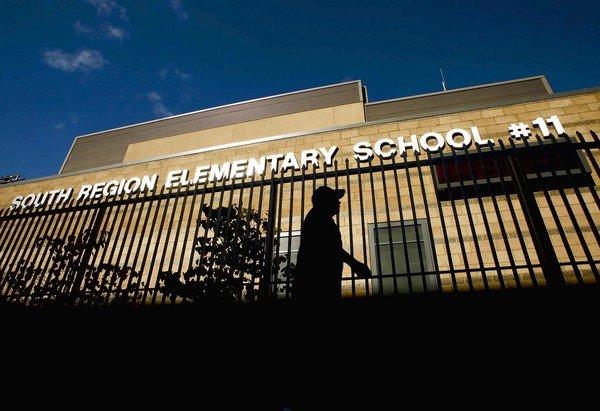
South Region Elementary School #11

South Region Elementary School #11, L.A. Unified's newest campus, recently opened. The principal said it would be re-named after a suitable moniker is decided upon. (Mark Boster / Los Angeles Times / December 5, 2012) [smf: Before I go off about  The Times ability to publish photos the day before they are taken – talk about beating the news cycle! – let me kvetch about how much money was spent on the sign with the “working title” of the school!]

December 4, 2012, 5:26 p.m.  ::  Carlos Santana. Johnnie Cochran. Al Gore. The parents of City Councilman Tony Cardenas. It's a diverse group with at least one thing in common: Los Angeles public schools bear their names.

The Los Angeles Unified School District's decade-long school building program is winding down after about 100 campuses have been named. As district officials replace such temporary generic names as South L.A. Area New High School No. 3 with permanent monikers, the process has become political, controversial or just plain wacky.

School names now run the gamut in the nation's second-largest district, which has more than 900 K-12 campuses. There's a Maurice Sendak Elementary, named after the author and illustrator of "Where the Wild Things Are." John A. Sutter Middle School is named after the Swiss gold-rush pioneer, and Quincy Jones Elementary for the music legend.

Some schools are named in a more traditional vein — for historical figures such as Robert F. Kennedy or local leaders such as former Supt. Roy Romer. But L.A. Unified officials have also taken the opportunity to pay tribute to district insiders, political allies and celebrities. Sometimes the decisions can cause dissension, as in the case of an arts high school named for former Supt. Ramon Cortines.

"It is both a blessing and curse to have all these opportunities to name schools," said school board member Bennett Kayser. "It's a blessing we are opening all these new schools, but it can be a curse because a naming can be divisive within and between communities."

For much of the district's 159-year history, there were simple guidelines for naming schools. Elementary campuses typically were named after the street where they were located or the surrounding neighborhood or city (First Street Elementary). Middle schools were named after prominent Californians (John Muir Middle School) and high schools after more well-known national figures or the neighborhood (Hollywood High).

More recent guidelines say board members should create a naming committee with representatives from the school, including teachers and parents. A ballot of suggested names should be voted on by the panel. The winning name should then be presented to the Board of Education for approval.

But the board has the authority to suspend those guidelines, and those with knowledge of the process say members can bypass those committees or guide the effort toward the name of their choice.

Last year, board member Nury Martinez dedicated an elementary school to Andres and Maria Cardenas — parents and "local heroes," as she called them, who lived in her San Fernando Valley district. "These were good, hardworking, honest people who raised 11 children to be educated, good citizens of their community," she said in a press release at the time.

The youngest of those children is Tony Cardenas, a Los Angeles city councilman recently elected to Congress — and Martinez's political ally. Martinez, who's not seeking reelection to the school board this spring, has been eyeing Cardenas' soon-to-be vacant seat — and she'd benefit from his support. Martinez did not respond to requests for comment.

Other schools have names that are unfamiliar to the general public . Mid-City's Prescott School of Enriched Sciences is named for the late Ronald Prescott, a former deputy superintendent of governmental relations and public affairs.

Perhaps indicative of the city's Democratic leanings, the last Republican president to have a school named for him — William Howard Taft — served when Ronald Reagan was an infant. Reagan and Richard Nixon, the two U.S. presidents most closely associated with California, do not have L.A. schools named after them. Bill Clinton and Barack Obama do.

In the 1990s, an effort to rename Mount Vernon Middle School in Mid-City after Old West lawman Wyatt Earp was shot down. The school was built on the site of the gunslinger's last residence.

Years later, shortly after the death of Johnnie Cochran Jr., district leaders moved to change Mount Vernon's name to honor the prominent attorney, who'd been a student there.

Cochran built his reputation through police abuse and civil rights cases; he gained international fame for helping win acquittal of O.J. Simpson on murder charges.

Relatives of Nicole Brown Simpson, the former football star's ex-wife, chafed at the idea. Her sister said at the time that naming a school for Cochran would be in "bad taste." But the campus and the street in front of it — now Johnnie Cochran Vista — did get renamed.

Former board member Yolie Flores succeeded in having five schools named after successful Latinas. Her staff had found that most campuses were named after men, and that women — especially Latinas — were underrepresented, she said. She asked parents, teachers and others for suggestions.

The schools include Sonia M. Sotomayor Learning Academies, for the U.S. Supreme Court justice; the Hilda L. Solis Learning Academy, for the U.S. secretary of Labor; and the Sandra Cisneros Learning Academy, for the author.

"I want students to be inspired by people who look just like them and had the same struggles growing up as they do," Flores said.

Historically, officials largely have steered clear of naming a school for someone still living because it leaves open the possibility that the person might do something to mar his or her reputation, embarrassing the district. The recent debate over the Ramon C. Cortines School of Visual and Performing Arts, named for the former superintendent, is an example.

A group of parents who had initially complained that they were left out of the naming process asked the school board to change the name of the downtown campus after it was revealed that L.A. Unified paid a settlement to an employee who had accused Cortines of sexual harassment.

Their efforts were to no avail. Board President Monica Garcia argued that Cortines had been a champion of the arts and had played a large role in opening the school. Instead, Garcia suggested offering students an unofficial diploma with both the school's current name and its former temporary name: Los Angeles Central High School No. 9.

The naming of a $75.5-million high school devoted to environmental sciences proved tricky. One suggestion — naming the Mid-City school after folk singer and environmentalist Pete Seeger — was scuttled by board member Marguerite Poindexter LaMotte. She said Seeger's past "affiliation with the Communist Party" made the choice inappropriate.

The campus was eventually named for two notable leaders in the field: the late author Rachel Carson, whose classic 1962 book "Silent Spring" is credited with sparking the modern environmental movement, and former Vice President Al Gore, who raised awareness about global warming with his film "An Inconvenient Truth."

Unfortunately, the Carson-Gore Academy of Environmental Sciences sat on a toxic site that required a $4-million cleanup before students could safely begin their studies.

The irony wasn't lost on the school board, but the name remained.

A NEW WAY TO RATE L.A. UNIFIED’S TEACHERS

An agreement on evaluations takes a broad-based approach, using student test scores but not relying too heavily on that one measure.

LA Times Editorial |  http://lat.ms/XqdzcA

Supt. Deasy

Los Angeles Unified School District Supt. John Deasy chats with students on the first day of classes at the Hilda L. Solis Learning Academy in East Los Angeles on Aug. 14. (Los Angeles Times)

December 5, 2012  ::  What kind of process for evaluating teachers can possibly be devised by a determinedly reform-minded administration, a stubborn union and plaintiffs in a hostile lawsuit? As it turns out, a better kind than they've had up to now.

A tentative agreement reached last week would for the first time allow the Los Angeles Unified School District to use students' standardized test scores to rate teacher effectiveness, something many other schools across the nation are already doing. But just as important is what it wouldn't do — rely too heavily on how well each teacher's students scored on the tests. Those scores can be particularly volatile from year to year, and although they can help identify the very best and worst teachers, they are poor at differentiating among the 80% in between.

Instead, the evaluations would use a mix of schoolwide scores and the scores of individual teachers' students. That mix would be less specific to each teacher, and would include a factor that individual teachers can't fully control, but it would encourage teachers to work as a team. It's unclear how much the combined scores would count for; the district and the union agreed only that they would not be the "sole, primary or controlling factors" in evaluations. Supt. John Deasy has in the past said they should account for about 25% of a teacher's evaluation. That's reasonable.

In evaluating teachers, it is important to measure how well students are doing on standardized tests, but that's only one factor in the equation. One of the best things about the tentative agreement is its broad-based approach. Graduation rates also would count in some form in the new evaluations, as well as attendance and the use of disciplinary measures. In-class observations of teacher skills would be more heavily weighted than those other factors in measuring a teacher's effectiveness.

If the agreement is approved by teachers and the school board, L.A. Unified might end up with the most sensible and nuanced evaluation process in the country. It would meet the requirements of a judge's ruling in a lawsuit brought by EdVoice, a Sacramento-based education advocacy group, that test scores must be included. At the same time, it would improve on the blunt-instrument approach of the U.S. Department of Education, which has pushed the use of test scores so hard that some states and districts make those scores count for half or more of evaluations.

Under the agreement, experienced teachers might be evaluated as infrequently as once every five years, which seems too long. Just as important as what the evaluations would measure is how they would be used. The district should be helping teachers with the lowest evaluations to become more effective at their jobs and moving to dismiss them when they don't. Improved evaluations aren't worth much if teachers don't improve along with them.

L.A. UNIFIED SAYS DEAL ON EVALUATIONS MEETS COURT ORDER + smf’s 2¢

District files brief by judge's deadline, but details remain unresolved in agreement with union on using student test scores to assess teachers.

By Teresa Watanabe and Howard Blume, Los Angeles Times | http://lat.ms/TJaQFr

December 4, 2012, 9:20 p.m.  ::  The Los Angeles Unified School District filed court papers Tuesday asserting that a new tentative agreement with the teachers union has satisfied judicial orders to use state standardized test scores in instructor evaluations.

The deal, reached last week after months of intense negotiation, would allow data from the tests and other sources to be used as one measure of teachers' effectiveness for the first time.

Los Angeles County Superior Court Judge James C. Chalfant had ordered L.A. Unified to show that it was using test scores in evaluations by Tuesday after ruling earlier this year that state law required such data as evidence of whether teachers have helped their students progress academically.

"Pupil progress will now be incorporated in the final evaluation of teachers," the district said in its court filing.

Crucial details remain to be worked out, such as how data would be used and how much that should count in the final rating. The agreement proposes to evaluate a teacher's effect on students' learning in part with an unusual mix of individual and school-wide data from such sources as state standardized tests, high school exit exams and district assessments, along with rates of high school graduation, attendance and suspensions.

Although hailed by many as a creative, groundbreaking proposal that would help teachers improve, some criticisms are emerging. A number of teachers said they still oppose any use of student test scores in evaluations. Meanwhile, some outside groups have challenged whether the agreement goes far enough in using such data and having it apply directly to a performance review.

In a step that was mostly a formality, the Los Angeles Board of Education voted 5 to 0 Tuesday to file the tentative agreement with the court. Two board members, Tamar Galatzan and Marguerite Poindexter LaMotte, were absent from the brief closed session discussion.

Board member Richard Vladovic said he and his colleagues felt good about the deal.

"There was concurrence that this was truly a compromise and both sides were very positive and very directed in what they did," Vladovic said Tuesday. "Both parties did the right thing and put in sufficient protections so due-process rights are protected."

He added: "The kids are the real benefactors of this agreement."

The school board has not yet scheduled a vote to ratify the deal and probably won't do so until and unless teachers approve it. That union vote is scheduled for January.

United Teachers Los Angeles President Warren Fletcher said he would urge members to back the agreement. He said standardized tests "will always be a less than perfect way of introducing data into an evaluation. However, with the mandates of state law, we needed to find a way to incorporate them into the process."

Advocates for the Los Angeles parents who sued the district over what they viewed as ineffective teacher evaluations said they were pleased with the agreement and supported the court filing. They urged teachers to approve the agreement.

"Now is the time for UTLA to put up or shut up," said Scott Witlin , an attorney for the families.

"We'll be watching implementation closely," said Bill Lucia of EdVoice, the Sacramento-based organization that brought the lawsuit. "The adults have an opportunity to get it right to the benefit of the kids and improving effectiveness of struggling staff.”


2cents smf: Now that the brief has been filed with the court it probably doesn’t matter how the  UTLA rank-and- file votes or how the Board of Ed votes or whether the plaintiffs approve. The interpretation as to whether the proposal complies with the court order – and ultimately how it is implemented  – is purely up to the court,  Judge Chalfont and Judge Chalfont alone will decide.

CITY BAILS OUT ON LEASE WITH DYSFUNCTIONAL COMMUNUTY COLLEGE DISTRICT, EXPOSES DEMOCRATIC PARTY MACHINE

The Van de Kamps Follies continue at Los Angeles Community College District, unabated

by Miki Jackson and Laura Gutierrez , CityWatch VOICES -   /Vol 10 Issue 97 |  http://bit.ly/YOiLaI

DEc 4, 2012  ::  On Wednesday (December 5, 2012), the Board of the Los Angeles Community College District (LACCD) is expected to accept the City of Los Angeles’ decision to prematurely terminate its lease of the historic Van de Kamp Bakery Building at the Glassell Park/Atwater Village campus after only 19 months of occupancy.  The City’s abrupt walking away from its lease of the Bakery Building means that all of the sub-tenants that were paying rent through the City of Los Angeles to the LACCD for use of the community college school building have or are departing effective December 31, 2012.   

This stunning news highlights a complete failure of leadership by a large number of Democratic machine leaders to whom we have appealed for help and who have refused to perform their public jobs to protect taxpayer interests.

A bit of history illustrates the magnitude of failure from the highest levels of the state down to the local City Council district.  About $93 million of taxpayer-financed community college bonds were used to acquire, design, and build the Van de Kamps Satellite Campus of Los Angeles City College.  The campus includes the original Bakery Building and a New Educational Building.  Los Angeles City College officials in 2000-2004 worked closely with a community Van de Kamps advisory group to develop a plan to open the campus without need of state financial assistance.  The plan was validated as overwhelmingly economically feasible by the respected economic analysis firm Larry Kosmont Associates.

The plan included a great deal of what are called “community services” classes to be marketed to Northeast area residents who are underserved by LACCD.  These could be all sorts of non-degree business skills courses, foreign language classes, etc.  To provide “ladders of economic opportunity” to young adults from Northeast, about 20% of the classes were to be degreed academic programs intended to reach out to populations at highest risk of hopelessness and gang activity.

But Carl Friedlander and Gary Columbo of the Faculty Union did not support building Van de Kamps, probably because a great deal of the classes would be non-union instructors not under the thumb of the union.  We believe Friedlander and Columbo used the chaos of the state budget crisis to convince former chancellor Marshall Drummond to reverse course just 9 months before Van de Kamps was scheduled to open.

With the support of Vice Chancellor Marvin Martinez and Deputy Mayor Larry Frank, emails show a scheme was hatched among Drummond, LA City College President Jamillah Moore, and Faculty Senate President Ken Sherwood to scare the LA City College faculty to vote to transfer control of the Van de Kamps campus from City College to LACCD central office administrators.  And once control was wrested from City College, central office administrators like Columbo, Martinez, and disgraced and fired Facilities Manager Larry Eisenberg could lobby the LACCD Board to move to just “lease out” the Van de Kamps campus for a stream of cash.  Gullible Board Members Mona Field, Sylvia Scott-Hayes, Kelly Candeale, and Nancy Pearlman went along.

Emails show that it was Columbo who first reached out to Judy Burton, the $270,000-per-year CEO of Alliance for College-Ready Public Schools (yes, she pulls almost the same salary as LAUSD’s John Deasy for administering a fraction of the schools he does) to see if Alliance would be interested leasing the New Education Building at the VDK Campus.  You bet she would! 

What charter high school operator would not want classrooms and laboratories with college-level equipment that had just been constructed with college bond funds?  And, Burton and her staff assured the LACCD Board that Alliance would move on to another location if the community college district became ready to use the buildings for their intended purpose.  In fact, Burton bragged in email how the Alliance was adept at finding new locations.

Flash forward to this past May when Superior Court Judge Ann I. Jones agreed with our Coalition that LACCD staff “lied” to the LACCD Board of Trustees about environmental compliance issues surrounding lease of the New Education Building to Burton, and ordered the LACCD to set aside the charter school lease and prepare a Subsequent Environmental Impact Report.  In connection with that order, Burton submitted sworn testimony claiming she could not possibly move the Alliance charter school as a result of the lease termination.  These were the tears of a crocodile with very sharp teeth.

LACCD and the Alliance appealed the decision.  We think they did this not because Judge Jones was wrong on the merits, but with an appeal pending, LACCD could continue to ignore Judge Jones’ order to set aside the charter school lease.  Burton knows that if the lease is set aside before renewal or extension, there are other disturbing questions about how Alliance was given the facility without LACCD conducting any competitive bidding among other possible lessees of the site.

And, because the Alliance is paying only $1,000 per student per year capped at $500,000, instead of market-based square footage prices, Burton and her Board of Directors, including Richard Riordan and Eli Broad’s foundation, are literally “stealing” the facilities for themselves.  Yes, some LACCD dunce actually agreed to this way-below market rate price. 

Based on prevailing market rents, we estimate the LACCD could be getting at least $250,000 more per year than Alliance is paying.  No wonder Burton and her politically-connected cronies are lobbying the LACCD Board to renew the lease.  Hell, maybe they are now lobbying to take over the whole LACCD campus for an equally idiotic pricing scheme now that the City is bailing out.  They want LACCD to hurry up and finish the environmental report and quickly release the site to them before anyone asks any further embarrassing questions.

LACCD is now preparing a report to evaluate whether any of this leasing activity is consistent with environmental constraints of the site.  Could it be that the City’s subtenants are revolting and reneging on their leases of the Bakery building over compliance with traffic limitations?  Or, has the economic stimulus money that once flowed freely to these workforce training non-profits dried up?  Maybe it’s a bit of both or something else Deputy Mayor Larry Frank is not talking about.

The subtenants occupying the historic Bakery building are community-based non-profits who claimed they would provide job training and worker retraining opportunities. They are Community Career Development, Inc. led by Gloria Moore, the Worker Education and Resource Center, Inc. led by Diane Factor, the Archdiocesan Youth Employment Center Project led by staff of Catholic Charities, Inc., and the Los Angeles City College Workforce Center Offices.

This is where the abrupt departure of these non-profits ought to outrage Northeast taxpayers and leaders.  Fired Facilities Director Larry Eisenberg’s staff at LACCD spent $7 million of bond funds to destroy community college classroom designs and build office space for the non-profits.  Emails show WERC Director Diane Factor “bitching” that she could not see on the new construction plans her “private suite” of offices that she wanted built with the bond funds.

These non-profits, backed by Deputy Mayor Larry Frank of Antonio Villaraigosa’s office, were literally given the benefit of millions of dollars of tenant improvements that they appear to be walking away from without reimbursing the LACCD or taxpayers!  Who was the Einstein at LACCD who negotiated a deal to trust the Mayor’s office and these workforce training non-profits?

Over the past three years, we have met with, telephoned, and written to the many elected officials seeking assistance to halt the illegal expenditure of bond funds for the benefit of these non-profits who we said could never pay enough to reimburse LACCD for the millions illegally spent.  Now, just 19 months after taking possession of “their” custom offices and training rooms, these non-profits are leaving LACCD and the taxpayers with a multi-million dollar scandal.

Who could have intervened yet did not due to lobbying from the public unions behind these work training non-profits?  Councilmembers Ed Reyes and Eric Garcetti in whose districts the Van de Kamps campus sits or did sit, did nothing and approved City of Los Angeles leasing of the Bakery Building as a conduit and “front” for the non-profits.  Their cooperation in the Mayor’s office “takeover” of Van de Kamps is inexcusable.

State Senator Kevin de Leon and State Assemblymember Gil Cedillo were asked by us on numerous occasions to help intervene to stop this disaster.  In fact, de Leon’s chief of staff, Steve Veres, ran for and got elected to the LACCD Board and is its President.  One could argue that de Leon, through his Chief of Staff, has presided over the Van de Kamps fiasco.

Congressman Xavier Becerra, who programmed $500,000 of federal money to pay for physical exercise equipment for our community’s use, remained silent while LACCD handed this equipment over to the use of Burton’s charter school.

Governor Jerry Brown’s staff, while he was Attorney General, reviewed our evidence of illegally spent bond funds and while agreeing that there appeared to be improprieties, claimed Brown had no budget to investigate his fellow Democrats.  State law provides the Attorney General recovers investigative costs from those investigated.  He could have stopped this and did not.

State Controller John Chiang, initially sent his auditors into LACCD and uncovered $140 million of misspent funds, and concluded the unqualified person hired as LACCD’s Inspector General, Christine Marez, was hired as a result of criminal malfeasance by LACCD officials.  When LACCD refused to turn over Van de Kamps construction records for his inspection, Chiang appears to have backed off investigation of his fellow Democrats to get to the bottom of this corruption.

Republican District Attorney Steve Cooley’s staff is aware of the illegal expenditure allegations.  Cooley’s office opened a criminal investigation on the hiring of Marez that has resulted in no action.  How come little City of Bell gets trounced by the DA, but the big fish at the City and LACCD remain uninvestigated?

City Controller and Mayoral Candidate Wendy Greuel concluded in her report that Christine Marez’s hiring violated LACCD’s procurement policies, but failed to even recommend termination of the ill-begotten Inspector General contract and rebidding.  As a result, Marez takes classes on how to be an inspector general while raking in the dough on a $3.5 million contract with LACCD.

And Christine Marez herself is to blame.  By LACCD Board resolution championed by former Board President Miguel Santiago, the first investigation of the new LACCD Inspector General was supposed to determine the legality of the bond expenditures at Van de Kamps.  Her report skirted the issue completely and instead raised a few minor accounting problems.  Has Santiago demanded a full report?

And recently, Ms. Marez moved her offices to new digs.  Guess where?  Yes.  LACCD’s Inspector General moved into the second floor of the historic Bakery building.  She is literally sitting in the very spot where officials illegally used $7 million of bond funds to benefit non-profits linked to Antonio Villaraigosa by destroying planned classrooms and substituting custom office space.

When you picture Ms. Marez, sitting in the middle of the building where she refused to investigate her Democratic party bosses’ illegal expenditure of taxpayer bonds, you begin to see that many persons in the corrupt Democratic Party machine are responsible for this disaster because they themselves committed a form of malfeasance in office.  How will they redeem themselves in the eyes of voters?

(Miki Jackson and Laura Gutierrez are members of the Van de Kamps Coalition and CityWatch contributors.  The Van de Kamps Coalition is a voluntary group of community organizations and individuals who support restoration of community college programming at the Van de Kamps campus.  Miki Jackson can be reached at Mikijackson@sbcglobal.net) –cw

Tuesday, December 04, 2012

THE ‘FLORIDA MIRACLE’ (aka THE TEXAS MIRACLE v 2.0): How Florida Schools Are Failing To Prepare Graduates For College

13th Grade: Florida’s K-12 public education system has graduated hundreds of thousands of students in the past decade who couldn’t read, write or solve math problems well enough to take some college-level courses.

By Mc Nelly Torres

and Lynn Waddell. Florida Center for Investigative Reporting| http://bit.ly/Vu9Ry9

<>

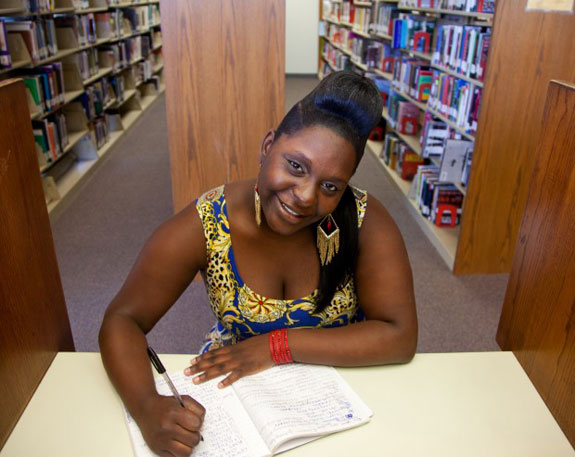
Shakira Lockett, 22, spent three semesters taking remedial classes before she began working on college-level courses. Lockett, who attended Miami Dade College’s Wolfson campus in downtown Miami, beat the odds by completing her associate’s degree in mass communications and journalism in May. (Photo by Sagette Van Embden.)


Listen to the companion radio report by Sarah Gonzalez of StateImpact Florida

About This Story: The series “13th Grade” is the result of a collaboration between the Florida Center for Investigative Reporting and StateImpact Florida.
Related: Read other parts in the series.

Published on December 3, 2012.  ::  More than half of high school graduates who took the college placement test in the 2010-2011 school year found out they had to take at least one remedial course in college to boost basic skill. These students couldn’t pass at least one subject on the placement exam used to assess the abilities of incoming students.

Florida’s 28 public community and state colleges are required to accept anyone with a high school diploma or G.E.D.

Students taking remedial classes have a harder time getting through college. They must pay for —  and the state must subsidize – these basic-skills courses. They do not receive credit toward graduation for remedial classes, and can’t take courses that do count for credit until their skills improve. The result for these students is a longer path to graduating college.

Many of those students never complete their studies.

The need for remedial education is a nationwide problem. But it’s a significantly worse problem in Florida than elsewhere, despite the state’s reputation as a pioneer in overhauling K-12 education.

Some 54 percent of Florida students who took the state college placement test need remedial work in at least one subject. The national average for first-time students needing remediation is 40 percent.

Demand for remedial courses in Florida has doubled since 2007.

Reducing the number of unprepared students in Florida is critical to the state’s economic recovery for several reasons:

  • Remedial education increases the cost of a college degree to students and taxpayers.
  • Research shows that students who take remedial classes are less likely to graduate from college than those who arrive ready for college-level work.
  • Florida’s economy needs more college-educated workers.
  • Without a college degree, workers earn lower wages and contribute less in taxes.

National educators are watching how Florida addresses this problem. The Sunshine State has one of the largest community and state college systems in the country. Randall W. Hanna oversees it.

“There is a cost, a cost to the state, a cost to the student. There’s a cost of time,” said Hanna, chancellor of the Florida College System, which does not include the state’s four-year universities. “We all know if they go into the lower-level math class, they have less of a chance to make it all the way through. We have a real incentive from a cost standpoint to reduce the number of students in developmental education and to make sure they are college ready when they come to our system.”

The Economy’s Effect

One in two Florida students who took the state’s college placement exam in the 2010-2011 school year had to take remedial courses. Those students are less likely to graduate than a student who does not take any remedial classes. (Photo: Flickr.)>>

There are many factors behind the growing crisis of remedial education at Florida’s community and state colleges. Two of them stand out.

One is the Great Recession. The persistently weak job market has produced a surge of displaced older workers at community and state colleges. The number of students aged 20 and older grew by 63 percent between 2003 and 2011. Many of them have been encouraged by the increased availability of federal financial aid.

Some of these older students are going to college for the first time or finishing degrees they never completed. Others are going back to retrain for a different career. Either way, their basic skills tend to be rusty. Older students accounted for 85 percent of those taking remedial courses at Florida’s state colleges in 2010-11.

The subject these students need the most help with is math. Four of every five first-year, full-time students over age 20 had to take remedial math courses, according to the 2011 Florida College System Readiness report using 2009-10 data. For those age 35 and older, the rate increased to 90 percent.

A Skills Gap

<< Researcher Matthew Ladner says that as Florida schools increase their high school graduation rates, more students will likely need remedial classes. (Photo courtesy of EducationNext.org.)

The other big factor is more endemic to public education in Florida. Essentially, there is a disconnect between what students are learning in K-12 schools and what they need to succeed once they get to college.

For more than a decade, under the auspices of reform, Florida has been making dramatic changes to primary education. That included changes in curriculum and graduation requirements aimed at improving student performance in core subjects like reading, math, writing and science.

Standardized tests became more important. The Florida Comprehensive Assessment Test, or FCAT, became more than a measure of student performance. Scores became a determinant of how much state funding schools received or whether they could remain open at all. Starting this year, scores help determine teacher pay.

The overriding goal of these changes was to increase the high school graduation rate – and they did. Though Florida has changed the way it calculates its graduation rates, the rate has risen both before and after the change.

But as it’s turned out, increasing the number of high school graduates is not necessarily the same thing as producing more students who are ready for college.

Policy makers have known this for a while. In 2006, the state Office of Program Policy Analysis and Government Accountability, the research arm of Florida Legislature, found the state’s effort to improve K-12 education hadn’t improved college readiness among students.

At that time, the state agency recommended bridging what it called a “curriculum gap” – the difference between what high school students are taught and what they need to know going into college. Among the problems the OPPAGA report noted included the lack of rigorous high school graduation requirements that go hand-in-hand with college expectations and the need to integrate mathematics and reading to reinforce other courses such as social studies, science and electives.

Measures have only recently been implemented under legislative mandate.

Some education experts lay the blame on the FCAT. Critics say the FCAT’s outsized importance leaves schools little choice but to teach to the test. One of them is Bob Schaeffer, the public education director for the National Center for Fair & Open Testing. He contends that the test interferes with the ability of public schools to prepare students for college.

“When K-12 classes focus on preparation for a narrow, flawed FCAT exam, students are denied the opportunity to master the more sophisticated content and higher-level thinking skills they need to succeed as undergraduates or in the workforce,” Schaeffer said. “The huge percentage of Florida high school graduates who must take remedial courses in college is yet another example of the failure of FCAT-driven public education.”

Matthew Ladner disagrees. He’s a policy and research adviser for Jeb Bush’s Foundation for Excellence in Education, an organization that promotes nationally some of the changes Bush pushed in Florida while he was governor – like increasing emphasis on FCAT scores.  Ladner said Florida’s public education has made significant gains in the past decade, thanks in part to high-stakes testing.

“I think people are throwing out the baby with the bath water,” Ladner said. “If you think about what Florida was like before the FCAT, Florida was one of the lowest-ranked states in the country on NAEP.”  The NAEP is a national assessment provided to students in grades, 4, 8 and 12 to track student academic progress over time.

To some degree, according to Ladner, Florida’s public education system may be a victim of its own success. He credits the FCAT for increasing the number of high school graduates. Ladner sees it as not altogether unexpected that some of those students would struggle at the college level.

“When you have a substantial increase in graduation rates and you have an increase of kids taking college placement exams, some of these problems would become natural,” Ladner said, referring to the large number of students who can’t pass the college placement exam. “It’s not to diminish that remediation is a problem.”

The Search For Solutions

Lenore Rodicio of Miami Dade College. (Photo courtesy of Miami Dade College.)

Florida has begun to address the remedial education problem. In fact, the number of high school students who are prepared for college work has improved some 10 points since 2003 when 64 percent of high school graduates failed at least one subject on the college entrance exam. Still, state education officials acknowledge that the improvements have fallen short of what’s necessary.

Recent legislative changes have taken aim at the problem. The changes include a creating a new college placement test to identify which subjects current high school students need help with before they get to college; increasing  the amount of math instruction high schoolers are required to have in order to graduate; and evaluating students’ college readiness before 12th grade.

Florida also is moving away from the FCAT toward something called the Common Core State Standards. These are academic standards for K-12 students that are supposed to be more aligned to college standards. Forty-five states and the District of Columbia have signed on to the new standards. New curriculum and assessments are being created for Florida based on these standards.

The Florida college system also is revamping remedial courses themselves. The goal is to use computerized classes and other targeted teaching techniques aimed at teaching students the skills they need to continue their college programs. But college educators can do little to prepare students before they reach their campuses.

That’s the point Lenore P. Rodicio repeats over and over again when she speaks at public events. Rodicio is the Vice Provost for Student Achievement Initiatives at Miami Dade College. At her school, 63 percent of high school graduates take at least one remedial course upon enrollment. As Rodicio sees it, receiving a high school diploma today should mean a student is ready for college.

“It’s the case for some students now,” Rodicio said, “but not for everybody.”

In a series of stories this week and throughout December, the Florida Center for Investigating Reporting and StateImpact Florida will explore the growing need for remedial education among Florida’s high school graduates and older students. We’ll try to figure out how we got here and what the state can do to improve public education and provide students with the skills and tools they need to succeed in college and in the workforce.  

</>

Saturday, December 01, 2012

AT BROOKLYN FREE SCHOOL, A MOVEMENT BORN WITH LIBERTY AND NO TESTING FOR ALL

Lucas Kavner

Lucas Kavner / huffington post | http://huff.to/VlRSKh

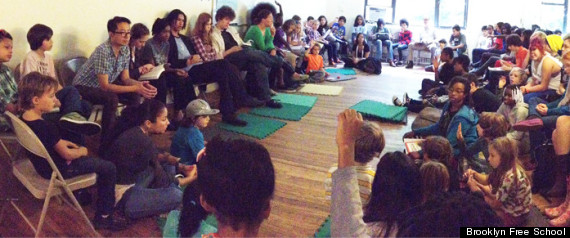
All_school_meeting_fall2012

11/30/2012 8:38 am EST Updated: 11/30/2012 11:46 pm EST  ::  NEW YORK -- On a recent Wednesday morning at the Brooklyn Free School, a class was in session. Ten students, ranging in age from about 12 to 16, sat around a table having a heated debate about chemistry. And superpowers.

"Those elements don't really go together," said one boy in a hoodie and glasses. "Or I don't think they go together."

"But that would make it a good power," another boy piped in. "Cause they're all so different. It'd be awesome to get all those elements together in one guy."

"Maybe," The boy in the hoodie replied. "Let's say maybe."

This was Chemistry: The Gathering, a class where students were creating an "elemental" version of the popular card game, "Magic: The Gathering," involving different characters with specific chemical powers. Its curriculum was approved by the students themselves, just like all of the classes at Brooklyn Free School, a completely democratic K-12 private school occupying four floors of a quaint brownstone in the Fort Greene neighborhood of Brooklyn.

As the animated back-and-forth went on, the young teacher, or "advisor," who could have been mistaken for a student, mostly sat quietly and listened. Occasionally he posed questions, but generally the students guided the discussion. They were running the show.

At Brooklyn Free School, which is split up into an upper school (ages 11 to 18) and lower school (ages 4 to 11), everything works like this: the students make the rules, they pick their classes, and they don't have to come if they don't want. There are no tests, no mandatory homework, no grades on a transcript. If there's an issue that needs to be raised, you can call a meeting and discuss it with the entire school. If you're sick of Chemistry: The Gathering, you can get up and walk out, or head up to a lounge and read a book all day, as certain kids are wont to do. Some spend years on "independent study" projects of their own choosing, while others opt for another class, like Screenwriting, Architecture and Design, Dystopian Literature, Serial Killers in Society, or Seinfeld Appreciation, a student-led class that started recently.

The Brooklyn Free School is looked to as a beacon for what independent, democratic schools can offer, especially to students who previously struggled in public schools. It has led a resurgence in the movement in America overall, one that peaked in the early-'70s and then mostly died out with the Nixon administration.

It’s also a model that has been widely criticized. Critics of the model say its completely structureless environment won't prepare students for the real world, and that lower income students, who can't afford outside tutors, will miss out on essential learning.

Renowned education writer and researcher Jonathan Kozol said that American free schools in the late-'60s and early-'70s, catered too much to the white middle class, even going so far as to refer to them, in his book, “Free Schools,” as "a sandbox for the children of the SS guards at Auschwitz.”

But Brooklyn Free School’s founding principal, Alan Berger, soft-spoken and blunt, said a primary mission is to create a diverse student body, economically and ethnically. Only 20 percent pay full tuition, he said, and many simply pay what they can. The student body, made up of 60 students, is 49 percent white, 30 percent black, 13 percent Hispanic, and 5 percent Asian.

Berger used to work in business, before he grew tired of all the "mergers and acquisitions" and moved on to education. He worked in New York public schools for a while, as a teacher and administrator, before being turned off again, this time by the lack of creativity and choice available to teachers and students in that rigid system.

Berger said that every student "finding their own way" is a key part of his free school philosophy now.

One student, Oscar (all students' names have been changed), a talkative upper school kid with an impressive vocabulary, found his path after a rocky start. He said his favorite classes were The Wire and Urban Studies, where students watched and discussed the TV show "The Wire," and another involving the study of different voting patterns, where they analyzed the best restaurants in the area, and then went and ate at those restaurants.

"I also liked this class where we made exact replicas of ourselves out of tape," Oscar said.

He loves talking about the school, although he said it's hard to explain to his friends what he does all day. It also took him a while, he said, to get acclimated to the free-for-all environment.

"It's easy to figure out how everything works, but to get used to how everything works is another story," he said. "Some kids fit right in. For me it took more than a year. I was upstairs playing Minedraft all the time."

If you don't force any set of rules or academic requirements, Oscar said, each student will discover his or her own path to success.

"Kids that don't want to do anything, for example, eventually they just say, 'I'm going to start doing something,'" he said. "The key is to build a relationship. That's what we try to do here."

"Oddly enough," said Oscar, "It works every single time."

"Well," Berger paused and laughed under his breath. "Mostly."

IS A ‘WIDE OPEN CLASSROOM’ FOR EVERYONE?

When Berger founded the Brooklyn Free School in 2004, inside a Methodist Church in Brooklyn's Park Slope neighborhood, he wasn't sure what would happen. His was the first free school in the New York City area since the last one, the Fifteenth Street School, closed in 1975. Would people come? Would they stay?

Free schools in the U.S. in the late-1960s and early-1970s were a result of the "whole social upheaval going on at the time," said Ron Miller, author of "Free Schools, Free People: Education and Democracy After the 1960s." These free schools were often in obscure locations with minimal resources, like abandoned dry cleaners, public parks, and churches.

"1972 was about the peak year, a sense that a real revolution was happening in education," Miller said. "Not only were there these hundreds of independent free schools, but even in public education, people were pushing for open classrooms."

But that initial surge faded, quashed by the Nixon administration's strict education policies, Miller said, and most of the schools closed. Now 30 years later, the movement is revving up again, though it remains mostly private in the United States. Education Revolution, a website of alternative education resources, lists more than 100 free schools. Most are in blue states, but some have spread into the red ones, like the Great Oak School in Spring, Texas, and the Farm School in Summertown, Tenn. In New York, Brooklyn Free School paved the way for the Manhattan Free School, which opened in 2008. There are other free schools all over the world, including Palestine, Indonesia and Egypt.

Miller lamented that today’s American free schools still generally cater more to middle and upper middle-class students. He pointed to the Albany Free School, founded in 1969 and open since, as an anomaly, and one that future free schools should look to. The Albany Free School calls itself "the oldest inner-city independent alternative school in the United States," and the Brooklyn Free School has adopted many of its policies.

"What I think is happening is that as the system becomes ever more standardized, with more control at the top from government, corporations, another grassroots movement is coming," said Miller. "What you're seeing now with Brooklyn Free School and others is families and educators wanting to get out from under the thumb of this standardization agenda."

Miller said he understood the reticence from certain parents and educators to the free school philosophy. "A wide open free classroom" will not be the best environment for every student, he explained. But the principles behind the free school movement -- the idea that every family blazes their own path for their children and each student discovers his or her own way of learning at their own pace -- is an agenda that serves the student, he said.

"So many kids going to these alternative schools have really thrived," Miller said. "Because they've been freed from the rat race. They follow their own path. They're happy. And that's what this is about: not having to be successful in conventional terms."

THE ‘SELF-ESTEEM INOCULATION’

Lily Mercogliano, a former student of the Albany Free School, has been on the Board of Trustees and has worked as an advisor at Brooklyn Free School since 2005.

"Most people who went through the free school system certainly have an affection for it," Mercogliano said. "They see what it can do."

Isaac Graves, a former Albany Free School school student who now writes and researches free school programs extensively, said he took from his experience a startling, "legitimate passion to learn," and appreciated how few constraints there were on what he was allowed to study. He remembers being 13 and reading about acid rain, how it was killing all these fish in the Adirondacks, so he and a group of students decided to try and stop it. They became so passionate that they contacted Eliot Spitzer, who was attorney general and "fighting coal plants" at the time, and asked him to speak to students. They also brought in a government biologist.

"Nobody told us to learn about these things," Graves said. "We wanted to."

A sense of community is inherent in the free school movement. At Brooklyn Free School, if a parent or outside volunteer wants to teach a class, they can. There's also quite a bit of volunteering. After Hurricane Sandy, many students have dedicated each Friday to gathering supplies and working at local Occupy Sandy depots.

Kristan Morrison, an education professor at Radford University in Virginia and author of "Free School Teaching," said she has been amazed at how well-rounded free school students are. She said many free school students often opt for a more standardized high school education -- mostly because of parents' persuasion -- but because of their free school "foundation," they are more able to thrive there.

"They learn quickly how to play the game, how to do what teachers expected, and picked up knowing how to be competitive," Morrison said. "The harder game is how to be emotionally whole and emotionally healthy. I grew up thinking: this is the way the world is, this is the way I have to be. Whereas [free school] kids know there's another choice. They might want to play this game, or not."

Free schools offer a sort of "self esteem inoculation," Morrison said, where if someone thinks well of you, then you thrive. She said she wishes this notion was more central in inner city schools, where some teachers are often despondent and kids are caught in "bubbles" that they never burst.

"Know the whole child, understand where the child is coming from, adapt the curriculum to the child's background and interests, give the child a lot of autonomy, there's so much info out there, and all of it speaks to the sorts of things being done in progressive schools like Albany Free School, Brooklyn Free School," Morrison said. "Those schools take it to the far extreme of progressive education, but theres a lot of research out there that says: this stuff works."

One potential problem in free schools being widely accepted, Morrison said, is free school "official data." When asked how many graduates the Brooklyn Free School has had, for instance, Berger said "20 or 21." When asked how many had gone to college, Berger said, "We know how many have gone," but wouldn't provide a number.

Still, Berger said, there are 60 students at the Brooklyn Free School, and a "growing waiting list." He just wants to make sure he continues fostering a diverse mix of students, and to keep offering affordable tuition.

"We've learned a lot since we first started," Berger said. "But we try to make it work for all kids. We support kids for who they are."

WHEELS! SCREENS! CHOICE!

After Chemistry: The Gathering, the students clear the classroom of folding tables, and both the upper and lower school kids stream in and began setting up chairs in a circle. It's time for the All School Democratic Meeting, which happens every Wednesday morning. The volume is unrestrained. The kids are loud. There's a lot of dyed hair.

This is the meeting where both students and teachers can bring proposals to the floor, and the entire school votes. Some kids come prepared with proposals they know they'd like addressed, but most just come with vague ideas of things that bother them.

First, students raise their hands and nominate a meeting "chair." Every student has to accept the nomination, and most of the lower school kids decline.

"I nominate Alla," one very young boy offered.

"I don't accept," she said immediately.

Eventually an upper school girl in a beanie and canvas jacket, Lee, won the nomination by a show of hands. The first order of business is introducing a reporter from The Huffington Post. There is a buzz, but Lee called "order," and everyone mostly quiets. Throughout the meeting, some kids would not speak, and many chose to read or stare off into space rather than participate. "Order" was yelled often, over a rush of voices. A group of girls in a corner drew giant televisions with highlighters.

The first order of business is that the Turtles, AKA the 8- to 11-year-olds, have raised the necessary funds to create the "Turtle Times" magazine. Forty percent of the proceeds from the magazine will go to staging the all-school play. At the Brooklyn Free School, Berger said, everyone gets a role in the annual all-school play.

One lower school girl, Sasha, small with big eyes and a giant frizzy winter hat, brought up the issue of "wheels," basically whether lower school kids could bring skateboards, skates, or bikes to the park for recess.

"I have the proposal you are allowed to bring a skateboard there, but only on the basketball court and you can't use it other places," she said. The issue was that many kids without "wheels" were getting left behind.

One of the advisors, David, made an amendment to Sasha's proposal. He asked if she'd be willing to have one "wheels at the park" day, where kids can bring wheels of their choosing one day a week.

"Yeah, I guess," she replied. "Sure."

"And would you add that people need to have helmets?"

"Well that's a school rule," Sasha said. "So yeah."

"Can I propose something?" An upper school girl chimed in. "A pajama day."

"Wait, can we finish talking about wheels?" Lily requested.

"Okay, yes, " Sasha said. "The proposal is that there will be a wheels day on Friday to test out the wheels at the park. if it works, I'll be making a proposal to have wheels be allowed on Fridays."

This motion passes.

The meeting, in general, seems very exciting to a select few, and immensely boring to the majority. As it progresses, kids get more restless. One boy spends the entire meeting with his head in his hands.

The issue of "screens" is raised and many of the advisors break into a half-smile. This issue, said David, one of the advisors, has been coming up almost every week since the school was founded. "Screens" are more commonly known as computers, iPods and cell phones, and the rules seem to change constantly, he said, with some kids understanding that school is not a time to play games, and others thinking they should be allowed to do anything they want.

The argument today: upper school kids need screens to study and write their school transcripts for college. All transcripts at Brooklyn Free School are lengthy and creative, and the students work on them for a long time. Berger said the extra time allows students to focus on catering their transcripts toward their first-choice schools. But because of the absence of grades, it doesn’t work out that way. He said the creative transcripts certainly please “smaller, private schools,” but some larger ones weren't always responsive.

Still, transcripts are worked on extensively by certain upper school students with college hopes. Walter, a lower school kid with shaggy brown hair, said he thinks it "isn't fair” that upper school kids can use screens whenever they want. If upper school is allowed screens, he said, then lower school should, too.

"Do you want to use screens all the time?" An upper school girl asks him. "Like any time you want?"

"Yeah," Walter said. "Or upper school doesn't get to use them at all."

"The upper and lower should have the same sort of rules, yes," Sarah, a fast-talking upper school girl countered. "But if someone's watching a lecture or typing a transcript, that's very different than someone playing that dots game. Screens are not just screens."

The issue is not exactly resolved. It will likely come up again the following week.

An hour later, the meeting ends. One advisor said he wishes there could be some sort of fight, just so I could see how it was resolved at one of these meetings.

"The wisdom that comes out of them figuring out what to do," he said. "Why did you do this? What's underlying this? The whole school gets together. It's amazing."

Past arguments have been over gay slurs, name-calling and bullying, and were resolved through lengthy negotiations. Suffice it to say, some weeks a lot of meetings are called.

But all the kids seem used to it, even the ones who have only been there for a few months. Upper school student Sarah, a student at Brooklyn Free School for three months, said this is the first school where she's felt fully comfortable to be herself. Like Graves, the former Albany Free School student, she said being able to choose your own classes and way of doing things just made more sense to her.

"The biggest different is choice, and not being confined to 15 minutes of socialization a day," Sarah said. "I've always liked to read a lot. i was reading books in my old school that I'd read when I was 6, and my teacher was always saying I wasn't taking enough time, I wasn't trying hard enough, but I'd already read the book!"

Experts pointed to Finland as a sort of guidepost. Finnish schools are often cited as among the best in the world, and students rank highly in all subjects. There, students aren't measured at all for the first six years of their education, they're not tested until high school, they have more recess and free time, and take fewer classes. The teachers have more creativity in assigning curricula. Though there's more structure in Finnish schools, their values share a certain kinship with democratic schools.

Kristan Morrison said she thinks Americans are hungry for alterations to the system like these, but with current government views on education, it will be a while before schools can change course.

"There are still so many restrictions from federal and state governments," Morrison said. "Teachers go in to teaching because they want to be engaging, creative, and then they're stuck with all this testing."

These ideas are not lost on Berger, who has clearly taken creative, progressive education to the extreme.

"We're trying to nurture kids to stay themselves," Berger said. "That's what they need to bring to the world, to live a successful, individually happy life. There's much more power in that, and it really brings diversity to the fold."

Later in the day, Berger wandered up to the top floor, past the "gym," which is really just an emptied out classroom. He said they had an epic, all-school "Rock paper scissors" tournament in there recently. Generally, the classrooms are small, with artwork lining the walls and folding chairs and messy tables scattered around. At night, many of these classrooms are rented out to yoga classes or artists looking for studio space, so Berger can supplement the school's income.

On the top floor of the brownstone was Berger's small office, which he shared.

He leaned back in his chair.

"One of the joys of running a school like this is there are so many opportunities to get to know kids for who they really are," Berger said. "We're figuring out how to make the world for everybody, not to fit everybody into the world."

Report: SCHOOL TESTING IN U.S. COSTS $1.7 BILLION; BUT THAT MAY NO BE ENOUGH

Joy Resmovits

Joy resmovits / huffington post  | http://huff.to/QxqOFi

School Testing

11/29/2012 6:47 pm EST Updated: 11/29/2012 8:37 pm EST  ::  Matt Chingos has an idea that will likely roil the scores of parents and teachers who think the U.S. tests its students too much: we might actually spend too little on standardized testing.

But he's not alone.

"He shows, that with the debate about testing in this country -- it costs too much money -- it's absolutely wrong," said David Coleman, president of the College Board, the company that administers the SATs.

In a report released Thursday titled "State Spending on K-12 Assessments," (follows) Chingos, a fellow at the Brookings Institute, tallied up the cost of standardized testing, a subject that has fueled much debate and speculation. After sending out countless Freedom of Information Act requests and rummaging through boxes of documents, he arrived at an estimate of $1.7 billion.

"While it may seem like a lot, it's more or less a drop in the bucket," Chingos told The Huffington Post. All told, that number represents one quarter of one percent of all money spent on education. According to his calculations, ending all testing and reallocating the cost to personnel could either decrease the student-teacher ratio by .1 students per teacher, or give teachers a raise of $550.

These numbers matter because even in an environment of economic woe and budget cuts, tests are about to see the biggest wave of change since the passage of the No Child Left Behind Act, which required states to test students annually from third grade onward. Now, 45 states are preparing to adopt a new generation of tests aligned with the Common Core State Standards, a set of teaching goals aimed to get kids to think more deeply about things like fractions and evidence-based arguments, and to eventually prepare them for college or the workforce. Funding for these exams has so far come largely from the federal government, but will dry up six months before the tests' first administration.

And with testing at an inflection point, Common Core advocates are seeing this moment as a critical one in marketing their veracity to teachers. On various polls, only between 20 and 25 percent of teachers indicate that they think the standardized tests associated with NCLB are accurate reflections of their students' learning. The perceived fallibility of these exams is part of what gave NCLB such a bad rap in the first place. In fact, this week, the American Federation of Teachers launched a campaign to end the "fixation on standardized testing" (but the union does support the Common Core.)

"You get this rage up that we're wasting time testing, and you're making testing shorter and shittier," Coleman said at a Brookings panel Thursday. "And then people say the test is all multiple choice and bad. We've worked ourselves into a set of stupidities when really -- I'll say it -- we might want want longer, more thoughtful exams." And those exams might cost more.

Nancy Grasmick, a previous Maryland education chief, saw the drawbacks of these transitions. "We lost something when we went to a multiple-choice test that did not require writing but required filling in the right circle," Grasmick said.

Such changes can bring anxiety for the test takers. Gerard Robinson, the former education chief of Florida and Virginia, put it this way: "I won't pretend that tests don't matter and there's no anxiety -- but I also tell people there's anxiety with sex. There's anxiety with sex, but there isn't any talk about getting rid of that."

For his study, Chingos was able to procure testing contracts from 44 states and Washington, D.C., and found that, on average, states spend about $27 on testing per student between grades three and nine. In general, he found that smaller states spend more: D.C. spends $114 per student, whereas New York spends only $7.

"This relatively low level of spending on assessment, combined with concerns that the quality of tests in many states is not high enough to use them for high-stakes purposes such as teacher evaluation, strongly suggests that states should seek efficiencies in order to absorb budget cuts without compromising test quality or to free up resources that could be reinvested in upgrades to assessment systems," Chingos wrote.

"We don't spend much on testing in this country," he said, "perhaps we're spending less than we should."

11 Assessment Chingos Final[1]

Public Education in the other LA: LOUISIANA VOUCHER PROGRAM RULED UNCONSTITUTIONAL

By Stephanie Simon/Reuters / from Huffinton Post | http://huff.to/QVnFR8

Louisiana Voucher Program

11/30/2012 5:49 pm EST Updated: 11/30/2012 11:06 pm EST  ::  (Reuters) - A state judge on Friday shot down Louisiana's sweeping school voucher program, ruling that the state could not use funds set aside for public education to pay private-school tuition for thousands of low- and middle-income children.

Louisiana Governor Bobby Jindal, who had championed the program, called the ruling "wrong-headed" and "a travesty for parents across Louisiana who want nothing more than for their children to have an equal opportunity at receiving a great education."

Jindal, a Republican, vowed to appeal.

While State District Judge Tim Kelley ruled the voucher program unconstitutional, he did not issue an immediate injunction to stop it. The 5,000 students currently receiving vouchers will be able to continue attending their private schools pending an appeal, state officials said.

"We are optimistic this decision will be reversed," said John White, state superintendent of education.

But Kelley's ruling is not the only challenge facing the voucher program.

Earlier this week, a federal judge in New Orleans ruled that the program had the potential to disrupt the region's court-ordered efforts to desegregate public schools. The judge issued a temporary injunction halting the use of vouchers in Tangipahoa Parish over concern that the program was siphoning off state dollars needed to implement the desegregation plan.

While that ruling just applied to the one parish, at least 30 other school districts in Louisiana are under desegregation orders; opponents of the voucher program have said they will bring similar federal court cases in those districts.

They may not need to take such action, however, if Friday's ruling is upheld. Kelley issued his 39-page decision after a brief but emotional trial in a case brought by two teachers unions, dozens of local school boards and the state school board association.

"Today is really significant," said Steve Monaghan, president of the Louisiana Federation of Teachers. "What the governor was doing was unprecedented and unconstitutional under Louisiana law."

About 5,000 students are currently receiving the vouchers, which cover tuition and fees at scores of private and parochial schools, including some small church-based schools that infuse all their classes with Biblical references and do not teach subjects such as evolution.

Students are eligible if they attend a poorly performing public school and if their families meet income guidelines. Households can qualify with annual income up to 250 percent of the poverty line, or $57,625 for a family of four.

The state had argued that as long as it was funding public schools adequately and equitably, it could give a portion of state education funds to private and parochial schools as well, in the interest of giving families more educational options.

But Judge Kelley ruled that Louisiana's annual education appropriation, calculated under a complex formula known as the Minimum Foundation Program, was intended exclusively for public schools. To divert it, he said, violated the state constitution.

The use of state money to pay for religious education was not at issue in the case; the U.S. Supreme Court has ruled that vouchers can be used for religious education so long as the state is not promoting any one faith but letting parents choose where to enroll their children.

Within minutes of the ruling, state education officials were scrambling to come up with a workaround that would let them continue the program with a different funding mechanism, said Barry Landry, a spokesman for the department of education.

One possible solution: The legislature could appropriate money to pay private-school tuition from the state's general fund, rather than digging into the separate pot of money set aside for public education. General fund money has been used for several years without court challenge to pay for a much smaller voucher program in New Orleans.

But finding funds to pay private-school tuition statewide could be tough; the tab is expected to hit about $25 million this year and could rise sharply if, as state officials expect, more private schools open up seats for voucher students and more families apply for the aid. Louisiana has been hit hard by the recession and has made several painful budget cuts in recent years, including sharp cuts to the public hospital system.

Monaghan, the teachers union president, all but dared the governor to seek a general fund appropriation for the voucher program, betting it wouldn't fly in an age of austerity. "The next move is for the governor," he said.

In a statement, Jindal didn't tip his hand about his tactics but did issue a forceful vow to defend his signature program. The opportunity to attend private schools, he said, "is a chance that every child deserves, and we will continue the fight to give it to them." (Reporting by Stephanie Simon; editing by Prudence Crowther)


Louisiana voucher case ruling: reactions of the parties

Lauren McGaughy, NOLA.com|The Times Picayune


By Lauren McGaughy, NOLA.com|The Times Picayune | http://bit.ly/Tz1SKY

November 30, 2012 at 5:09 PM, updated November 30, 2012 at 6:15 PM

Louisiana Gov. Bobby Jindal:

"Today's ruling is wrong headed and a travesty for parents across Louisiana who want nothing more than for their children to have an equal opportunity at receiving a great education. That opportunity is a chance that every child deserves and we will continue the fight to give it to them. The opinion sadly ignores the rights of families who do not have the means necessary to escape failing schools. On behalf of the citizens that cast their votes for reform, the parents who want more choices, and the kids who deserve a chance, we will appeal today's decision, and I'm confident we will prevail. This ruling changes nothing for the students currently in the program. All along, we expected this to be decided by the Louisiana Supreme Court."

Department of Education Superintendent John White:

"We strongly disagree with the ruling. We are optimistic this decision will be reversed on appeal."

Louisiana Board of Elementary and Secondary Education (BESE) President Penny Dastugue:

"This legal battle attempts to prevent children who have been assigned to persistently failing schools the opportunity for a better education at the school their parents have determined is in their best interest. BESE strongly disagrees with today's ruling on funding for the Scholarship Program and will appeal for the sake of the 5,000 students participating in the program."

Black Alliance for Educational Options President Kenneth Campbell:

"Justice and equality has not prevailed in this case. As a result of this decision, hope and opportunity have been taken away from families who are only trying to escape failing schools and gain access to better educational options," said BAEO President, Kenneth Campbell. "We are outraged at the groups who felt it was necessary to go this far to rob our students of high-quality educations. In actuality no one was a winner today."

State Rep. Kevin Pearson, R-Slidell:

"It saddens me to think that the children of Louisiana whose parents chose to remove them from potentially failing schools might now be required to send them back to those institutions. The Constitution of Louisiana is 40 years old, and there are many areas in which former legislators seemed to go overboard in protecting areas of funding without any measure of accountability. I trust Judge Kelly could not get around certain areas of law and rule in favor of the children seeking better educational opportunity, and was forced by legal language to rule in the manner he did.

This decision will certainly be appealed, but there is more than one way to fund these scholarships. This is a brief setback to those hoping to improve from Louisiana's current 48th ranking among the states, yet an encouragement to those who support a status quo. Fortunately, there are many in the Legislature who remain unwilling to accept our current standing and who are determined to make Louisiana a state of opportunity for our children."

Senator Mary Landrieu, D-La.:

"It is no surprise that State District Judge Tim Kelley today ruled the unnecessarily aggressive and overreaching statewide voucher program unconstitutional. A strategic use of state-funded vouchers could be appropriate, but this diversion of public education dollars was a step too far and diminishes resources for meaningful reform efforts already underway at the local level. Judge Kelley was correct in setting appropriate limits."

State Rep. John Bel Edwards, D-Amite:

"None of us are happy with the state of public education. We all need to work together to improve it but we are truly a nation of laws and we never have the option to do that which is constitutional."

Louisiana School Board Association, Louisiana Association of Educators, Louisiana Federation of Teachers:

"On behalf of the Louisiana School Boards Association and 43 public school boards, we certainly respect the decision of the trial court; however, we know that this is only an initial step in a possibly prolonged legal process.

School Boards had no desire to seek a legal remedy to the constitutional problems associated with the recent legislation in Act 2 and SCR 99/MFP, but had no choice due to the fact that these pieces of legislation were not properly vetted in the beginning of the legislative session; and, were unnecessarily fast-tracked for obvious reasons.

LSBA remains committed to ensuring that all school boards perform their statutorily mandated directive to seek all funds available in order to provide quality educational services. We strongly believe that public tax dollars should not be diverted to private entities, especially given the current economic climate -- and, this litigation begs the question as to the effectiveness of state-funding shell game called the MINIMUM Foundation Program.

LSBA along with all school boards and our parent organization, the National School Boards Association, will continue to work to see this important litigation reach final resolution -- for the children we are charged with serving."