First-Year Results Indicate a Wider Test Score Gap
The much anticipated first-year Smarter Balanced assessment (SBAC)
test results were largely unsurprising: a smaller share of California
students scored at or above the benchmark for the new Common Core State
Standards (CDE 2015; EdSource 2015). However, the results for English
Learner and economically disadvantaged students suggest that high-need
students are further behind than educators may have thought.
The overall outcome was widely anticipated, and California is not
alone—many other states that are implementing the Common Core standards
and new assessments saw lower shares meeting their new standards than
their old standards (Butrymowicz and Felton 2015; Harris 2015). There
are many reasons for the lower scores: the new standards being taught
changed and are being implemented unevenly across school districts (
Warren and Murphy 2014;
McLaughlin, Glaab and Carrasco 2014, Harrington 2016); the definition
of having met the standards changed; and the testing method changed (
London and Warren 2015).
1
While it is true that these assessments are in many ways not comparable
(indeed, legislation passed in 2013 prohibits the CDE and local
education agencies from doing so),
2
it is useful to understand which districts and schools are doing
consistently well on both tests, and whether districts doing well on the
SBAC English language arts (ELA) also do well on the SBAC math.
English Learner (EL): A
student whose first language is not English who is deemed without
sufficiently fluent academic English to succeed unsupported in classroom
settings. EL students receive English Language Development instruction
until their academic English improves and they are reclassified.
Economically disadvantaged: A student who qualifies for free or reduced-price school meals.
High-need: A student who is
either an EL, economically disadvantaged, or foster youth. High-need
students generate extra funding for their school district (or school, in
the case of charter schools) through the Local Control Funding Formula.
In this report, we do not disaggregate test scores for foster youth.
However, the drop in scores was particularly pronounced among
high-need students. For example, only 12 percent of 4th-grade ELs met
the SBAC ELA standard, compared to 30 percent the last time the CST was
administered. Similarly, 26 percent of economically disadvantaged 4th
graders met the SBAC standard, while more than half (53%) met the
standard the last time the CST was administered (2012–13). As a result,
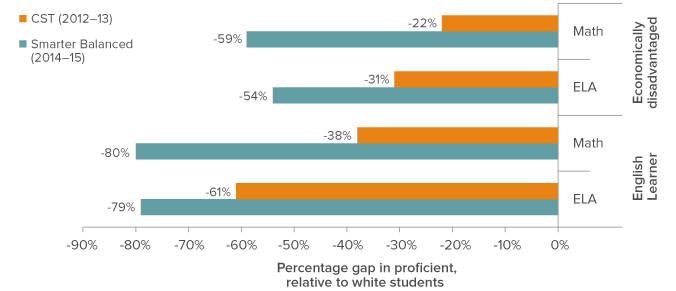
the test score gaps between high-need students and white students are
larger on the SBAC than they were on CST for both math and ELA (Figure
1).
3
In particular, the gap in math between EL students and white students
was 80 percent on the SBAC, compared to 38 percent on the CST—in other
words, the share of EL students who met the standard for the SBAC was 80
percent lower than the share of white students who met those standards.
For the ELA test, the SBAC score gap was 79 percent, rather than 61
percent on the CST. These gaps were larger for EL students than any
other group. Gaps between economically disadvantaged students and white
students are larger as well. For math, the gap between economically
disadvantaged students and white students was 59 percent on the SBAC and
22 percent on the CST. For the ELA test, the gap was 54 percent on the
SBAC and 31 percent on the CST.
SOURCES: 2012–13 CST and 2014–15 SBAC.
NOTE: All students, statewide.
Not only are these gaps larger in the first year of SBAC testing, but
the ELA gaps for English Learner and economically disadvantaged
students are now similar to the math gaps whereas previously the gaps
were larger for ELA. This is not entirely unexpected: educators were
expecting that some students would find math especially challenging
because Common Core math requires more ELA proficiency than California’s
old standards.
4
But it does suggest that, as measured in the first year of the SBAC,
high-need students have farther to go—perhaps further than the old
standards and assessments indicated.
CST: California Standards
Test. Implemented in 1998 to accompany new statewide standards and
administered until the 2012–13 school year.
SBAC: Assessments developed
by the Smarter Balanced Assessment Consortium to assess student
progress toward meeting the Common Core State Standards. These
standardized tests were administered to students statewide for the first
time in 2014–15 school year. California adopted the Common Core
standards in 2010, but did not require implementation until 2013–14.
Scaled score: Number of
correct answers (raw score) converted to a standardized and consistent
score. For 4th graders on the SBAC ELA assessment, the scaled score
ranges from 2,131 to 2,663. Scaled score ranges correspond to
achievement levels (for example, scores from 2,416 to 2,472 correspond
to a level called "standard nearly met”).
Meeting the standard: The
benchmark for meeting the standard varies by grade and subject matter.
For 4th graders on the ELA portion of the SBAC, the scaled score must be
at least 2473.
Test score gap: The
percentage difference between the share meeting the standard for two
student groups. For example, if 10 percent of group A and 15 percent of
group B met the standard, the test score gap for group A is 50 percent.
Said another way, group A’s scores are 50 percent lower than those of
group B.
To better understand the test score gap, we explored the relationship
between the share of students who are high-need in a district (or
school) and the share of EL and economically disadvantaged students who
met the SBAC standards. We explored the same relationship with the CST
in order to identify the largest gaps for high-need students with SBAC
and whether they are the same districts and schools with low scores on
the CST. Before the SBAC results were released, there were cautions
issued against comparing the test results. As we’ve already noted, the
SBAC test assesses students according to different (arguably more
difficult) standards that are in the early phases of implementation, and
the test itself is very different. However, highlighting the districts
and schools that have done well with both tests may prove useful for
districts and schools looking to improve their results. Similarly,
districts and schools that did well with the CST but are now struggling
with the SBAC may need to change course.
We focus on English language arts results in the 4th grade both
because early test scores have proven useful in predicting later
educational outcomes (see an example in
Zau and Betts 2008) and because so many English Learners are reclassified at this grade level (
Hill, Weston, and Hayes 2014).
The decision to move students out of EL status, which has historically
depended heavily on scores on the ELA portion of the CST, has important
implications for long-term student success. We include comparable
findings for math in the appendix.
Assessing Test Scores at the District Level
In school districts with higher percentages of high-need students,
smaller shares of students meet or exceed either the new Common Core
standards as measured by the SBAC, or the old standards as measured by
the CST. This is why the Local Control Funding Formula (LCFF) directs
more funding (on a per pupil basis) to districts with a higher
proportion of high-need students (
Rose and Weston 2013).
Along with the extra funding, districts have more spending flexibility.
But they also have more responsibility for improving all student
outcomes and closing achievement gaps for EL, economically
disadvantaged, and other students.
District-designed accountability plans (known as LCAPs) include a
variety of measures, including test scores. These plans are meant to
help local stakeholders assess school and district progress, but the
accountability mechanism is not yet clear. Policymakers at the state
level are designing a replacement for the state’s old accountability
metric (the API), but what it will include is still uncertain. While the
SBAC is just one measure of academic achievement, it is an important
one and will likely be a part of the state’s new accountability measure.
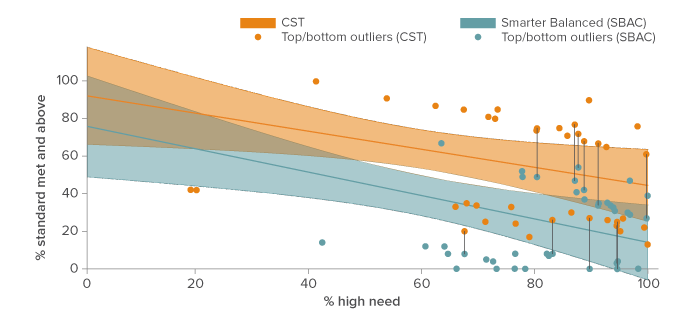
The solid diagonal lines in Figure 2 illustrate the relationship
between the share of high-need students and the share meeting the
standards at school districts, with orange for the CST and teal for the
SBAC.
5
We find a statistically measurable difference in the strength of the
relationship between SBAC and CST scores and the district-wide
percentage of high-need students. This is additional evidence that many
districts—particularly those serving large high-need populations—had a
difficult time adjusting to the new standards.
In Figure 2, the curved lines provide a sense of how this relationship varied across districts.
6
The lines indicate the upper and lower bounds for the shares of 4th
graders who met the ELA standard in 68 percent of demographically
similar school districts.
7
Overall, the scores were lower in districts with larger shares of
high-need students, but in some districts student performance was either
better or worse than expected, based on the shares of high-need
students.
8
The orange dots (for the CST) and the teal dots (for the SBAC)
represent the 20 school districts that were furthest above or below
expectations—these dots are mostly outside the curved lines.
These findings are important for districts that are performing below
expectations for two reasons. First, these districts may not be aware of
how far below average their high-need students are; and second,
struggling districts may be able to learn from districts that are
outperforming expectations.
SOURCES: 2012–13 CST and 2014–15 SBAC.
NOTES: Figure includes all school districts. Top 20 and bottom 20
school districts are among those with at least 100 students tested in
all grades. Schools only needed to be in operation for one test to be
included in our analysis. County Office of Education schools (16 in
total) were included.
9
In some districts, high-need students performed similarly on both
tests. In Figure 2, we indicate that a district that is a top-20
performer on both the CST and the SBAC with a line that connects its
test score dots. This shows that even in top performing school
districts, a much lower share of students met the standard on the new
test. Six the top 20 districts on the CST also performed in the top 20
on the SBAC. Five of the bottom 20 districts on the CST were also in the
bottom 20 for on SBAC.
10
We further explore the relationship in performance across the two
tests, still focusing on high-need students, but analyzing the results
separately for EL and economically disadvantaged students, both of which
are treated separately in LCAPs and accountability measures.
Economically disadvantaged students
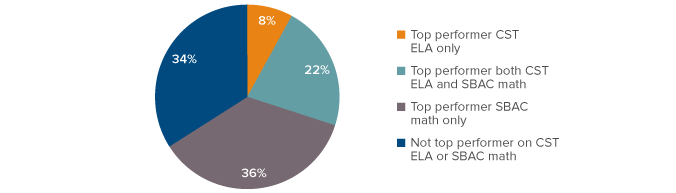
We find among the top 50 districts for SBAC ELA performance for
economically disadvantaged students, 30 percent of these districts were
also top performers on the CST ELA.
11
Nearly one-third of districts that exceeded expectations under the old
standards are doing much better than expected with the new standards, as
measured by these tests. Fifty-eight percent of districts in which
economically disadvantaged students did well on the ELA portion of the
SBAC were also likely to have good results on the math portion of the
SBAC. More than a fifth (22%) of districts with good ELA results were
also top performers on the CST ELA—as well as in SBAC math. At the other
end of the spectrum, we found that 38 percent of districts among the
lowest 50 performers were also at the bottom on the CST ELA. More than
half of the districts with performance that was worse than expected on
the SBAC ELA also fared poorly on the SBAC math (52%).
SOURCES: 2012–13 CST and 2014–15 SBAC.
NOTES: Top 50 districts are among those with at least 100 students
tested in all grades. Schools only needed to be in operation for one
test to be included in our analysis. County Office of Education schools
(16 in total) were included.
English Learner students
To better understand the SBAC performance of EL students at the
district level, we explored the degree to which districts with
relatively high English Learner performance on the SBAC ELA overlap with
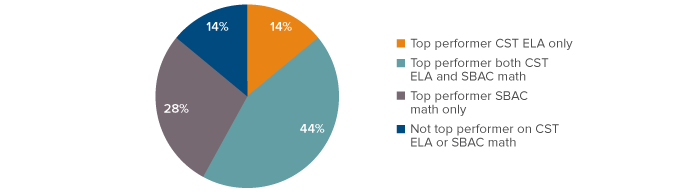
top performers on other exams. Overall, 58 percent of the
high-performing districts on the SBAC were also top performers on the
CST ELA.
12
Nearly three-quarters (72 percent) of the 50 top performing districts
on the SBAC ELA were also top performers on the SBAC math. More than
two-fifths (44 percent) of districts that were high performers on the
ELA portion were also high performers on the CST ELA and in SBAC math.
Among the 50 districts in which the EL population performed much worse
than expected, 38 percent also underperformed on the CST ELA and 54
percent were underperformers on the SBAC math test.
13
In 20 school districts, no 4th-grade EL students scored at or above the
state standard on the ELA assessment. This means that many students
will fall short of the standards for reclassification—as recently as
2012–13, 30 percent of school districts required scores of "proficient”
on the CST in order for ELs to be reclassified (
Hill, Weston, and Hayes 2014).
Our finding implies that 4 percent of school districts would have no
students eligible for reclassification based on that cut-off. In other
words, some school districts have a great deal of work to do to improve
EL student outcomes.
SOURCES: 2012–13 CST and 2014–15 SBAC.
NOTES: Top 50 districts are among those with at least 100 students
tested tested in all grades. Schools only needed to be in operation for
one test to be included in our analysis. County Office of Education
schools (16 in total) were included.
Despite differences in standards, assessments, testing methods, and
benchmarks for meeting the standards, there is some overlap between
high-performing districts on the SBAC and CST. However, more than half
of high-performing districts on the SBAC were not high performing on the
CST.
14
And for many districts, what worked well in the past does not appear to
be working as well now. Future research could help low-performing
high-need districts understand how other districts with similar shares
of high-need students managed to exceed expectations.
Assessing Test Performance at the School Level
LCFF dollars flow to districts, and districts have both the
responsibility and opportunity for improving all student outcomes and
closing achievement gaps for students at their district schools. Annual
results from the Smarter Balanced assessments should help districts
evaluate progress toward those LCAP goals that rely on SBAC scores and
evaluate whether their LCFF funding is being directed toward students
and schools in the most beneficial manner. Here, we examine the
performance of economically disadvantaged students and EL students at
schools throughout the state.
15
As with the district analysis, we focus on English language arts
results for 4th graders. We find that as the share of economically
disadvantaged or EL students increases at a school, those students
exhibit lower test scores, on average, and we examine the performance of
EL and economically disadvantaged students separately at their schools.
Economically disadvantaged students
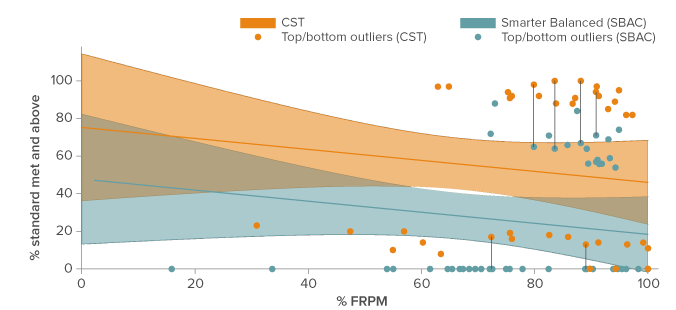
Our analysis of school-level test results indicates that as the share
of economically disadvantaged students in a school increases, the share
of those students scoring at or above the level of the standard falls
on both the CST and the SBAC. In Figure 5, this is illustrated with the
solid, downward trending line. As we did at the district level, we find
that some schools exceed or fall far below expectations. Because
districts are responsible for improving educational outcomes, it is
important to identify the schools that may need the most help. These
struggling schools may benefit from the experience of schools that are
faring relatively well on the SBAC.
16
Four of the 20 schools in which economically disadvantaged students
scored better than expected on the SBAC were also in the top 20
performers on the CST.
17
Conversely, three of the 20 schools with scores that were much worse
than expected on the SBAC were also low performers on the CST.
18
SOURCES: 2012–13 CST and 2014–15 SBAC.
NOTES: Figure includes all schools. Top 20 and bottom 20 schools
are among those with at least 100 students tested in all grades. Schools
only needed to be in operation for one test to be included in our
analysis. County Office of Education schools (16 in total) were
included.
When we compare the results from top and bottom performing schools on
the SBAC ELA to their experiences with the CST, we find that 26 of the
top 100 SBAC performers were also among the 100 schools that exceeded
expectations on the CST the most. Almost half (47%) of the top
performing schools on the ELA portion of the SBAC were also top
performers on the math portion. At the other end of the spectrum, we
find that 18 of the bottom 100 performing schools were also among the
bottom performers on the CST. Just 29 percent were on the
bottom-performing lists for both the SBAC ELA and math tests.
19
English Learner students
EL students are the least likely of all student groups to meet the
state standards as measured by the SBAC—only 12 percent of 4th-grade ELs
did so in the first year of testing. This means that in hundreds of
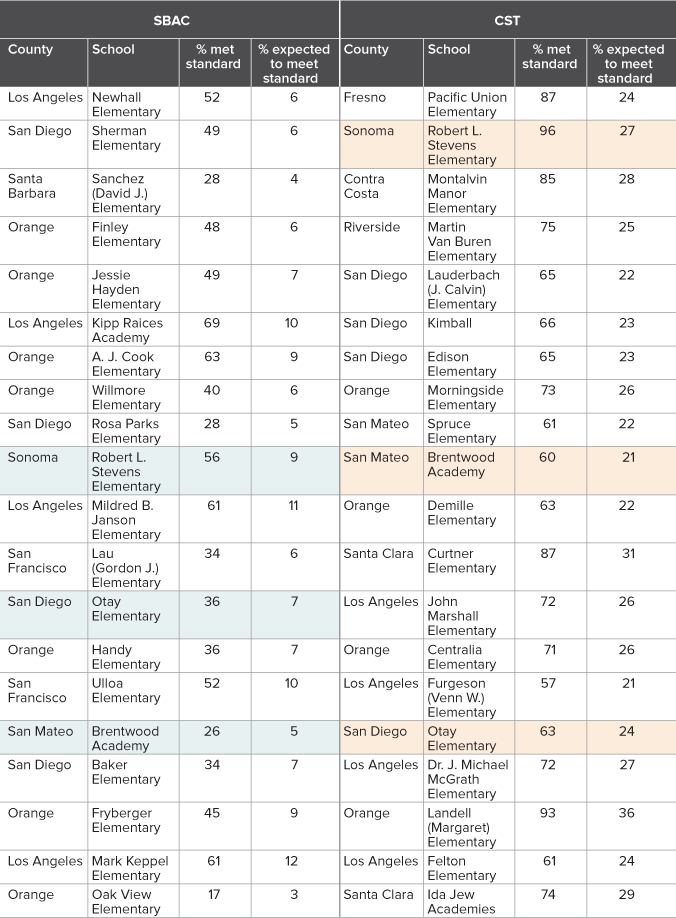
schools, no EL students are meeting the state ELA standard. In Table 1,
we list the schools with EL test scores in the top 20 on the SBAC (on
the left) and the CST (on the right). Only three schools (Brentwood
Academy in Ravenswood City Elementary School District, Otay Elementary
in Chula Vista, and Robert Louis Stevenson in Wright Elementary School
District) are top performers on both the CST and SBAC. (These schools
are highlighted in the table.)
The biggest overachiever in terms of EL scores on the SBAC was
Newhall Elementary in Newhall School District. Based on the school’s
demographic profile, 6 percent of EL students would have been expected
to meet or exceed the state ELA standard, but 52 percent actually did
so.
SOURCES: 2012–13 CST and 2014–15 SBAC.
NOTES: Schools that were top performers on both the SBAC and the
CST are shaded in teal for the SBAC, orange for the CST. Only schools
where at least 100 ELs were tested in all grades are included in the
table. Schools only needed to be in operation for one test to be
included in our analysis. County Office of Education schools (16 in
total) were included. Table is sorted by the percentage difference
between the expected and acutal score.
Four of the top 20 performers are in Westminster School District in
Orange County, two are in San Diego Unified School District, and two are
in San Francisco Unified School District.
Of the 1,653 schools with at least 100 EL students taking the SBAC,
273 (or 17%) had no 4th-grade EL students who met the ELA standards. The
shares of EL students in these schools ranged from about 25 percent to
84 percent. We found no relationship between EL test scores (as opposed
to the percentage who met the standard) and shares of EL students at
these schools. Mean ELA scaled scores for ELs in these schools range
from 2,307 to 2,396 (out of 2,663 possible points) at the lowest
achievement level ("Standard Not Met”). When we include all schools with
enough tested ELs (10 or more) to have their scores reported by CDE, we
find that in 740 out of 3,464 schools (21%), no 4th-grade ELs who met
the state ELA standard; in 748 of these schools, no ELs met the math
standard.
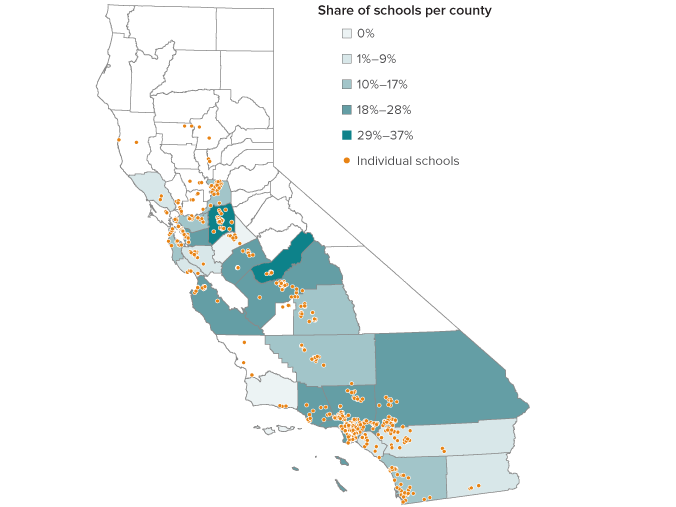
The schools with no EL students meeting the SBAC standards are
distributed across the state (Figure 6). In counties with at least 10
schools that administered tests to 100 or more ELs, the shares of
schools in which no 4th-grade ELs met the state ELA standard are
indicated by shading.
SOURCE: 2014–15 Smarter Balanced assessments.
NOTE: We calculated the share of schools where no students met the
state ELA standard in counties with sufficiently large EL populations,
excluding counties that had fewer than ten schools with more than 100
ELs. County Office of Education schools are included. Unshaded areas are
counties in which there are fewer than 10 schools with at least 100
ELs, so we did not calculate the county share for schools not meeting
the standard. We do report any individual schools where no 4th-grade ELs
met the ELA standard.
In more than 30 percent of the schools in Madera and San Joaquin
Counties that administered tests to 100 or more EL students, no ELs met
the SBAC standards. The district with the largest number of schools in
which no EL students met the ELA standards is Los Angeles Unified School
District: in 182 of the 343 schools with more than 100 EL students, no
students met the standards. There were 21 such schools in Oakland
Unified (out of 34); and there were 31 schools (out of 45) with 100 or
more ELs in which no ELs met the standards in Fresno Unified, 22 (out of
31) in Stockton, and 12 (out of 25) in Ontario Montclair.
20
Overall, 30 percent of SBAC high-performing schools and 17 percent of
SBAC low-performing schools are similarly ranked for the CST. In
addition, there is a high degree of overlap in over-performers on the
SBAC ELA and math tests (53%).
21 However, there is much less overlap—just 8 percent—in the bottom performing lists for both ELA and math.
While there are some schools with high concentrations of successful
EL students, many more are falling far short—in more than 700 schools,
no tested EL students met the state standard. It will be important for
these schools to find ways to help their EL students master the
standards, especially because scores on the SBAC are likely to be an
important criterion by which EL students will be evaluated for
reclassification.
Policy Implications
With the advent of the Common Core standards and the SBAC
assessments, the bar for "meeting the standard” is clearly higher. The
first-year test results indicate that English Learners and economically
disadvantaged students have the most ground to cover. However, in some
districts and schools these students performed relatively well,
including some whose students performed well on the CST, but also some
in which students did not.
As California’s new accountability framework is being developed,
educators at the district and school levels have a unique and important
opportunity to examine their performance, and to learn from schools and
districts that are having more success with the SBAC. The state should
play a role in facilitating this process; the CORE districts’ peer
matching program may prove to be a useful model. The CORE districts, a
collection of 10 districts representing more than one million students,
pair "schools of distinction” with demographically similar
low-performing schools to encourage collaboration between their teachers
and administrators. The State Board of Education could also facilitate
research and encourage or require the California Collaborative for
Educational Excellence and the county offices of education to enlist
peer schools to provide technical assistance to struggling districts and
schools.
22
There is strong evidence that English Learner students have the
farthest to go in meeting the new standards. In the past, the state ELA
test was a critical factor in reclassification decisions. If this
carries over to the new reclassification policy, the SBAC may become a
large barrier to reclassification for many EL students. State
policymakers should consider the findings we have presented when
implementing the new EL standards and deciding how EL students will be
reclassified.
Accountability in California is still evolving—there are many
questions about the LCAP, the LCAP rubrics, the state replacement for
the Academic Performance Index (API), and the federal Every Student
Succeeds Act (ESSA). But, however these questions are resolved, the goal
of the LCFF is clear: to improve outcomes for all students and close
achievement gaps for high-need students. The first-year SBAC results
provide an important call to action for districts and schools that are
struggling to educate high-need students.


