Saturday, January 23, 2016

WI-FI ENABLED BUSES LEAVE NO CHILD OFFLINE: Coachella Unified Superintendent, a Former LAUSD Music Teacher, Tries to Close the Digital Divide


BY LEAH CLAPMAN | PBS NewsHour | http://to.pbs.org/1ZJMUTG


Jan 22, 2016  ::  The digital divide and lack of reliable internet access at home can put low-income and rural students at a real disadvantage when it comes to 21st century skills and connected learning.

 So when Superintendent Darryl Adams took over the second poorest school district in the nation, Coachella Valley Unified School in California, one of his priorities was getting his students online. But how do you do that in a rural area where many of his students live in trailer parks and remote communities? The answer: the 100 school buses that roll into the parking lot every day.

In one of the most innovative and successful programs of its kind, Coachella has outfitted school buses with Wi-Fi routers and solar panels and parks them overnight in the most underserved communities. “We wanted to ensure that students had 24/7 access to the Internet. Because learning does not stop at the end of the school day,” Adams said.

The country’s Chief Technology Officer Megan Smith calls Coachella “an incredibly creative idea” that enables rural areas to take advantage of innovative learning strategies, such as flipped classrooms, which enable students to watch or listen to lectures at home and then do team projects or get extra help at school. Smith said there’s a lot of work to be done in rural areas: census data shows that there are still 5 million households with school-aged children who are not effectively connected to the Internet.


Read the full transcript of this segment below:
HARI SREENIVASAN: Tonight: an innovative solution to bridging the digital divide for students.
Too frequently, kids and their parents in rural low-income communities don’t have access to the Internet and high-quality learning technologies. But, in California, a unique project is providing free home access to the Web in one of the nation’s poorest districts.
Much of the footage for this story was shot by teenagers who are part of our Student Reporting Labs network, in collaboration with PBS SoCal in Southern California.
The correspondent is David Nazar.
DAVID NAZAR: Thirty minutes west of the wealthy suburbs of Palm Springs is a desert oasis best known its annual Coachella Valley Music and Arts Festival.
But behind the parties and concerts stretches a vast and isolated landscape, home to the second poorest school district in the country, where most families live below the poverty line and struggle just to pay the rent.
DARRYL ADAMS, Superintendent, Coachella Valley Unified School District: We have some of the poorest of the poor in our country, very economically challenged, and 100 percent of our students are on free and reduced lunch. Some of them living at trailer home parks that some have been condemned recently, or some in railroad, abandoned railroad cars. It’s just unbelievable, some of the challenges they face.
DAVID NAZAR: Coachella Valley Unified School District Superintendent Darryl Adams believes the right use of technology is critical for the families in this area, like Norma Olivas and her daughter, Anisa Perez.
NORMA OLIVAS, Anisa’s Mother: I do see students sometimes struggling, and, right now, sometimes, some of the kids struggling to get school, to do certain things. And I wouldn’t want my daughter to go through any that. I wouldn’t want her to be a dropout.
DAVID NAZAR: When Adams took the job in 2011, the graduation rate was 70 percent, according to the district. One of his key initiatives was to get every student an iPad and Wi-Fi service, but he knew it would be challenge.
DARRYL ADAMS: We have 1,250 square miles to cover, larger than the state of Rhode Island. So, when we out there were spots in every which way, students weren’t connected, we said, well, how can we get them connected?
And so one of the ways, we said, look, we got 100 buses. Let’s put Wi-Fi routers on those buses. And let’s park them where the need is.
DAVID NAZAR: Finding the funding for this fleet of buses was no easy tasks. Nevertheless, in 2012, the community voted for and passed Measure X, a nearly $45 million school bond to fund the Mobile Learning Initiative over 10 years. They called the program Wi-Fi on Wheels.
ANISA PEREZ, Student, Desert Mirage High School: In the bus, it’s kind of cool that we have Internet, because when the project is due the next day, we can actually spend time to do it.
DAVID NAZAR: Completing assignments was difficult for Anisa before getting her iPad and Wi-Fi service at home.
NORMA OLIVAS: We would have to travel actually to go in, go to the library, get the books she needed to look up the information and go home. I don’t make a lot of money, but I will do whatever it takes to make sure she does get a better education.
DAVID NAZAR: Adams is doing whatever he can to make sure that the 20,000 students in his schools, 98 percent Hispanic and about 10 percent undocumented, develop the skills they need to graduate.
DARRYL ADAMS: So we realized that we had to provide this to our students in order for them to compete in the 21st century.
DAVID NAZAR: Installing solar panels on rooftops of the school buses to power the state-of-the-art Wi-Fi routers was a solution proposed by Adams.
DARRYL ADAMS: Being a musician by trade — I was a music teacher from L.A. Unified when I started out 30 years ago — and, as a musician, you’re always creating and thinking of different ways to do things or to play things or to hear things.
And so I brought that to my career in education. And I have had some difficulty in the past, because some people weren’t really kind of ready for Adams’ crazy ideas. But this district was. And just about anything we do that’s maybe different and is good for kids, we go with it.
DAVID NAZAR: CVUSD’s director of technical services, Israel Oliveros, provides the technical support for the entire district.
ISRAEL OLIVEROS, Director, Technology Services CVUSD: We run power through a conduit that is already existing on the bus. It goes through the front of the bus. That’s where the router is located. Then we do have the antennas pointed in different directions. For the students, that will cover a 150-foot radius.
DAVID NAZAR: The school districts allows a few of these buses to be parked throughout the East Valley overnight. For students, it’s a lifeline to the outside world.
DARRYL ADAMS: We wanted to ensure that students have 24/7 access to the Internet, because learning doesn’t stop at the end of the school day.
DAVID NAZAR: Megan Smith is the chief technology officer of the United States. It’s her job to advise the president on technology and innovation that will improve the future.
MEGAN SMITH, Chief Technology Officer, Office of Science and Technology Policy: Coachella is an incredibly creative idea. Being able to flip the classroom and be involved in — have video at home, instead of the classroom has a lecture. So, a lot of work to do in the rural areas.
DAVID NAZAR: There are federal programs in place to help provide Wi-Fi to rural school districts, like the FCC’s E-rate program, which provides about $1.5 billion each year to schools. However, census data shows that there are still five million households with school-age children who are not effectively connected to the Internet.
Smith says that has to change.
MEGAN SMITH: There is a lot of creativity that American people have.
And so whether it’s going to come from a school district, a municipal leader, or one of our national players, we need everybody in on this game working on it. It’s a very, very important, fundamental resource for all of our people. And it drives our economy. And it drives our community and our interconnections.
DAVID NAZAR: With Adams at the wheel, the graduation rate jumped from 70 percent to 80 percent. Now the superintendent has aspirations beyond students getting their homework done. He wants to connect everyone in the East Valley.
DARRYL ADAMS: Because we found that we had a problem with some of the third-party Internet service provider companies not willing to go into some of the areas where we serve. So, in the long run, we would like to become our own Time Warner or our own Cox Communication and provide this for our students. It’s too crucial for them to have this access for us not to go down this path.
DAVID NAZAR: Anisa recognizes that technology and the Wi-Fi on Wheels program is playing a vital role in her education.
ANISA PEREZ: I want to do this for my mom, because my mom didn’t really get to finish school. So that’s what motivates me to actually do — to finish school and complete my work and get the job I want.
NORMA OLIVAS: I would want her to have a better life than what I have right now. I would want her to do really, really good in school, so she can get all these ideas that she wants, nice restaurants, different things like that. That’s one thing she always wants to do, travel. And that’s what she’s hoping to go for.
DAVID NAZAR: For the PBS NewsHour, I’m David Nazar in Coachella Valley, California.
HARI SREENIVASAN: Two of our Student Reporting Labs, Etiwanda High School and West Ranch High School, traveled to the Coachella Valley to shoot the video for this story.
For a behind-the-scenes look at their journey and how the program is training the next generation of public media producers, visit the Web site at studentreportinglabs.com.
PBS NewsHour education coverage is part of American Graduate: Let’s Make it Happen, a public media initiative made possible by the Corporation for Public Broadcasting.

2016 LAUSD Academic Decathlon Volunteer Application and Job Description


Download as fillable .pdf

INCENTIVE PAY TO KEEP NEWPORT-MESA UNIFIED OFFICIAL FROM RETIRING HAS TOPPED $273,000


Jan 23, 2016  ::  The Newport-Mesa Unified School District has paid $273,591 into a separate retirement account for its deputy superintendent and chief business official as an incentive to delay his retirement.

The fund for Paul Reed was created "in recognition of the board's desire that the deputy superintendent continue to serve the district past the optimal STRS retirement age of 62," Reed's contract states.

Reed, 68, also will receive a pension from the state when he retires.

But the district's former director of human resources, John Caldecott, said the lack of specifics related to the retirement contributions raises red flags and questions about transparency. Information about the retirement fund was obtained by Caldecott after he filed a state public records request.

"There is no way the public would have known the dollar amount that is being contributed by the district to Paul Reed," Caldecott said. "The board is elected to be the eyes, ears and voice of the taxpayer. I don't think that happened in this case. They have been the voice of the administration."

District officials said the extra funds are merited because of Reed's skill set.

"Experienced professionals with strong business and education proficiencies, like Paul Reed, are difficult to come by," board President Dana Black said. "We value his knowledge, expertise and success in ensuring our continued fiscally responsible approach to providing a world-class education for our students."

Reed began working at Newport-Mesa in 2002 after spending 26 years in the Irvine Unified School District, where he got his start as a labor negotiator. As one of Newport-Mesa's top officials, Reed has guided the district through recession and cuts in education funding.

Caldecott, however, said Reed "does nothing for this compensation. This is a gift. It doesn't make sense to pay someone not to retire."

Reed declined to comment.

Reed is the only management employee who receives additional retirement money from the district, Newport-Mesa spokeswoman Annette Franco said.

The contributions were first approved by the board in 2009 and are transferred annually into an account at Reed's bank, Franco said.

At that time, the board offered to buy service credit from the California State Teachers' Retirement System, or CalSTRS, which would have, in essence, increased the number of years Reed has served in public education in the eyes of the state retirement agency. That number is used as part of a calculation to determine compensation after an employee retires, according to CalSTRS.

However, Reed asked the board, and it agreed, to purchase a tax-sheltered annuity of "like value" instead of the CalSTRS credit. A tax-sheltered annuity, also known as a 403(b) account, is similar to a 401(k) in that it enables employees to defer some of their salary in individual accounts. The deferred salary is generally not subject to federal or state income tax until it is distributed, according to the Internal Revenue Service.

It's not unheard of for public employees to receive retirement funds in the form of tax-sheltered annuities, said Michael Sicilia, media relations manager with CalSTRS.

"We wouldn't even know about it because it wouldn't have an impact on STRS credit," he said. "It's something that's negotiated in employee contracts."

Reed's contract does not specify how the district calculates the amount to contribute to his retirement fund or the amount to be paid annually.

But this year, the board agreed to pay $40,414 into the fund, according to information provided by Newport-Mesa Unified.

Reed will earn a base salary of $259,143 this year. He also receives annual allowances of $7,800 for transportation and $1,200 for communications such as cellphones, according to his contract.
The board fired Caldecott in January 2015 shortly after he filed a lawsuit against the district to compel officials to release internal emails and other documents related to his claim that Supt. Fred Navarro had created a hostile work environment for employees and retaliated against Caldecott for questioning salary reports to CalSTRS.

In December, a three-judge panel of the state 4th District Court of Appeal ruled that the school district must release dozens of documents related to Caldecott's allegations against Navarro. The district plans to release the documents after a final review by an Orange County Superior Court judge.

KIDS FROM AROUND THE WORLD FIND COMMUNITY, LEARN ENGLISH THROUGH POETRY


117462 full


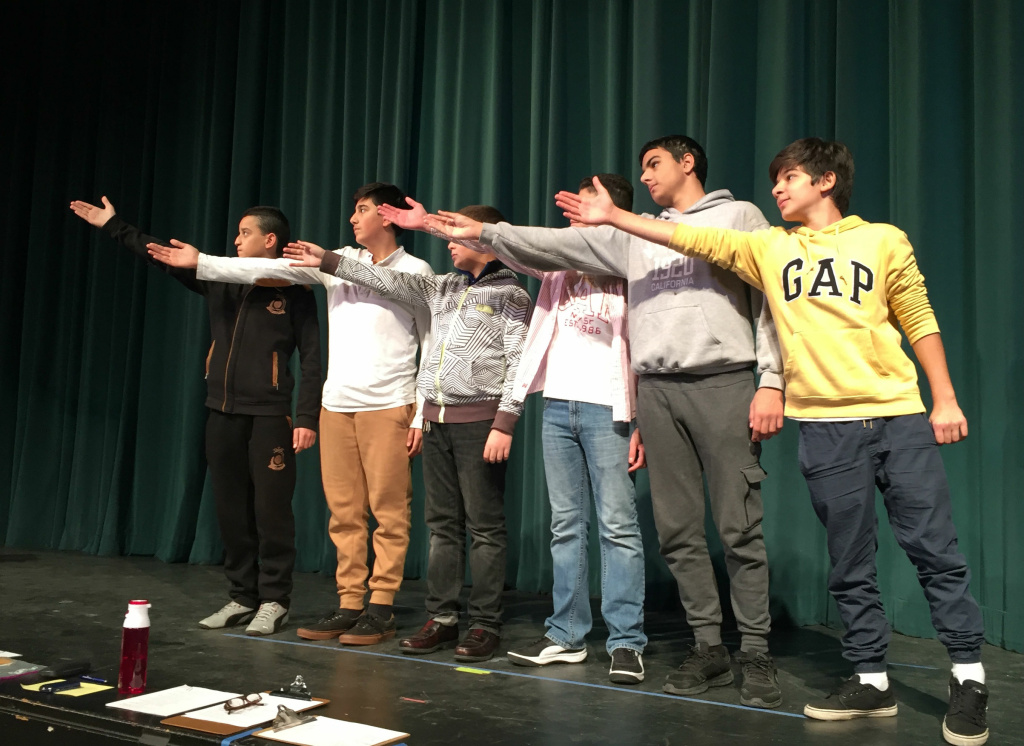
January 22, 05:00 AM  ::  Under the bright lights of the auditorium of John Muir Middle School, dozens of students are on stage rehearsing for a big poetry performance. 

Standing in a row with her classmates, Jwail Alnamh, a Syrian immigrant, recites her line: "I remember home when my country was all good and my grandma could take me everywhere."
"I dream about seeing my friends once again and jumping rope and laughing," said Fima Kaoumi, who is also from Syria.

These students are 48 of the students enrolled in English Language Development classes at the Burbank middle school. Like many recent immigrants, they're slowly mastering a language they didn't grow up speaking. To help them cope -- linguistically and emotionally -- teachers have designed a unit that uses poetry and performance to help English learners improve their language skills.


Teaching artist Kate Randolph works in schools all around Los Angeles County.
Teaching artist Kate Randolph works in schools all around Los Angeles County. Priska Neely
For years now, teaching artist Kate Randolph has come the school to work with students on different theater techniques -- articulation, projection, body movement. Usually her class culminates with a performance of classic poetry, but this year she’s trying something different.

"We’ve always based it on Langston Hughes poems about dreams, which is great," Randolph said. "But I thought, you know, you have such a tapestry of countries and ethnicities, why don’t we expand it?"

So this year, the students wrote their own poems, all based around on the theme "homeland." Along with lines from published works, the students will perform their poems at a school assembly on Friday.

'A SENSE OF BELONGING'

About 7 percent of the roughly 1,400 students at Muir are not native English speakers. Teacher Jessica Wertlieb says the English learners are a really diverse group from a dozen countries, including Armenia, Syria, Russia and Mexico.

She combines her class of intermediate and advanced English learners with the class of teacher James Koontz, who teaches beginners. Even though students are from all over the world, Wertlieb says they’re forging a little community.

"It’s hard for them to fit in when they come to this school," she said, "and so I think this really gives them an opportunity to feel a sense of belonging."

In his poem, seventh-grader Alexandr Ter-Zakaryan wrote that he dreams of one day being president of Armenia. Most of the English learners at the school are Armenian. Burbank has one of the largest Armenian communities in the U.S.

Alexandr arrived here five months ago and he’s still searching for that sense of belonging.
"It’s very hard because some people don’t understand you. Sometimes when teachers say something it’s like, 'What?' " he said sighing heavily.

He said the transition has been stressful, but the theater class is helping him practice his words and understand his classmates.

A SAFE SPACE TO LEARN

Liane Brouillette is an education professor at the University of California, Irvine. She studies the effects of performing arts programs on the skills of young English learners.
She says oral language is always the first step.

"If they’re not engaged in oral language and they’re silent in the classroom, they don’t have that foundation for literacy."

Brouillette says incorporating drama also can put students in a mental and emotional space where it’s easier to learn.

"Because the arts aren’t usually graded in the same way, they feel less self-conscious and that’s actually when you remember the best."

She says this is especially true in middle school where students are maybe more self-conscious than ever.

At Muir, Randolph does 10 sessions with the students, teaching them what it takes to be a performer -- how to stand, project, articulate. Teachers keep her coming back each year with grants from the education foundation Burbank Arts for All.

During rehearsal she yelled out a mantra the children know very well. "Remember it’s your job to be heard, understood, and felt, OK?"

She encouraged the students to show emotion in their performance and their writing. Eighth grader Meray Mahfoud took that advice to heart.


Meray Mahfoud (foreground) came to the U.S. from Syria three years ago.
Meray Mahfoud (foreground) came to the U.S. from Syria three years ago. Priska Neely
"When I was writing I was, like, it was so sad," said Meray, who left Syria three years ago to escape the war. "I want to go back to my country but it’s really hard and difficult and everything’s messed up there and I miss my grandmom."

She channeled those very real feelings into her poem.

"I remember home," she recited during rehearsal, "when I see the cookies in the market that my grandmother used to make. I feel her and how she wants me to go back to Syria."

This is Meray's third year working with Randolph. Her teachers say she's blossomed and gained confidence. She says making an emotional connection has really helped her learn English.
"When you don’t understand the word and then they explain it to you and you do it emotionally, it helps you to understand the word," she said.

The teachers say putting poetry into performance serves a dual purpose -- it helps with the practical stuff – vocabulary and presentation skills.  And writing about personal experience has made students value the art of poetry.

"I think it woke up in them, 'Oh that’s how poetry gets born,'" said Randolph. "It’s really real; it’s not just that corny stuff that we have to memorize and recite sometimes."

LAUSD AUDIT SHOWS DISTRICT DEBT OUTSTRIPS ASSETS BY $4,2 BILLION +smf's 2¢


MelbaSimpsonAuditor
Melba Simpson conducted the audit

   ::  The latest independent audit of LA Unified shows that through the end of the last fiscal year, on June 30, the district had liabilities that surpassed assets by $4.2 billion.
The previous year showed assets over liabilities by $1.7 billion, making for a 12-month swing of $5.9 billion, according to Melba W. Simpson, of Simpson & Simpson Certified Public Accountants, the company that has done audits for the past seven years for LAUSD.

“For the first time the district has a negative net position,” Simpson told the school board’s budget committee this week. “The biggest change is that you are going in the red now.”

LA Unified’s Chief Financial Officer Megan Reilly said the big swing reflects new reporting standards put in place by the non-governmental Governmental Accounting Standards Board, which now requires the district to post pensions and longterm liabilities.

“We are having to front-load the $5.2 billion (in retiree pensions); that’s why we’re going into the red in one year,” Reilly said, explaining that the entire amount is being posted in the audit rather than in a footnote as had been done previously. In the past, there was a concern that pension obligations were not reflected properly in audits, Reilly said, adding “This change is happening in government and financial statements and put longterm and pension benefits on the books.”

The numbers will only get worse, because LAUSD’s other post-employment benefits, which are unfunded for the district, are estimated at $10.9 billion. The total is only expected to increase because of rising medical costs and longer life spans.


The district’s retirement health plan costs $800 million a year, and it was eventually going to put the district in the red, Simpson said, but the new pension accounting escalated the numbers.

The audit report was made at the Budget, Facilities and Audit Committee and four of the seven board members were in attendance. The audit is required by law for the district and cost $879,000, taking 10,000 hours to complete, Simpson said.

The audit includes depreciation on buildings owned by the district. That resulted in capital assets decreasing by $44.7 million. The district also had to repay nearly $580 million in bonds.
Board member Richard Vladovic pointed out that the capital depreciation is unfair because it doesn’t include the value of the land.

Confirming the reliability of the report, Reilly said “We have to have discussions about what the trends are saying and peel that onion back a little bit.”

Mónica Ratliff, who chairs the budget committee, said it is important to have an independent analysis of the district finances. She said she attended some of the superintendent search forum meetings and was surprised about the number of people who did not trust the district’s budget and thought money was being hidden.

“It is essential to be transparent with the public and have an independent auditor and see that everything is under standard procedure. I greatly appreciate that,” Ratliff said. “Now we need to see recommendations to handle our total liability.”


This is really not new news. The good news is that the bad news is being reported in the audit and not dismissed+ignored in the footnotes; this content was previously reported in the Independent Financial Review Panel - the group formed in March by Superintendent Ramon Cortines - report last November. And it wasn't news then either.
 The accounting standards have changed and the district is no worse off than it was last year, it’s just that the long-standing bad situation is more obvious.  LAUSD is not alone in this situation, it's just bigger and the numbers are bigger.

The "swing" of $5.9 billion reported by LASR is moving the money from from one cell in the spreadsheet to another  ...but where would we be without the LA School Report declaring that "The Sky is Falling" - and proving it w/data?

The is. of course, a double standard in the application of the accounting standards. If a charter operator had an audit report like this the District would be wise (and correct) to shut them down. Hopefully LAUSD will begin to address this situation in the upcoming year.

Friday, January 22, 2016

ILLINOIS REPUBLICANS PROPOSE TAKEOVER OF CHICAGO SCHOOLS FROM MAYOR ...AND EVENTUAL RETURN TO ELECTED SCHOOL BOARD CONTROL

From Politico Morning Education | http://politi.co/1KrlFGf

- REPUBLICANS PROPOSE CHICAGO TAKEOVER

 Jan 20, 2016  ::  Illinois. Gov. Bruce Rauner and other state Republicans are expected to unveil legislation today that would allow an emergency financial oversight board appointed by the state to take over Chicago Public Schools. The emergency financial takeover would allow the district to declare bankruptcy as the CPS system faces an imminent $500 million shortfall. Once the financial situation is remediated, the legislation would call for an elected school board, "Chicago Tonight" reports. "I'm very concerned about the trajectory of where we're going for CPS," Rauner said. "We are going to take action to protect the school children so they have good access to teachers, and effective children. We're going to protect the children and the taxpayers too." More: http://bit.ly/1SvpLoP.

- Chicago Mayor Rahm Emanuel responded with a statement saying, "The mayor is 100 percent opposed to Gov Rauner's 'plan' to drive CPS bankrupt. If the governor was serious about helping Chicago students, he should start by proposing - and passing - a budget that fully funds education and treats CPS students like every other child in the state." More from CBS: http://cbsloc.al/1KqdV7q.

Tuesday, January 19, 2016

TIME TO BREAK UP GIANT SCHOOL DISTRICTS + smf’s 2¢


 By Walt Gardner in EdWeek | http://bit.ly/1PoDFlU

January 18, 2016 7:35 AM  ::  The beginning of the new calendar year is a propitious time to question whether the nation's largest school districts can ever deliver a quality education ("Principals' Union Says Mayor de Blasio Has Lost Focus on Students," The New York Times, Jan. 11, and "What new L.A. schools chief Michelle King needs to do now," Los Angeles Times, Jan. 15).  

The New York City and Los Angeles school systems, the largest and second largest, respectively, are cases in point.  Both have consistently shortchanged students they are supposed to educate. I maintain that they are ungovernable and will remain ungovernable because of their size.  I'll take each district separately.

The union representing the 6,000 members of the Council of School Supervisors and Administrators has gone on record that it has lost confidence in the Bill de Blasio administration.  (In New York City, the mayor is the head of public schools.)  Principals in 94 of the district's lowest-performing schools complain that they are swamped with paperwork, meetings and micromanagement, to the point that they cannot do what they believe is best for their students.

The district's chancellor, Carmen Farina, counters that autonomy has to be earned.  When it isn't, principals are replaced. To date, roughly one third of principals in these underperforming schools have fallen into that category. Adding to the problem is that the number of complaints received by the special commissioner of investigation has reached an all-time high of 5,566. Although graduation rates are at record levels at 70 percent, taxpayers have not forgotten the New York Post's articles titled the "EZ-Pass" scandal that documented grade tampering and questionable summer-school programs ("The phoniest statistic in education," Thomas Fordham Institute, Jan. 13). 

The situation in Los Angeles is not much better.  When Superintendent John Deasy resigned in Oct. 2014, he was replaced by Ramon Cortines as interim superintendent.  Deasy's tumultuous three-and-a-half-year tenure was characterized by a botched $1.3 billion plan to give iPads to 640,000 students in 900 schools and by his testimony in the controversial Vergara v. State of California case. Although test scores and graduation rates improved slightly, the LAUSD is reeling from declining enrollment and a precarious financial status. On Jan. 11, Michelle King was named the new superintendent after a five-month nationwide search.

The district has long been known for heated politics and an assertive teachers' union. The school board's members have only exacerbated matters by failing to understand their job as elected overseers, which is why there have been eight superintendents over the last 20 years.  Some have been outsiders and some insiders. But neither has mattered. This time the board selected King, the consummate insider, because of her experience as a student, teacher, high-school principal, and senior administrator in the district.

I don't think anything significant will ever change in New York or Los Angeles unless both school systems are broken up into smaller, more manageable districts.  Behemoths cannot fulfill their obligations to all stakeholders, no matter who is at the helm.  I'm not saying that dismantlement will result in miracles.  But I believe that smaller school districts will be in a far better position to serve students and parents because they are more nimble and more attuned to their constituents.

My proposal is not original. Over the years, there have been several such proposals, but to no avail. For example, on Oct. 7, 2014, a petition was circulated by the California Trust for Public Schools to break up the LAUSD, but it met with fierce resistance from vested interests ("Break up the Los Angeles Unified School District," GoPetition).  On Mar. 30, 2015, Education Next called for an overhaul of the New York City school district ("New York City's Small-Schools Revolution").  If the goal is to create a governing structure that works for students, shuffling leaders will not do the job.  Something more fundamental needs to be done.  If not now, when? 


Walt Gardner taught for 28 years in the Los Angeles Unified School District and was a lecturer in the UCLA Graduate School of Education. Follow Walt Gardner on Twitter.


 _____________

Quoting: My proposal is not original. Over the years, there have been several such proposals, but to no avail.

Really??

1. Drawing on a comment from an EdWeek reader “Been there, done that!” 
In 1969, New York State devolved the New York City Public School System into 32 self-governing school districts - for over thirty years the decentralized system staggered, the lowest performing districts became patronage pools for the local electeds, scandal after scandal, the middle class districts thrived, the "haves" prospered and the "have-nots" were ignored.   [See: The Great School Wars: A History of the New York City Public Schools by Diane Ravitch]

In 2002 Mayor Bloomberg convinced the Albany establishment to re-centralize NYC schools and move to mayoral control. Since then not much has changed, educationally.

2. The NYC Principal’s Union isn’t asking for the District to be broken up, they are asking for an end to mayoral control.

3. If LAUSD were to be broken up, how do were guarantee that the results of the 1969 NYC break-up aren’t replicated on the Left Coast?

4. Please excuse my clinging to the status quo like Charlton Heston  to his beloved guns, but how will we equitably assign the $20 billion-plus in bonded indebtedness held by LAUSD to multiple school districts?

Monday, January 18, 2016

JOURNALISM ETHICIST - WHO WROTE THE BOOK ON THE SUBJECT - SAYS L.A. TIMES IS "TRAPPED IN A MASSIVE CONFLICT OF INTEREST"


January 18, 2016  ::  A member of a Facebook group that discusses education asked journalism ethics expert Peter Sussman about the LA Times coverage and posted this. Shared with their permission:

I asked a journalist friend about the ethics of the L.A. Times taking money from Eli Broad while editorializing in favor of his project.

His response:

PETER SUSSMAN: "Was I tagged because this is such a tough ethical issue to parse? 
"It is not.

"With this kind of entanglement with the subject of its news stories, the Times has given up the right to expect any trust or credibility for its journalism on education. They are trapped in a massive conflict of interest, and no amount of pro forma disclosure will fix that. It's so sad to see what has happened to that once-great publication.

"You can add to the comment that trust and credibility are the life's blood of journalism, and without it, a "news" organization is no different than any other partisan in public disputes, with the added problem that there is no major paper to hold it accountable, although in this case a blogger has apparently stepped into the breach. People have jeopardized and lost their jobs for defending their editorial independence and standing up to such conflicts of interest.

"I haven't read the background on the issue you've highlighted, but if all your information is accurate, the Times' problem extends beyond opinions to reporting, however well-intentioned their education reporters are."


--Peter Sussman, retired longtime San Francisco Chronicle editor. Sussman has held a number of positions in the Society of Professional Journalists, the nation’s oldest, largest and most broadly based association of journalists. He was a 15-year member of the Society’s national Ethics Committee and was a co-author of the organization’s 1996 Code of Ethics, which had generally been considered the primary ethics code for the profession for almost two decades.