Tuesday, October 27, 2015

Breaking: L.A. SCHOOL BOARD WILL CONSIDER APPOINTING OUTSIDE SUPERINTENDENT SEARCH COMMITTEE IN CLOSED SESSION …AGAIN! + smf’s 2¢


Howard Blume

by Howard Blume | LA Times |http://lat.ms/1RcZDex


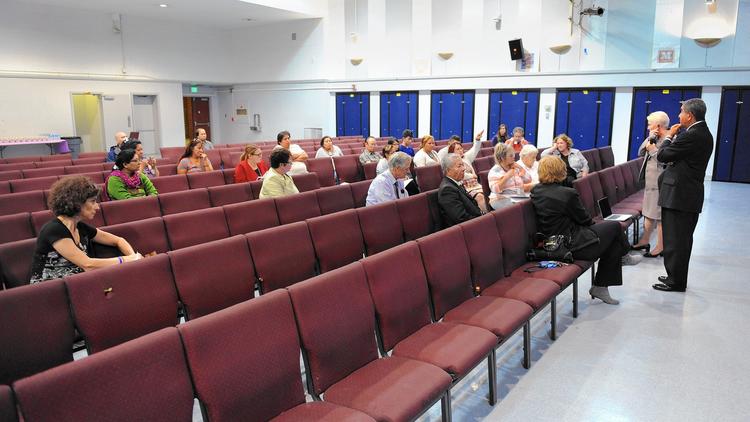
Consultant Hank Gmitro

L.A. Unified consultant Hank Gmitro, standing, asks a group of parents, employees and community members what qualities they would like to see in the next schools superintendent.

Oct 27, 2015 | 6AM  ::The Los Angeles Board of Education on Tuesday is expected to consider appointing an outside committee to guide its search for the next superintendent of schools.

A group of civic leaders has pressed the school board repeatedly on the issue.

“I don’t know why you would not want some people around a table giving input,” said Elise Buik, chief executive of United Way of Greater Los Angeles.

L.A. Unified hopes to choose a new leader by the end of the year, when current Supt. Ramon C. Cortines, who is 83, said he would like to step down. Cortines agreed to serve a year ago, when Supt. John Deasy resigned under pressure.

Buik has been among the most consistent voices urging the Board of Education to call on other leaders who could provide perspective and expertise in various areas.

If the district allows a hiring committee to screen for finalists, “my belief is that we’re going to make a better decision,” Buik said. “It will unify the community around a decision. And I think candidates will be encouraged to apply when they see the diversity of people involved in the decision.”

Buik said the hiring process itself could remain confidential — to ensure the best pool of applicants.

She and others, part of the Civic Alliance group, made similar arguments at an Aug. 19 lunch with school board president Steve Zimmer. Then, earlier this month, a separate but overlapping group of local organizations reiterated the request in a letter to the board.

Zimmer did not commit to the idea, but brought it before his colleagues in an earlier closed session, during which the board decided against an outside committee.

Several board members have noted in public that one of their fundamental duties as elected officials is to choose a superintendent -- and that they intend to handle the process themselves. Privately, some said they were concerned that an outside committee might try to co-opt the process, leaving board members unable to determine whom they most wanted.

Still, the board will discuss the matter once more in closed session this week, sources confirmed.

An executive search firm, meanwhile, already is accepting applications and recruiting candidates. And the same consulting team also is collecting public input through a series of community meetings that will conclude this week.

The United Way and other allied groups have not yet met with the consultants, Buik said.

District officials said they encourage all groups to submit input through the public process or in private meetings. The consultants expect to submit a report on community feedback by Nov. 10.

Other groups have different ideas on the search process. The teachers union, for example, has called for making the identity of the finalists public.

Board member Monica Ratliff supports that idea, even though some candidates might prefer to apply confidentially.

“It should not be a secret that one wants to try to help hundreds of thousands of students achieve their potential,” Ratliff said in an interview. “I would also prefer a superintendent that can face the idea of disappointment and rejection. This is no job for the meek. The job comes with tremendous scrutiny and controversy, but it is an amazing opportunity to change the world for the better. The person who takes the job will lead tens of thousands of employees and impact the lives of hundreds of thousands of students. They will need to have many qualities -- including courage.”

The board voted against revealing the finalists by a tally of 4 to 3.


  • 2cents_thumbOh look – this story came out at 6AM on the morning of this week’s 1!AM Closed Session Board Meeting. How transparent+open can we get? 
  • Is this the Special Interests being especially interested?
  • Hasn’t this issue been previously asked and answered?
  • How does this issue align with the published agenda of this morning’s meeting?  By what legal, parliamentary or imaginary stretch does this become a part of the superintendent’s performance review? Or a subject for Closed Session Action?

URGING STUDENTS TO APPLY TO COLLEGE, NEW YORK CITY SCHOOLS WILL MAKE SAT FREE FOR JUNIORS

By ELIZABETH A. HARRIS, New York Times | http://nyti.ms/1jOdqOa

Photo Schools Chancellor Carmen Fariña with students from the High School of Fashion Industries in Manhattan on Monday. Credit Hilary Swift for The New York Times

OCT. 26, 2015  ::  As part of a push to encourage more students to apply to college, New York City will begin offering the SAT free to all public school juniors, Schools Chancellor Carmen Fariña announced on Monday. The test will be given during the school day — not on a Saturday, as is now the common practice.

Education officials said that by removing barriers to entry — like the required fee and the very act of signing up — the hope is that students who might not otherwise have taken the test will do so.

“The opportunity to go to college should never be decided by students’ backgrounds or ZIP codes,” Ms. Fariña said in a statement. “I only became the first person in my family to go to college because a teacher let me know it was an option and supported me through the application and enrollment process so I could follow my dreams of becoming a teacher.”

With this change, which will take effect in the spring of the 2016-17 school year, the city joins several statewide efforts to increase the number of students taking college entrance exams, like the SAT or ACT. States including Kentucky, South Carolina and Wisconsin have students take the ACT to fulfill their high school testing requirements, and in August, Connecticut announced all 11th graders would have to take the SAT.


Photo Schools Chancellor Carmen Fariña announced the new SAT effort on Monday. Credit Hilary Swift for The New York Times

In Connecticut, at least part of the impetus was to reduce the number of tests students take. The SAT replaced an existing exam. Access was less of an issue, because even before the change was made, 83 percent of the state’s high school graduates already took the SAT.

In New York City, only 56 percent of the class of 2015 took the SAT at least once, according to the Education Department.

Ms. Fariña made the announcement as part of College Application Week, a national program that encourages students to apply to college. Nearly 300 city schools are participating this year in events that give students the chance to speak with admissions officers from State University of New York colleges, for example, and provide free online help with college essays.

Daryl Blank, the principal of High School of Fashion Industries in Manhattan, where Ms. Fariña announced the new program, said that for students, taking the test during the regular school day and “in the comforts of where they learn” would make a big difference.

“I think the ‘for free’ part is actually a pretty big deal, also,” Mr. Blank continued. The regular cost of taking the SAT is $54.50, and if the test is “something that’s on a Saturday, that’s considered optional, and you have to pay $54.50, if you’re a teenager, you might decide to spend that $54.50 somewhere else,” he said.

Students will not be required to take the exam, but educators hope the new program will make it a regular part of their educational landscape.

Benjamin L. Castleman, an assistant professor of education and public policy at the University of Virginia who has done research on college access, said that across a variety of programs, like organ donation and retirement plans, participation tends to be much higher when taking part is the default. That same principle, he said, can be applied to college entrance exams.

“For some families, maybe from better educated or more affluent backgrounds, the SAT or ACT really is a default; you know you’re going to do it,” Mr. Castleman said. “For those who are less educated, the SAT may not be part of the default practice. Applying to college may not be the default practice.”

“By making it universal,” he added of the tests, “you make it something that every student who shows up on that day” is going to take.

City officials pointed on Monday to the success of a similar program for the Preliminary SAT exams. The Education Department began offering that test free during the school day to sophomores and juniors in 2007, and has since seen the number of students who participate almost triple. The city will continue to offer the preliminary exam to sophomores, while offering the SAT to juniors.

While the SAT will not be given in classrooms citywide until the next school year, the exam will be given to 15,000 students in the spring of 2016 to test the program. The Education Department said about 6,000 students participated in a pilot program in the spring of 2015.

The program is expected to cost the city $1.8 million annually.

Sunday, October 25, 2015

School Attendance: MAYBE ACADEMIC SUCCESS COMES DOWN TO JUST SHOWING UP

Politicians focus on untested, costly theories about student achievement

Insist that students to show up for class on time, ready to learn

School attendance is a predictor of academic success

By Symia Stigler. Special to The Sacramento Bee | http://bit.ly/1POZKP0

Isaiah Brumfield, 6, works on a math lesson at the Mustard Seed school for homeless children on Oct. 1, 2015, in Sacramento. All children have a wellspring of energy, enthusiasm and potential waiting to be tapped. The beginning of that path to success begins with showing up prepared, engaged and ready to learn each school day.

Isaiah Brumfield, 6, works on a math lesson at the Mustard Seed school for homeless children on Oct. 1, 2015, in Sacramento. All children have a wellspring of energy, enthusiasm and potential waiting to be tapped. The beginning of that path to success begins with showing up prepared, engaged and ready to learn each school day. Renée C. Byer rbyer@sacbee.com


Noise surrounding what is wrong with public education is jarring. Blog posts, news reports and studies focus on funding gaps, teacher quality and achievement inequity. Adults point fingers at all that is wrong while simultaneously waving in costly, mostly untested solutions.

What if, instead, we started the dialogue by simply stating the expectation that all students show up for school on time, every day, ready to learn?

It is a simple approach but one that attracted the interest of the White House, which this month announced a campaign to get schools and their communities to make attendance a priority and eliminate chronic absenteeism.

We frequently talk about preparing students to be college and career ready. Yet we seek definitions and a reliable path to get there. Our State Board of Education, Superintendent of Public Instruction Tom Torlakson and Gov. Jerry Brown struggle to construct the next iteration of an accountability system that will propel higher performance in this era of the Common Core.

What if instead of talking, we appeal to the aspiration in each student – the desire to become an inventor or a pilot, a teacher, a doctor, an electrician or a salon owner? All children have a wellspring of energy, enthusiasm and potential waiting to be tapped. The beginning of that path to success begins with showing up prepared, engaged and ready to learn each school day.

Attorney General Kamala Harris’ latest report, “In School + On Track 2015,” notes that 230,000 elementary students in California missed more than 18 days during the 2014-15 school year, classifying them as chronically absent. The same report says elementary truancy rates in Sacramento County increased from 26 percent in 2012-13 to 31 percent in 2013-14. That increase covers about 74,000 students.

The conclusion is indisputable. School attendance is a top indicator of academic success. A Grad Nation, the University of Chicago Consortium on School Research, and many other institutions have published extensive multiyear studies that report the critical role school attendance plays in academic career success.

School attendance is a top indicator of academic success.

Knowing what we know about school attendance, why isn’t the expectation that students arrive on time, every day better conveyed, without caveat or reservation to parents and students?

Absenteeism too often is set aside in favor of other educational functions that may or may not have an impact on performance goals.

We have been too quick to excuse and too willing to allow a child to fall behind, never to catch up. What if, instead of focusing on all the reasons students can’t, don’t and won’t show up, we focus on the maxim that you must be present and engaged to succeed in school and in life? What if we appealed to a student’s ambitions beyond the high school cap and gown?

There are innovative ways of collecting attendance and engagement data that can pinpoint when a student is at risk of falling off track. A goal of 100 percent perfect student attendance should be at the top of the list when administrators, school board members, parents and teachers meet to develop, adopt, update and fulfill the intention their district’s Local Control Accountability Plan.

Attendance alone will not solve all of our educational challenges, but it is a major factor in guaranteeing more children will thrive academically and become prepared to successfully graduate from high school and progress toward a bright future.

  • Symia Stigler is executive director of the Attendance Institute, sponsor of the #WhyIShowUp campaign, a Sacramento-based nonprofit that works with schools and communities to improve student attendance and family engagement.

Saturday, October 24, 2015

TEACHING TEACHERS TO TEACH. IT’S NOT SO ELEMENTARY

Good teachers aren't born, they're trained. Pilots, doctors, plumbers and hairdressers don't learn on the job. And teachers shouldn't either.

MR


Sarah Hulett All Things Considered | http://n.pr/1GphSgv

Listen to the Story  5:46

Deborah Ball introduces a math problem to students at the Mathematics Teaching and Learning to Teach seminar at the University of Michigan.

Deborah Ball introduces a math problem to students at the Mathematics Teaching and Learning to Teach seminar at the University of Michigan.  Brian Powers/University of Michigan

October 24, 2015 5:10 PM ET  ::  Deborah Ball realized years ago she had a problem.

It was around 1980. She'd been working as an elementary school teacher in East Lansing, Michigan for about five years. But she felt like she just wasn't getting any better at it.

"I felt like I was really thoughtful," she says. "I tried to make stuff make sense to them. I used examples and tried to connect them to their lives, but they would forget things as fast as I taught them. On Friday they could do it, on Monday they would have forgotten."

Ball is now the dean of the School of Education at the University of Michigan, and kind of a rock star in the field of teacher education.

She's spent the past three and a half decades thinking about what good teaching looks like. And every summer, she puts her own practice on display, teaching math to fifth-graders in front of an audience of educators. It's part of a program called Teaching Works she started, in part, to help teachers figure out how to get students to not just give right answers, but really understand math.

"I'm really trying hard to dispel this idea that teaching is this thing you're born to do and it's somehow natural to everyday life," Ball says. "I don't think either of those things is true."

What Ball is trying to model at U of M is a system where future teachers have to demonstrate they can do some core things — like present a math problem, and lead a discussion about it — before they're safe to practice.

"Nobody goes out in a pilot school and is told: 'Go out in the plane today! Try it out. See how it works,'" Ball says.

"Maybe they don't really get this"

At the Elementary Mathematics Laboratory on the campus of the University of Michigan, 28 children sit at tables arranged in a horseshoe shape. Ball was just introduced to these students — from a nearby school district — a couple of days before, at the start of a two-week class. But she moves around the room in a way that suggests they've been working together for much longer – commenting on their work, complimenting their thinking and always using their first names.

Today they're working on a fraction problem. It's a tricky one, designed to test their understanding of the concepts "equal parts" and "the whole."

What fraction of the rectangle below is shaded gray?

Generally, a class of students will understand right away that the fraction of the shaded area in this rectangle is 1/3 because there are three equal parts.

Generally, a class of students will understand right away that the fraction of the shaded area in this rectangle is 1/3 because there are three equal parts.

LA Johnson/NPR

Students might think that the fraction of the shaded area in this rectangle is 1/3, 1/4 or 1 1/2.

Students might think that the fraction of the shaded area in this rectangle is 1/3, 1/4 or 1 1/2.

LA Johnson/NPR

There's a lengthy discussion of the problem, with Ball gently probing the students' thinking – never correcting, never saying an idea is wrong – just asking more questions.

There are some, shall we say, creative interpretations of the math concepts this lesson is intended to impart. It's clear some kids don't understand that a shape has to be divided into equal parts in order to figure out what the fraction is.

And then, after 22 minutes, a student named Mitchio says something, which Ball then repeats to make sure it sinks in for the whole class:

The parts have to be equal to identify a fraction.

A few minutes later, I catch Ball during a break. She says the thing that was throwing kids with the fraction lesson was that they'd never seen a shape that wasn't already neatly divided into equal parts.

"And that's the question we never ask in school," Ball says. "We just give them all those right answers ... we give them drawings that are already divided correctly, and we never stop to think – 'huh, maybe they don't really get this.'"

Good teachers aren't born, they're trained

It's that question – is this kid really getting this? – that was nagging Ball decades ago as an elementary math teacher. And it's one she'd like more teachers to ask, more frequently.

Noncy Fields teaches fourth grade in Ypsilanti, just a few miles from the University of Michigan. She's been to several of Ball's summer teaching sessions, and says watching Deborah Ball in front of a classroom has totally changed how she teaches.

"When I came out [of college] 20-plus years ago, I was almost married to the textbook and I felt like I welcomed right answers," Fields says. "Wrong answers, I wanted nothing to do with them. It froze me if a kid were to say something wrong. Now, I feel like a doctor. I diagnose problems. I look for those misunderstandings. That's when I dive in and I do my best work."

The University of Michigan is not a school that churns out thousands of teachers every year. By that measure, it's actually a pretty tiny program. But Deborah Ball has had a big influence on the national conversation about teacher quality.

What Ball is trying to model at U of M is a system where future teachers have to demonstrate they can do some core things – like present a math problem, and lead a discussion about it – before they're safe to practice.

She says pilots, doctors, plumbers and hairdressers don't learn on the job. And teachers shouldn't either.

OBAMA WANTS STUDENTS TO STOP TAKING UNNECESSARY TESTS

"I hear from parents who rightly worry about too much testing, and from teachers who feel so much pressure to teach to a test that it takes the joy out of teaching and learning both for them and for the students. I want to fix that."

Anya Kamenetz  | NPR |http://n.pr/1S3teaU

President Barack Obama and Secretary of Education Arne Duncan (left), at North High School in Des Moines this month. The White House and the Department of Education are calling on states to cut the "burden" of unnecessary testing. i

President Barack Obama and Secretary of Education Arne Duncan (left), at North High School in Des Moines this month. The White House and the Department of Education are calling on states to cut the "burden" of unnecessary testing.  | Andrew Harnik/AP

October 24, 2015 3:33 PM ET  ::  Today, President Obama and the Department of Education released a Testing Action Plan, calling on states to cut back on "unnecessary testing" that consumes "too much instructional time" and creates "undue stress for educators and students."

In a video posted on Facebook, President Obama added, "I hear from parents who rightly worry about too much testing, and from teachers who feel so much pressure to teach to a test that it takes the joy out of teaching and learning both for them and for the students. I want to fix that."

The administration used the moment to acknowledge its own role in the proliferation of burdensome standardized tests. In fact, the Education Department's plan uses the word "burden" eight times and says, "we have not provided clear enough assistance for how to thoughtfully approach testing and assessment."

The federal government's power to reduce or cap testing is limited, however, and the President has made clear he has no intention of scaling back the current federal requirement that all students, from grades 3 through 8, be tested annually in math and reading and that students between grades 10 and 12 be tested at least once. Indeed, Congress seems to agree with Obama on the importance of these once-a-year tests. Both House and Senate draft updates to the main federal education law preserve the testing mandate.

Those federally-required tests make up a small share of the tests U.S. students take each year. A just-released survey by the Council of Great City Schools found that also contributing to the "burden of testing" is a laundry list of formative, benchmark, diagnostic, and practice tests required at the state and district level. According to the survey, the average student will take 112 standardized tests between preschool and high school graduation, spending as much as 25 hours a year testing.

Here are a few more headlines from the administration's Testing Action Plan:

Two Percent Cap: The administration recommends capping at 2 percent the amount of classroom time students spend taking required, statewide standardized tests. It also suggests schools be required to send parents written notice if students exceed this cap and to post an action plan "to describe the steps the state will take to review and eliminate unnecessary assessments."

Flexibility on Teacher Evaluations: Federal rules requiring the use of test scores in teacher evaluations have angered teacher unions. This helped swell the ranks of the "opt-out" movement in New York State and elsewhere. The administration pledges more flexibility to states in designing teacher evaluation systems that include other measures of student progress, especially in the case of, for example, an art teacher being evaluated using student English scores.

Multiple Measures: The administration also promises technical support and, in some cases, money to states that want to expand the use of portfolios, projects, technology-supported assessments, competency-based assessments, student surveys, measures of school climate and discipline and other indicators besides standardized tests to determine how well students are learning and schools are functioning. The plan also calls on Congress to fund states that want to "audit" their testing and cut back on redundant or low-quality tests.

LAUSD INDEPENDENT FINANCIAL REVIEW PANEL: The Board Informative and Meeting Materials

image

LAUSD Independent Financial Review Panel - Meeting Materials as of 23 Oct 2015

(260 pages)

FIRST PUBLIC TEST OF EARTHQUAKE ALERT SYSTEM ROLLS OUT AT EAGLE ROCK HIGH SCHOOL

Rosanna Xia

by Rosanna Xia | LA Times | http://lat.ms/204D3uy

First public test of earthquake alert system rolls out at L.A. school

Eagle Rock High School students listen as USGS seismologist Lucy Jones, center, tells them about the earthquake early warning system that is being tested in a few classrooms at the school. (Allen J. Schaben / Los Angeles Times)


Oct 23, 9:43 pm  ::  In a major sign that California's earthquake early warning system is moving forward, officials announced Friday that Eagle Rock High School will provide the first classrooms to test the program developed by the U.S. Geological Survey and a team of scientists.

This marks the first time officials have tried the system with the general public. Until recently, only academics, select government agencies and a few private firms have received the alerts.

"This is really about helping us understand what works, what doesn't," USGS seismologist Lucy Jones said Friday to a classroom filled with excited students, school board members and city officials. "By putting it in with ordinary people — with not geeks, not Caltech — we can start seeing … how people hear the information, how they process it, how they make decisions."

Scientists now have enough ground sensors in the Los Angeles and San Francisco areas to broaden their pilot programs. They emphasized that the system, known as ShakeAlert, is far from perfected, but said expanded access will help identify problems and fine-tune its usability.

Early warnings were successfully generated last year when several moderate earthquakes hit Southern California. Scientists testing the system in San Francisco got eight seconds of warning before shaking arrived from the 6.0 Napa earthquake in August 2014. The system is already being used by the BART commuter rail system in the Bay Area to slow down trains before a quake hits, reducing the risk of derailment.

First public test of earthquake alert system rolls out at L.A. school

L.A. Mayor Eric Garcetti poses with Eagle Rock High School students after announcing the rollout of the USGS earthquake early warning system at the school. (Allen J. Schaben / Los Angeles Times)

Now, 10 science classrooms at Eagle Rock High School have been hooked up to the system. Alerts have been programmed to go off on a teacher's computer even during small earthquakes, said Jill Barnes, emergency services coordinator for the Los Angeles Unified School District. Students will be able to study the data and practice responding to the alerts by taking cover under their desks.

Officials will learn from the way students and staff react to the alerts. Different emergency procedures, such as knowing what to do if an earthquake hits during recess or in the cafeteria, will be developed and taught to students. Social scientists will help experiment with various interfaces and sounds to see what works best with a general audience.

The early warning system operates on a simple principle: The shaking from an earthquake travels at about the speed of sound — slower than the speed of light. That means it would take more than a minute for the shaking from, say, a 7.8 earthquake that starts at the Salton Sea to actually hit Los Angeles 150 miles away.

Seismic sensors stationed at the Salton Sea would detect the first shaking waves in as little as 5 seconds, and blast a warning throughout Southern California. In this scenario, Palm Springs would have 20 seconds of warning; San Bernardino, 45 seconds; and the Los Angeles area, more than a minute.

In its fully envisioned form, the warning system could help automatically shut off sensitive equipment at private companies and alert workers at construction sites to move from dangerous locations before the shaking begins. Even a few seconds' notice to duck under a sturdy desk could be a matter of surviving a building's collapse, officials said.

"In the future, it may mean you'll have enough time to pull over to the side of the road, or step back from getting in an elevator, or stop medical surgery that's underway.... The applications truly are endless," Los Angeles Mayor Eric Garcetti said. "No Angeleno should die in an earthquake because of inaction."

One private firm, Seismic Warning Systems, has already begun selling its own early warning tools to certain cities and businesses in California. School districts in the Coachella Valley have been working with this private system since 2009, said Scott Nebenzahl, a vice president of the company.

The ShakeAlert system envisioned by the USGS would be free to the public. The USGS, which developed the system with Caltech, UC Berkeley and other state and local partners, has been sharing the prototype with companies that have been inventing smartphone apps and machines that trigger automatic safety options, such as opening a heavy fire station door or prompting an elevator to open at the next possible floor.

In Northern California, school superintendents in the Redwood Empire have been testing the system and mapping out how students and staff would respond when the alerts go off. Once a procedure has been established, schools will begin live-testing the system in classrooms, said Jennifer Strauss of the Berkeley Seismological Laboratory.

At L.A. Unified, the goal is to roll out early warnings to the rest of Eagle Rock High and other schools using the loudspeaker system.

"Once we have gotten some good feedback from Eagle Rock, and once we look at funding options, and the options that are available to us in terms of how we can roll something out in a larger way, then we can put something in place in more schools and hopefully district-wide," Barnes said.

For now, the alerts will be a useful, impromptu way of teaching students about primary and secondary seismic waves, said Eagle Rock science teacher Sara Ramos.

In Ramos' classroom Friday, Jones fielded questions from students. When will this system become permanent? one asked.

"You're going to always have it here at school," Jones explained. "We hope to get it to everybody through a computer interface, through broadcast on TV, through, eventually, a smartphone app as soon as we have the funding in place to make sure we don't screw up."

Scientists need about $16.1 million a year to complete and maintain the system. President Obama earlier this year proposed $5 million in the federal budget, and officials have also been seeking state funding.

Once full funding is achieved, the system could be running within two years, Jones said.

LCAP REVIEWS CONTINUE WITHOUT EVALUATION TOOL


by Tom Chorneau | SI&A Cabinet Report :: The Essential Resource for Superintendents and the Cabinet http://bit.ly/1LLXSRS

October 19, 2015( Calif.)  :: This month, county superintendents throughout the state are completing their reviews of accountability plans submitted by local districts – a process that lacks for a second year a key evaluation tool.

Limited to using a simple, three-question criteria to determine adequacy of the Local Control Accountability Plans, county offices of education are expected once again to reject only a handful, similar to the number held back last year.

Still, reports from the field suggest county superintendents remain optimistic about the direction that California is taking in redefining student performance and accountability of schools – even though most acknowledge the system will need several more years to become fully operational.

“It’s evolving,” said Peter Birdsall, executive director of the California County Superintendents Educational Services Association. “It’s evolving very rapidly when you consider that it took us over 20 years to develop the current fiscal accountability system. We obviously need to get this up and running sooner – but I think there’s a broad consensus that we’ve accomplished a lot in just two years.”

Adopted as part of Gov. Jerry Brown’s sweeping restructuring of the state’s role in both funding and overseeing K-12 education, the LCAPs were initially envisioned as a reporting vehicle to explain how districts spent new resources for low-income students, English learners and foster youth.

But increasingly, as state officials struggled in another arena to construct a school accountability system not exclusively reliant on test scores, the LCAPs have emerged as the focal point for articulating academic success as well.

As a result, the process that counties and the state will use to evaluate the LCAP is critical as are all the scoring components that will be used.

Last year, the California State Board of Education developed a detailed LCAP template for districts to follow. The multi-page matrix provides dozens of boxes to be filled in, explaining how spending and services fulfill new mandates around eight educational priorities that include increasing pupil achievement; improving student engagement, school climate and pupil and staff safety; and ensuring school facilities are maintained in good repair.

Although local officials have been given wide authority to decide how to spend the extra state dollars, the law requires that districts engage in meaningful dialogue with parents and community stakeholders about the budget and the needs of the students.

Eventually, state officials have said, the LCAPs and its many layers of reporting could serve as the primary tool for telling the public what schools are doing and how students are performing.

Meanwhile, counties are being asked to review the LCAPs using only the three-question criterion included in the original authorizing legislation:

• Has the district properly filled out the LCAP template?

• Does the district have the financial resources to carry out the programs and goals spelled out in the LCAP?

• Does the plan properly direct supplemental state funds at the target student populations?

State law has placed the county offices as the first step in the chain of review for the LCAPs and Birdsall noted that currently, if a district’s plan meets all three conditions, it must be approved.

That is likely to change next fall when the state board is required to finish work on a set of LCAP rubrics – the evaluation tool still missing.

As designed in law, the rubrics will serve two roles – one to help districts evaluate the strengths and weaknesses of LCAPs. Graduation and attendance rates are likely to be rubric components, and expectations are that the state board will assign a numeric performance goal that districts would aim for.

Secondly, state law directs the rubrics to be used in assessing whether districts are making progress on student achievement based on the state’s eight educational priorities.

Birdsall said that once the rubrics have been established, there will be something of a complimentary review process.

“You would start by looking at whether a district has filled out the template, if they have the resources to do what they say they plan to do and if they have allocated the money proportionally to the kids,” he explained.

“Then the rubrics would be used to look at whether you are making progress in improving student achievement,” he said. “If that’s not the case then the county superintendent is required to provide technical assistance – and that’s something else that is still under discussion.”

If the technical assistance from the county level doesn’t seem to be making progress, the next step on the accountability ladder is the California Collaborative for Educational Excellence – a special committee empowered under state law to “advise and assist” school districts, county superintendents or charter schools on performance issues.

State officials have said that the accountability process will not be based on sanctions or penalties but will instead focus on problem-solving and support. Still, if a district repeatedly fails to meet standards, the state superintendent of public instruction, in coordination with the state board, retain broad powers to intervene.

There remains much uncertainty about what measures will be included in the rubrics and how they will ultimately be used. But Birdsall said there is really no mystery surrounding what will make the new system successful.

“A plan is just a plan until you implement it,” he said. “All of this work isn’t just about getting the plan right – it’s about improving what happens at the school level.”

The barriers, he noted, are issues frequently in play before the Legislature and policy makers – how to attract and retain qualified teachers and principals, development of better instructional materials, use assessments to improve instruction and provide more teacher training.

“The LCAP – in my view – is a tool to help us all work together,” he said. “The reason the counties have supported the governor’s plan is because it shifts the system from a state-driven model to one where locals are working together.”

L.A. ARCHDIOCESE DROPS SUPPORT FOR LAUSD EFFORTS IN TEACHER SEX ABUSE CASE OVER STRATEGY OF ALLOWING EVIDENCE OF CHILD’S PAST SEXUAL HISTORY IN EVIDENCE

“They’re arguing for more protection for institutions that allow molestation instead of more protections for children.”

Teresa Watanabe

by Teresa Watanabe, LA Times |http://lat.ms/1S2yZFM

Archdiocese and L.A. Unified

Attorneys for sex abuse victims criticized Archbishop Jose H. Gomez and the Los Angeles Archdiocese for siding with L.A. Unified in opposing a lower bar to prove liability in such misconduct cases. (Francine Orr / Los Angeles Times)

The Roman Catholic Archdiocese of Los Angeles abruptly dropped its support for efforts by the Los Angeles Unified School District to make it more difficult to hold institutions liable for employees who commit sexual abuse.

In a letter to the California Supreme Court this week, archdiocesan attorneys had objected to an appellate court’s ruling that plaintiffs only prove that an institution knew an employee had a “potential” for sexual abuse instead of a “dangerous propensity,” as the trial court judge had instructed jurors in the L.A. Unified case.

In that case, the district argued a 14-year-old girl was partly to blame for sexual abuse by her then-math teacher at Edison Middle School during 2010 and 2011. The teacher, Elkis Hermida, was convicted of lewd conduct with a minor and sentenced to three years in state prison, but the girl has filed a civil suit against L.A. Unified, claiming negligence.

A jury found that L.A. Unified was not liable because the girl and the teacher concealed their behavior from school officials. But the Court of Appeal reversed that decision last month, saying that L.A. Superior Court Judge Lawrence Cho erred in using the “dangerous propensity” standard and in allowing evidence of the girl's past sexual history and arguments that she was partly to blame for her abuse. The appellate court ordered a new civil trial.

The Los Angeles Board of Education has authorized an appeal of the ruling on the standard to the high court and attorneys are finalizing documents to do so by Monday, said General Counsel David Holmquist.

But the district will no longer be supported by the archdiocese, whose intervention in the case had drawn criticism from attorneys representing sexual abuse victims.

“They’re arguing for more protection for institutions that allow molestation instead of more protections for children,” said Frank Perez, attorney for the girl in the L.A. Unified case. “It’s very offensive.”

The archdiocese had asked the high court to bar publication of the appellate decision so it could not be cited or used as precedent. It justified its intervention by saying it has been subjected to lawsuits raising such issues and could face them again in the future.

The appellate court decision “appears to set up an unworkable, indefinite standard that is based on no precedent and provides no guidance for claims of negligent supervision in a sex abuse,” according to the Oct. 19 letter signed by Lee W. Potts of the McKool Smith law firm.

But Potts sent a new letter to the high court Friday, withdrawing the request.

"The Archdiocese initially expressed concern regarding publication when it concluded that the now conflicting Court of Appeal decisions could be used to confuse the standards for employers to protect children and young people from abuse," the letter said. "Upon further reflection, the Archdiocese is withdrawing its request.

"The Archdiocese supports justice for victims of abuse and a process that assures that perpetrators and anyone complicit are held accountable for abuse against a child or young person."

John Manly and Vince Finaldi, whose law firm has represented more than 150 victims of clergy sex abuse in California, had criticized Los Angeles Archbishop Jose Gomez for allowing the request to go forward. They said the actions contradicted recent promises by Pope Francis to hold bishops accountable for failing to protect children from misconduct.

Friday, October 23, 2015

Prop 98 minimum school funding guarantee has jumped almost 32%: FINAL BUDGET REPORT NOTES BIG SCHOOL SPENDING UPTURN


by Tom Chorneau | SI&A Cabinet Report :: The Essential Resource for Superintendents and the Cabinet http://bit.ly/1MJL3qW

October 20, 2015(Calif.)  ::   The Proposition 98 minimum school funding guarantee has jumped almost 32 percent from the depth of the recession to surpass $68.4 billion for the 2015-16 fiscal year, according to a new report from the nonpartisan Legislative Analyst.

The gains, which have not gone unnoticed as both the state and national economies have rebounded dramatically in the past four years, are nonetheless impressive after so many years of struggle.

Adjustments made to the guarantee as a result of final tallies from tax collections assigned to prior years resulted in a $612 million increase to the 2013-14 budget year and a whopping $5.4 billion designated to last year’s budget.

A large share of the income can be attributed to higher income taxes being paid by the state’s biggest wage earners – a plan adopted by voters in 2012 – but capital gains taxes paid by Wall Street investors in the past two years have also been a major source of additional state revenue.

In addition, the LAO noted that the state has paid down a big chunk of the past debt owed schools, much of it generated during the five-year recession.

The Proposition 98 “maintenance factor” – a liability to the state when the funding guarantee slips below a long-range benchmark – is expected to fall to just $743 million at the end of 2014-15, the smallest it has been almost a decade.

Rising revenue has also allowed the state to pay down debt owed on K-14 mandates – an expense created by legislation that requires schools to perform new duties that are otherwise not covered in the budget. The 2015-16 budget includes $3.8 billion for mandate reimbursement that goes to both K-12 schools and community colleges.

A $500 million, one-time grant to improve teacher training and support is being distributed to school districts, county offices of education and charter schools based on the number of full-time equivalent certificated staff they employed in 2014-15.

The LAO pointed out that the teacher training money can be used for a broad array of activities, including beginning teacher support, assistance for struggling veteran teachers, training for implementation of new state standards, and administrator training.

School funds for facility repairs – long neglected since lawmakers turned off a required set-aside during the budget crunch – will also get some relief in the 2015-16 budget: statute requires the state to provide a total of $800 million to school districts for emergency facility repairs.

Also, the budget offers $50 million in grant money to help some schools improve Internet connections. According to the LAO, the only schools eligible are ones that cannot administer online tests or are forced to shut down all other online activities in order to conduct testing. The Department of Finance must approve projects with costs exceeding $1,000 per test-taking pupil and notify the Legislature.

Other budget highlights that may have been overlooked:

  • Trailer legislation modifies Transitional Kindergarten rules to allow school districts and charter schools to enroll four-year-old children if their fifth birthday falls between December 2 and the end of the school year. These children will begin generating attendance-based funding when they turn five. Before, only children turning five years of age between September 1 and December 2 could enroll in the new early learner program.
  • Clarifies requirements related to identifying low-income students: Statute contains certain rules relating to how LEAs are to identify low-income students for the purposes of generating LCFF supplemental and concentration funding. The LEAs identify most low-income students based on annual paperwork that these students submit to participate in the National School Lunch Program. To identify some other low-income students, LEAs use what is known as the “alternative household income form.” Trailer legislation clarifies the information that LEAs must include on the alternative form and how the forms can be used and shared by LEAs.
  • Trailer legislation also adds intent language imposing new LEA reporting requirements once LCFF is fully implemented. At that time, LEAs will be required to report annually the amount of supplemental and concentration funding they received on behalf of low-income students, English learners, and foster youth as well as the amount they spent on behalf of these students.

REPORT CALLS FOR BIG CHANGES IN EDUCATING STATE’S ENGLISH LEARNERS

By John Fensterwald | EdSource Today | http://bit.ly/1MJHuBc

students write on worksheets in classroom
Credit: Lillian Mongeau for EdSource | Second graders Jayden Lew and Giselle Ortega work on their Spanish grammar at Edison Elementary School in Glendale, where they are enrolled in a dual language immersion program.

Oct 22, 2015 | Researchers studying a group of California school districts are highly critical of the state’s system for providing services to English language learners in a report released this week.

Citing disparities in results and strategies among districts, professors from Stanford and other universities called for creating common, statewide criteria for determining who English learners are and for determining when they no longer need extra help. They also recommend:

  • Stronger monitoring to ensure that English learners have access to core academic classes and demanding content, the lack of which contributes to a lower graduation rate and readiness for college.
  • Better preparing new teachers and training existing teachers to understand second language acquisition and how to incorporate language instruction in all content areas.
  • Ending the general ban on bilingual education and creating incentives for districts to expand bilingual and dual language immersion programs, which researchers said can be more effective than English-only instruction in teaching English fluency. An initiative to rescind Proposition 227, the 1998 general ban on bilingual education, will be on the ballot in 2016.

The report incorporates findings of three school district–university research partnerships: in Los Angeles Unified, in a collaboration of seven small and medium-sized districts known as the English Language Learner Leadership Network, and in an unnamed large urban district working with Stanford’s Center for Education Policy Analysis. The report was published by Policy Analysis for California Education, or PACE, an education research and policy organization. Ilana Umansky, an assistant professor in the College of Education at the University of Oregon, was the lead researcher. Several professors at the Stanford University Graduate School of Education, including Sean Reardon and Kenji Hakuta, were co-authors.

Seminar on findings

Professor Ilana Umansky, the lead author of the report on English learners, and her colleagues will present findings on Friday, Oct. 23 from 11:30 a.m. to 1 p.m. in Room 242, the Department of Rehabilitation, 721 Capitol Mall in Sacramento. Go here for more information.

One key finding was the rate at which English learners were identified as learning disabled. In six of the seven districts in the English learner network, long-term English learners – those receiving language services for six or more years – were also classified in need of special education at two to four times the rate as non-English learners. In Napa Unified, 40 percent of long-term English learners were co-labeled special education students. This may indicate that the districts can’t distinguish between English learners with academic needs and those with learning disabilities, the study said.

About 23 percent of California’s students are English learners, the largest number of any state in the nation. By most academic measures – including graduation rates, dropout rates and college attendance – they lag other students in the state. In the initial results of the Smarter Balanced standardized tests in the Common Core standards, only 11 percent of English learners were designated as meeting requirements in math and English language arts – far below the state average.

But the researchers noted that the transition to new academic standards and additional funding for English learners through the Local Control Funding Formula present opportunities for improving education for the state’s 1.4 million English learners, including longer school days for some students.

There will also be a new English proficiency assessment, the English Language Proficiency Assessments for California, or ELPAC, aligned to the Common Core. Replacing the current California English Language Development Test, or CELDT, it will be used to determine when English learners can be reclassified as fluent in English and no longer needing language assistance. The report says it’s critical to set the proficiency score at a level that ensures students will be able to handle academic core content. This was not always the case with the CELDT, it said.

Related: Report urges more attention to English learners in LCAPs

The ELPAC should be used as the sole measure for redesignation statewide, the researchers said. Districts have used additional measures, such as grades and proficiency scores on other state tests, in which the scores held back some students no longer needing sheltered English instruction in classes with less demanding content. There also has been too much discretion in determining reclassification, the report said, and a tendency in some districts to prematurely redesignate middle and high school students.

The report also said that the initial English learner classification is overly broad and does not reflect home conditions, family education and wealth, which are predictive of how quickly an English learner will likely become proficient. The classification rates vary significantly among districts, the report said. It also noted “troubling achievement gaps among English learners of different linguistic and national origins,” with 90 percent English learners of Chinese origin in one district reclassified by middle school, compared to 65 percent of Hispanic English learners.

Citing the need to expand access to core academic instruction, bilingual instruction and better prepared teachers, the report concluded, “Changes along these lines would not necessarily require large new investments, but they could yield substantial benefits for large numbers of California students.”


Opportunities and Outcomes of California’s Students Learning English: Findings from School District–University Collaborative Partnerships

Executive Summary

Recent policy changes in California’s education system have opened up a unique opportunity to improve educational opportunities for the state’s 1.4 million English learner students (ELs).

The implementation of new state standards including new English Language Development standards will require major changes in teaching and learning for all students including ELs, while the Local Control Funding Formula gives districts that educate large numbers of ELs additional resources to improve the services that they provide. To take full advantage of these opportunities policymakers and educators should rely on the best available evidence to shape state and district policies and to inform classroom instructional practice for EL students.

In this policy brief Ilana Umansky and her co-authors review research findings from three university school district research partnerships and present recommendations for changes in policy and practice to expand opportunities for EL students.

They draw three main conclusions.

First, California must improve the ways in which students who need language supports are classified and reclassified, in order to improve alignment across districts in the state, and alignment between classification and services.

Second, state and local officials must become more systematic in how data on ELs are collected and used, by tracking students’ progress over longer time periods and by including all students who were ever ELs in accountability metrics.

Finally, and most importantly, the state must improve ELs’ educational opportunities in school by expanding access to core content, bilingual instruction, and well-prepared teachers.

Changes along these lines would not necessarily require large new investments, but they could yield substantial benefits for large numbers of California students.


FULL REPORT: Opportunities and Outcomes of California’s Students Learning English: Findings from School District–University Collaborative Partnerships

MAYOR GARCETTI ANNOUNCES EAGLE ROCK HS TO GET EARTHQUAKE WARNING SYSTEM

Posted on  LA School Report by Craig Clough | http://bit.ly/UXHVhZ

Los Angeles Mayor Eric Garcetti

Los Angeles Mayor Eric Garcetti

October 23, 2015 2:43 pm  ::  Los Angeles Mayor Eric Garcetti announced today that classrooms in Eagle Rock High School will be the first in the country to pilot the United States Geological Survey’s (USGS) earthquake early warning system, ShakeAlert, a software application that will be installed on classroom computers at the school.

The software reads data from 625 seismic sensors across the West Coast to deliver a warning, lasting from a few seconds to a few minutes before an earthquake hits.

“The success of ShakeAlert is integral to our city’s future: here in Los Angeles, we know the question is when — not if — the next big earthquake will hit, and a warning can mean the difference between life and death,” Garcetti said in a press release. “As a national leader on earthquake resilience and a tech capital, it seems natural that L.A. would be the test bed for this pioneering seismic safety technology– all while inspiring a future generation of engineers and seismologists in our schools.”

The news for Eagle Rock high students comes just days after a NASA-led team of scientists published a report that predicted the Los Angeles area has a 99.9 percent chance of suffering a magnitude 5.0 earthquake within the next two and a half years. The USGS refuted the report, saying the chance of such a quake is an 85 percent probability.

Either way, the ShakeAlert could come in handy.

“When disaster hits, a fraction of a second is valuable, a few seconds can save lives, but being able to detect the unpredictable? That’s priceless,” LA City Councilmember Bob Blumenfield said in a statement. “As a technophile and policymaker, I’m thrilled that Los Angeles is leading in the deployment of cutting edge solutions to enhance the safety of our communities and our schools.”

The ShakeAlert system is still in a trial form in Southern California, and there are plans to expand it across the West Coast as more seismic sensors are installed and the system becomes more robust, according a city press release.

HIGH-POWERED SECRET PANEL EXAMINING LAUSD FINANCES + smf's 2¢

Posted on LA School Report  by Mike Szymanski | http://bit.ly/1kAKZ6l

Bill-LockyerOctober 23, 2015 11:32 am  ::  A blue-ribbon panel of leading figures in education, politics and finance has been working behind the scenes to help LA Unified identify financial challenges and solutions as the district faces budget deficits in the near future.

The panel includes people who have worked with the district in the past, and many have won awards or honors for their involvement in education. One member is now working for the search firm hired to find the district’s next superintendent.

Known as the Independent Financial Review Panel, the group was formed in March by Superintendent Ramon Cortines and is being supported by $250,000, approved by the board. The panel’s findings and recommendations are due before the end of the current academic year. Cortines has expressed his desire to step down by the end of the calendar year.

<<Former state treasurer Bill Lockyer on panel to advise LAUSD.

The money to support the examination was approved in June, but no one is being paid, said a district spokesperson, adding, “We will be buying them sandwiches.”

Despite the constant refrain by board members to bring transparency and accountability to the business of the district, the work of the panel is being conducted in private. The members of the panel were not identified publicly (see below), and meetings are not open to the public. The panel was mentioned almost as an afterthought in a report earlier this week before the Budget, Facilities and Audit Committee by Chief Financial Office Megan Reilly, whose office is overseeing the panel’s work.

In her presentation, Reilly said it is an “all-volunteer” panel that will take “a comprehensive deep dive and look at the financial problems facing the district.” She said they were “outside experts asked to join us on behalf of Mr. Cortines.”

Reilly has projected a budget shortfall of $333 million in 2017-18, presumably one of the reason the group was impaneled.

During the public forum section of the committee meeting, led by board member Mónica Ratliff, a former school board member, David Tokofsky, pointed to the secrecy surrounding the panel and its work.

“This is the first time in a public meeting that this financial review panel has ever been mentioned,” he said.

The district did not immediately respond to a request for more detailed information about the panel and its progress.

According to Reilly, Cortines asked her in March to establish a group of experts in California public finance and education. The panel convened that month to “help review and make recommendations concerning the long-term financial sustainability and health of the district,” according to a slide she presented at the committee meeting. She added, “Their work is intended to provide a foundation for our discussions regarding the district’s long-term priorities and investments.”

This is the first time such a high-profile panel of outside experts have been asked to look at LAUSD’s budget.

According to another statement, the panel is “expected to review and make recommendations concerning long-term financial matters, financial priorities and the health of the district’s finances.” The report says the panel “will not be involved in the development of current budget plans or discussions with the district’s collective bargaining units.”


This Official Statement, which includes the cover page through the appendices hereto, is provided to furnish information in connection with the sale of the $326,045,000 2015 General Obligation Refunding Bonds, Series A (the "Bonds ") by the Los Angeles Unified School District (the "District "). The Bonds are issued pursuant to certain provisions of the California Government Code and other applicable law and a resolution adopted by the Board of Education of the District (the "District Board ") on April 14, 2015 (collectively, the "Resolution ") authorizing the issuance of not to exceed $2,500,000,000 of general obligation refunding bonds.

Independent Financial Review Panel:

In March 2015, the Superintendent announced the formation of an independent panel with
expertise in public finance and education in the State (the "Independent Financial Review Panel "). The
Independent Financial Review Panel is expected to review and make recommendations concerning longterm
financial matters, financial priorities and the health of the District's finances. The Independent
Financial Review Panel will not be involved in the development of current budget plans or discussions
with the District's collective bargaining units. The Superintendent expects the Independent Financial
Review Panel to release a report with its recommendations during the 2015 -16 school year.

- “$326,045,000 Los Angeles Unified School District 2015 General Obligation Refunding Bonds, Series A” 6/15/2015 : pp A-3

These are the members of the panel:

  • Maria Anguiano, an architect of the University of California-wide fiscal improvements plan and a former senior advisor to the Bill and Melinda Gates Foundation Post-Secondary Success Team.
  • Delaine Eastin, the 25th California State Superintendent of Public Instruction and the first woman to be elected to that position.
  • Michael Fine, a deputy superintendent for the Riverside Unified School District. Chief administrator for Fiscal Crisis and Management Assistance Team.
  • Bill Lockyer, former California Treasurer and veteran politician.
  • Darline Robles, the former superintendent of Los Angeles County Office of Education and the Salt Lake City School District who is now part of the search firm seeking the next LAUSD superintendent.  (●●smf: Dr. Robles is a former board member of the now-defunct Pearson Charitable Foundation)
  • Miguel Santana, former city administrative officer for Los Angeles Antonio Villaraigosa and deal with a time of severe belt-tightening for the city.
  • Darrell Steinberg, longtime state politician and president pro tem of the Senate who authored more than 70 bills involving education, mental health and foster care.
  • Peter Taylor, president of ECMC Foundation, chaired the James Irvine Foundation and is on the boards of the Kaiser Family Foundation and the J. Paul Getty Trust.
  • Kent Wong, the director of the UCLA Labor Center, and former staff attorney for the Service Employees International Union.

___________________

2cents_thumb Apparently John Walsh, listed variously as the Assistant General Counsel at Los Angeles Unified School District and LAUSD Financial Policy Director  is facilitating the Independent Financial Review Panel meetings and preparing its report. Earlier Walsh justified LAUSD’s misbegotten iPad finance polices thus: 

“Another issue was whether it's legal to buy tablets, with an estimated life of three to five years, with bonds that taxpayers would retire over 25 years. Early on, the district talked of using short-term bonds that would match the life of the tablets.

“But officials have since decided that regular, long-term bonds can be legally used, provided that some of the money goes to projects, such as buildings, with a longer lifespan, said John Walsh, L.A. Unified's director of finance policy.” [LA Times/Aug 27, 2013 | http://lat.ms/2041tEw ]

…and maybe an answer: L.A. MAYOR ERIC GARCETTI SAYS LOS ANGELES UNIFIED'S NEXT SUPERINTENDENT SHOULD HAVE THE QUALITIES OF FORMER SUPERINTENDENT ROY ROMER.

Adolfo Guzman-Lopez/KPCC 89.3  | http://bit.ly/1LrWxSg

Los Angeles Mayor Eric Garcetti says Los Angeles Unified's next superintendent should have the qualities of a former superintendent, Roy Romer.

Oct 23, 2015  ::  5:10 AM  ::  Mayor Eric Garcetti suggested the Los Angeles Unified School District look to the past as it searches for a superintendent for the future.

Asked Thursday what he would like to see in the next leader of the country's second largest school district, Garcetti said: “Somebody in the Roy Romer mold, I think, who has the gravitas.”

Romer was a three-term governor of Colorado and the general chairman of the Democratic National Committee before he arrived in Los Angeles to serve as superintendent from 2000 to 2006. During his tenure, he shepherded a massive school construction project and helped expand charter schools.

With several camps currently battling over the direction of LAUSD, Garcetti said the district’s next superintendent should have Romer’s political skills.

“I do think you need somebody with enough gravitas to bring these warring parties together, hit their heads together and say, ‘Look, the kids have to come first,” he said, speaking after a press conference on the Department of Water and Power.

Since taking office as mayor, Garcetti has rarely commented publicly on the direction of the public schools. In sharp contrast to previous mayors, Garcetti has generally refrained from voicing opinions on how the 600,000-student LAUSD should operate or how it can be improved.

His immediate predecessor, Antonio Villaraigosa, made public education a top priority of his campaign and administration. He actively sought control of the LAUSD school board through state legislation that was later ruled unconstitutional.

The teachers' union opposed his move to assert his authority over the board* as did then-Superintendent Romer.

* This is more than a bit of selective memory. UTLA initially supported Mayor Tony’s (a former UTLA official) takeover

Romer’s leadership was marked by urgency and statesmanship, said LAUSD school board president Steve Zimmer.

“More important than the profile of the name is this ability to truly galvanize our disparate communities, our disparate perspectives, and bring people together in a way that has not been done recently,” Zimmer said.

But not everyone shares Zimmer's and Garcetti's positive assessment of the former superintendent.

United Teachers Los Angeles President Alex Caputo-Pearl remembers Romer as a top-down leader who didn’t collaborate with the labor group.

“We don’t need a superintendent who is going to try to bring the so-called warring parties together,” Caputo-Pearl said.

The effort by philanthropist Eli Broad to double the number of charter schools in Los Angeles will destroy the school district as an institution, he said.

“We need a superintendent who is going to push back against that effort,” the labor leader said.

On Monday, Caputo-Pearl shared his opinions on the next superintendent with Hazard, Young, Attea & Assoicates, the search firm hired by LAUSD to help run the hunt for its next superintendent. The firm is scheduling more than 100 meetings with civic leaders and community groups within the school district to gather views on the kind of superintendent needed for the district.

Earlier on Thursday, Garcetti met with Hank Gmitro, the president of the search firm, to share his views on the topic.

Public forums continue to be held throughout the district to collect comments on the superintendent search. A list of dates, times and locations are available on the LAUSD website.

2 questions from The Times: WHAT ROLE SHOULD PARENTS TAKE IN THE LAUSD SUPERINTENDENT SEARCH?

Editorial by  The Times Editorial Board | http://lat.ms/1MY9qpj

Choosing a new superintendent

About two dozen people showed up on Monday evening, Oct. 19, to the Roybal Learning Center just west of downtown to talk about what they want in a new L.A. schools chief. (Los Angeles Times)


23 October 2015  ::  Everybody seems to have an idea about how the Los Angeles Unified school board should go about finding a new superintendent. Open up the interviews to the public, some say. Or at least make the identities of the finalists known, or their background and qualifications, so that people can weigh in with their opinions. Most recently, a coalition of local groups, many of them reform-oriented, sent a letter to the board urging it to form a search committee of community leaders to interview candidates and recommend finalists.

So far, the board hasn't been interested. It recently voted against holding a public forum to introduce the finalists. And that's just fine.

This page has frequently criticized the board for micromanaging its superintendents. By the same token, though, the board should not be micromanaged by outside forces as it selects a new chief executive.

Some districts across the country have successfully used independent search committees to hire superintendents, and some have made the finalists' names public. Those are perfectly valid ways to go about it, under the right circumstances. But the board's decision to keep this confidential is equally legitimate and far more common.

In a district as politicized as L.A. Unified, an open search process would be more likely to backfire than to bring about a moment of clasped hands among the various factions. Divisions over the candidates would form between reform and labor leaders. And what if the board ultimately ignored the committee's recommendation? The bad feelings would start even before the new L.A. Unified boss' first day on the job.

Making the identities of the finalists public would be just as problematic. Various people would have different favorites, and the "losers" would seethe with resentment, making it hard for the chosen candidate to succeed in an already very tough job.

The public still gets a chance to say its piece. Unfortunately, the board's first nod to that idea — an online survey — is a weak effort. It's more like a checklist of the attributes of a great superintendent than a smart tool for sussing out what parents want from the schools' next leader.

But now the board is holding multiple public workshops so that anyone — parents, reform advocates, teachers — can have a say. The first meeting, held this week, drew a small audience, and that's disappointing. If the public wants to influence the hiring process, these community meetings are the right forum for making their views known.

Love charter schools? Hate them? Want more tests in school? Fewer? This is the chance to show up and speak up. And then let the board do its job.


Remaining Community Forums (Foræ if you took Latin in school!):

MONDAY, OCT. 26

9 a.m.

Local District-West Community Forum

Webster Middle School-Daniel's Den

11330 W. Graham Pl.

Los Angeles 90064


7 p.m.

Local District-West Community Forum

Webster Middle School -Daniel's Den

11330 W. Graham Pl.

Los Angeles 90064


TUESDAY, OCT. 27

9 a.m.

Local District-West Community Forum

Crenshaw High School-Multipurpose Room

4120 11th Ave.

Los Angeles 90008


11 a.m.

Local District-Central Community Forum

Eagle Rock High School Auditorium

1750 Yosemite Dr.

Los Angeles 90041


6:30 p.m. – smf/4LAKids will attend this one!

Local District-Central Community Forum

Eagle Rock High School Auditorium

1750 Yosemite Dr.

Los Angeles 90041


7 p.m.

Local District-West Community Forum

Crenshaw High School

4120 11th Ave.

Los Angeles 90008


WEDNESDAY, OCT. 28

7 p.m.

Local District-Northeast Community Forum

Van Nuys High School

6535 Cedris Ave.

Van Nuys 91411


7 p.m.

Local District-South Community Forum

White Middle School-White Hall

22102 S. Figueroa St.

Carson 90745

2 from The Times: WHO MIGHT HEAD L.A, UNIFIED, AND WHAT ARE OFFICIALS LOOKING FOR IN A LEADER?

Howard Blume

by Howard Blume | LA Times | http://lat.ms/1XoMfI1

Who might head L.A. Unified and what are officials looking for in a leader?

Parents and teachers attend a community meeting this week to weigh in on the qualities they want to see in the next L.A. Unified superintendent. (Wally Skalij / Los Angeles Times)


23 October 2015  ::  In its search for a new superintendent, the Los Angeles Board of Education is out to find that rare leader who can tame political turmoil, manage a multibillion-dollar organization and somehow drive academic achievement upward.

But what type of person would that be? And who would want a job that presents almost insurmountable challenges?

If the board is seeking an educator with big-city experience, they are likely to look at the school chiefs in Miami, Alberto Carvalho, and in San Francisco, Richard Carranza. Both have generally strong track records and also are regarded as leaders among other superintendents.

If they are looking for an insider, Michelle King, the No. 2 person in L.A. Unified, would seem a viable option.

Within Southern California, the sizable Long Beach school district has racked up accolades compared with its larger neighbor to the north — so that could be a place to look even though its leader, Christopher Steinhauser, has shunned entreaties in the past.

Then there are the those who promote aggressive change — inside or outside traditional public schools. John King, who was selected recently to become the acting U.S. secretary of education, had been seen as a possible L.A. Unified leader for the way he pushed controversial reforms through the state of New York.

The board has hired a search firm to find candidates to replace current Supt. Ramon C. Cortines, 83, who came out of retirement a year ago when former Supt. John Deasy resigned under pressure. Cortines has said he would like to leave by the end of the year.

Los Angeles Unified, the nation's second-largest school system, is widely viewed as a management minefield. The district leader reports to seven elected board members, with differing politics and priorities. The superintendent runs a $12.6-billion entity, develops and carries out policies, and negotiates contracts with employee unions — all the while confronting lagging academic achievement and declining enrollment.

“I'm worried that no one smart enough to do the job would be crazy enough to take it.” - Virgil Roberts

"I'm worried that no one smart enough to do the job would be crazy enough to take it," said attorney Virgil Roberts, a veteran of the battles over education in Los Angeles. "A true visionary could find an easier path to getting things done and making a difference elsewhere. And few educators, even if they are willing, have the necessary political skills."

L.A. Unified has hired unconventional superintendents in the recent past. Former Colorado Gov. Roy Romer had little education experience but won high marks for his political skills and marshaling the district's massive school building program. Navy admiral David Brewer had a mixed record, with some saying he couldn't manage the politics inside or outside the school system.

It isn't clear which of the people whose names are being circulated would want the job. Recruiting is going on behind closed doors in an attempt to yield the best pool of candidates. At last week's school board meeting, board member Monica Ratliff proposed making the finalists public, but her effort failed.

Several qualities could give a candidate an advantage. It may help to belong to an ethnic minority — reflecting the district's majority Latino student enrollment, for example. The district is 74% Latino, 10% white, 8% black and 4% Asian.

A woman also could have an advantage, given that a woman has not led L.A.'s schools since 1929.

Experience in an urban district would help, especially if students in that system have performed well or at least made strong gains.

Political skills are a must, given that competing factions are clashing over the direction of the district. Deasy maintained support from local philanthropists and civic leaders, but lost the trust of the school board and the goodwill of many teachers and other employees. Simmering antipathy toward Deasy still was evident among district staff who took part this week in public forums that were held to collect input about the qualities desired in the next leader.

The search comes at a pivotal moment for the district. A plan spearheaded by philanthropist Eli Broad would move half of district students into independently run charter schools over the next eight years. The teachers union and other critics are opposed, saying it would devastate the district's other schools.

"I really hope … that we find a common-ground candidate," said Elise Buik, chief executive of the United Way of Greater Los Angeles, who has been at odds with the teachers union over some issues.

Buik remains a fan of Deasy, who pressed for an agenda that included using student test scores as a factor in evaluating teachers and limiting traditional teacher job protections.

In Long Beach, Steinhauser has avoided alienating either teachers or civic leaders. Another possibility would be his predecessor Carl A. Cohn, who recently took a job as executive director of California Collaborative for Educational Excellence, which assists school districts in meeting academic achievement targets. Another veteran administrator, Randolph E. Ward, who once was part of the Long Beach senior leadership team, could be a viable candidate as well. He now heads the San Diego County Office of Education.

School board members are not discussing specific candidates in public, but, by and large, they appear to be leaning toward an educator. Board members want someone who will push for getting more resources to schools — through better use of district funding and from improved coordination with outside agencies.

Overall, they'd also like to see a leader who will stay awhile — perhaps five years, and who could push hard for academic improvement without fomenting discord among teachers and others. The position is expected to pay upward of $300,000.

The teachers union has called for a leader with a history of collaborating with parents, the community and school employees.

The union also would be against any candidate ideologically allied with Broad and Deasy, or who touts running school districts like businesses, said Alex Caputo-Pearl, president of United Teachers Los Angeles.

There's also discussion about whether a current district employee would be well-suited for the job.

An insider would bring knowledge of the system, but might lack broader perspective or be hamstrung by long-standing friendships.

"I wouldn't rule out an external candidate," said Ama Nyamekye, executive director of Educators 4 Excellence, a foundation-funded group that was supportive of Deasy. "There is some benefit, however, from having local folks who are not too wedded to how things work, but bring an understanding of the local landscape and an open mind to innovation."

King of L.A. Unified earned positive reviews working her way up through the ranks and served Cortines and Deasy. But she's never been in charge of managing district policy or confronting its roiling politics.

Other whose names get mentioned include several top regional administrators within L.A. Unified: Roberto Martinez, Christopher Downing and Frances Gipson.

Jim Morris, superintendent in Fremont Unified, would be among former L.A. Unified officials with a shot if he expressed interest.

The Los Angeles Area Chamber of Commerce said it would like to see someone who, like Cortines, could manage competing factions. The chamber also wants someone who would continue Cortines' efforts to move more authority to individual schools.

The current search — like past ones — also is expected to yield some nontraditional options. In the past, the district had tried to recruit former federal Housing and Urban Development Secretary Henry Cisneros and retired Gen. Wesley Clark. In this round, federal Housing and Urban Development Secretary Julian Castro, the former mayor of San Antonio, appeals to many.

There also was recent talk among some civic leaders about Arne Duncan, when he announced his pending resignation as U.S. secretary of Education. But Duncan has indicated he plans to return to his home in Chicago.

Those with nontraditional backgrounds should be considered, said Maria Brenes, the executive director of InnerCity Struggle, a nonprofit that works with students east of downtown.

"I think the board should be pushed to think outside the box," Brenes said. "There has been some progress but much more needs to be made."