Thursday, March 26, 2015

TWO AUTHORS, TWO VIEWS ON THE FUTURES OF CHARTER SCHOOLs

by Charlie Boss of The Columbus Dispatch for the Education Writers Association | EWA Educated Reporter Blog | http://bit.ly/1HN9bLN

Image of Two Authors, Two Views on Future of Charter Schools

Authors Richard Whitmire (left) and Richard Kahlenberg speak with EWA's Erik Robelen at the University of Colorado Denver School of Public Affairs. (EWA/Emily Richmond)

March 18, 2015   ::  Where are charter schools headed? Two authors offer different takes on the movement.

A pair of recent books provide notably different takes on the charter schools sector, including its strengths and weaknesses, as well as what the main focus of these public schools of choice should be.

Richard Kahlenberg, the author of A Smarter Charter and a senior fellow at The Century Foundation, said today’s charter schools are a far cry from the vision union leader Albert Shanker put forward in 1988. Shanker, the former president of the American Federation of Teacher, thought charter schools should be teacher-led and foster innovation, Kahlenberg explained at the Education Writers Association’s seminar on charter schools and choice last month in Denver.

Shanker believed charters should be labs where the best ideas can be tested and shared, and where teachers would be empowered, Kahlenberg said. Charters would also be socially and economically integrated. But Kahlenberg argued that the charter sector has failed to live up to its vision, as many are highly segregated, most of the schools are not unionized and struggle with high rates of teacher turnover. And he sees little evidence of innovative practices in most of the schools.

“The idea in some ways has been flipped on its head,” he said.

Kahlenberg was joined on the Feb. 27 panel by Richard Whitmire, author of the 2014 book On the Rocketship, who delved into how top charter schools are raising the bar. Whitmire is a fellow at the Emerson Collective and a former editorial writer and reporter at USA Today.

For his book, Whitmire followed the high-profile Rocketship network through a school year, examining what makes the Rocketship charter school network and other charters successful. (Along the way, he also discovered some of the challenges Rocketship encountered, including a year of disappointing test results.)

Among his observations: Teachers have more of a voice to help student outcomes. Successful charter schools learn from one another. At Rocketship, for example, educators visited high-performing charters in Denver and Memphis, Whitmire said.

“We are on the cusp of something special,” he said.

Much like their books, both Whitmire and Kahlenberg offered two different thoughts on stories reporters should examine.

Whitmire suggested reporters pay attention to the top-performing charter schools that are borrowing from one another. Also look at the relationship between charter schools and districts, he said. How are they working together? Are they sharing resources such as special education?

Kahlenberg, meanwhile, pointed to what he sees as the rising level of teacher dissatisfaction in charter schools. He recalled interviews author Steven Brill conducted with teachers who talked about the experience of burnout in some charters and their decision to leave education.

Teacher turnover rates, teacher voice, collective bargaining and teacher recruitment in charter schools are important issues, he said.

Kahlenberg noted challenges charter schools face in recruiting effective teachers, referencing a study last year that found that high-performing charters tend to be in cities where they can attract bright and talented people.

He also suggested looking at the racial and economic diversity of families served by charter schools. Do families care about diversity or do they want out of neighborhood schools?

_________________


2cents_small_thumb[2][1] …so the best practice is to share best practices with other charter schools?  Isn’t that the exact opposite of the intent?

Wednesday, March 25, 2015

CALIFORNIA STATE PTA ANNOUNCES SUPPORT FOR IMMUNIZATION BILL

CA PTA MEDIA ADVISORY

March 25, 2015 – SACRAMENTO  ::   California State PTA, the state’s largest children’s advocacy organization, has taken a support position on Senate Bill 277 (Pan).

Currently, children entering the school system or child care are required to be immunized against various communicable diseases unless they medically cannot receive immunizations, or unless immunization is contrary to personal beliefs. SB 277 would eliminate the personal belief exemption and have all medically eligible children be immunized against vaccine-preventable diseases thus protecting vulnerable children.

California State PTA President Colleen A. R. You issued the following statement:

“PTA, both nationally and in California, has been a strong supporter of vaccinations for many decades. At past state conventions, our members approved two important resolutions -- Immunization Awareness and Education Programs and Measles (Rubeola*), Mumps and Rubella Vaccinations -- that are the basis for our authority to support SB 277.

“We are grateful to Senators Pan and Allen for their leadership on this vital health issue. It is our duty as a community to protect children in school, especially medically vulnerable children – and SB 277 will do that.

“We understand this may be a sensitive issue for some who wish to retain the personal-belief vaccine exemption, and we considered that important perspective. However, we believe the vaccines in use today are extremely safe and effective for the general population. Immunizations are recognized as one of the most beneficial and effective public-health measures.”


California State PTA Logo

Information Alert
March 25, 2015

California State PTA supports immunization bill

California State PTA has taken a support position on Senate Bill 277 (Pan).

Currently, children entering the school system or child care are required to be immunized against various communicable diseases unless they medically cannot receive immunizations, or unless immunization is contrary to personal beliefs. SB 277 would eliminate the personal belief exemption and have all medically eligible children be immunized against vaccine-preventable diseases thus protecting vulnerable children.

Background

California has recently suffered two outbreaks of highly contagious diseases. Northern California experienced an outbreak of pertussis -- commonly called whooping cough -- last spring, and a recent outbreak of measles in Southern California has been traced to an initial exposure at Disneyland. There were at least three fatalities of young children associated with pertussis in Northern California counties. Measles can be fatal as well; however, there have been no reported deaths to date related to this recent outbreak.

The underlying tragedy is that these contagious diseases are preventable. Vaccines have dramatically decreased the rate of mortality associated with many viral and some bacterial diseases. The vaccines we use today are extremely safe and effective for the general population. Immunizations are recognized as one of the most beneficial and effective public-health measures.

PTA, both nationally and in California, has been a strong supporter of vaccinations. Beginning in 1925, PTA was a driving force behind providing check-ups to identify health problems in 5- to 6-year-olds entering school for the first time. This became the main vehicle for immunizing children against diseases.

The members of California State PTA have adopted two resolutions -- Immunization Awareness and Education Programs and Measles (Rubeola*), Mumps and Rubella Vaccinations -- that are the basis for our authority to support SB 277. At its March meeting, the Legislative Action Committee as part of our decision-making process further considered the input of our members, including those who wish to retain the personal-belief vaccine exemption. We also were informed by the statement issued by Rob Ring, chief science officer for Autism Speaks: "Over the last two decades, extensive research has asked whether there is any link between childhood vaccinations and autism. The results of this research are clear: Vaccines do not cause autism. We urge that all children be fully vaccinated."

Why is it important for all medically eligible children to be fully vaccinated?

If 96 percent or more of our population is vaccinated against communicable diseases, the small portion of people who medically cannot be vaccinated are protected. Children who are immunocompromised and cannot be vaccinated are extremely vulnerable to vaccine-preventable diseases and suffer a greater chance of dying than the general population. It is our duty as a community to protect these children in school. Others such as infants and adults who are immunocompromised are also at risk.

In 2000, measles was declared eliminated in the Unites States but not globally. According to the U.S. Centers for Disease Control and Prevention, there have been more cases of measles in January 2015 than in any one month in the past 20 years. Since 2000, the number of families requesting personal-belief exemptions for children entering kindergarten in California has risen from .7 percent to 2.6 percent, resulting in some kindergarten classes with vaccination rates of under 80 percent. This is well below the threshold to protect medically vulnerable children.

Learn more about this once-eliminated childhood disease:

For more on SB 277, please contact Health Advocate Cathy Hall at chall@capta.org or Director of Legislation Kathy Moffat at legislation@capta.org. To learn more about healthcare and immunizations, visit capta.org. Stay tuned for more information on how you can take action to help support SB 277.

CALIFORNIA TEACHERS UNIONS PROMOTE CHARTER SCHOOL BILLS

Capitol Alert /The Sacramento Bee

The go-to source for news on California policy and politics

By Jeremy B. White | Sacramento Bee | http://bit.ly/1HI3zPf


 Students at Madison Elementary School on Tuesday July 1, 2014 in North Highlands, Calif.

Students at Madison Elementary School on Tuesday July 1, 2014 in North Highlands, Calif. Paul Kitagaki Jr.

Updated 3/25/2015 3:17 PM  ::  California’s politically potent teachers unions are promoting bills requiring charter schools to hold open meetings and to consider all applicants while cracking down on for-profit charter operators.

Charters schools, which receive public funding but operate under different rules than traditional public schools and often employ non-unionized staff, now number more than 1,100 in California. Critics that often include union officials accuse charters of selectively admitting only the most promising students, warn that charters produce uneven results and argue that some schools are motivated more by the pursuit of profit than by student success.

“What we see nationally and in California is that these for-profit companies are siphoning off funds that should go to the classroom for corporate profits,” said Ron Rapp, a lobbyist for the California Federation of Teachers. “This must stop.”

A bill sponsored by the California Teachers Association, the California Federation of Teachers and the California Labor Federation would prohibit charter schools from being managed by for-profit corporations. Assembly Bill 787 would also ensure charter teachers are covered by the Education Employment Relations Act, part of what the bill’s author called an effort to help teachers organize.

The bill “would open up the already legal avenue to unionize,” said Assemblyman Roger Hernández, D-West Covina. “The ability to unionize is a civil right, the right of association is a civil right, but charter schools have this culture of infringement on those rights.”

While many charter schools do an exemplary job, said Sen. Mark Leno, D-San Francisco, he argued that some cherrypick students by imposing entrance requirements that include having parents volunteer, requiring entrance exams or dictating a minimum GPA. Senate Bill 322 would ban such requirements and have charters comply with the same expulsion and suspension requirements governing traditional public schools.

“Charter schools were established with the mission of providing educational opportunities for all students, with a special emphasis on providing educational opportunities for students who are academically low-performing or with some special needs,” Leno said, adding that his bill “re-establishes California’s commitment to this goal.”

Assembly Bill 709, by Assemblyman Mike Gipson, D-Carson, would require charters to comply with open meetings and public records laws.

Representatives of the California Charter Schools Association, which is opposing the Leno and Gipson bills and is evaluating Hernández’s measure, said supporters of the package repeatedly mischaracterized charter schools. Charter schools’ student bodies “look an awful lot like traditional public schools,” said California Charter Schools Association lobbyist Rand Martin, discounting the notion that charters skim off top students, and his organization estimates that a sliver – between two and three percent – of California charters are run by for-profit corporations.

On unionization, “we’ve never had a problem with that,” Martin added. “CCSA has been agnostic on the issue of unionization since its beginning and the law is agnostic on that – it lets them unionize.”

SMARTER BALANCED INTERIM ASSESSMENTS DELAYED FOR MOST STUDENTS. Delayed? They never happened!

By Laurie Udesky | EdSource | http://bit.ly/1M0Ltyz

Third grader taking a test at Bayshore Elementary School in Daly City

Mar 24, 2015  ::  As millions of California students prepare to take the new Smarter Balanced assessments this spring, most will not have had the benefit of taking a series of “interim assessments” that were supposed to help them and their teachers prepare for the new tests aligned with the Common Core State Standards.

The interim assessments were supposed to give students a way to rehearse for the Smarter Balanced assessments and allow teachers to see how well students had mastered the math and English Language Arts curriculum tied to the Common Core.

That’s not how it has worked out, however. The interim assessments were supposed to be in the hands of educators last fall. But the Smarter Balanced Assessment Consortium didn’t complete them until the end of January, too late for most teachers or districts to use them extensively, according to interviews conducted by EdSource.

Luci Willits, deputy executive director of the Smarter Balanced consortium, told EdSource earlier this year that the release was delayed because teachers had not finished vetting test questions until late October. It was further delayed by test designers who had to field questions from states about scoring the essay portions of the assessments.

“Ideally, it would have been best to have the interim items available in the fall, but circumstances prohibited the rollout earlier,” Willits said.

As a result, superintendents of six school districts EdSource is tracking as they implement the Common Core said that, for the most part, the interim assessments have been of limited use. Districts that were counting on giving their students the optional midterm assessments either abandoned those plans or scaled them back significantly.

“I’m dying to know how our kids are going to do,” said Elise Darwish, chief academic officer for Aspire Public Schools. “But it is too much to ask for kids to spend seven hours in March on a practice test when they’re going to take the actual test in two months anyway.”

Others, such as Santa Ana Unified, were not planning on using them.

“The information has been very long in coming,” said Garden Grove Unified Superintendent Gabriela Mafi, who said that as recently as the beginning of March her district had not been provided with log-in information that would enable students to take the interim assessments.

Fresno Unified School District Superintendent Michael Hanson offered teachers in his district the option of giving interim assessments, but he expected few teachers would want to use them now.

“They look at this and they go, ‘I already have a testing cycle coming up. I don’t want to spend any more time on this when there’s really not anything I can do with the results between now and the time I’m going to give the exam [the Smarter Balanced assessments] anyway,’” he said.

“The best we can do now is offer it as an option,” he said. “People would be in absolute mutiny if you tried to force them [the assessments] on them right before we do the actual testing.”

Visalia Unified Superintendent Craig Wheaton said he wished that the interim assessments had been available six months earlier. He said his district has pulled together a group of teachers to use them in a systematic fashion, and that some began using them as soon as they became available.

“We were really trying to have an organized pilot and were exploring how to share them,” he said. But their late delivery thwarted plans to use the assessments extensively in the district, he said.

The Smarter Balanced consortium promoted the interim assessments on its website as “one of the three major components of the Smarter Balanced Assessment System.”

The other two components were a digital library of so-called “formative assessments” – tools and practices that teachers could use to see how students are doing to help “form” the instruction they receive – and the end-of-year “summative assessments” students will take this spring measuring the “sum” of what students learned during the year.

By contrast, the interim assessments were intended for use by teachers “throughout the year to gauge student progress toward mastery of the skills measured by the summative assessment and to assess targeted concepts at strategic points during the school year.”

Santa Ana Superintentendent Rick Miller said his district was never planning to use the interim assessments extensively, and that teachers had been using their own “formative” tools in the classroom to assess student progress. “We are doing things other than interim assessments,” he said.

The interim assessments come in two forms. One is the Interim Comprehensive Assessment, which  is essentially the same test as the final summative assessment. It runs at least seven hours and includes math and English Language Arts, according to information on the website of the California Department of Education. The other assessment is the Interim Block Assessment. That test is not longer than an hour and is focused on a particular subject area, such as math, or even more specific areas, such as a week’s lesson in algebra or geometry.

Elise Darwish, chief academic officer for Aspire Public Schools, a charter management organization with 35 schools around the state, said that some Aspire schools are using the “block” interim assessments focused on discrete parts of the curriculum. She said it was tempting to administer the Interim Comprehensive Assessment, but Aspire officials did not think it was viable.

“I’m dying to know how our kids are going to do,” she said. “But it is too much to ask for kids to spend seven hours in March on a practice test when they’re going to take the actual test in two months anyway.”

As a result of the delays, California will receive a credit on some of the funds it paid the Smarter Balanced consortium to produce the interim assessments. The cost of the assessments was bundled with the cost of producing the digital library for teachers. That total was $3.35 million. Keric Ashley, interim deputy superintendent of public instruction, did not disclose the amount of California’s credit, but said at a recent State Board of Education meeting that “it would not be insignificant.”

Some teachers who have used the interim assessments said they were useful. Thanh Vo, a math teacher at Gompers K-8 school in Lakewood, used one of the Interim Block Assessments that was an overview of 7th-grade math to see what his 8th-graders remembered from last year. He said it took students only 45 minutes to complete the hour-long test, which included algebra and geometry, but the results were enlightening.

In particular, the test results showed Vo that his 8th-graders had forgotten the formulas for calculating the volume of shapes like cylinders and cones, which they had covered for a couple of weeks in 7th grade. Based on those results, Vo reworked his approach to teaching volume calculation.

For example, he had his students apply formulas for volume to real-life situations. One popular problem was asking his students to calculate the volume of a pizza he brought in to class.

Debbie Williams, a math coordinator for the San Joaquin County Office of Education who works with smaller districts in the Central Valley, said besides helping teachers understand where their students are in learning math and English tied to the Common Core, the interim assessments would have given students the chance to see what the year-end assessments will look like.

“There are kids who didn’t take the [Smarter Balanced] field test last year,” she said. “They’re going to come up to the computer to take it for the first time, and it’s going to be a shock for them if they’ve never seen it before.

Going Deeper

Interim assessments explained

Assessments A-Z

TEACHERS UNION CALLS FOR MiSiS MEETING WITH LAUSD, STATE SUPERINTENDENT


By Thomas Himes, Los Angeles Daily News/Pasadena Star News |  http://bit.ly/18Ypwhz

3/24/15, 12:01 AM PDT | In an effort to avoid losing millions of dollars because of a failed record-keeping system, the president of the teachers union called Tuesday for Los Angeles Unified’s superintendent to travel with him to Sacramento and explain the MiSiS crisis to California’s top education chief.

District officials estimate losses of up to $47 million, in part because the system bungled attendance records the state usually requires to determine funding levels.

“The state has a process that ensures school districts are not penalized when there’s an earthquake or a blizzard that affects attendance,” United Teachers Los Angeles President Alex Caputo-Pearl said. “MiSiS is worse than an earthquake and blizzard together in terms of the amount of attendance count loss here.”

California law allows State Superintendent Tom Torlakson to waive the attendance reporting if records have been lost or destroyed, California Department of Education spokeswoman Pam Slater said in a written statement. LAUSD has yet to make such a request, Slater said.

MiSiS launched at the start of the school year, losing attendance records, transcripts, class schedules, grades and other information needed for campuses to operate. Students were left stranded in the wrong classes for weeks. Teachers reverted to taking attendance on paper forms from decades ago.

While district officials continue to reconcile the bungled records, they are not prepared to say precisely how much money will be lost as a direct result of MiSiS, Assistant General Counsel John Walsh said. Without a waiver from Torlakson, district officials will need to nail down and substantiate their figures by the state’s April 21 deadline.

LAUSD reported an average daily attendance of 513,765.9 to the state in January. The preliminary figure is down from the 532,932.8 reported last year, according to LAUSD figures.

The district anticipates losing an additional $10 million due to declining enrollment, Walsh said. LAUSD projects 3.1 percent fewer students next year and 2.7 percent fewer in the 2016-17 school year.

School board members feared losing the $57 million as part of a projected $88.4 million deficit when they voted earlier this month to notify 609 teachers, counselors and social workers they might be laid off in May.

In an email to Torlakson earlier this month, UTLA states all of the $47 million loss would be a result of MiSiS.

Caputo-Pearl said he hopes a meeting with Torlakson and LAUSD Superintendent Ramon Cortines will “clarify what the MiSiS discrepancies are and get that $47 million back for our schools and our students.”

______________________

2cents_small_thumb[2][1] I can’t resist pointing out that UTLA members are refusing to attend faculty meetings at their schools – and contract negotiations are officially at an impasse  …but  UTLA President Alex Caputo Pearl  is proposing to fly up to Sacramento with Superintendent Cortines, take a meeting with Tom Torlakson and fly back – hopefully with $47 million in their carry-ons in the return trip.

Maybe they can chat on the airplane and resolve some other issues they have outstanding. Class size? Salaries? One nurse in every nurse’s office?  I have a couple of Southwest drink coupons I’m willing to commit to the effort if that would help.

Report: RISKING PUBLIC MONEY: CALIFORNIA CHARTER SCHOOL FRAUD - 3 stories, the report, the CCSA response + smf’s 2¢

LOS ANGELES TIMES

Report calling for more oversight to prevent charter school fraud draws rebuke

03/25/15

California lawmakers must strengthen financial oversight of charter schools to stem cases of fraud and mismanagement that have already cost taxpayers $81 million, according to a new report from several advocacy groups.

The report by the Center for Popular Democracy, the Alliance of Californians for Community Empowerment Institute and Public Advocates Inc., said state and local leaders rely too heavily on self-reporting through whistleblowers or audits paid for by charter school operators. Local leaders also lack the staff and training to monitor charter schools and identify fraud, according to the report.

http://www.latimes.com/local/lanow/la-me-ln-report-charter-school-fraud-20150324-post.html

LA SCHOOL REPORT

Report finds lack of proper fraud oversight at charters in state

MARCH 24,, 2015

California is extremely vulnerable to fraud at charter schools and as a result can expect to lose $100 million in wasted tax money in 2015, a new report released today finds.

The report from the Center for Popular Democracy, Alliance of Californians for Community Empowerment and Public Advocates found that there are “structural oversight weaknesses” in the state’s charter system.

http://laschoolreport.com/

WASHINGTON POST

California charter schools vulnerable to fraud, report says

Journalists, auditors and other investigators have turned up more than $80 million in charter school fraud in California to date, according to a new report by a coalition of left-leaning organizations, which argues that lax oversight of the state’s charter schools is leaving taxpayer dollars vulnerable to abuse.

http://www.washingtonpost.com/news/local/wp/2015/03/24/california-charter-schools-vulnerable-to-fraud-report-says/


____________________________________________________

from the center for popular democracy | http://bit.ly/1BrpJ3J

Risking Public Money: California Charter School Fraud

Mar 19, 2015

Executive Summary

In 1992, California became the second state in the nation to pass legislation authorizing the creation of charter schools. Since the law’s passage, which originally authorized 100 charter schools, the number of charter schools in California has grown rapidly. Today, California is home to the largest number of charter schools in the country, with over 1100 schools providing instruction to over half a million students. In the 2013-14 school year, California charter schools received more than $3 billion in public funding.

Download the full report here.

Despite the tremendous investment of public dollars and the size of its charter school population, California has failed to implement a system that proactively monitors charters for fraud, waste and mismanagement. While charter schools are subject to significant reporting requirements and monitoring by oversight bodies, including chartering entities, county superintendents and the State Controller, no oversight body regularly conducts audits.

In 2006, California took a step in the right direction by amending the Charter Schools Act to permit county superintendents who suspect fraud or mismanagement at charter schools to request an “extraordinary audit” from the Financial Crisis and Management Assistance Team (FCMAT), a state agency charged with helping local educational agencies fulfill their financial and management responsibilities. Although FCMAT only conducts an audit when requested to do so, its findings reveal internal control deficiencies and various forms of mismanagement ranging in severity and form—from inappropriate self-dealing by charter school staff to the spending of thousands of public dollars without documentation. Even after 2006, charter schools in California continue to operate year in and year out without regulator-level audits that are designed specifically to determine whether the public dollars funding these privately managed schools are being spent properly. This lack of appropriate government audits is a problem, especially given the findings of FCMAT’s audits.

The number of instances of serious fraud uncovered by whistleblowers and the FCMAT suggests that the fraud problem is likely not isolated to the charter operators that have been caught. In fact, California’s charter oversight system’s deficiencies suggest that the $81,400,000 in fraud, waste and abuse by charter operators that has been uncovered to date is likely just the tip of the iceberg. Based on conservative estimates, California stands to lose more than $100 million to charter school fraud in 2015. The vast majority of this fraud perpetrated by charter officials will go undetected because California lacks the oversight necessary to identify the fraud. In this report we describe three fundamental flaws with California’s oversight of charter schools:

  • Oversight depends heavily on self-reporting by charter schools or by whistleblowers. California’s oversight agencies rely almost entirely on audits paid for by charter operators and complaints from whistleblowers. Both methods are important to uncover fraud; however,neither is a systematic approach to fraud detection, nor are they effective in fraud prevention.
  • General auditing techniques alone do not uncover fraud. The audits commissioned by the charter schools use general auditing techniques rather than techniques specifically designed to detect and uncover fraud. The current processes may expose inaccuracies or inefficiencies; however, without audits targeted at uncovering financial fraud, state and local agencies will rarely be able to detect fraud without a whistleblower.
  • Oversight bodies lack adequate staffing to detect and eliminate fraud. In California, the vast majority of charter schools are authorized by local school districts that lack adequate staffing to monitor charter schools and ferret out fraud. Staff members who are responsible for oversight often juggle competing obligations that make it difficult to focus on oversight and identify signs of potential fraud and abuse.

To address these serious deficiencies in California’s system, we recommend the following reforms:

Mandate Audits Designed to Detect and Prevent Fraud

  • Charter schools should be required to institute an internal fraud risk management program, including an annual fraud risk assessment.
  • Charter schools should be required to commission an annual audit of internal controls over financial reporting that is integrated with the audit of financial statements charter schools currently commission. These integrated audits should require auditors to provide an opinion on the quality of internal controls and financial statements.
  • Oversight agencies, such as the State Comptroller’s Office and Fiscal Crisis and Management Assistance Team (FCMAT), a state agency, should conduct audits on charter schools once every three years.
  • Auditing teams should include members certified in Financial Forensics trained to detect fraud.

Increase Transparency & Accountability

  • Oversight agencies should create a system to categorize and rank charter audits by level of fraud risk they pose to facilitate public engagement.
  • Oversight agencies should post the findings of their annual internal assessments of fraud risk on their websites.
  • Oversight agencies should determine what steps charter school nonprofit governing boards and executives have taken to guard against fraud over the past 10 years and issue a report to the public detailing theirs findings and recommendations.
  • Charter school authorizers should take fraud risk assessments into account when evaluating whether to renew a school’s charter.
  • Until the state implements the oversight mechanisms described above, authorizers should only approve new charters that commit to the fraud controls recommended above.

Given the rapid and continuing expansion of the charter school industry and the tremendous investment of public dollars, California must act now to reform its oversight system. Without reform, California stands to lose millions of dollars as a result of charter school fraud, waste, and mismanagement.

Download the full report here.

_________________________________________

from the California Charter School Association |  http://bit.ly/1BMObfG

Response to Report "Risking Public Money: California Charter School Fraud"

March 24, 2015  ::  This report does nothing to point to an issue in CA's fraud prevention, detection and resolution. It refers to examples that are not only dated but that were resolved in a way to prevent further financial issues from arising, since the schools closed or made management systemic changes. These are in fact all examples (see list below of examples from report and their current status) of the charter school system working how it's supposed to. In a charter sector the size of California's surfacing so little, and making estimates based on global assumptions calls into the question the credibility of the report and the organizations that published it. This is not the first time that CCSA has had to respond to a report by this organization that was simply inaccurate.

While we don't presume to understand the motives behind this report we do know that California is a state where the charter school sector, authorizers and legislators have come together to put into place real solutions. It is unfortunate that we continue to have similar distractions for a sector that the report itself suggests is demonstrating to be responsible users of precious public funds in addition to serving a half a million public school students well.

  • We agree that inappropriate use of public dollars intended for public school students should be prevented.
  • We believe that the system that CA has very carefully and thoughtfully implemented does just that.
  • For a report of this nature to have found so few and very old examples in a charter school sector the size of CA's sector suggests that CA's fraud detection and resolution system is working.
  • This report is not only based on old examples many of which resulted in real solutions and indeed changes in CA's laws, but it also does not accurately report on how financial reports and audits are conducted, reviewed and reported in the state, including the extensive oversight already in place by multiple agencies for charter schools.
    • For example, the report cites a 2002 BSA report which is over 13 years old and does not acknowledge that the next year the law changed creating specific greater authorizer responsibilities. In other words, the issue identified by that report was resolved.
    • The current regulatory funding determination process for nonclassroom-based charter schools was specifically enacted to address these issues identified in the CATO and Sierra Summit examples. In other words, the issue identified by those examples was resolved.
    • Some of the reports cited and suggested to be "audits" were not in fact audits (e.g., the LAUSD OIG conducted a "financial review" of Magnolia as part of the LAUSD's oversight function and the report references findings from a state audit that has not yet been issued).
  • To assume that there is a greater risk at charter schools than school districts, particularly in light of all the real time oversight on financial reports, is simply unfounded.
  • And the report's estimate of charter fraud by simply applying a 5% assumption of fraud based on some "global assumptions" without any specific analysis, simply calls the whole report into question. Frankly a similar percentage could easily be applied to school districts and indeed the organizations that released the report and have the same level of credibility.
  • The fraud-prevention mechanisms work exactly the same for traditional public schools as for charters - neither the safeguards nor the outcomes are unique to charters - why charters are being singled out here belies a different motivation than more accurately representing the challenges of fraud prevention in the public school SECTOR.
  • One can only conclude that the absence of accurate information, more recent examples, the inclusion of how the system actually works, and the involvement of charters and organizations such as CCSA working on charter related issues in the report preparation and publication was intended for a purpose other than actually solving anything.

Details on Financial Reporting for California Charter Schools:

  • The report not only provides no evidence of a systemic issue, it does not do justice to the system already in place and that is actually more rigorous for charter schools than for other LEAs in the state (e.g., school districts).
    • For example, charter schools already provide real time financials (e.g., quarterly financial reporting to authorizers and county offices of education, independently conducted audits, etc.)
    • Furthermore, financial information is already required of charter public schools and must be made available under federal tax filings (Form 990) annual reports, which are available online, and can be obtained directly from any nonprofit public benefit corporation, and in annual independent financial audits required by state law.
    • Every charter school in California is also required to have an annual independent audit, which must be submitted to the charter school authorizer in addition to annual budgets and financial statements. This requirement, while clear in California law, is not always required in other states.
  • The system in place in CA for charter audits for example is essentially the same process used for all LEA's (e.g., school districts). These audits are completed per the audit guide by independent auditors. There is no state agency auditing LEA's and to assume that there is a greater risk at charter schools than school districts, particularly in light of all the real time oversight on financial reports, is simply unfounded.
  • The majority of the examples cited in this report are old, from schools that have since closed, and reflect old laws that were updated to provide even greater protection.

Schools Listed as Examples in the Report and their Current Status:

  • California Charter Academy- Closed in 2004; legal action taken
  • Ivy Academia Charter School - school open, Board restructured, legal action taken
  • LA Academy - report cites "fake charter schools invented" and legal action taken
  • Center for Excellence in Education - Closed in 2004
  • American Indian Public Charter II - school open after school and authorizer resolved issues (CCSA took a public position that schools should close)
  • Cato School of Reason - Revoked 1997
  • Magnolia Charter Schools - all issues addressed by school and authorizer, renewed recently by LAUSD, following OIG investigation and referral to state auditor (results expected in April 2015).
  • Wisdom Academy of Young Scientists - Revoked 2014
  • El Portal Leadership- Academia Calmecac - Closed in 2009
  • Westwood Charter School - school is still open, restructured
  • Oak Hills Academy - Revoked in 2007
  • Albor Charter School - Closed in 2006
  • Sierra Summit Academy - Revoked 2001
  • Challenge Charter School - Closed 2009
  • Children's Conversation Academy* - Closed 2005

*Please note this is a misprint in the report, we believe the school they are referring to is the Children's Conservation Academy.

___________________

2cents_small_thumb[2][1] “These are in fact all examples of the charter school system working how it's supposed to.”   OK: First the grammar police: “…working as it’s supposed to!”

These are fifteen examples of wrongdoing that were caught, charters revoked, suspended or governing boards restructured and/or legal action taken. There are examples here where folks went to jail …and that’s the system working how  as it’s supposed to?  Really??  The exception is Magnolia – where a deal was reached behind closed doors: So much for the increased accountability-in-exchange-for-flexibility promised under the charter law. 

Someone posed this challenge to me  today – and let me put it out there:  Name one instance where a California Charter School has served as an incubator for reform and shared its best practice/lessons learned to benefit the traditional public school community.

LAUSD SUPERINTENDENT ANNOUNCES ANTICPATED LOCAL DISTRICT REORGANIZATION

from the office of the superintendent

 LAUSD Organization of Districts (Effective July 1, 2015)

Tuesday, March 24, 2015

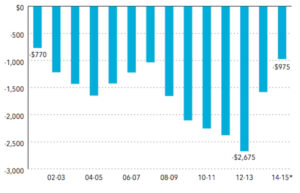
From 42nd to 29th: PROPOSITION 3o CLOSES SPENDING GAP BETWEEN STATE AND NATION – but California is still $975 below U.S. average in per pupil spending

By John Fensterwald | EdSource | http://bit.ly/1HCBVGY

Mar 23, 2015 | Revenue from temporary taxes from Proposition 30 has closed the K-12 spending gap between California and the national average by more than 60 percent, according to data released Monday (follows)  by the California Budget and Policy Center, a nonprofit research organization.

<<Source: California Budget and Policy Center - This chart shows the per pupil spending gap between California's K-12 schools and the national average over the past 14 years in inflation-adjusted dollars. It has narrowed substantially in the past two years, through revenue from Proposition 30, but is still nearly $1,000 per student below average – about what it was in 2007-08, before the recession.

The center is using data released last week (follows) by the National Education Association, and includes estimates for 2014-15, based on twice yearly surveys of the states. In 2014-15, California is expected to spend $11,190 per student, including federal, state and local revenue sources, according to the NEA, ranking the state 29th among the 50 states and Washington, D.C.

California was 42nd in spending in 2012-13, with spending of $9,013 per student.

The reason for the increase is Proposition 30, a seven-year tax increase that California voters passed in 2012. It is expected to bring in an additional $7.9 billion this year in school funding through increases in the personal income taxes of the top wage earners and a higher sales tax rate.

In 2012-13, per-student spending in California was $2,675 less than the average of the 49 other states and Washington, D.C. This year, California will spend $975 less per student, according to the center.

While subject to revision, “this is the best snapshot we have,” said Jonathan Kaplan, senior policy analyst for the center.

Earlier this year, Education Week’s annual ranking placed California 46th in per-student spending, compared with 50th the previous year.  But Ed Week’s rankings are three years old, based on data collected by the National Center for Education Statistics, and also were adjusted, using wage and salary data, to reflect regional costs of living.

Education advocates tend to cite either the NEA or Ed Week, depending on their points of view. The California Budget and Policy Center plans to issue a comparison of the two approaches in coming weeks.

Proposition 30 is set to expire within the next three years, starting with the end of the quarter-cent increase in the sales tax after 2015-16. At that point K-12 and community college revenues are expected to flatten out or, in the case of a recession, decline. The California Teachers Association and the California School Boards Association support an initiative for the 2016 ballot extending the tax or making it permanent. Gov. Jerry Brown so far has indicated he opposes renewing it.


___________________


image

_________

image

NEA Research: Rankings 2014 and Estimates 20155!03!11a[1] 

[https://www.scribd.com/doc/259865080/NEA-Research-Rankings-2014-and-Estimates-20155-03-11a-1]

8th GRADE HONORS HISTORY TEACHER SUSPENDED FOR ALLEGEDLY USING ‘N-WORD’ IN CLASS. So why do students want him back? + smf’s 2¢

by Howard Blume | LA Times | http://lat.ms/1xf4YN4

Rally Held in Support of Brentwood Teacher Accused of Making Racist Remarks

Rally Held in Support of Brentwood Teacher Accused of Making Racist Remarks : KTLA - Los Angeles

23 March 2015  9:55 PM  ::  Parents and students are pressing for the reinstatement of a veteran English and history middle school teacher who was suspended after a student accused him of making racially charged comments in class.

Carnine’s defenders call him an inspiring teacher who makes students think and skillfully uses primary historical resources in his classes, even when they contain language that would be considered offensive.

Carnine, 64, has taught in L.A. Unified since 1985, and at Revere, in Pacific Palisades, since 1991.

The accusations against him are contained in a lawsuit filed March 18 in L.A. County Superior Court against the school system and Revere by a girl identified as Maggie B. in the litigation.

The  girl began attending Carnine’s 8th grade honors history class Jan. 12. Several days later, the suit alleges, the instructor talked of racial stereotypes in an offensive way, as though they were true.

In one comment, the suit alleges, Carnine said that Michael Brown, an unarmed black man who was killed in Ferguson, Mo., “got what he deserved.” The suit alleges that, in another lesson, Carnine noted that President Lincoln was disliked for being a “n-lover.”

The court filing also claims that the school did not take concerns raised by the girl’s father seriously.

After the suit was filed, the district pulled Carnine from class.

In a statement, the district declined to comment on the specifics of the case.

“District policy is adamant that all students are to be treated with respect,” the statement said. “The safety of students is L.A. Unified’s highest priority.”

Revere students rallied during school hours Monday, prompting the principal to invite protesters to attend an assembly with district officials. Few questions were answered, said 8th-grader Will Elander.

“This teacher is really knowledgeable in his field, really experienced,” said Will, who took a class with Carnine last year. “He really gets kids. I had him. Both of my sisters had him. He’s really caring and he really means well.”

Will’s mother said she is optimistic Carnine will be reinstated. She said L.A. schools Supt. Ramon Cortines returned her call personally in an effort to understand what was going on.

“The students were talking about Abe Lincoln and the n-word,” she said, adding that she has conferred with other parents. “The n-word was spoken in class. They talked about how racism developed. He didn’t use the word against anyone in class. He was covering material in the syllabus for a U.S. history course.”

An online petition, titled “Save Mr. Carnine!” had recorded 779 signatures as of early Monday evening.

____________

2cents_small_thumb[2][1] As usual there is more+less here than meets the eye. Two questions loom large:

1. It looks like initial complaints were made long before the lawsuit was filed. One can only assume that someone was asleep at the switch and ignored student+parent concerns and sensitivity  – either that or someone had looked into this situation and determined that there was no ‘there’ there. In which case, why has the teacher been suspended?

2. …or is this another rampant overreaction by everyone – from the same wonderful folks who decided that a student science  fair project that built a marshmallow gun (of the same design demonstrated by the POTUS at a White House press event)  – violated the zero tolerance policy about firearms?

This may come as a surprise, but (are you sitting down?) PEOPLE ARE PISSED AT PEARSON! Really!!

by Alan Singer in the Huffington Post Education Blog | http://huff.to/1EOzNbu

24 March 2015  ::  Sir Michael Barber, Pearson's chief educational officer, actually became a British knight in 2005 for his role in leading marketplace "educational reform" in Great Britain. I suspect if he were good in math they would have made him a count. Barber apparently can't decide whether Pearson is leading a global Renaissance (rebirth) in education, a global revolution, or both. But in either case he believes that globalisation (he spells it like a Brit) and technology will direct the changes and we mere peasants have no choice but to go along. Sir Mike constantly writes and speaks about efficacy, the ability to produce a desired or intended result. But as you look at what is happening with Pearson and education, you see very little efficacy. Pearson's only intended result is to make more and more money. That is why so many people are pissed at Pearson and fighting back against Common Core and Pearson PARCC exams.

In Massachusetts, teachers are pissed at Pearson. Pearson wanted teachers proctoring PARCC exams to sign a "security agreement" that threatened their jobs if they failed to comply. The agreement included the warning, in the test manual and on PARCC letterhead, "Failure to abide by the terms of the agreement may result in an investigation that leads to sanctions including employment and licensure consequences, according to your state policies." The state's teachers' union demanded that the Commissioner of Education rescind the signing directive. In response, Commissioner of Education Mitchell Chester issued a memorandum that teachers did not have to sign the PARCC Security Agreement in order to proctor the test.

In New York State, university professors are pissed at Pearson. The State Education Department (NYSED) sent out a survey to University Schools of Education "to obtain feedback from New York State educators regarding the importance of the assessment competencies to the job of an educator in the above field in New York State public schools." But the survey was not being conducted by the New York State Education Department; it was being done by Pearson. Participants were instructed, "If you have any questions, please e-mail us at es-cvsurvey@pearson.com or call our toll-free number: 1-800-877-4584." The questions on the survey were also ridiculous.

Pearson wanted to know whether reviewers think teacher command of content knowledge and analytical tools in an academic field is of "no importance," "Little importance," "Moderate importance," "Great importance," or "Very great importance." Similar messages were sent to school principals. Basically, this was a pretend survey so that NYSED and Pearson could claim experts in the field were consulted in the preparation of teacher certification material.

In New Jersey, parents and students are pissed at Pearson. Pearson has contracted out the "test-security services" to a company based in Salt Lake City, Utah. Caveon Web Patrol provides Pearson with "continual, consistent monitoring (of) the internet for illicit sharing of valuable intellectual property."

Pearson's agents monitored social media and Twitter after students took a Pearson PARCC exam. They notified state education officials of a possible "security breach." The state education officials then demanded that schools discipline the students. On its website, Pearson claims "when test questions or elements of a test are posted publicly to the Internet, including social media, we are obligated to alert PARCC states. Any contact with students or decisions about student consequences are handled at the local level." By any standard Pearson goes to absurd policing extremes. According to the website, "A breach includes any time someone shares information about a test outside of the classroom -- from casual conversations to posts on social media." In Pearson world, students, teachers, and parents are not even allowed to talk about the tests in "casual conversations."

Forbes magazine reported that Michael Yaple, the director of public information for the New Jersey Department of Education, supported Pearson. According to Yaple, "Students may not realize that each test item involves a substantial commitment of taxpayer expense and a great deal of time and effort of dozens of educators in New Jersey and across the consortium who review and design each test question -- which is proprietary, copyrighted material."

A group called the Badass Teachers Association (BAT) demanded that the United States Justice Department investigate charges that Pearson's spying on children violates First Amendment and privacy rights. In New Jersey, no cheating was ever implied, only discussing the test. BAT is calling on parents, teachers, and students to email the U.S Department of Justice at AskDOJ@usdoj.gov to demand the investigation.

The American Federation of Teachers, concerned that "Big Brother really is watching," has launched a petition campaign demanding to know "who Pearson is watching, what they do with the data and what agreements they have with states to monitor what our kids are saying."

Meanwhile, NJ Advance Media has been examining Pearson/PARCC contracts with the state of New Jersey. They claim the documents show a "complex deal with more than 60 price variables that make it almost impossible to determine how much New Jersey will eventually spend on PARCC testing over the next few years." Pearson secured the contract to provide the exams without a "traditional competitive bidding process."

Also in New Jersey, a group called NJ Working Families is protesting against an $83 million dollar tax break Pearson Education received from the state's Economic Development Authority for moving 628 employees about 27 miles from Upper Saddle River to Hoboken.

In Ohio, schools are pissed at Pearson. Pearson received over 9,600 phone calls, emails and chats from Ohio districts complaining about problems administering online PARCC/Common Core-aligned English and math standardized exams after testing began in February. According to The Columbus Dispatch, "Most of the queries -- 86 percent -- were related to problems with administering the test, including registering students, getting them into online test sessions and responding to test policies and procedures such as make-up testing." Students couldn't log on, some were cut off before finishing the test, and some computers couldn't operate the system as promised. District technology staff were forced to solve problems themselves instead of waiting on the phone for a response from the Pearson help line. The scores of the spring assessments will not be available until next fall, which means they will not be useful in diagnosing the needs of individual students. The Ohio state legislature is now investigating the impact, delivery, and usefulness of the tests.

In Indiana, the Governor is pissed at Pearson. Pearson was awarded the contract to create the state's ISTEP standardized tests. But the tests are so expensive that the governor and state legislature are considering getting rid of the tests altogether.

In California, the State Education Department is pissed at Pearson. Pearson recently lost out in bidding to administer state standardized tests and is now threatening to sue. Pearson ranked lowest among the three bidders and was rated poorly in assessment development, test security and administration, technology support and its overall comprehensive plan and schedule of deliverables of the online assessments. Pearson's reputation was hurt by an ongoing FBI investigation of possible collusion in dealings with the Los Angeles Unified in a contract with Apple and Pearson to supply iPads pre-loaded with Pearson's Common Core curriculum.

In Colorado, parents are pissed at Pearson. Parents are protesting against the collection of student data by Pearson and are demanding to know how it is being used. In November 2014, high school students in Boulder walked out in protests over the PARCC exams and in the small Peetz Plateau school district nearly a quarter of the students "opted-out" of the exams.

In New Mexico, a judge is hearing a suit brought by another testing company that alleges that there were irregularities when Pearson was awarded the contract to develop PARCC tests for the state. The legal challenge could halt PARCC testing in the state. Meanwhile pissed at Pearson protesters marched on the home of State Education Secretary Hanna Skandera demanding the suspension of Pearson PARCC exams.

In New York City, everybody may be pissed with Pearson. The latest miracle math cure is a "blended" program called School of One. An airport-style algorithm makes it possible to group 120 students in a room for individualized computer-based learning with minimum teacher involvement. The program includes "a library of 12,000 lessons, some created by its staff, but most bought à la carte from companies like Pearson and IXL." The only problem is that School of One is "expensive, and not yet proven effective."

An elementary school teacher on Long Island in New York, a former test developer for Pearson, analyzed questions on the third grade Common Core reading test and discovered that the reading level of passages and questions was as much as two years above grade level. He wrote, "It is clear the Common Core state tests have no regard for the most widely understood testing principle -- write questions that are on grade level ... Imagine giving 3rd graders 6th, 7th, and 8th grade level questions and thinking this is somehow the proper measure of their growth or their teacher's instruction."

According to G. F. Brandenburg, a retired Washington DC math teacher who now blogs on educational issues, Pearson and Common Core advocates are designing math tests that result in "mass failure" so they can "proclaim that public education is a failure and must be abolished."

G. F. Brandenburg may be right. Pearson is already investing in building a chain of private for-profit schools in third world countries including South Africa, the Philippines, Ghana, and India.

Financially, Pearson may not being doing as well as it claims. Pearson reports its adjusted profits have increased, but in February it appointed a new chief financial officer when it became clear that in 2014 its net profit fell by almost 9% from the previous year, roughly $100 million by my calculations. Sales declined by 7% in Pearson's education business. Pearson generates about three-quarters of its revenue from sales to schools and school districts.

If you are pissed with Pearson, know you are not alone. There actually is a website, Pissed Consumers, with a special Pearson Education page with complaints ranging from broken CDs to online sites that do not function and poor customer support. New York State student teachers who have been blocked from certification, because Pearson still has not graded tests administered in September 2014, can post complaints here. But you should also contact your elected state officials and you can call Pearson customer service directly at 800-848-9500. Flood their lines. Pissed with Pearson, let's keep them on the run!

headshot[1] Alan Singer, Director, Secondary Education Social Studies
Teacher Education Programs
128 Hagedorn Hall / 119 Hofstra University / Hempstead, NY 11549

Blogs, essays, interviews, and e-blasts present my views and not those of Hofstra University

Sunday, March 22, 2015

GRANADA HILLS HIGH WINS STATE ACADEMIC DECATHLON: El Camino is 2nd, South Pasadena 3rd, Marshall 4th, Franklin 5th, Garfield 7th

Thomas Himes | LA Daily News | http://bayareane.ws/1xr3wYs

3/22/2015 05:11:41 PM PDT | SACRAMENTO >>In its quest for a fourth national title, Granada Hills Charter High School defeated neighboring rival El Camino Real Charter High School on Sunday to claim victory at the 36th annual California Academic Decathlon.

The Granada Hills team will represent California when it competes against teams from 49 other states next month, April 17-19 in Garden Grove.

“They wanted it and they risked a lot to get it,” Granada Hills Coach Mathew Arnold said. “But this is the ultimate validation to all the work we put in.”

El Camino Real Charter High finished in second place, while South Pasadena took third place and Alhambra’s Mark Keppel High finished ninth. The only school to place from San Bernardino to place was Chaffey High School, which ranked 10th in scoring

Three more teams from Los Angeles Unified finished in the top 10 including: Marshall High School finished fourth.

Franklin High School took fifth and East Los Angeles’ Garfield High School take seventh place

Saturday, March 21, 2015

HIPSTERS FOR CHARTER SCHOOLS: The big lie “Togetherness” tells about race and education


Rich whites run charter industry and funnel them cash. On HBO, it's a post-racial bandwagon gutting public schools

by Joshua Leibner in Salon |  http://bit.ly/1bl874n

Hipsters for charter schools: The big lie "Togetherness" tells about race and education

Michelle Rhee; Melanie Lynskey in "Togetherness" (Credit: AP/Jacquelyn Martin/HBO/Jaimie Trueblood)

Saturday, Mar 21, 2015 06:29 AM PST  ::  Michelle Pierson, a 40-ish mother of two, is in a state of confusion over her the direction in life and finds herself wandering down the main drag of her gentrifying, hip Northeast Los Angeles neighborhood. She hears a confident voice coming from Eagle Rock City Hall that entices her in.

Inside, David Garcia, a handsome, charismatic Latino, is speaking stirringly to a group of concerned parents. He says, “There’s like bird shit all over the place — I mean you got kids eating five-day-old sloppy joes. Our public school system is broken. I don’t think we can fix the old schools but I’ll tell you what we can do. We can build a new one. Isn’t a great school no more than a box and an inspired teacher inside of it? We need a great charter school here in Eagle Rock. Let’s create a place for our children to flourish. There’s a big empty hole in our community. And if we don’t do anything about it, our kids are going to be more disenfranchised and lost than we are now.”

Michelle is entranced, and suddenly her life has found a purpose.

Charter school dogma has made it to the Big Time: It just got its own soapbox on the Duplass brothers’ HBO Sunday night series “Togetherness.”

The one thing the aging-hipster parents know of their school district, Los Angeles Unified, is its “broken-ness” — and by extension, the rest of America’s obsession with that term. These “thoughtful” parents don’t waste one breath discussing the possibility of their white middle-class children attending their neighborhood school, saving it instead for lengthy wails of anxiety about private school applications and liberal guilt about isolating their kids from “the community.”

Who cares what a Hollywood show about “disenfranchised and lost” film industry workers and their precious progeny does?

We all should, because “Togetherness” very much reflects the state of national discourse on education and its corrosive effects on public schools, particularly as it has played out in Los Angeles. (I taught in LAUSD public schools for 20 years.) The show also presciently mirrors a current school board race in that district that is pitting a charter school reformer against an old-time public school advocate.

With “Togetherness,” we witness the battle through the intersection of art, politics, race and class.


The show’s creators, Mark and Jay Duplass, are the very talented Hollywood powerhouse titans of smart, artsy films about the white middle class and its obsessions; their work dominates Sundance and they have a four-picture deal with Netflix. The brothers also live in Eagle Rock, Los Angeles School Board District 5, and that’s where they’ve set “Togetherness.” It also happens to be where I live and will send my son to school when he is old enough. Although the show is ostensibly about the marriage and lives of Hollywood sound man Brett and his wife, Michelle, the charter school plotline is enlightening and can be discussed in light of not only LAUSD’s relationship to these characters, but to the nation as a whole.

The charter school speech-maker, David Garcia, an aspiring politician, begins with the mantra that has been drummed around the country for the last 20 years: “Our public education system is broken.”

Is it broken in Palos Verdes? In Beverly Hills? In Malibu? Or any of the richer districts that surround L.A.?  No, but definitely, apparently, in Eagle Rock.

Michelle goes up to David after his speech and says, “My daughter is going to start kindergarten and we’re talking about where is she going to go… what is she going to do… I’m wondering why is there not some community place — somewhere I can put her and feel good with a lot of different people. I don’t want to put her in a private school where she doesn’t get to experience what life is like where we live. I mean why is there not a great place?”

The Eagle Rock public schools are obviously not an option for Michelle. Our local elementary schools — Eagle Rock, Rockdale, Dahlia Heights — get conflated into the fictional “Townsend Elementary,”  and are clearly not gonna cut it. It goes without saying.

Michelle has previously been shown speaking longingly to her husband, who has all but decided to put their kid in private school: “Don’t you want her to be in a different kind of community with kids of different colors and economic backgrounds?

That obviously — to these characters and to many real life members of their demographic — isn’t the public schools.

But why not? One LAUSD school board member has said pointedly that “maybe it’s time for the district to look in the mirror and figure out what can be done within district schools to make parents less eager to remove their children into charters.”

True enough. And maybe it’s time for charter school advocates to look into their own mirror.

Is it, could it actually be, the “bird shit” and “five-day-old sloppy joes”? No, because episode 6 demonstrates how hard Michelle is willing to work to find and clean out an old building for the new school. Surely, cleaning up some bird feces at an already functioning facility and agitating for better food — or packing a lunchbox — would have been much easier.

Is it because a bloated school bureaucracy is truly causing these parents to be “disenfranchised and lost”? Not really, because when David and Michelle finally make their impassioned plea for a charter to the public school commission in Sacramento, they are met with misty-eyed commissioners and an implied approval.

Could it be — gasp! — race, or class? Eagle Rock Elementary School is only 17 percent white, with 57 percent of the kids qualifying for subsidized school lunches.

No, no, no, no! the series replies. In the final episode, there is Michelle leading a post-racial bandwagon, driving up to Sacramento to argue their case. Along with David, the show’s sole Latino, there’s a gay Asian political consultant and a black principal who will fight for this charter. They all bond over a car karaoke hit.

Wealthy white people, as a rule, control the charter school industry across the country. White people run the billionaire philanthropic foundations that funnel money into charter schools. White people dominate the editorial boards of the major urban papers who sympathize with charter school interests. But, in a smoke-screen that has also been used in real life, we get well-spoken, dynamic David as our charter spokesman for the show.

Class, he and the show simply never address.

Neighborhood schools have become the bogeyman for all of society’s social failings, particularly from a class of moneyed interests who share both Democratic and Republican affiliations. For Brett and Michelle Pierson and many white parents of their education and class, all the education reform nonsense might “feel right” for minority kids — but just not for their children. The reality is that these power parents, who share a kinship with almost all of L.A.’s economic, political and media elite, do not want to send their own kids to a school that neo-liberal mayors of Chicago, Washington, D.C., and New York, who aggressively pursued the reform agenda, created for the working-class kids of color they “served.” All these cities had school superintendents who believed in a different pedagogy for poor kids.

These are schools with ever-growing class sizes, maligned teachers, schools obsessed with standardized test-based “rigor,” stripped of arts, music, field trips, nurses, janitors, counselors, libraries, physical education, integrity, or as Education Secretary Arne Duncan might put it, “air.” They are schools deprived of much-needed physical repairs and teachers deprived of support and training in favor of ill-considered technological quick-fixes (the quicker the better!). Schools that have fallen victim to “market-based” reforms imposed without a shred of evidence of pedagogical effectiveness, except the fantasies of economists and billionaire businessmen who demanded them in the first place.

There is much more that can and has been said about the larger economic and political forces at work in the “reform” movement, and particularly the charter school industry. The sad reality is that almost anything can be imposed on the neighborhood schools of poor kids of color — testing, school closing, inexperienced “revolving door” teachers — because those parents simply do not have the same economic or political clout as their white counterparts. Race and class majority issues are profoundly uncomfortable, to the point of taboo, to speak about in these contexts.

Let us substitute instead, as does “Togetherness,” a code phrase: “test scores.”

As a viewer who flips back and forth from fantasy to reality versions of Eagle Rock, I wonder if the Piersons ever investigated the elementary schools in Eagle Rock. If they did, my bet is the  reason they found them lacking was because middle-class whites weren’t the majority. The school automatically became suspect, and they used “test scores” — whatever the hell that means! — to justify looking elsewhere. “Test scores” are code words for minority underclass.

The political consultant in the car tells David, “You have to convince them that we’re gonna deliver way higher scores than Townsend Elementary, and with Anita’s track record we got a shot.”

We are left with two fantasies: that test scores (tests designed and scored by for-profit corporations, again without regard for pedagogical soundness) can be somehow divorced from neighborhood contexts of poverty, immigration status, English language proficiency, etc.  And that a great school is “no more than a box and an inspired teacher inside of it.”

It’s easy to see why these fantasies are comforting, and why they have been so useful for certain political ends.

Parents like Michelle and Brett don’t have time to ask big policy questions about school funding inequity and collective responsibility. They — like everyone — want what’s best for their own kid, and believe they are acting on it. They seek out an alternative that they believe they can control — their own school.

When David Garcia finishes his impassioned speech before the overwhelmingly white Sacramento State Ed board, the chairman is savvy enough to recognize Garcia’s political ambitions and ask who will actually be running the proposed charter school.

The members of the Rainbow Coalition look at each other nervously. They have clearly never considered this. Anita, even with her “track record,” stays quiet.

Michelle nervously comes to the podium to declare that she — a mom with some “background in social work” — will be the “main man” at the school. She starts hesitantly, but gets stronger as she concludes: “It’s valuable to all our families who are eager to stay in Eagle Rock. They just need a good reason. This school is that reason. I find it very hard to accept that of the 100 charter schools in the state, not one is in my district when we need it more than most. I want to stick in and fight for my community. I do, but if we don’t get a good school then we are going to be forced to move like so many of our friends have. My kids need this school. Our community really needs this school and I need this school.”

Setting aside the grotesque assertion that Eagle Rock needs an alternative to its neighborhood public schools “more than most,” the notion of “community” put forward by Michelle here encapsulates the most insidious aspect of the charter school movement. With the exception of white middle-class children whose parents enroll them elsewhere, Eagle Rock public school demographics represent the racial and economic diversity of Eagle Rock community very well.

Though it must never be said out loud, this community is too much for the vision of Michelle’s “community.”

Michelle’s liberal conscience prods her to speak appreciatively about color and class diversity, but when that aspect of Eagle Rock’s community collides with her “community,” she wants to use a charter school to regain a sense of control.

The scenario is familiar in LAUSD from some of the charter school skirmishes on the West Side with parents with clout and power arguing for co-locations. This dinner table discussion is familiar to plenty of educated, middle-upper class parents in urban districts who would like to consider a local school — but…

Many are too busy in their own lives to do the true hard work of making public education better, so they leave it to “organizations” with a glossy spiel to do the heavy lifting and then sign up with them. Then they convince themselves that this is the best thing for their kid, and once that decision is made, they have a vested interest in believing it to the point where now they will do the hard work to preserve what they have for their kid.

And the show’s State Board of Education appears to lap it up.

If “Togetherness” showed the slightest shred of self-awareness, we might interpret this subplot as a radical critique of the worst elements of the charter school movement: its hollow rhetoric and pedagogical vacuity, its appeal to narrow self-interest, the way it divides communities and the way the state has embraced all of it uncritically for political (financial) ends.

Instead, it’s clear that the Duplass brothers and their characters are speaking completely un-ironically and obliviously about all their (now cliché) white privilege and entitlement and, yes, racism and classism in defining what constitutes “good” for them. With HBO’s endorsement, they believe (hope) that they are speaking for and to an affluent white audience who are rooting for these characters.

Michelle Pierson’s narcissistic appeal on behalf of the Eagle Rock Charter reveals her entire world view — that she and her kids ARE “the community” — and much of the charter school movement depends on that view.

Like everything else, art plays out on a socio-economic battlefield. You may not watch “Togetherness,” but people who shape the culture and economy do.

And the viewpoints depicted in the show trickle down Colorado Blvd. to L.A’.s District 5 school board race and join the debate throughout the rest of the country.

We should all be very, very concerned with the type of “togetherness” we are being sold here.

I invite my fellow citizens of Eagle Rock — the entire, real community — to work together to save our neighborhood public schools.

Even when it is sometimes from ourselves.


  • Joshua Leibner is a National Board Certified Teacher who taught English, Film and Philosophy in the LA School system for twenty years. He lives in Eagle Rock/ Bennett Kayser's district/ ESC East -- the setting of both the fictional HBO series and the latest real life fight for L.A. schools.