Saturday, November 22, 2014

CORTINES APPROVES NEXT PHASE OF LAUSD iPAD PROGRAM …but returns the armored vehicle

by LA School Report | http://bit.ly/1xD7hHl

LAUSD Superintedent Ray Cortines

LAUSD Superintedent Ray Cortines

November 21, 2014 5:35 pm  ::  Let the iPads roll. Again.

LA Unified Superintendent Ramon Cortines today approved moving ahead with the next phase of the district’s iPad program, officially known as Phase 2B of the Common Core Technology Project.

It’s actually, iPads et. al.

The goal with this action is to complete the second round of buying digital devices by equipping teachers and students at an additional 27 schools with learning devices. That brings the total to 85 district schools with iPads or, in the case of the Phase 2B buy, other digital devices, such as Chromebooks.

The total reflects 47 schools receiving iPads in Phase 1 and 11 in Phase 2A, which was halted by former Superintendent John Deasy after questions arose about the procurement process.

The cost to date: $114 million, which covers devices, keyboards, charging carts, testing devices, and the laptop pilot program for 21 high schools.

In this latest phase announced today, each school will have the option of buying devices that the principal and teachers deem best for their students. And the district intends to sustain that approach going forward.

District officials said they expect this latest round of devices to reach students by February.

“Our students deserve the best tools available to meet the requirements to be successful in the 21st century workforce,” Cortines said in a statement. “Without the appropriate tools, they will be disadvantaged compared to their peers across the entire nation. We also need to keep the dialogue open with our schools. We want Phase 2B to provide more options than previous phases so that our students are fully utilizing the most appropriate and current devices available.”

Unlike iPads being purchased under a new request of $13.3 million from the Bond Oversight Committee for computerized testing at the end of the academic year, the Phase 2B devices will be loaded with instructional software.

The list of schools scheduled to receive new devices is here.

image


LAUSD sending iPads, laptops to 27 more schools

Annie Gilbertson | KPCC 89.3 | http://bit.ly/1xD8TkC

69379 full

The Los Angeles school district is expanding its iPad program, adding 27 schools to those outfitted with tablets or laptops. DAMIEN MEYER/AFP/Getty Images

Audio from this story:  0:46 Listen

November 21, 06:51 PM   ::  Los Angeles school district superintendent Ramon Cortines is expanding the iPad program to 27 more schools, the second round of computer purchases announced this week.

Without seeking new bids from tech companies for the latest purchases, the district may need to rely on a controversial contract with Apple that former Superintendent John Deasy said would be canceled.

"Our students deserve the best tools available to meet the requirements to be successful in the 21st century workforce," Cortines said in a statement on Friday.

Before a bond oversight committee Thursday, Cortines requested $22 million worth of iPads and Google Chromebooks to allow students to take new digital state tests.

In the latest announcement, the superintendent declared he would tap into a $114 million fund (allocated in January) to extend the school technology program to 27 more schools. That would bring the total of schools outfitted with tablets or laptops  to 106 of the district's more than 800 schools.

Deasy spearheaded the effort to supply all students with a tablet, but the program stalled after reports of missing iPads, inadequate school WiFi and a controversial contract with Apple.

KPCC found Deasy had close ties with executives at Apple and Pearson, the manufacturer of the curriculum software loaded onto many of the tablets.  KPCC reported in August that email conversations between top district staff and the vendors resembled bidding requirements, calling into question whether the bidding process was fair.

Deasy canceled the contract three days later, stating the district would reopen the bid. It hasn't.

"There was no need to cancel the contract," said Mark Hovatter, LAUSD chief facilities executive, on Wednesday. "We believe we got the best value."

Purchases under the latest two announcements allow for principals to choose their preferred device for their schools. Shannon Haber, a district spokeswoman, said the officials were still deciding whether to expand offerings beyond iPads and Chromebooks.


LAUSD school police return armored military vehicle, which is now in Barstow

By Thomas Himes, Los Angeles Daily News | http://bit.ly/1xDa7w3

The Los Angeles Unified School District has returned the $733,000 MRAP military personnel carrier it received from the federal government that looks like this one now owned by the Whittier Police Department. The LAUSD's MRAP is now in Barstow. (File photo by Keith Durflinger/Whittier Daily News)


Posted: 11/21/14, 5:24 PM PST | Updated: 11/22  ::  Los Angeles Unified’s school police have returned their armored vehicle after community outcry over a federal program that sent military weapons to local law enforcement agencies.

That “1033 program” came under scrutiny in the wake of scenes from Ferguson, Mo., where police confronted protesters with military weapons.

The school police had also accepted battle-ready weapons.

After returning three grenade launchers in September, School Police Chief Steven Zipperman said Friday he sent back the mine resistant and ambush proof (MRAP) vehicle his department received in June.

“We’ve decided that particular vehicle, based on its sheer size and maneuverability and the resources it takes to operate it, wasn’t viable for us,” Zipperman said.

At nearly 20 feet long, the more than 14-ton vehicle was designed to keep troops safe during ambushes in which enemies would blow up the lead vehicle of a convoy, while raining down gunfire on Marines and soldiers who were trapped.

School police wanted the MRAP to rescue people in the event of a wide-scale attack that would prevent other law enforcement agencies from responding to campuses, Zipperman said.

With a value of $733,000, the vehicle seemed a cost-effective alternative to armor-plated vehicles built for civilian use, which cost $300,000, Zipperman has said. However, the cost of maintenance and certifying a driver played a role in Zipperman’s decision to send the MRAP back to state officials who administer the federal program, he said.

State officials transferred the MRAP to the Barstow Police Department last month, said Alex Pal, an attorney in the Governor’s Office of Emergency Services.

As for a replacement, Zipperman said, the district will consider obtaining a used armored car and other cost-effective alternatives.

Manuel Criollo of the Community Rights Campaign has been advocating for LAUSD police to destroy its military arsenal, as part of efforts to demilitarize law enforcement across the city.

“We’re trying to demilitarize all police in Los Angeles, so clearly it’s an important breakthrough they’re returning the MRAP vehicle that was made for Iraq and Afghanistan and had no place on school grounds,” Criollo said.

Last month his organization sponsored a protest near Manual Arts High School in Los Angeles. Youths who turned out for the demonstration told stories of how police patrol their neighborhoods in military gear, he said.

“It’s a real thing,” Criollo said. “It’s not just that people are fearing their right to protest and the reaction of police, but we see a lot of this military equipment in use.”

The Community Rights Campaign has requested an inventory of all weapons possessed by LAUSD.

The school district previously returned three 40mm grenade launchers that were used for fighting in the jungles of Vietnam — and obtained by LAUSD in the months following Sept. 11, 2001 — as a means to fire less-than-lethal rounds that could disperse crowds in civil unrest, Zipperman has said.

However, LAUSD’s armory still contains M16 rifles received through the program. The 61 fully automatic rifles were converted to semi-auto and are used in training by officers seeking credentials to fire assault rifles, he said.

Zipperman said his department is in the process of providing public records that will detail the district’s weapon inventory. Once that happens, Criollo wants the school board to ensure all of the weapons are either destroyed, disassembled or returned to the Department of Defense, according to a Nov. 10 letter he sent to board members.

The Community Rights Campaign is also part of a coalition of groups urging the federal government to end its 1033 program.

U.S. Navy Vice Admiral Mark Harnitchek wrote that state agencies decided how to distribute weapons to local agencies. However, Harnitchek notes that he fully supports President Barack Obama’s decision to review the program.

“I have directed my staff to cooperate fully with the review as I strongly support ensuring transfers of Department of Defense materials for law enforcement activities strike a proper balance of accountability and need,” Harnitchek wrote in an Oct. 17 letter.

Since 1993, Southland law enforcement agencies have collected $150 million worth of military gear, according to a database maintained by the Governor’s Office of Emergency Services. More than $4.2 billion in equipment has been given away nationwide since the 1990s, according to an Associated Press report that found a disproportionate share went to police departments in rural areas with few officers and little crime.

While federal authorities previously released a database detailing equipment giveaways to county law enforcement agencies, a database detailing equipment collected by local police is expected to be released any day, Pal said.

As police prepared to react to civil unrest in Ferguson, U.S. Attorney General Eric Holder on Friday urged officers to show restraint.

“The Justice Department encourages law enforcement officials, in every jurisdiction, to work with the communities they serve to minimize needless confrontation,” Holder said.

ALEC: John Oliver explains it all for you

November 22, 2014  ::  Diane Ravitch writes in her blog:  “ John Oliver has some of the smartest political commentary on television. In this Youtube video, he explains ALEC, (The American Legislative Exchange Council) the corporate-funded organization that writes model legislation for states to benefit corporations and defund the public sector. One of every four state legislators, Oliver says, belongs to this secretive group that promotes privatization. ALEC supports charters and vouchers and test-based teacher evaluation. It opposes teacher tenure and unions. For some inexplicable reason, ALEC is tax-exempt.”

4LAKids is hiding behind Dr. Ravitch here because Mr, Oliver uses a naughty word that the LAUSD e-mail censors would block if they could hind it embedded in the video.

“The email you attempted to send to a member of the LAUSD community has been
rejected because it contains a word that has been associated with adult-oriented
spam.”

Mr. Oliver is a Brit and they spell the word differently over there – maybe the NetNanny anti-Spam firewall wouldn’t detect it?

Let’s just say the video is NSFS [Not Safe for School) – and 4LAKids does not condone broadcasting it on the AllCall ConnectEd phone broadcast link home or the school PA system.

Especially at Palisades Charter High School where  the cranky neighbors are listening. (Apparently they didn’t notice there was a high school next door when they purchased their homes.)


Friday, November 21, 2014

L.A. SCHOOLS WILL PAY VICTIMS IN CHILD ABUSE SCANDAL $139 MILLION – not including $30 million previously awarded and its own legal costs.

By Stephen Ceasar, Corina Knoll, LA Times | http://lat.ms/1taR4E4

 Mark Berndt
Former Miramonte Elementary School teacher Mark Berndt, 62, right, in court in November 2013, pleaded no contest to 23 counts of lewd conduct with students at his school. (Mark Boster / Los Angeles Times)

Nov 21, 2014 11:42 AM  ::  The L.A. Unified School District will pay out $139 million in settlements in the Miramonte Elementary School child abuse scandal, bringing nearer to a close the costly and lengthy case that led to changes in state law and district policies, attorneys said Friday.

The payouts will go to settle about 150 legal claims from former Miramonte students who were subjected to third-grade teacher Mark Berndt's lewd acts and their families.

"We hope that this will help the community heal and move forward," said L.A. Unified general counsel Dave Holmquist. "We really want the community to feel healed by this."

The court will independently review each claim and determine the appropriate amount for each of the 81 families involved.

Attorney John Manly, who represents 38 children and 25 parents who sought damages, said the settlement showed that the district taking responsibility for its failures.

We hope that this will help the community heal and move forward. We really want the community to feel healed by this. - Dave Holmquist, L.A. Unified general counsel

It “shows a level of culpability and contrition by the district that is appropriate, and the hope for all of us is that it will lead to reforms so this doesn’t happen to another child in Los Angeles.”

L.A. Unified Supt. Ramon Cortines said he believed the district would continue to work with parents and communities to better protect students. The agreement balances the goal of sparing children the trauma of a trial with that of reaching a fair settlement, he said.

“There is nothing more important to us than the safety of the students we serve,” Cortines said. “Our goal from the outset of these appalling revelations has been to spare the Miramonte community the anguish of a protracted trial, while at the same time being mindful of the financial consequences stemming from settlements. Given these circumstances, we believe we struck a balance between those objectives.”

Berndt pleaded no contest to the abuse charges a year ago and was sentenced to 25 years in prison, but the case against L.A. Unified has dragged out.

Dozens of claims were settled last year for about $30 million, but a contingent of parents and students opted to take their grievances to civil court, accusing L.A. Unified of not doing enough to protect students after receiving past complaints about Berndt.

Jury selection in the case began Monday, still L.A. Superior Court Judge John Shepard Wiley continued to push both parties to reach an agreement. The Board of Education met behind closed doors Tuesday evening to discuss settlement terms.

The case triggered a review of employee files going back decades in an effort to rid the district of potential problem employees. L.A. Unified also submitted, or resubmitted, hundreds of reports of alleged misconduct to the state Commission on Teacher Credentialing.

Reports of possible misconduct ballooned. The week before Berndt's arrest there were 19. The following week yielded 77, according to district records.

Then-Supt. John Deasy removed scores of teachers from their classrooms. A zero-tolerance policy for employee misconduct was enforced.

The teachers union charged that the district was overreacting, holding teachers allegedly involved in misconduct in what they called "teacher jails" for far too long without giving them information on their cases and unjustly firing other instructors.

L.A. Unified also temporarily replaced the entire staff at Miramonte in the second half of the school year, and required all employees to take a course on the reporting of abuse.

In January, the district assembled a team of experienced law enforcement investigators to take over probes into sexual abuse. The team has since investigated dozens of new allegations and has operated at a quicker pace than when investigations were left to principals, according to figures provided by the district.

In direct response to the Miramonte case, Gov. Jerry Brown signed a bill earlier this year aimed at speeding the dismissal of public school teachers for gross misconduct.

At the center of the scandal was a teacher who was once invited to students' birthday parties and quinceaƱeras. Fond of Hawaiian shirts and class field trips, Berndt was known to hand out lollipops and silly nicknames. He joined children for dodgeball games, sent them holiday cards and managed to turn seemingly mundane topics into interesting lessons.

But in the fall of 2010, a drugstore photo technician processed a photo that showed a child blindfolded and gagged with clear tape. Other photos showed a spoon filled with a milky liquid, which was also seen in and around children's mouths. Los Angeles County sheriff's investigators began quietly looking into Berndt.

A detective found a spoon in Berndt's classroom trash can that looked like the one in the photos. It tested positive for traces of semen that matched Berndt's DNA.

Authorities later found that Berndt had been the target of a 1994 police investigation in which a girl accused the teacher of reaching toward her genitals while she was taking a test. Prosecutors had determined there was insufficient evidence to file charges.

Two women who said they had been Berndt's former students in the 1990s came forward after his arrest and said they saw the teacher masturbating behind his desk. They said they informed a school counselor who advised them to stop making up stories. Other former students recalled to the Los Angeles Times that the teacher had a habit of putting his hand inside the waistband of his pants and that he often perched himself on the steps near the playground, his legs splayed wide.

Court documents released last month revealed that a parent had complained about Berndt as far back as 1983. The parent told the principal at the time that Berndt had dropped his pants during a student field trip to a museum. The principal made notes about the incident in a memo, but Berndt remained on staff.

"Thanks again for the support you gave me," Berndt wrote in a note to the principal. "I did learn at least one thing for sure! Not to take students to the museum while wearing baggy shorts!"

A 512-page report based on a two-year inquiry by the sheriff's department was also filled with allegations that Berndt touched children in a sexual manner and urged them to reciprocate. "There is a suggestion in the police report that Berndt watched videos of bondage of women, and that his taping of children was for Berndt some version of sexualized bondage," Judge Shepard Wiley wrote about the report.

In 2008, the district destroyed about 2,000 reports containing abuse allegations because officials determined that state law banned them from possessing the forms because of privacy rules, according to an L.A. Unified spokesman

LAUSD TEACHERS RALLY FOR PAY RAISES, SMALLER CLASS SIZES

By Thomas Himes, Los Angeles Daily News  | http://bit.ly/1At6Y4o

Chatsworth High School history teacher Jim Hayden carries a Navy Jack flag to a rally in front of Monroe High School in North Hills in support of pay raises and improvements to other working conditions at LAUSD schools, Thursday, November 20, 2014. (Photo by Michael Owen Baker/Los Angeles Daily News),

Chatsworth High School history teacher Jim Hayden carries a Navy Jack flag to a rally in front of Monroe High School in North Hills in support of pay raises and improvements to other working conditions at LAUSD schools, Thursday, November 20, 2014. (Photo by Michael Owen Baker/Los Angeles Daily News),

Harvey Abram, a teacher at Van Gogh

Elementary School in Granada Hills, carries a sign with teachers marching along Nordhoff Street at Monroe High School during a rally in support of pay raises and improvements to other working conditions at LAUSD schools, Thursday, November 20, 2014. (Photo by Michael Owen Baker/Los Angeles Daily News)

Posted: 11/20/14, 8:08 PM PST  ::  Kicking off a series of “escalating actions,” thousands of teachers from across Los Angeles rallied Thursday in support of union demands for a pay raise, smaller class sizes and other points of contention in contract talks with the nation’s second-largest school district.

At Monroe High School in North Hills, about a thousand teachers carried signs and sang “We Will Rock You” to music blaring from loudspeakers on a flatbed truck on Haskell Avenue, which was closed for the rally.

“The fact that we got a huge turnout in four other locations shows that educators, students and parents around the city are ready to fight for our demands,” United Teachers Los Angeles President Alex Caputo-Pearl said at the North Hills event.

The 35,000-member union and Los Angeles Unified School District remain at odds over key issues, including teacher demands for an immediate 10 percent pay raise and district efforts to implement an evaluation system that scores educators, in part, on the performance of their students.

“The teacher evaluation is unfair. It was (former Superintendent John) Deasy’s autocratic way of doing business. That’s why he’s out,” said Manuel Reyes, a fourth-grade teacher at O’Melveny Elementary School in San Fernando and who has taught in the district for 15 years. “We haven’t had a raise in seven years.”

Talk of a strike among union leaders and members continues. UTLA last walked off the job in 1989. That protest lasted nine days.

While Superintendent Ramon Cortines plans to work toward certain union requests, including smaller class sizes under an effort he has said will be evident on campuses when students return for second semester, he is standing by the pay package his predecessor offered.

Under a three-year deal, teachers would collect 6.64 percent in pay raises spread over the next 20 months and, additionally, a one-time bonus equal to 2 percent of their current pay. Before abruptly resigning, Deasy said the district would need to cut costs elsewhere to finance the raises. Meeting union demands, which previously stood at 17.6 percent, would bankrupt the district, Deasy had said.

Under UTLA’s current request, teachers would receive an immediate 10 percent raise and re-open negotiations for increases in coming years.

The two sides head back to the bargaining table Dec. 4.

LAUSD BOND PANEL OKs ANOTHER $25 MILLION FOR MiSiS, DEVICES + smf’s (very costly) 2¢

by Vanessa Romo, LA School Eeport | http://bit.ly/1z31Ob0

Chief Strategy Officer Matt Hill

Chief Strategy Officer Matt Hill

Posted on November 20, 2014 3:44 pm  ::  The LA Unified Bond Oversight Committee today agreed to approve another $25 million in bond fund spending to help the district fix MiSiS problems and equip schools with computers for standardized testing in the Spring.

A team of district officials, including Superintendent Ramon Cortines, made lengthy presentations to the nine member committee, insisting that in both cases the district would fail to comply with state and federal mandates without the additional financial help.

About $12.1 million of the money approved today is intended to provide a series of temporary “band aids” for MiSiS that will cover the costs of fixing bugs, stabilizing district servers so they can handle high volumes of traffic, and adding customer support and help desk staff. It will also pay for the implementation of MiSiS at the district’s charter schools, which the district has delayed doing despite a legal obligation.

“That part has been really difficult to do,” Chief Strategy Officer Matt Hill told the committee, referring to computer systems that would prove incompatible with MiSiS. “What we found is that the charter systems have bolted on other applications and tools to their data management systems and given the number of charters we have, it’s very difficult to get them into MiSiS.”

Hill estimates it will cost about $1.3 million to integrate them into the student data management system.

Earlier in the week, Cortines announced he would be asking the bond committee for $53 million, but today he said the district had revised the figure, pending an assessment of future needs by MiSiS team leaders.

“We are being prudent and responsible by only requesting enough funding to carry us through February 2015,” Cortines said. But he added that he will return to the committee in January to request more support.

“At this point, we don’t know what we don’t know,” he said. “In January we’ll have a better idea of what we’ll need for the rest of the year.”

The committee also gave the go-ahead for disbursing another $13 million to buy a combination of iPads, keyboards, Chromebooks and device carts in anticipation of the Smarter Balanced tests in the Spring.

All students in third through eighth grade and all 11th graders are required to take the computer exam this year. Last year only a small fraction of district students took the test, and a review of the field test found a slew of problems preventing students from completing the test. The most common complaint was that students were not able to connect to the internet.

The district’s plan is to spend the $13 million as well as an additional $9.2 million it has in reserves from the last batch of approved bond funds to buy approximately 20,000 testing devices. Unlike the tablets and computers purchased under the one-to-one program, these will not be pre-loaded with instructional curriculum.

Cortines assured the committee that, like the testing devices purchased last year, these will also be available for instructional use once the Smarter Balanced tests are completed. However, three months into the school year, many of those  tablets have yet to be delivered to classrooms.

Although, several committee members expressed skepticism over the district’s timeline for purchasing and deploying the devices, Cortines assured them they would arrive by January, giving students ample time to become familiar with them.

“It’s not fair to this community and the children that they’ve been denied the ability to practice while other districts have been practicing all year,” he said.

Principal Jose Huerta from Garfield High School put a finer point on it.

“Our teachers and our students have put in great effort into teaching and learning the Common Core standards and this is our chance to show that off,” he said. “But without the appropriate conditions and the right technology to take the test, we won’t be able to do that.”


2cents small “We don’t know what we don’t know”: In fairness and reality, the superintendents ask of  $12.1 million over the originally stated ask of $53 million is NOT a reduction. The $12.1 million will cover MiSiS triage and emergency treatment (‘band-aids”) only though Feb 15, 2015 – there will be additional costs to complete MiSiS recovery and rehabilitation  and it is extremely doubtful that the total will be less than $53 million. It also must be noted that these costs only account for bond-funded MiSiS expenditure …there is substantial general fund costs associated with MiSiS Crisis recovery also.

Wednesday, November 19, 2014

FRIEDRICHS v. CTA: Was Labor’s biggest mistake not organizing the Federal Judiciary?

2cents small What’s the opposite of local control? Distant chaos? Can it get more distant than to have the Supreme Court in Washington DC decide educational policy in California? Was the International Court of Justice in the Hague too busy?

4LAKids is not a fan of letting educational policy be set in union negotiations and enshrined in the teachers’ union contract. In my perpetual Pollyanna  position I would like curriculum, pedagogy and education policy to be set by the Board of Education in the clear light of open board meetings within the context of the California Ed Code rather than by Collective Bargainers hammering out and constantly renegotiating the union contract in all-night marathon bargaining sessions behind closed doors.

If folks are going to be spending all night at something it should be helping with homework or assembling stuff that says ‘some assembly required’! Plus, we all know that cigar smoking and bourbon whiskey drinking goes on behind closed doors. And worse!

Speaking of worse, here's an example of how to get all the way to worst:

from Politico Morning Ed | http://t.co/D8TwNY4SY1

19 Nov 2014  :: NEXT STOP: SCOTUS? A case challenging California state law mandating that teachers pay compulsory union dues now has a chance at being heard by the U.S. Supreme Court. A three-judge panel of the U.S. Court of Appeals for the Ninth Circuit issued an order [http://bit.ly/1tbgCA2 ] Wednesday allowing the plaintiffs in Friedrichs v. California Teachers Association to petition the Supreme Court for a review of their case. The appeals court had to reject the teachers' argument in order for the case to move forward. California teacher Rebecca Friedrichs filed suit when state law mandated that she pay a share of the union's collective bargaining expenses because she was covered by the negotiated contract, even though she was no longer a union member. The Center for Individual Rights is representing Friedrichs and several other California teachers along with the Christian Educators Association International in the case against the California Teachers Association. CIR President Terence Pell thinks the case might have a shot on the Supreme Court's October 2015 docket.

- 'The Ninth Circuit granted Friedrich's motion to decide the case quickly on the basis of existing law, which means she loses for now,' Pell said. 'But it also means she can immediately ask the Supreme Court to the hear the case and ask it to overturn its prior decisions that allow states to make union dues compulsory in 26 states."

- Friedrichs and her co-plaintiffs have insisted that the only court that can provide relief is the highest court in the land. The plaintiffs say the case concerns fundamental First Amendment rights: Individual teachers and other public employees should decide for themselves whether to join and financially support a union. And states shouldn't be allowed to compel union members to continue their financial support when those members disagree with the union. For example, teachers shouldn't have to financially support the political positions often taken by unions in collective bargaining negotiations, the plaintiffs argue [ http://bit.ly/1p0adMt].

- The Supreme Court previously signaled its distaste for state laws that require public sectors to pay union dues, but the court stopped short of doing away with them. In late June, the Supreme Court ruled [http://politico.pro/V597RM ] by a 5-4 vote in Harris v. Quinn that home health care workers can't be compelled to financially support a union if they don't wish to join. Those health care workers weren't truly state employees, so the justices issued a more narrow ruling. The decision was still seen as a major blow to unions, which see the lawsuit as baseless and an attempt to diminish workers' rights.

PEARSON FOUNDATION, A NON-PROFIT IN TROUBLE FOR ITS TIES TO THE PARENT PEARSON LLC, WILL CLOSE SHOP BY YEAR’S END

from Politico Morning Ed Newsletter | http://politi.co/11CfRu8

19 Nov. 2014  ::  PEARSON NONPROFIT'S FOR-PROFIT TIES: The Pearson Charitable Foundation, which has run up sizable debts and depended almost entirely on tens of millions in contributions from its parent publishing giant, announced on Tuesday it will shutter its doors by year's end. Kate James, Pearson's chief corporate affairs officer, said the decision was purely pragmatic. The company thinks it can have more of a social impact by taking charge of its own philanthropic work, she said. But the foundation has had its share of legal troubles. New York Attorney General Eric Schneiderman alleged that it illegally used its charitable funds to develop products and cultivate clients for its corporate parent and the foundation entered into a settlement over the issue late last year. But our own Stephanie Simon finds that the connections between the foundation's charitable work and the corporate bottom line go beyond Schneiderman's allegations.

- Among the findings: The Pearson Foundation runs a free online social learning network, Project MASH [http://bit.ly/11AqayT], for students and teachers. Project MASH collects a substantial amount of personal data from participants, including names, phone numbers, email addresses and dates of birth, as well as information gleaned from their responses to surveys and their posts in online forums. The Project MASH privacy policy [http://bit.ly/1wV6aP7 ] explicitly gives the foundation the right to share that information with Pearson for direct marketing purposes, though individuals can elect to opt out. The privacy policy also lets the foundation share users' personal data with Pearson "for business and operational purposes related to our mission." There is no opt-out provision in that clause. Pearson said Tuesday that no personal information had been shared with the company or with any other outside organization. Stephanie Simon reports: http://politico.pro/1yQq8wT  (pay site)

Tuesday, November 18, 2014

LCFF/LCAP: STATE BOARD APPROVES FINAL LOCAL CONTROL FUNDING FORMULA/LOCAL CONTROL ACCOUNTABILTY PLAN RULES

By Louis Freedberg | EdSource | http://bit.ly/1yjECFn

November 17, 2014 | After soliciting input for over a year from education groups, research and advocacy organizations, students and parents, the State Board of Education on Friday approved final regulations governing how districts spend funds they receive through the Local Control Funding Formula, the state’s new school financing law.

The board also adopted final regulations for Local Control and Accountability Plans, which outline how districts intend to spend those funds.

The law devolves more decision-making powers to local school districts and for the first time gives them additional funds based on the number of “high-needs” students – low-income students, English learners and foster children – they are serving.

In a detailed 98-page document, the board staff described each comment it received, and then whether they felt the proposed change in the regulations were warranted. Among the changes that the board approved is requiring school districts to get input from students into their accountability plans.

In January of this year the state board, whose members are appointed by the governor, enacted emergency regulations that governed the first year of implementation of the new funding law. Gov. Jerry Brown first proposed the basic idea behind the law in his State of the State speech in January 2012.

It was derived from a proposal described in a 2007 paper co-written by Alan Bersin, at the time a member of the State Board of Education, Goodwin Liu, then a professor at the UC Berkeley School of Law, and Michael Kirst, a Stanford University professor who is currently president of the state board and has been a longtime education advisor to the governor.

The authors proposed targeting funds at “high-needs” students based on what it called a “weighted student formula” that they argued would “result in a simpler, fairer, and more coherent system of school finance, one that is responsive to student needs and regional costs.”

Since the passage of the law, the board has devoted a significant amount of time getting public input and made several changes to the regulations, in addition to those requiring more student input. They included adopting a redesign of the LCAP template and adding a requirement that makes it clear that additional money districts receive for “high-needs” students must be used “principally” to benefit them. The word “principally” had become a contentious one – supported by a range of advocacy groups, and opposed by the California School Boards Association.

What was notable about Friday’s action is that several advocacy organizations that had criticized the board for not being aggressive enough in ensuring that districts spent the extra funds they received on “high-needs” students welcomed the final regulations.

David Sapp, director of education advocacy for the ACLU of California, said the board’s process for soliciting input from students and parents was “historic,” as was the board’s willingness to make changes to the initial regulations. In a 45-day review period at the beginning of the year, the board received 2,300 comments, and then in two subsequent 15-day review periods it received dozens more.

As a result of the changes, Sapp said, local districts will now be required to state clearly how they will achieve the goals outlined in their accountability plans, as well as specify the progress they are making to reach them.

“It is not just a technicality that districts address each element in the plan,” he said. “It is essential to the success of this entire undertaking.”

John Affeldt, managing attorney for Public Advocates in San Francisco, a public interest law firm that has been heavily involved in education policy in the state, also welcomed the board’s vote on Friday.

“No state has devoted this much in resources for high-need students,” he said. The difference between the regulations first proposed by the board and those enacted on Friday, he said, was “night and day.” What is in place now, he said, attacks the problem of underachieving students “in a more holistic way than the No Child Left Behind law,” the federal legislation that has governed education reform over the past dozen years – and which has not come close to achieving its stated goals.

Also celebrating the board’s action was Californians for Justice, a nonprofit advocacy organization, which had helped organize a “Student Voice Matters” campaign. Edgar Campos, the organization’s policy director, welcomed the provisions in the regulations that will require districts to get student input for their accountability plans by conducting student surveys, creating student advisory committees, or other strategies.

Barbara Ledterman of the California State PTA said that adoption of the regulations was a “beginning” rather than the end of a process. She said a major challenge will be to increase levels of parent participation in implementing the new law, especially in schools serving low-income communities. “Most parents are working, and don’t understand their role in the law,” she said. Often, she said, “parents don’t feel anyone at their school will listen to them.”

Sheila Whitley, a math teacher at El Capitan High School in Merced and a California Teachers Association member, said that involving students in the development of the Local Control and Accountability Plan is “not going to happen overnight.” She said it will take a conscious effort to encourage students, along the lines of what her school is doing to ensure that students participate in clubs, athletic programs, and civic organizations. But, she said, the law “is a step in the right direction.”

Going Deeper

Final Rules+Regs LCFF/LCAP

Revisions to the Local Control and Accountability Plan template

List of commenters to the LCAP regulations


Louis Freedberg covers education reform and is Executive Director of EdSource.

Double Standardized Education: CALIFORNIA STUDENTS IN HIGH-POVERTY SCHOOLS LOSE LEARNING TIME COMPARED TO AFFLUENT PEERS, STUDY SAYS

By Teresa Watanabe, LA Times | http://lat.ms/1yjBiKC

2021538_ME_jefferson_high_GMF_

Armani Richards, a senior at Jefferson High School, is one of hundreds of students at the school who lost learning time this year because a malfunctioning computer system failed to provide accurate schedules. (Gina Ferazzi / Los Angeles Times)

Nov. 18, 2014 ::  California high schools with high-poverty students lose nearly two weeks of learning time annually because of teacher absences, testing, emergency lockdowns and other disruptions compared with their more affluent peers in other schools, according to a new UCLA study.

Although public schools generally offer the same number of school days and hours, following state law, the study detailed the significant differences in how the time is actually used. In heavily low-income schools, students lost about 30 minutes a day to factors often connected to economic pressures. Lack of transportation led to more tardiness, for instance, and more transiency made it more difficult to form stable classrooms.

Teachers at disadvantaged schools reported spending significantly more time on counseling, college and career advice, discussions about inequality and financial responsibility, access to healthcare and other issues not necessarily connected to academic subjects.

Their students were nearly three times as likely as more affluent peers to suffer stress from violence, immigration, caring for family members, lack of healthcare, hunger and unstable housing, the study found. And the schools struggled more with ineffective substitutes, access to school libraries and computers and noisy and dirty classrooms than higher-income campuses.

"Students in the highest-poverty schools are getting less even as they need more," said John Rogers, a UCLA education professor who co-wrote the study with colleague Nicole Mirra. "Quality of education differs by zip code."

The survey of 793 teachers in 193 high schools last November and December examined schools by the percentage of students eligible for federal school meal subsidies, an indicator of poverty.

Students in the highest-poverty schools are getting less even as they need more. Quality of education differs by zip code. - John Rogers, UCLA education professor

The issue of unequal learning time recently came to a head at Jefferson High School in Los Angeles, a high-poverty campus where hundreds of students walked out of classes to protest a malfunctioning scheduling system that caused them to lose days of instructional time.  The L.A. Unified Board of Education last month approved a $1.1-million plan for a longer school day, additional classes and tutoring after a court ruling ordered the district to fix the problem.

Statewide, the American Civil Liberties Union, Public Counsel and others filed a class-action lawsuit this year on behalf of students at nine California schools asserting that a loss of learning time violated their constitutional rights to an equal education. The lawsuit asks the state to develop a system to track days and minutes of actual academic instruction.

Educators have long called for more learning time; the 1983 "Nation at Risk" report, which kicked off a national school reform fervor, recommended an expansion of the school year to at least 200 days (California law requires a minimum 175-day school year). But steep budget cuts triggered by the 2008 recession forced many school districts to shorten their school year.

Meanwhile, Rogers said, economic segregation has intensified in Los Angeles County, exacerbating the problem of unequal instructional time. In 1970, 52% of L.A. neighborhoods were middle-class, but by 2000 that had dropped to 28.3%, placing the region last among 100 metropolitan areas, according to a 2006 study by the Brookings Institution.

The state's shift to a school funding system that gives more money to campuses for students who are low-income, learning English or in foster care could help close the gap, Rogers said. But he added that monitoring would be needed to make sure that schools actually used the extra dollars to extend the school day or school year.

So far, 51 of 60 California school districts have indicated plans to use the new funding to expand summer school, according to a new survey by the Partnership for Children & Youth, an Oakland-based educational nonprofit.

Rogers added that the transition to new learning standards known as Common Core could potentially reduce time spent on drills to pass multiple-choice standardized tests. The survey found that high-poverty schools spent nearly eight days annually on district assessment and test preparation, compared with four days in affluent schools. But Common Core standards will require teachers to tackle subjects with greater depth and develop student skills in problem solving and critical thinking, potentially expanding time spent on more engaging and enriching academic activities, he said.

Other ideas, Rogers said, include creating a pool of high-quality substitutes. High-poverty schools lost four more days to teacher absences than more affluent ones, with learning essentially halted during that time because of poorly trained substitutes, the survey found.

Double Standardized Education: HOW STRICT IS TOO STRICT? :: The backlash against no-excuses discipline in high school

Sarah Carr The Atlantic | http://theatln.tc/11paE7T

All photos by William Widmer

Nov 17 2014, 9:36 AM ET  ::  From the moment Summer Duskin arrived at Carver Collegiate Academy in New Orleans last fall, she struggled to keep track of all the rules. There were rules governing how she talked. She had to say thank you constantly, including when she was given the “opportunity”—as the school handbook put it—to answer questions in class. And she had to communicate using “scholar talk,” which the school defined as complete, grammatical sentences with conventional vocabulary. When students lapsed, they were corrected by a teacher and asked to repeat the amended statement.

There were rules governing how Summer moved. Teachers issued demerits when students leaned against a wall, or placed their heads on their desks. (The penalty for falling asleep was 10 demerits, which triggered a detention; skipping detention could warrant a suspension.) Teachers praised students for shaking hands firmly, sitting up straight, and “tracking” the designated speaker with their eyes. The 51-page handbook encouraged students to twist in their chairs or whip their necks around to follow whichever classmate or teacher held the floor. Closed eyes carried a penalty of two demerits. The rules did not ease up between classes: students had to walk single file between the wall and a line marked with orange tape.

And there were, predictably, rules governing how Summer dressed. Carver Collegiate’s coed code called for khaki pants pulled up to the hip; a black or brown leather (or imitation-leather) belt; a school-issued polo shirt with the collar turned down; a white or black undershirt; and no hats, sunglasses, sparkles, flash, or bling of any kind. Students could be barred from class for wearing the wrong kind of shoe, such as the popular Air Jordans; the code mandated specific colors, styles, and brands, Adidas and Chuck Taylor among them.

Summer was a high-school freshman, 14 years old. “It felt like I was in elementary school,” she said, where in fact she had had it easy by New Orleans standards: she’d been spared the silent lunches and embarrassing punishments her peers at some other schools had endured. At Carver, Summer quietly rejoiced whenever she discovered a way to assert her individuality without breaking code, like wearing purple lipstick.

Over the past two decades, hundreds of elementary and middle schools across the country have embraced an uncompromisingly stern approach to educating low-income students of color. But only more recently have some of the charter networks that helped popularize strictness, including the Knowledge Is Power Program (KIPP), opened high schools—an expansion that has tested the model in new, and divisive, ways. There’s no official name for this type of school, and not all of the informal terms please the educators in charge: the ethos is often described as “no excuses,” “paternalistic,” or devoted to “sweating the small stuff.” The schools, most of them urban charters, share an aversion to even minor signs of disorder and a pressing need to meet the test-based achievement standards of the No Child Left Behind era or else find themselves shuttered. Front and center in their defense of intensive regimentation for their predominantly minority students is a stirring goal beyond that bottom line: to send all their graduates, many of them first-generation college aspirants, on to higher education.

“You have to be hard and strict,” a parent urged the principal. “You can’t be soft, because you know how these kids are.”

Yet a growing array of critics is concerned that the no-excuses approach more effectively contributes to very different results: a flagrant form of two-tiered education and a rise in racially skewed suspension and expulsion rates for low-level misbehavior—a trend that Secretary of Education Arne Duncan has railed against repeatedly over the past year. Some go further, arguing that those taped lines point the way to prison rather than to college—that the harsh discipline is a civil-rights abomination, destined to push too many kids out of school and into trouble with the law. For the families involved, particularly the students, the story is more complicated. Many of them come to appreciate the intense structure, but only if they also come to trust the mostly young educators who enforce it. As school leaders in New Orleans are discovering, forging that trust is far harder than teaching someone to say thank you and toe an orange line.
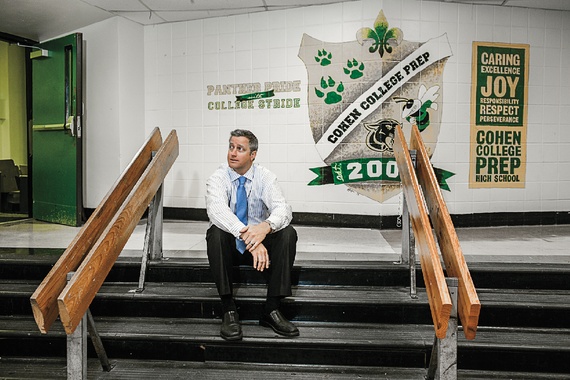
Ben Kleban, the founder and CEO of New Orleans College Prep, grew concerned about a suspension rate that exceeded 50 percent, and began rethinking disciplinary policies.

New Orleans schools, which have taken the experiment with paternalistic public education to a new extreme, have been at the forefront of extending regimented discipline to the high-school level. After Hurricane Katrina devastated the region in 2005, the city became a proving ground for the most popular and contentious reforms. The charter-school movement grew, spreading a heavy reliance on alternative teacher-recruiting programs like Teach for America—and, not least, a commitment to comprehensive, punitive discipline policies very different from the pedagogical flexibility and emphasis on individual expression favored by many traditional education schools.

In step with an energetic breed of charter advocates nationally, the reformers who descended on New Orleans were convinced that progressive pedagogy and discipline had an especially sorry record in low-income districts, where many children faced more than their share of disorder and violence. Chaotic classrooms, the newcomers argued, were a major reason schools floundered and failed. The controversial broken-windows theory—which holds that a firm response to minor signs of disarray, like broken windows, is essential to inhibiting more-serious criminal activity—was the reigning analogy, invoked by top administrators on down. No infraction was too small to address. A uniform violation, I heard one high-school teacher remark, “means a broken window, which means a broken path to college.”

There was no better place to apply this theory than New Orleans, where, the year before Katrina, about two-thirds of schools failed to meet Louisiana’s standards for acceptable performance, defined largely by test scores. By one estimate, based on a combination of local, state, and federal data, 5 percent of the city’s black public-school students went on to graduate from college. Former students and teachers told too many stories of decrepit buildings where hallways reeked of marijuana, burned-out teachers slept through class, frightened students carried weapons for self-protection, and few people talked about college.

Almost a decade has passed since reformers began overhauling the school system, and academic performance has improved citywide: nearly two-thirds of students in grades three through eight currently meet state proficiency standards. Graduation-rate data, several researchers agree, still aren’t solid enough to cite. Yet along with the growth in achievement has come plenty of debate about what is driving it. As New Orleans students who entered kindergarten after Katrina make their way into the city’s new high schools, Summer Duskin isn’t the only one questioning the doctrinaire approach to discipline. Some educators themselves are wondering whether it has become an obstacle to progress.

Erin Lockley at first bridled at her school’s stern tactics, but now, in her senior year at Cohen College Prep, she feels the approach can work if students are given more of a voice as they get older.

Idealistic and ambitious young charter-school leaders like Ben Kleban and Ben Marcovitz arrived in New Orleans as fervent believers in an unwaveringly firm approach. “In 2007–8, if a student had a stripe on their sock or a mark on a shoe, there was a consequence,” says Kleban, who was 27 when he founded New Orleans College Prep seven years ago, admitting sixth-graders who this year became the first batch of 12th-grade graduates at Kleban’s high school, Cohen College Prep. As a student named Erin Lockley quickly discovered upon her entry into New Orleans College Prep in 2008, her teachers meant business. After hastily pulling on a green undershirt on the first day, rather than the requisite black or white one, she was barred from class until she changed it—and she had to write out her multiplication tables (from one to 14) 10 times that night as punishment.

Ben Marcovitz—now 35 and the CEO of Collegiate Academies, which runs three charter high schools, among them Carver Collegiate, Summer’s school—embraced stringent discipline and character education, too, when he launched the first of his trio, Sci Academy, in 2008. And in 2010, KIPP opened a high school in New Orleans, among the first for the charter network, which initially focused just on the middle grades and now encompasses more than 160 schools nationally. As part of its college push—KIPP’s current, ambitious target is bachelor’s degrees for three-quarters of its graduates—the network decided to extend its hyper-structured approach straight up to the college door.

At the inaugural parents’ meeting, in late August of 2010, the administrators of the new KIPP high school, called Renaissance, didn’t have a hard sell. Dozens of eager mothers, plus a few fathers, had climbed two flights of stairs on that sweltering evening to listen to the school’s 31-year-old principal, Brian Dassler, describe his vision for the school. Several parents fanned themselves with copies of the school’s so-called discipline matrix, and the audience cheered him on as he outlined the school’s “no idling” policy. After Dassler noted that the Renaissance staff hadn’t been vigilant enough about preventing the students from rolling up the sleeves of their uniforms, a mother shouted, “Get even stricter, Mr. Dassler! Do it!” Another chimed in, “You have to be hard and strict. You can’t be soft, because you know how these kids are.”

For the many parents who shared the charter founders’ big dreams of college, those hopes went along with a more immediate concern: keeping their children safe. As the sociologist Annette Lareau documents in Unequal Childhoods (2003), low-income parents as a group tend toward a firmly directive approach with their children, whereas middle-class parents typically favor a more solicitous tack, encouraging their kids to question adult authority. Lareau takes note of the different effects on behavior: dutiful respect versus a sense of entitlement.

As adolescence arrives, strict enforcement gets harder, but no less urgent in the eyes of many families in urban settings like New Orleans—and for good reason. Children growing up poor and black in the city are more likely to witness gun violence and street drug sales than their middle-class peers are. Once teens, they are more likely to attract the suspicion of the police, to be arrested if they break the law, to spend their lives behind bars, and to die young. If they make a mistake—fall in with the wrong crowd, antagonize the wrong adults, drop out of school—they are less likely to get a second chance. One study found, for instance, that marijuana use among whites is slightly higher than among blacks, yet blacks are arrested for it nearly four times as often. “The margin for error is much smaller in black communities, especially for black boys,” Troy Henry, a New Orleans parent, told me, defending an even tougher approach to keeping kids on the straight and narrow at the mostly black Catholic school where he served as a board member until this summer: corporal punishment.

Worries about jobs play a role, too. For generations, the New Orleans public schools have graduated countless students straight into low-paying work in the tourism business. With only a few exceptions, the industry’s dishwashing, housekeeping, and other positions are nonunionized and come with little job security. Employees who make even a small misstep can be speedily replaced with new hires who don’t show up late, forget their uniform, or talk back to customers—as anxious parents are well aware. “If you mess up once at Harrah’s [a New Orleans casino], you are going to be fired!” a parent called out during the KIPP Renaissance meeting. A sense of entitlement, she knew, wouldn’t take these workers far; a willingness to learn and follow the rules was essential.

Students at KIPP Renaissance liked to joke that the charter’s acronym stood for the Kids in Prison Program. But a slim 15-year-old I met in 2010 shared some of the same hopes nursed by resolute reformers: that the no-excuses ethos could be the key to rescuing, rather than winnowing out, the toughest cases. Brice, whose last name I agreed not to publish, signed himself up for KIPP Renaissance because of—not in spite of—the rules. He’d already been expelled from one school and could feel himself getting pulled into the drug scene in Hollygrove, the working-class New Orleans neighborhood where he lived with his mother. He was desperate for structure that would keep him from getting into more trouble, and keep other troublemakers away from him. Brice told me, “You got to be really big and really on top of your game to make me do what you want.”

Yet a rigid focus on rules also turns out to put students at risk in ways that they and their parents, and educators as well, don’t always anticipate. The use of out-of-school suspensions has soared at schools of all types since the 1980s, when a “zero tolerance” policy similar to the no-excuses approach became popular in noncharter schools. Drawing on suspension and test-score data in North Carolina, one economist recently concluded that the approach can help principals “maximize achievement,” because students profit when disruptive classmates are removed. But an American Psychological Association report in 2008 offered a different view. The authors found no evidence that high rates of suspension or expulsion improve either student behavior or school safety, much less the educational climate: even controlling for a variety of demographic factors, the research they cited showed declines in academic achievement.

And the zealous disciplinary tactics at the paternalistic charters that are overrepresented in poor urban districts contribute to persistent racial gaps in students’ experience. Starting in preschool, black children are suspended and expelled at far higher rates than white students are, despite little objective evidence that they behave any worse. The discrepancy persists as children get older and the number of overall suspensions rises. In high school, black students are more than three times as likely as white students to get suspended at least once. Untangling causation and correlation is obviously no easy matter, but one statewide study in Texas reported that students suspended or expelled for a “discretionary violation”—having a bad attitude, for example—were nearly three times as likely to come into contact with the juvenile-justice system the following year. Ramifications like these have spurred several large urban districts (Baltimore, Los Angeles, Chicago) to take aggressive measures over the past couple of years to curb discretionary discipline tactics. Schools have begun banning suspensions, for instance, for vaguely defined offenses like “willful defiance,” which can contribute to the troubling racial disparities, several experts have concluded.

In New Orleans, too, alarming numbers have begun to prompt challenges to and reassessments of charters’ no-excuses regimens. In 2012–13, their first academic year, Carver Collegiate and its sister school in Ben Marcovitz’s trio, Carver Prep, led local high schools in suspension rates—this in a city where suspending more than a fifth of a school’s students each year is not uncommon. At Carver Collegiate the figure was 69 percent, and at Carver Prep it was 61 percent; the national average for high schools was 11 percent. School officials said 80 percent of suspensions lasted for just a single day. Yet several students complained that they were sometimes sent home “off the books,” with nobody documenting the dismissal and minimal or no inquiry into the circumstances that led to the misbehavior. Disputing their accounts, Marcovitz emphasizes that Collegiate Academies strives to be as accurate as possible with its data. At KIPP Renaissance, the discipline so eagerly welcomed soon proved ineffectual, and many parents’ support eroded. Several years after he founded New Orleans College Prep, Ben Kleban became disturbed by a suspension rate that exceeded 50 percent as his first students made their way into Cohen College Prep High School.

A report found no evidence that high rates of suspension or expulsion improve student behavior or school safety.

Some have called the problem “the progress trap”: when systems designed to help students catch up start holding them back instead. As Elizabeth Green recounts in her new book, Building a Better Teacher, educators in some charter schools around the country quietly began questioning the rigidly rule-based mentality—in themselves and in their students—around the time reform in New Orleans was getting under way. If mutely regimented middle-school students turned into rowdy bus riders a couple of years later, what did that say about the no-excuses theory in practice? The students were testing boundaries, as of course older kids do, yet the no-excuses culture was intended to be cumulative. The overarching goal was not to exact obedience for obedience’s sake, or merely to chalk up short-term gains in test scores, and it certainly was not to encourage teachers to be tyrants. The point was to develop increasing self-control in students en route to graduation. In college, after all, the ability to think critically and navigate coursework independently counts for much more than reflexive compliance.
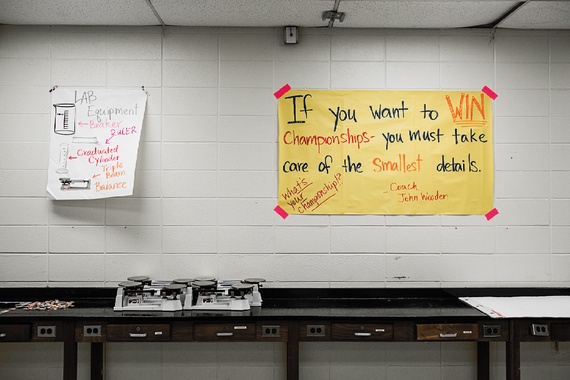
Kleban, who faced a 62 percent suspension rate at Cohen College Prep in 2011–12, found himself reexamining the behavior policies at his charter chain with such concerns in mind: he wanted to prepare his oldest students for autonomy—without scaling back too much on structure. Besides, suspensions weren’t working for many students. Fourteen percent of students were barred from campus just once, a single suspension was all it took to jolt them into improved behavior; another 13 percent were suspended twice. But 35 percent of students were sent home three times or more; they clearly weren’t getting the message.

“There’s a value in being consistent,” Kleban says, and the no-excuses and zero-tolerance approaches have the benefit of clear-cut implementation—a tidy matrix or rule book. “But the reality is, kids are different,” and problems arise “when students feel like something is being done to them and they don’t understand why.” At Cohen, the principal and other administrators held town-hall meetings where they solicited students’ views on school rules, and then hammered out compromises. The student government drafted a new outerwear policy (more sweatshirt options) and spelled out the penalties for breaking the revised rules. Behind the scenes, the principal has gotten to know the students well enough to customize discipline when appropriate—overlook a uniform violation, for example, and help a student get an item of clothing when a family is going through a rough patch financially. School officials also inaugurated extracurricular activities students said they wanted, along with more pep rallies and other celebratory events.

Erin Lockley, who had bridled at the punishment for wearing the wrong undershirt as a sixth-grader, is now a senior who credits the no-nonsense ethos with teaching her self-discipline. She feels the approach can work if students are given a voice, particularly as they get older. Teachers—“most of the time … coming from New York or further out,” she says—understand that “they have to meet us halfway.” Sometimes that’s as simple as talking less and listening more. Kleban and his staff still wrestle with the appropriate balance of structure and flexibility. But he says he hears fewer complaints about the charter network’s disciplinary practices. And by 2013–14, the suspension rate at Cohen had fallen to 37 percent, with the proportion of repeat offenders plummeting.

A rocky first year at KIPP Renaissance exposed the discipline matrix as no guarantee of the orderly school parents had been hoping for. Brice was an extreme: a repeat offender who eventually goaded a frustrated young principal to enforce a 45‑day suspension, a rare move at even the strictest schools—and a patently risky one. As Brice himself could have predicted, a month and a half at loose ends all but ensured that he would fall deeper into a dangerous scene in his neighborhood, which he did. He returned to school, but soon ended up in jail, and has been in and out of prison ever since. KIPP, meanwhile, has struggled with staff turnover—five principals (among them, one interim and two who shared the role)—further eroding something no less important than disciplinary consistency: a sense of a school community. A spokesperson for KIPP New Orleans says the school has made significant progress in staff retention over the past year, and adds that the school has modified its disciplinary practices, learning from past mistakes. With the goal of suspending students “only as a last resort,” a team of administrators now decides whether the move is warranted. The suspension rate has fallen dramatically, and Renaissance, he says, is in a “very different place than it was in 2010.”

At Collegiate Academies, where Summer Duskin had balked at strictures she felt she’d outgrown, Ben Marcovitz has been struggling too. On the positive side, he points to Sci Academy, the first high school in his network, as proof of success: though attrition has been high (its initial class shrank 37 percent over the school’s first two years), some of the students who make it through end up accepting—even appreciating—the strictness, and more than 90 percent go on to graduate and enroll in college. Yet last winter, Marcovitz and his staff faced a series of student protests at Carver Prep and Carver Collegiate. At the same time, a civil-rights complaint filed by students and parents asked state, federal, and local authorities to investigate the schools’ disciplinary policies, alleging abuse of students with special needs and overuse of suspensions for trivial matters. Marcovitz says the allegations “were shocking to me and completely uncharacteristic of our entire philosophy and approach.”

Summer—who had received countless demerits and three out-of-school suspensions in her first semester as a freshman—was among the roughly 60 students who walked over to a nearby park wearing orange wristbands that read Let me explain. In a letter of demands she helped write, the teenagers lamented, “We get disciplined for anything and everything.” High on their list of complaints were the stiff penalties for failing to follow the taped lines in the hallways, for slouching, for not raising their hands with ramrod-straight elbows. “The teachers and administrators tell us this is because they are preparing us for college,” the students wrote. “If college is going to be like Carver, we don’t want to go to college.”

Marcovitz believes some of the students’ claims were exaggerated, and he makes a point of noting the praise that counters the stern rebukes, the warmth that accompanies the structure. But by the summer, he was ready to tackle what he casts as the next challenge in the reform project: if Sci Academy was evidence of what stringent discipline could help achieve, now his high schools would pursue the same results through gentler means. “While it was extremely tough to hear so much concern about our program, we took it as a mandate from the community,” he says, and maintains that high suspension rates already had his attention. He committed the Collegiate Academies leaders to zero out-of-school suspensions in the 2014–15 school year. “We don’t know how to do this yet,” Marcovitz admitted before classes began. There will inevitably be stumbles, he acknowledged, as they explore an array of alternatives, from partnerships with juvenile-justice groups in the city to “restorative justice” strategies that get students talking through problems rather than simply paying penalties. The new ethos will require “relationships being very clearly built” and “love being very clearly expressed.” But apart from that, he and his staff are forging ahead largely without a rule book, and so far they report having issued a handful of suspensions.

The change came too late for Summer, who had already transferred to McDonogh 35, which opened nearly a century ago as the city’s first public high school for black students. Many of the city’s young school reformers dismiss the contemporary McDonogh 35 as chaotic and poorly run, and its academic reputation has slipped in recent years. But its legendary history—Ernest Nathan Morial, the city’s first black mayor, was one of many local African American leaders nurtured within its walls—undergirds an ethos of pride and engaged purpose that Summer and her family had lost sight of at Carver Collegiate. The strictness wasn’t the main issue, at least not for Summer’s father—he attended an all-boys Catholic high school in New Orleans that was, if anything, stricter. The problem, as he puts it, is that “I can’t get my mind around these folks to see what’s the point.” School disciplinarians had failed to cultivate a shared sense of direction and the trust that goes with it. When that happens, he agrees with his daughter, even the most well-intentioned system can end up feeling like “a blind application of rules.”

LAUSD/UTLA CONTRACT NEGOTIATIONS: LA Unified guaranteeing teachers the pay raise already offered

  by LA School Report | http://bit.ly/11yY2vT

teachers union raise salary UTLA Contract Negotiations LA UnifiedPosted on November 17, 2014 4:51 pm  ::  LA Unified said today it has altered its salary offer to teachers by eliminating any contingency on a package that includes raises of 2 percent for this year, 2 percent for next year and 2.5 percent for the year after that.

The district’s previous offer to the union, UTLA, had been with the same percentage increases, provided funds were available.

“The removal of this language is very significant,” Vivian Ekchian, the District’s chief labor negotiator, said in a statement. “It assures our teachers of the District’s long-term commitment to providing them with the compensation they deserve, in addition to sustaining a robust health benefits package for them and their family members.”

The district is still including a 2 percent lump sum payout for last year.

In negotiations last week, the district said subjects discussed covered a range of subjects, including teacher evaluation, student discipline, grievance procedures, teacher transfers, small-learning communities, campus safety, shared-decision making, school-based management and the student records system known as MISIS.

Neither side has reported any agreement on anything.

$40 billion of need: LAUSD EYEING MORE BONDS AS FUNDS FOR SCHOOL REPAIRS DWINDLE + smf’s 2¢

Annie Gilbertson, KPCC  89.3 | http://bit.ly/1u6nbEd


92022 full

File: Christopher Cadena climbs in a hole five-feet deep, unearthing a leaking water main that feeds the fire sprinkler system at Hoover Street Elementary School. A backlog of repair requests show plumbing problems plague many campuses. Benjamin Brayfield/KPCC


November 17, 05:30 AM  ::  Los Angeles Unified School District officials estimate another $40 billion is needed to replace roofs, upgrade plumbing and repair hundreds of aging campuses  – but first they'll need the voters' blessing.

On Tuesday, the school board is scheduled to consider a $22.4 million request to address antiquated heating and cooling systems, failing walls, deteriorated pavement and broken fire alarm systems.

The request covers projects at seven schools, barely making a dent in the district's estimate of need for 13,500 buildings.

A request to sell more bonds is all but sure to find its way onto future ballots, said Roger Finstad, director of maintenance and operations for L.A. Unified.

"It's inevitable," he said. "We want our students and staff to be in buildings and on grounds that are in good condition, where the roofs don't leak and the air conditioning works."

The campaign for more funds – expected within the next decade – may face opposition from voters feeling burned by controversial and over-budget projects.

"I'm not voting for any bonds," said Monica Whalen, a parent and teacher at Franklin High School in Highland Park, a school approaching its centennial.

"They wasted the funds on the iPads. They didn't repair the problems the schools are facing," she said.

The district set aside $1.3 billion in school construction and modernization bond funds to supply every student and teacher with a tablet, education software and to upgrade  campus Wi-Fi.

Meanwhile, the district is chipping away at a backlog of 50,000 repairs, be they leaks in the district's 40,200 drinking fountains or problems with its 68,000 heating and air conditioners.

KPCC reported in September the backlog included 200 fire safety concerns such as aging alarms, outdated extinguishers and leaking sprinklers.

District officials have found many of these repairs are routine maintenance and not bond fundable. Bonds are typically used to replace a roof not fix a leak.

Since 1997, voters agreed to a property tax hike to pay for $19.5 billion for school construction and improvements through several bond measures.

The district built 130 new schools to relieve overcrowding, but now it faces the opposite problem – fewer and fewer students.

A  recent Moody's report outlined financial concerns stemming from declining enrollment, though the investor service still rates L.A. Unified highly (Aa2 stable).

By next spring, district officials said they'll begin planning to sell the last package of bonds that voters approved, Measure Q's $7 billion.

Finstad said the district plans to use cash from the Measure Q bond sale to reprioritize.

"We had a tremendous organization that went out and built new schools," Finstad said. "We now are having to refocus and develop skill sets to assess and upgrade our existing facilities. It's really a different task."

The district can't continue to underfund and defer needed repairs, said Mark Hovatter, chief facilities executive, in a recent memo to interim Superintendent Ramon Cortines.

"We would jeopardize student and staff safety and we would also lose the confidence of teachers principals, and other district staff as well as the public who vote for our school construction bonds. Given these facts I believe we need to carefully consider how we plan our way ahead," Hovatter said.

Related Links


2cents small The need is very, very real. The headline writer is very, very alarmist.  The request for more bonds is expected, as the writer wrote: “within the next decade”.

That said, a decade isn’t forever.

A couple of points:

  • That $40 billion in need is not a static number; because it is not being adequately addressed it increases at about $1.1 billion a year.
  • Unless LAUSD spends about $2 billion a year on repairs and upgrades – a rate of spending matching the expenditure in the middle of the new school building program – we will not catch up. And the money must be spent strategically, effectively and wisely. We do not want to be shoveling the taxpayers’ hard earned cash into that hole in the photograph!
  • The use of the word “strategically” was intentionally ironic., The District's “Chief Strategy Officer” is the champion of the strategy of iPads and MiSiS.

The District must improve its game, with less no more  missteps like the iPad Fiasco and the MiSiS Crisis if it wants to pass a future bond!  And some sort of funding mechanism needs to be found to fund rather than defer routine maintenance of the district’s facilities. It is always better to fix a leak than replace a roof.

The argument over bond funds vs. general funds is bogus; The taxpayer pays for both; He or she  pays for the first with pocket change. The second is paid for by taking out a loan.

Just because enrollment is declining (which won’t happen forever) doesn't mean the buildings+infrastructure are getting any younger!

2ND ANNUAL LAUSD 5K ‘MOVE IT’ CHALLENGE AND HEALTH FESTIVAL IS SATURDAY AT DODGER STADIUM

By Staff Reports | LA Daily News | http://bit.ly/1HfrnMe

Students from Sun Valley’s Byrd Middle School practice Monday for the Los Angeles Unified School District’s 5K “Move It” Challenge and Health Festival to be held Saturday at Dodger Stadium.

Posted: 11/17/14, 7:15 PM PST | The festival, held from 8 a.m. to 1 p.m., raises awareness about the importance of physical activity and a healthy lifestyle and also raises funds for the LAUSD Wellness Centers.

image

To learn more and to register, please visit: http://moveit.lausd.net

Download the English flyer

Download the Spanish flyer

Newsfeed: JURY SELECTION BEGINS, SETTLEMENT TALKS CONTINUE IN MIRAMONTE CIVIL TRIAL


Google News :: Nov. 17-18 2013

Settlement Talks, Jury Selection Continues in Miramonte Case

NBC Southern California - ‎‎

Both sides opt to keep negotiating a settlement, instead of seeing potential jurors. John Klemack reports from Downtown LA for the NBC 4 News at 5 on Monday Nov. 17, 2014. (Published Monday, Nov 17, 2014). Monday, Nov 17, 2014 • Updated at 10:46 PM ...


Talks to continue for Miramonte school sex abuse suit against LAUSD

MyNewsLA.com - ‎

More settlement talks are expected Tuesday as a judge pushes attorneys to try to resolve litigation stemming from the sex abuse scandal at Miramonte Elementary School. Attorneys for the Los Angeles Unified School District and former students of teacher ...


LAUSD Miramonte lawsuit: Jury selection begins

KABC-TV -

Jury selection began Monday in a high-profile civil trial against the Los Angeles Unified School District. The lawsuit is being brought by abuse victims of former Miramonte Elementary School teacher Mark Berndt. At issue is whether or not the school district ...


Jury selection begins in Miramonte Elementary sex abuse lawsuit against LAUSD

MyNewsLA.com - ‎

Jury selection began Monday in the first civil trial against Los Angeles Unified stemming from the sex abuse scandal at Miramonte Elementary School, while the judge presiding over the case continued to press attorneys to settle the litigation. The civil suits ...

Jury Selection Begins In First Civil Trial In Miramonte Sex Abuse Scandal

CBS Local - ‎‎

LOS ANGELES (CBSLA.com) — Jury selection began Monday morning in the first civil trial against the Los Angeles Unified School District stemming from a sex abuse scandal at Miramonte Elementary School. “There's no more hiding behind the conference ...

Settlement Hearing, Jury Selection to Begin in Miramonte Sex Abuse Case

NBC Southern California - ‎‎

Miramonte Elementary School, in the unincorporated Florence-Firestone area, was the site of a sexual abuse scandal. Monday, Nov 17, 2014 • Updated at 3:12 PM PST. Jury selection began Monday in the civil case against the Los Angeles Unified School ...


Jury selection, settlement hearing to begin in Miramonte civil trial

LA School Report - ‎

miramonte Jury selection is scheduled to begin today in the civil case stemming from the sex abuse scandal at Miramonte Elementary School by former teacher Mark Berndt. Also set for today is a settlement hearing, which was scheduled by the judge in an ...

Jury selection for first civil trial against LAUSD for sex abuse scandal

MyNewsLA.com - ‎‎

Jury selection is scheduled to begin Monday in the first civil trial against Los Angeles Unified stemming from the sex abuse scandal at Miramonte Elementary School. The civil suits stem from the child abuse scandal involving former teacher Mark Berndt.