Saturday, July 08, 2006

The Republicans get it! – DAVID HERNANDEZ CALLS ON ARNOLD TO VETO VILLARAIGOSA LAUSD TAKEOVER

This letter will be sent to Governor Schwarzenegger today. (Monday, June 26, 2006)

I am calling on everyone who opposes the Governor signing legislation giving control of LAUSD to Mayor Villaraigosa to join me and my campaign to unite Republicans in calling for a pledge to Veto the pending bill in the Assembly. Once on the Governors desk, for the Governor to Veto the bill.

- David Hernandez


The Honorable Arnold Schwarzenegger
Governor of California
State Capitol Building
Sacramento, CA 95814

Dear Governor Schwarzenegger:

With both the California State Assembly and Senate controlled by Liberals, the Governor’s Veto is the only hope left for the men, women and families of California. But ability is useless if willingness is not there.

The people of Los Angeles County need your assistance. The actions of Mayor Villaraigosa, the California Legislature and the teacher’s union leaders supporting the mayor’s efforts to take over the Los Angeles Unified School District will result in legislation that takes away control of a duly elected board approved by the voters of the district. This legislation needs to be overturned and vetoed.

Governor Schwarzenegger, We the People of Los Angeles County ask that you exercise your right and duty associated with the Veto. We the People ask that you announce that any legislation regarding LAUSD that circumvents the rights and vote of the people will be vetoed!!

Mayoral takeover may be “bold” but it is destructive to the rights of the people. You yourself have quoted our US Constitution on many occasions and it is “We the People” not a powerful mayor and former legislator twisting arms in Sacramento to gain more power.

Please do not let this become an issue in your election such as that created by Gray Davis when he signed the driver’s license bill for illegal aliens.

One of the most exciting nights of my political history was spent with you on the Recall Election eve and your election as Governor. Every hour sacrificed away from my business and friends was worth it.

Please do not allow this mayoral takeover to occur. Please do not turn me and other Republican supporters into your adversaries.

Sincerely,

/s/ David Hernandez

2002, 2004 Republican Nominee, U.S. House of Representatives, District 28

Sunday, July 02, 2006

The Mayor's Plan for LAUSD: Connect the dots

Please read Antonio's Theory Of Relativity and Passing Marks -- both written by David Zahniser, followed by Hammered by Auditors written by Jeffrey Anderson in the June 28th LA Weekly

The first two paint the picture, name the players and present the scorecard on the current status of the Mayor/UTLA's plan in LA and Sacramento. The third - about the City of LA Building Department -- seems at first out of context ...until you see that it presents just how poorly city agencies and the city hall bureaucracy function at governance, accountability and oversight.

See my thoughts on how and why to Connect the Dots at LAVoice.

Friday, June 30, 2006

Great moments in parent involvement.

Mayor Villaraigosa, heckled, harassed and challenged by LAUSD parents opposed to the LAUSD takeover crafted in a Sacramento backroom by him and UTLA, took Superintendent Romer aside on Wednesday in the senate hearing room.

"You better control your parents," the Mayor said, "or I'll have them kicked out."

Tuesday, June 27, 2006

This is your school district under Mayoral Control Lite...


HELP STOP AB 1381 - THE LAUSD TAKEOVER BILL!

The following is the text of the letter that California School Boards Association sent to the members of the Senate Education Committee on June 23, 2006. Copies of the letter were also sent to the Democratic and Republican leadership in both houses and the Governor.

Dear Senator Scott:

The California School Boards Association (CSBA), which represents nearly 1,000 school districts and county boards of education statewide, is strongly opposed to AB 1381 (Nunez), as amended on June 21. This bill would shift authority for much of the governance of the Los Angeles Unified School District (LAUSD) from the elected school board to the mayor of Los Angeles and his or her sanctioned superintendent. Our concerns with the bill are as follows:

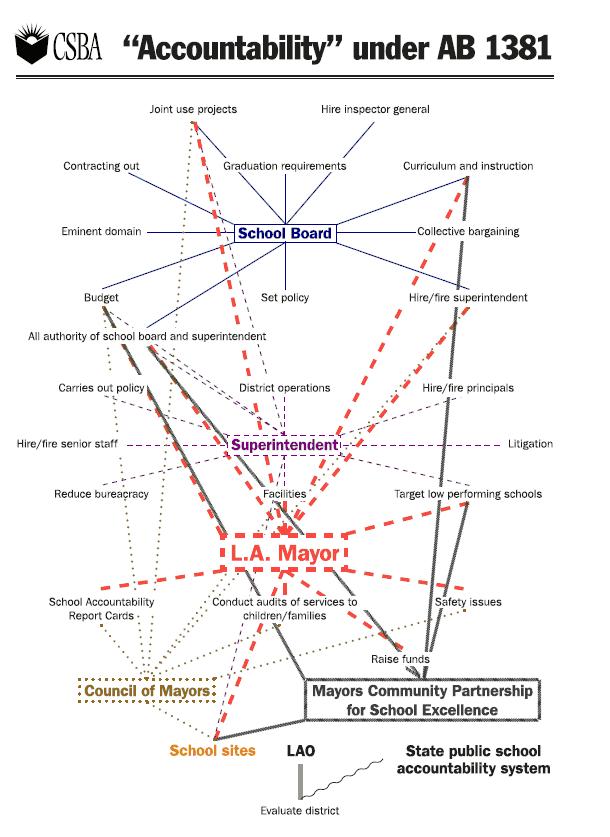
IT WOULD REDUCE—NOT INCREASE—ACCOUNTABILITY. Under AB 1381, LAUSD would be governed by a four-headed Hydra consisting of the elected governing board, a superintendent whose appointment would be subject to approval by the mayor, the mayor himself, and a Council of Mayors. Authority for the approval of budgets, fiscal management, collective bargaining, personnel decisions, facilities, and other matters would be split among the four heads. In addition, a fifth entity, “The Los Angeles Mayor’s Community Partnership for School Excellence,” (Community Partnership) would have “oversight” over three clusters of schools. “Oversight” is not defined, and the bill does not specify the boundaries (if any) between the responsibility of the Community Partnership and the responsibility of the district with respect to these schools.

All of this would result in a complex spider’s web of administrative and managerial confusion in which accountability would be blurred at best and nonexistent at worst.

It’s no wonder the LA Times concluded that “this deal spreads responsibility so thin that it’s hard to know who has it.” Under AB 1381, the district would become a virtual Petri dish for passing the buck.

IT DISENFRANCHISES FAMILIES AND VOTERS. By stripping authority away from the elected school board, voters will have their voices weakened. The 20 percent of LAUSD families that live outside of the City of Los Angeles—and therefore do not vote for the mayor—will be completely disenfranchised. The Council of Mayors is a weak substitute for true representation, because, with votes proportional to each city’s enrollment in LAUSD, the Los Angeles mayor would have 80 percent of the votes.

IT WOULD DISRUPT A SIX-YEAR TREND OF IMPRESSIVE STUDENT GAINS IN LAUSD. Contrary to conventional wisdom and much of the rhetoric surrounding this issue, LAUSD has outperformed not only other urban districts in California but the state as a whole in terms of improvements on the state’s Academic Performance Index. LAUSD has achieved these impressive results despite serving a student population that has higher risk factors than students elsewhere in California, such as increased homelessness, poverty, hunger, undiagnosed and/or untreated health problems, and a greater likelihood to be English language learners. The changes contained in AB 1381 are likely to be highly disruptive and run the risk of slowing—or even reversing—the gains that have already been realized.

IT CREATES CONFLICTS OF INTEREST. Especially with respect to facilities and litigation, AB 1381 gives the mayor or his/her superintendent carte blanche over matters where the city and school district might come into conflict. Decisions regarding the selection of new school sites, for example, are often the subject of intense negotiations between school districts and cities. The outcomes of these negotiations typically contain compromises in which the interests of the district’s students and families are balanced against the interests of the city. By shifting all authority for such decisions to the mayor, no one will have responsibility for standing up for the students and their families—or the authority to do so.

IT EXPANDS THE SCOPE OF COLLECTIVE BARGAINING. AB 1381 provides that, with respect to the clusters of schools overseen by the Community Partnership, “teachers and parents are full partners in the decisions that affect the schools.” Elsewhere (Section 35931 [a]), the bill provides that “employee organizations” shall share oversight as part of the Community Partnership. Taken together, these provide an even greater expansion of the scope of collective bargaining than was contained in AB 2160 (Goldberg) several years ago.

IT IS POOR EDUCATIONAL POLICY. School site decision making is a popular mantra, but its viability in the real world is not without limits. The striking success that LAUSD has realized over the past several years is due in large part to standardizing a district-wide curriculum and providing instructional materials and professional development around that curriculum. The students in LAUSD are highly transient. In many schools, more than half of the students in attendance at the beginning of the year are in a different school at the end of the year. Therefore, it is vitally important for student success that there be some consistency between the curriculum, instruction, and materials between schools so that when students (and sometimes teachers) move from school to school there is continuity in their educational experience.

AB 1381 would disrupt this continuity by allowing teachers at each school site to select that school’s instructional materials, curriculum, and methods of instruction. We know that this disruption has a negative effect on the achievement of students who experience it.

For these reasons, CSBA strongly opposes AB 1381 (Nunez) and respectfully urges your “NO” vote on this measure. If you have any questions about our position, please feel free to call me at 325-4020.

Sincerely,

Richard W. Pratt
Assistant Executive Director
Governmental Relations

Friday, June 23, 2006

Romer: Antonio sold out -- LAUSD deal gives too much power to unions

BY NAUSH BOGHOSSIAN, Staff Writer, LA Daily News

6/23/2006

The powerful teachers union in the Los Angeles Unified School District would
get unprecedented control over what kids are taught and how schools are run
under a deal brokered by Mayor Antonio Villaraigosa to save his reform plan,
LAUSD Superintendent Roy Romer charged Thursday.

Villaraigosa insisted he will take personal responsibility for L.A. schools,
but Romer - in his toughest remarks yet - said draft legislation shows the
mayor's deal would undercut gains in student achievement and send the
nation's second-largest district spiraling out of control.

"I'm concerned about the level of power the union would have. ... This turns
over massive tools of change to the union," Romer said.

"If passed, this bill would transfer that power to the union to control
curriculum at a site-based level. This is a very serious mistake and one the
mayor and unions bought off on because they're trying to serve each other's
interests."

The mayor's key education adviser defended the deal negotiated late Tuesday
behind closed doors with United Teachers Los Angeles and the California
Teachers Association, long one of the most powerful and biggest-spending
lobbying groups in Sacramento.

"Yes, this was a negotiation between the mayor and the teachers union, and
yes, as in most negotiations, each side gave up things that they wanted, but
there was no giving of additional power to the teachers union," said Thomas
Saenz, counsel to the mayor.

Despite the deal's being touted as a partnership, Saenz said the legislation
is structured to give Villaraigosa most of the control.

"People are missing the forest for the trees: Who's in charge is the mayor,"
Saenz said. "There's one person in charge of the system, and that's the
mayor."

A final version of the proposed legislation was expected to be disclosed as
early as today.

A spokeperson for Assembly Speaker Fabian Nuñez, a co-author of the bill,
said significant changes to the draft were being worked on.

But the draft indicates a committee of teachers, the principal and other
staff at each school would select that school's instructional materials from
among materials approved by the state Board of Education.

The draft also states that the "school community is held accountable for the
achievement of the goals" in areas ranging from improving graduation rates
and reducing dropout rates to reducing achievement gaps.

UTLA President A.J. Duffy shied away from saying the union would get more
power under the legislation.

"It's more a paradigm shift of how we view governance, accountability and
how we view the relationship between those two entities and the ultimate
goal, which is to create an educational program that really does the job,"
Duffy said.

"What it's really about is our agenda for local control. That's the bottom
line, and we feel that the best decisions for kids are made at the local
schools by teachers, principals, parents and through community involvement."


The bill still faces hurdles in Sacramento, but analysts said that if it
passes, the influence of the union is certain to grow.

"This was a very bold move on the part of the teachers union and on the part
of the mayor. ... In my estimation it reflects increased clout among the
teachers with regard to the direction of the school district," said Kent
Wong, director of the University of California, Los Angeles, Labor Center.

"This is an opportunity to see real change, and this move gives the mayor
more direct control and at the same time gives teachers and principals more
control over classroom instruction."

Others had a starker view.

"Where does the power lie? It doesn't lie with the board. It lies with the
union," said Sherry Bebitch Jeffe, a political analyst and senior scholar at
the School of Policy, Planning and Development at the University of Southern
California.

"The power the mayor would have is less than he wanted. It is clear that the
union once again illustrated that they are a political power and can
influence dramatically things that they care about - not only on a local
level, but in Sacramento, and it's clear the school board has lost quite a
bit of both authority and responsibility."

School board member David Tokofsky said it's unclear whether the deal makes
the union a greater power to be reckoned with.

"I've always known teachers are important and the union has been
influential, but I think it's been overstated that this is the monster that
controlled the school board," he said.

"We know that there is a lot of co-dependent behavior between the mayor and
the union, but I'm willing to hear how this changes the profession of
teaching and the results that kids can have."

Former school board member Roberta Weintraub said if there is no person
clearly in control, a strong organization can assume greater power.

"When you have a diffusion of control like that and you don't know who's the
boss, a strong, linear organization like UTLA can move into the breach, but
this thing is a long ways off from being a fait acompli," she said.

Ultimately, while critics have been buzzing that big promises must have been
made because the deal was made behind closed doors, the public shouldn't
rush to conclusions, said David Abel, chairman of New Schools Better
Neighborhoods, a civic advocacy organization for California's urban school
districts.

"The devil is in the details. We don't know, because it wasn't an open
process, what understandings were reached about the roles in implementing
the agreements, or what commitments will be made, or what kind of
superintendent will be selected," Abel said.

"You would assume that, given the language and arguments that were used over
the last couple of months (about mayoral takeover), ... for them all of a
sudden to reach an agreement involves more than what is written on the
original press release. But I don't think it's fair to judge that until we
know.

"I think this is an ongoing, living, breathing reform effort."

But excluding district leaders from the legislation negotiations confirmed
union strength, Bebitch Jeffe said.

"It's basically acknowledging the obvious - that the teachers union is the
major player in education policy," Bebitch Jeffe said. "They're just cutting
out the frontman."

Villaraigosa's Plan For L.A. Unified Faces Opposition in Classrooms

From the Los Angeles Times: Some teachers back the proposal, but many say more local autonomy could undo recent gains.

By Duke Helfand and Joel Rubin
Times Staff Writers

June 23, 2006

The teachers of Cahuenga Elementary near downtown Los Angeles had a message
Thursday for Mayor Antonio Villaraigosa: No thank you.

In South Los Angeles, staffers at Martin Luther King Jr. Elementary shook
their heads in disbelief.

But in more affluent Hancock Park, teachers at 3rd Street Elementary gave
the mayor a thumbs-up for injecting himself into the schools.

Villaraigosa's elaborate plan to take control of the Los Angeles Unified
School District grabbed the attention of rank-and-file teachers Thursday,
the day after it was announced. While some applauded it, many disagreed with
him - and their own union leadership.

In close consultation with teachers unions, the mayor agreed this week as
part of a sweeping reform plan to let schools choose their own instructional
methods and effectively do away with top-down centralized programs.

Villaraigosa said this week that his plan, which the Legislature is expected
to consider soon, would spawn "the kind of environment that really can be an
incubator for great ideas and success."

United Teachers Los Angeles has long chafed under what it considers overly
rigid mandates from the district's top officials, and the union has wanted
more leeway for teachers to decide what works best at their schools.

But teachers and principals at several L.A. Unified campuses said the
mayor's proposal could ravage districtwide reading and math programs that
they say have brought continuity to thousands of classrooms and helped drive
up standardized test scores over the last six years.

Uniformity is important, the educators said, because 28% of the district's
727,000 students leave L.A. Unified schools at least once during a school
year, with many of them going to other district campuses. Requiring schools
to use the same programs enables students who move to keep up with lessons,
the educators said.

"We need to put the children first," Cahuenga Elementary teacher Grace Blanc
said. "I think the consistency is what the children need."

Such resistance to Villaraigosa's plan echoed warnings by school district
leaders this week about what they perceived as a threat to the district's
progress and revealed deep divisions between some classroom teachers and
their union leaders, who forged the agreement with the mayor.

The skepticism extended to administrators, some of whom argued that their
schools have flexibility despite the district's mandates.

"We have to be very careful when it comes to our kids being affected by
adult decisions," said King Elementary Principal David Bell, a 16-year
district veteran. "I don't like it when our children are used."

Villaraigosa's top attorney, Thomas Saenz, said the mayor wants to give
campuses freedom to innovate and says they could continue to use their
existing programs if they deemed that best for their students. Schools would
be required to show progress and abide by state curriculum guidelines.

But Saenz also said the school board and the superintendent would continue
to play a role in overseeing instruction and curriculum. Details are still
being worked out.

"This is not a situation where there will be completely unguided, unfettered
authority for anyone at the local school site to make decisions," he said.

The roots of the current conflict over school-site authority stem from a
change in policy by the Board of Education in 2000.

To accommodate student mobility and help growing numbers of inexperienced
teachers, the board adopted a rigidly structured reading program - Open
Court - for nearly all district elementary schools.

Open Court combined direct, systematic phonics lessons in the early grades
with literature as children matured. It came with thick guides that told
instructors what to teach and when. The school district hired reading
coaches to coordinate lessons and guide new teachers, and introduced "pacing
plans" to literally keep teachers on the same page on the same day.
Students' progress was checked every six weeks.

Many teachers initially resisted, saying that they felt like test-prep
automatons stripped of their classroom creativity. But test scores rose at
many schools, particularly those serving large numbers of students for whom
English is a second language.

The teachers union's long-standing complaints about the top-down dictums
played a pivotal role in the legislative deal the union negotiated with
Villaraigosa. Union President A.J. Duffy said that allowing schools to
determine curriculum was a "critical piece" of the reform puzzle.

On Thursday, Duffy said his union was not trying to eliminate Open Court but
to modify its use so that teachers have more flexibility. "This idea of one
size fitting all, we do not agree with," Duffy said.

But Supt. Roy Romer said the district should stay the course.

"If you take away from the district the ability to have any districtwide
policy on curriculum, you have taken the foundation out from beneath all the
reform we have made," Romer said Wednesday. "That is a very serious issue
and it is one that will turn back the progress we have made."

Some educational researchers say that school-site authority works under
certain conditions.

UCLA education professor Jeannie Oakes recently completed a review of
research comparing top-down models to teacher-driven ones. She found that
school-level control can lead to strong gains in learning if local
curricular decisions are accompanied by rigorous teacher training and
collaboration. The combination is particularly important - and difficult -
in L.A. Unified, where schools suffer from high teacher turnover and
struggle with tight budgets.

"Simply having school-site control does not itself guarantee anything,"
Oakes said. "But if it is used to really engage teachers, it can lead to
really remarkable improvements that are not occurring with more tightly
prescriptive models."

At 3rd Street Elementary, teachers, administrators and parents said they
were eager to embrace the decentralized plan Villaraigosa has put forward.

The high-performing school serves many children from affluent families.
Teachers said they needed freedom from the district's strict mandates to
incorporate more challenging material.

"Each school is different. Each has different needs," Principal Suzie Oh
said. "We are the ones in the trenches all the time and know what our
students need rather than this one-size-fits-all approach."

Other L.A. Unified schools say they would seek a middle ground, much the way
they have in the past.

Cahuenga Elementary, for example, has readily embraced Open Court even as
the school has pursued novel language immersion programs in which some
children learn Spanish or Korean in addition to their English lessons.

"People say you don't have freedom," said Principal Lloyd Houske. "I say you
don't have freedom if you don't have the nerve to do something."

But Houske and other educators praised the district for implementing a
single reading program. He and others worry about hundreds of schools
pursuing their own methods and materials, reducing a mammoth but coordinated
instructional approach to chaos.

"I'm concerned that we'll go back to a system that is not coherent, changing
the program every two years, changing the assessments every two years," said
Principal Beth Bythrow of Multnomah Elementary in El Sereno.

"If you look at elementary schools, we have made a lot of progress. That's
because for the longest period of time, we've done the same thing."

Villaraigosa's hopes for getting a bill through the Legislature before its
July 8 break appeared to dim Thursday.

Assuming negotiators finalize the language in time, the bill would be one of
about 60 to be heard by the Senate Education Committee on Wednesday.

L.A. Unified legislation would also probably have to be heard by the Senate
Appropriations Committee prior to a vote by the Senate, then it would face a
vote of the Assembly before it could be signed by the governor.

*

_____

Times staff writer Nancy Vogel in Sacramento contributed to this report.

*

Test scores

--

Standardized test scores in reading and math have improved across California
since the state first gave tests tied to academic standards. L.A. Unified
School District had greater gains than the state overall except in high
school math.

Thursday, June 22, 2006

THIS IS REFORM? Mayor Villaraigosa pledged to take over L.A. schools. But what he's getting is something less dramatic -- and less helpful.

smf notes: The Times Editorial Board, which has been the champion of mayoral takeover, finally gets it right. A day late, and a dollar short.

EDITORIAL from the Los Angeles Times

June 22, 2006 -- Antonio Villaraigosa's one-year anniversary as mayor almost perfectly coincides with what he is heralding as the signature achievement of his term. But what he calls a grand compromise to bring greater accountability to the city's schools is better described as an ill-advised plan that cedes too much to teachers unions, offers too little to students and relies too much on the mayor's talent for consensus.

Since he took office last July, Villaraigosa has promised to take control of (actually, he prefers the phrase "bring oversight to") the schools, and in many ways he has staked his mayoralty on it. His passion for the issue is clear, and he says the deal he struck Wednesday with unions and state lawmakers is the best he could have hoped for. If that's the case, he would have been better off leaving Sacramento, declaring defeat and living to fight another day in L.A.

Under the proposed bill, details of which are not yet public, the school board would be in charge of student achievement — or at least parts of it — while the mayor would control about three dozen poorly performing schools. Both would have a role in hiring the superintendent. Schools would be in charge of their curriculums. Instead of creating a clean line of accountability — the chief advantage of having a mayor run the schools — this deal divides responsibility so confusingly that even the main players would have trouble figuring out who's in charge of what.

The school board would be a "broad policymaking body," the mayor says, "not a management body." Yet decisions about curriculum would be made at the local school level. The superintendent, meanwhile, would be charged with carrying out the policy set by the board — but he or she could be fired by the mayor. The superintendent would have power to sign contracts — except the biggest contract, with the teachers union, which would be negotiated by the board.

Most schools would be under the authority of the elected board, but a few dozen would be essentially run by the mayor. The mayor says that if these schools improve, the Legislature may be more willing to give a future mayor more direct control. Maybe so. But the rest of the plan would so damage the district that this experiment hardly seems worth it.

"Fragmentation is failing our kids," the mayor explained in his State of the City address in April. "Voters need to be able to hire and fire one person accountable to parents, teachers and taxpayers. A leader who is ultimately responsible for systemwide performance." Under this plan, fragmentation is increased, accountability diminished. Who's in charge of the schools? Any answer that requires more than one subject and one verb is no answer at all.

Consider a school whose students are failing at math. Who could responsible parents see to address the problem? The teachers picked the curriculum, but they can't be voted out of office. The school didn't decide its budget; the superintendent did that. But both the board and the mayor have a say in it. The board can't hire and fire the superintendent on its own; the mayor can say the board selects the superintendent. And because the board loses power in this deal, it has little interest in seeing it succeed.

The mayor has never been shy about wading into controversies, so he would almost certainly offer those concerned parents a hearing (actually, he could do so now). But how much he would be able to do is an open question. And the larger problem, as the mayor himself is fond of pointing out, is that this quest to improve L.A. Unified's schools is not about the mayor. It's about providing accountability — and accountability shouldn't depend on who happens to be sitting behind the mayor's desk.

"We're going to be responsible," the mayor said Wednesday. Unfortunately, this deal spreads responsibility so thin that it's hard to know who has it.

The Deal Done; a Done Deal. Dum-de-dum-dum.

Note: 4LAKids normally goes out late Saturday, but events are transpiring fast and furious – and I've begun to organize my thinking. Perhaps I and all the rest of us are overreacting to what we don't know – but we are so used to being treated this way by LAUSD it has become a modus operandi.

We have seen neither a plan nor legislation from the Mayor and his homies in Sacramento. But my phone doesn't stop ringing as media types ask me what I think – and organizing those thoughts as of 7AM Thursday seems like a good idea.

P.O.W.E.R.S.: Pre-write, Organize, Write, Edit, Revise and Share. Sometimes one can't wait to share! – smf

THE MAYOR'S/LEGISLATOR'S/TEACHER'S UNION DEAL is unquestionably a step in the right direction …for all the wrong reasons.

GOOD NEWS: The mayor has set down the gun he has been toting in his self-declared "war" with the school district and is at least talking to people.

BAD NEWS: He's talking to the wrong people at the wrong time in the wrong venue.

A back room deal that creates a blueprint for paradise is no less a back room deal.

This is a pure political compromise to salvage a doomed-to-failure agenda struck with state legislators and union leaders in Sacramento – 400 miles from LAUSD – upon which it is imposed. The Board of Education wasn't in the room. Parents and Principals – the folks theoretically being empowered – were not in the room. Students? Students are never in the room!

After a year of rhetoric, bombast and a "leaked" 42 page draft plan that even the mayor wouldn't endorse we are left with a "done deal" …and legislation that will be hastily written in the 36 hours before the legislative deadline.

This isn't "No Agenda Left Behind"; maybe Antonio's plan – or lack thereof should be mercifully allowed to fail.

Yesterday (Wednesday) night Mayor Villaraigosa was scheduled to meet with the mayors of six other cities in LAUSD for a long scheduled public discussion of his plan – and their plan - with parents, students and community members. The other mayors were there. Parents, students and community members were there. The Mayor of Los Angeles didn't show up.

The California Constitution says: "No school or college or any other part of the Public School System shall be, directly or indirectly, transferred from the Public School System or placed under the jurisdiction of any authority other than one included within the Public School System." It continues: "No public money shall ever be appropriated for the support (of) any school not under the exclusive control of the officers of the public schools."

What part of "No" is it that the mayor, the legislature and union leadership don't understand? - smf

Sunday, June 18, 2006

NYC REFUSES TO LIFT SCHOOL CELL PHONE BAN

NYC REFUSES TO LIFT SCHOOL CELL PHONE BAN

wnbc.com | Associated Press

June 14, 2006 -- NEW YORK -- Can you hear me now?

That's what parents, students and lawmakers who want a school cell phone ban lifted asked Mayor Michael Bloomberg's administration at a city council hearing Wednesday, but the city is refusing to budge.

One parent said the city's policy wouldn't affect her family's actions.

"My children will continue to carry cell phones," said Carmen Colon. "No one is going to tell me otherwise. I have no choice."

[You go Carmen! Say Dat! - smf]

Three high school students were among those who argued against the ban.

Sophomore Seth Pearce noted wryly during his testimony: "All three of us have cell phones right now in City Hall, and it seems to me the city is running just fine."

Pearce said he takes his cell phone to school every day, despite the ban.

"I need it because we live in a society where there are a lot of emergencies and a lot of situations where students need to be in contact," he said.

The prohibition on cell phones in the nation's biggest school system has been in place for years, but students have mostly carried the phones without consequence.

When the city began random security checks in late April as part of a weapons crackdown, authorities began finding -- and confiscating -- hundreds of cell phones, prompting a fierce battle over the ban.

New York schools have one of the toughest such bans among the nation's large districts, but similar debates have bubbled up in school systems elsewhere.

In New York, parents and students insist the right to carry mobile phones is a matter of safety -- they must be able to get in touch at any hour of the day for emergencies.

They have written letters, staged rallies and repeatedly called the mayor's weekly radio show to demand that he reconsider.

No chance, says the mayor.

Bloomberg, the former chief executive of a financial information company, has a certain obsession with technology and communications -- he and his aides are never without their BlackBerries -- but he has a similar fixation on efficiency and order.

He says cell phones are disruptive in schools, where students can use them to cheat on exams, take inappropriate photos and waste time chatting and text messaging instead of learning.

The City Council took up the dispute even though it is not clear whether it has much say on the matter. While the school system of 1.1 million students is under the mayor's management, it is regulated by the state.

Still, council members have introduced legislation that would guarantee parents the right to provide their children with cell phones to carry to and from school, and prohibit anyone from interfering with that right.

The council appears to have enough votes to override a likely mayoral veto, but the bill's supporters acknowledged that the point of the Wednesday hearing was not necessarily to push the law, but rather to nudge a compromise.

While some lawmakers cried that the mayor had "drawn a line in the sand" and warned they were prepared to "stage a battle" and go to court, others said they are hopeful that all sides could work it out.

"I would like to change this policy with the mayor, not over the mayor," Councilman Lewis Fidler said.

But the Bloomberg administration shows no room for compromise. Deputy Mayor Dennis Walcott described the policy as "non-negotiable."

DOE SAYS IT PLANS TO UPHOLD CELL PHONE BAN IN PUBLIC SCHOOLS

From NY1 News

June 17, 2006 - Despite pleas from parents, students and members of the City Council, the Bloomberg administration says its ban on cell phones in public schools is here to stay.

Two City Council committees held a hearing Wednesday on the Department of Education's cell phone ban in schools.

Under current city policy, students are not allowed to carry cell phones in school.

The Bloomberg administration says it will not support any legislation making it easier for students to bring cell phones to school, but it says it will clarify a rule that lets students with medical conditions carry cell phones.

Bloomberg officials say the ban is necessary, but some members of the City Council say the policy puts students at risk.

"I think our parents and I think our city wants to make sure that while we're in school our kids are focused on learning. That's really what's important. And I think the policy is the right policy," said Schools Chancellor Joel Klein.

"Cell phones distract teachers and students and disrupt learning. Despite this some parents want their children to have cell phones. I understand why a parent might want his or her child to have a phone, but that does not out weigh the problem associated with cell phone use or possession on school grounds," said Terence Tolbert of the DOE.

"Society's changed a lot, there's a lot fewer parents at home who are in a position to directly be there with their kids. It's night and day from even 10 years ago," said Brooklyn City Councilman Bill de Blasio. "I totally respect why you don't want to disrupt education, but safety comes first by so great a margin."

The city's ban has been in effect since 1988, but was not strictly enforced until recently. In April, school safety officers began random scanning of students with portable metal detectors. The goal was to find weapons, but cell phones were also confiscated.


NY1’s Michael Scotto filed this report:

LA GUARDIA HIGH SCHOOL STUDENT SETH PEARCE SAYS HIS CELL PHONE IS ESSENTIAL.

“We live in a society where there are a lot of emergencies and a lot of situations where students need to be in a contact with their parents,” Pearce said Wednesday.

But the Bloomberg administration says children need to find another way to stay in touch with their parents. Mayor Michael Bloomberg is standing firm on a controversial rule that prohibits students from bringing cell phones into city schools.

His deputies testified at a City Council hearing Wednesday.

“We're very focused as far as the policy that is in place and not moving away from that policy,” said Deputy Mayor Dennis Walcott.

That policy, established in 1988, made headlines in April when unannounced sweeps began, resulting in the confiscation of more than 3,000 cell phones to date.

The City Council has introduced legislation that would allow students to carry cell phones to and from school and place a moratorium on the seizure of the phones.

Administration officials say they are working on clarifying a rule that allows students with medical problems to carry phones. But that's as far as they'll go. They say a more lenient rule won't work, claiming cell phones will always be a problem.

“If they are in there, they will be used and they will disrupt teaching learning,” said the DOE’s Terence Tolbert. “We've seen in it movie theaters, we’ve seen it in planes, we’ve seen it everywhere.”

“If we can't stay in touch with our children, I don't know what is more disempowering and threatening and troubling to parents than loosing touch with our kids,” said City Councilman Bill de Blasio.

With both sides standing firm, this debate is likely to go on for some time. And some council members even hinted that it could end up in court.

LA MAYOR'S SCHOOL PLAN IN DANGER OF COLLAPSE + MAYOR TOLD FIGHT NEEDED TO SAVE HIS LAUSD PLAN + TENSION BUILDS BETWEEN L.A. MAYOR, ANGELIDES

LA MAYOR'S SCHOOL PLAN IN DANGER OF COLLAPSE IN SACRAMENTO

- by Michael R. Blood, Associated Press Political Writer/from the San Francisco Chronicle

Thursday, June 15, 2006 - Los Angeles (AP) - Mayor Antonio Villaraigosa's ambitious plan to take control of the Los Angeles Unified School District — the centerpiece of his mayoralty — is in danger of collapsing in the Legislature where Democrats are deeply divided over its reach and impact on teachers.

The future of the takeover proposal is so shaky that Assembly Speaker Fabian Nunez, a close friend of the mayor, warned him in a phone call Thursday that it could fall apart unless Villaraigosa makes a lobbying trip to Sacramento next week to personally pressure legislators and interest groups. Democrats hold a majority in both chambers.

"It's not dead but it's in trouble," Nunez said in an interview. The mayor "is not a threat to the teachers. ... He simply wants to close the achievement gap."

Villaraigosa's office confirmed the call and said a trip to the Capitol was being scheduled for Monday. He will meet with legislators, unions and business leaders with a stake in the outcome, his office said.

The mayor "has known all along that reforming the public schools would be an uphill battle," said a spokeswoman, Janelle Erickson. "He wants to force a debate that makes it impossible for people to say no to reform."

Villaraigosa has anchored his mayoralty to his proposed takeover of the 730,000-student system — the second-largest in the nation — which includes Los Angeles and more than two dozen smaller, suburban cities.

In April, Villaraigosa called on the Legislature to largely strip power from the troubled district and shift much of it to his office, a proposal that is loosely modeled on mayoral takeovers in Chicago, Boston and New York City.

If approved by lawmakers, it would negate the possibility of sending the issue to voters, where the outcome would be far from assured.

The mayor's blueprint would wrest control from an elected school board, establishing a council of mayors to oversee the schools. Los Angeles is by far the largest city in the district, and its mayor would essentially be in charge of the council.

Critics call the mayor's proposal a power grab, and it has strained his relationships with district officials and the teachers union. Villaraigosa has said he expects his proposal to result in a political war over school control.

"It's not a surprise it's in trouble — it's not a good idea," said Barbara Kerr, head of the 335,000-member California Teachers Association. "There are many things we can do for our students, but mayoral control is not one of them.

"If you take control of the schools farther away from the community and the parents, that will make it more difficult all the way around," Kerr said. "We see it as another entanglement — it's like another sideshow — instead of concentrating on the classroom and the teachers and the things that they need."

The perilous status of the school plan made clear that the mayor had been outflanked by the teachers, long a powerful force in Sacramento politics.

LAUSD board President Marlene Canter said she had been in Sacramento about once a week meeting with legislators and aides.

"I've been talking about the fact LAUSD is on the move, and when the trajectory is going up you don't risk anything on behalf of kids," Canter said.

____________

MAYOR TOLD FIGHT NEEDED TO SAVE HIS LAUSD PLAN

by Harrison Sheppard, Sacramento Bureau, LA Daily News

SACRAMENTO - Mayor Antonio Villaraigosa's plan to take over the LAUSD is in danger of collapsing under an aggressive onslaught of lobbying by powerful union and school board opponents.

Even though final legislation has not yet been introduced to lawmakers, Assembly Speaker Fabian Nuñez, D-Los Angeles, said Thursday that he was so concerned that he called the mayor and urged him to return to Sacramento soon to prop up the effort.

While Villaraigosa, a former Assembly speaker, has visited Sacramento several times in the past year to lobby for the legislation, Nuñez said the teachers unions and Los Angeles Unified School District board members have been more effective in reaching Democratic members of the education committee.

"He's the best salesman we've got on this," Nuñez said. "The other side is working this pretty hard. I want the mayor to be successful and I want our schools to be successful."

Nuñez said he supports the bill but has not been able to spend much time lobbying for it because he has been occupied with budget negotiations and the primary election earlier this month. Gov. Arnold Schwarzenegger also supports the mayor's plan, saying he would sign the bill if sent to him.

Villaraigosa's staff quickly put together a trip Monday, when the mayor is expected to meet with Nuñez and other key lawmakers. But Villaraigosa said he wasn't surprised the effort has been difficult.

"We've always said this was going to be an uphill battle," Villaraigosa said in a telephone interview. "There are strong forces defending the status quo. And I strongly believe the status quo is just not good enough."

Villaraigosa's proposal, contained in legislation authored by Sen. Gloria Romero, D-Los Angeles, calls for creating a Council of Mayors to replace the current school board in overseeing the district.

The council would be comprised of all the mayors in the district, with the most power granted to Los Angeles based on its biggest share of the district's student population.

The mayors would hire the district superintendent, who would be granted increased powers to oversee the LAUSD's day-to-day operations. The school board would continue to exist, but in a diminished capacity.

Romero submitted a draft of her legislation to the state Legislative Counsel's Office, but it has yet to come back to the Legislature in its official language. So lawmakers who form opinions now are doing so based on what they are being told by the two sides before they have a chance to read the details for themselves.

Some key members of the Education Committee said they have not yet heard from the mayor.

Assemblyman Mark Wyland, R-Vista, vice chairman of the Assembly Education Committee, said he has not made up his mind yet, but has had "substantial contact" with opponents of the effort. He said he has not heard from the mayor.

The California Teachers Association, which opposes the bill, is considered one of the most influential political groups in the state, as a big contributor of money and personnel to many Democratic campaigns. United Teachers Los Angeles is affiliated with the CTA.

CTA President Barbara Kerr said even though it is a Los Angeles issue, the group has gotten members from throughout the state involved in expressing opposition.

"We've been saying for almost a year now that mayoral control is not the way to go," Kerr said. "The mayor has his heart in the right place and he needs to work with the teachers. He needs to work together to make some real change. Mayoral control is not the real change."

Assemblywoman Jackie Goldberg, D-Los Angeles, chairwoman of the Assembly Education Committee, said she believes the bill is still far from the 41 votes it would need to get out of the Assembly.

Goldberg opposes the bill because she believes it is premature, and said the mayor should work more on fully detailing his plan and explaining it to the public.

And she said the issue should be decided locally, not by legislators from all over the state.

"I'm not that anxious to have someone from Fresno or Kern County or Riverside making a decision about how the schools will be governed in Los Angeles," Goldberg said.

School board President Marlene Canter said she has been traveling to Sacramento once a week for the past seven weeks to meet with lawmakers to express the board's opposition to legislation.

The argument she has made to lawmakers is that the district is already improving without a reorganization, as test scores and other measures of achievement rise.

"I've been up there really on behalf of making sure that the legislators were fully briefed on how come I and others keep saying LAUSD is a district on the move," Canter said. "And to substantiate the progress we have made in the last six years with a reform superintendent, Roy Romer, not only in the area of construction but in the area of instruction."

_________

TENSION BUILDS BETWEEN L.A. MAYOR, ANGELIDES: Villaraigosa declines to endorse the candidate, who's refused to back takeover of school district.

By Michael Finnegan, LA Times Staff Writer

June 17, 2006 - Tension between Antonio Villaraigosa and Democratic gubernatorial nominee Phil Angelides surfaced Friday as the Los Angeles mayor declined to say whether he backed his own party's candidate to unseat Gov. Arnold Schwarzenegger.

The rift between two of California's top Democrats became clear just after they appeared with Magic Johnson to celebrate the opening of a Starbucks on Crenshaw Boulevard.

Minutes after Villaraigosa's tepid remarks on his candidacy, Angelides refused to take a stand on Villaraigosa's plan to take over the Los Angeles public schools.

The dual snubs were part of a broad conflict between the two Democrats.

Villaraigosa is torn between party loyalty and the potential rewards offered by his new alliance with the Republican governor. He plans to campaign with Schwarzenegger for bond measures on the November ballot that could offer Los Angeles billions of dollars for schools, housing and traffic relief. And the governor would decide where much of that bounty went.

There is also a matter of personal ambition: Villaraigosa is widely seen as a top Democratic candidate for governor in 2010 — provided that Angelides loses.

For Angelides, support from Villaraigosa, a major political star, is crucial, especially in Southern California. But the mayor's top priority is his school takeover plan. And it should come as no surprise that Angelides is distancing himself from that: The effort's No. 1 opponent, the California Teachers Assn., has spent more than $1 million promoting Angelides for governor.

With that backdrop, the mayor was less than enthusiastic when asked outside Starbucks whether he supported his party's nominee for governor.

"I'm a Democrat, as you all know, but I've not made any endorsements at this time," Villaraigosa told a media cluster as Angelides waited nearby for the camera crews and reporters to turn his way.

With his school plan in jeopardy, thanks largely to the clout of the teachers union in the Legislature, Villaraigosa plans to lobby for the proposal Monday in Sacramento. That, he said, is a higher priority than announcing support for Angelides.

"At some point, I would campaign for him, should I endorse him," Villaraigosa said. "Right now, I've got to focus on this issue."

As he walked to his SUV, Villaraigosa said he had asked Angelides to back his school proposal — to no avail. "I think right now he's probably focused on his campaign, just like I'm focused on mine," the mayor said.

Angelides described his refusal to take a position on the schools issue as a matter of principle. "That's a decision for the local community to make," he said, echoing remarks he made during his primary campaign.

Angelides also brushed off speculation that Villaraigosa's potential interest in a 2010 race for governor might lead him to prefer a Schwarzenegger win.

"Oh, nooo — no, no," Angelides said. "Antonio Villaraigosa and I have shared values. We know that this governor's cut schools, turned his back on kids who need healthcare, and that together, we can do much better for California."

If Angelides wins the November election, he will be the party's presumed favorite for a second term, most likely forcing Villaraigosa and other Democrats with an eye on the job to wait until 2014 to run.

The intra-party split comes as Angelides is trying to rally every major California Democrat behind his candidacy. Apart from Villaraigosa, he has been successful. His rival in the primary, state Controller Steve Westly, endorsed Angelides the morning after the election last week — and called the treasurer "brilliant."

On Monday, San Francisco Mayor Gavin Newsom, another potential candidate for governor, threw his support behind Angelides and campaigned with him at a North Beach health clinic. Newsom, highly popular in his city, has also offered to gather every Bay Area Democratic official in a room to urge them to work for Angelides' election.

Newsom's unabashed support only underscored the unusual nature of Villaraigosa's reticence. Nearly all of California's other top Democrats, including U.S. Sens. Barbara Boxer and Dianne Feinstein, supported Angelides during the primary.

This week, the candidate hired a campaign media consultant, Bill Carrick, who produced television ads against Villaraigosa for former Los Angeles Mayor James K. Hahn in 2001 and 2005. Angelides did not support Villaraigosa in those campaigns, but party leaders who know both men played down talk of any political grudge as the source of the current chill.

"I don't believe he would hold that against Angelides," Los Angeles County Democratic Chairman Eric Bauman said of the mayor.

For Schwarzenegger, the clash among Democrats is good news, particularly given the mayor's iconic status among many Latinos, a crucial constituency in the race. The governor has endorsed the schools plan.

"Gov. Schwarzenegger applauds Mayor Villaraigosa's courage in fighting for the children of Los Angeles to give them a hand up at a better future by reforming the public school system," said Steve Schmidt, manager of Schwarzenegger's reelection campaign. "It is disappointing to see, once again, Phil Angelides' lack of political courage to put the kids first, to put the teachers first and to support Mayor Villaraigosa's very important proposal."

State Assembly Speaker Fabian Nuñez (D-Los Angeles), co-chairman of the Angelides campaign and a close friend of Villaraigosa, said it was just a matter of time before the mayor endorsed the candidate.

Angelides said he and Villaraigosa would be "getting together in the next few days" to talk things over.

"Look," Angelides said, "we're going to have a very united Democratic Party. The mayor's a friend of mine."

REMAINS, ARTIFACTS ON GRAND + CONSTRUCTION DELAYS WILL FORCE 4 NEW L.A. SCHOOLS TO OPEN LATE

REMAINS, ARTIFACTS ON GRAND + CONSTRUCTION DELAYS WILL FORCE 4 NEW L.A. SCHOOLS TO OPEN LATE

REMAINS, ARTIFACTS ON GRAND: Old cemetery's remnants lie under high school site

by Naush Boghossian, Staff Writer, LA Daily News

Friday, June 16, 2006 Overseeing construction of one of the nation's costliest schools, archaeologist Monica Strauss unearthed a treasure trove of the city's history beneath the LAUSD's former headquarters.

At the site of the $208 million performing arts high school at 450 N. Grand Ave., crews have found 140 artifacts, including the remains of 80 bodies, which they are going to extreme lengths to identify.

"Our historical research is so fruitful - the ample burial records, the historical maps," said Strauss, who's worked as an archaeologist for 10 years.

"Usually you get a lot of dead ends, but the history of the site is really coming together. It's the best feeling when you get a lot of information. It's like a mystery, like something out of `CSI.'

"Things are coming together and we're painting a picture of what life was like on the hill from the mid-1800s to now."

Once the highest point in Los Angeles, the site was known as Fort Moore, a lookout post during the Mexican-American War in 1847.

Probably due to its panoramic view of the city, people began using it as a place to bury their dead after the fort was vacated. In the 1860s, the booming city opened the hillside as its first cemetery.

The school district took over the land in 1887 and eventually used it to house the first building constructed as a high school - a structure converted to a junior high in the 1930s. In the mid-1900s, the Los Angeles Unified School District built its headquarters on the land.

When it came time to begin work on the performing arts high school, officials who examined historical records believed the cemetery had been relocated. But in December 2004 - a year after workers began excavating the site for the performing arts campus - historic artifacts were discovered.

Archaeologists have since found empty caskets, partial remains and the intact skeletons of those buried on the site more than 150 years earlier.

"We always knew there was the possibility we would encounter historical artifacts, but the records we had indicated the cemetery had been relocated," said Julia Hawkinson, project manager for Grand Avenue School. "We always had archaeologists on board, but we didn't know how much (would be found) or where."

California law requires that the district try to identify the remains - a nearly impossible task because of the lack of tombstones or identifiable jewelry or personal effects. DNA analysis won't work without a potential descendant against which to compare samples.

"The majority of our research is directed at who these people are and whether there are any descendants," Strauss said. "But it's very difficult to do. There are no headstones, but we hope to find jewelry, lockets, a decorative piece on the casket.

"We have nothing to go on."

The only hope is for archaeologists to use burial records, historical maps and identifiable markings on the caskets. Researchers are even tracking down old casket catalogs to help determine when they might have been purchased, Strauss said.

As bulldozers worked in the background Thursday, about 10 archaeologists used trowels and brushes to unearth the latest - and so far largest - cluster of grave sites.

One swept the dirt from a hexagonal-shape casket, revealing its wood as well as the bones of the feet of its occupant at the narrow end and a single vertebra toward the top.

When the remains were found, Strauss said, officials notified the Los Angeles County Coroner's Office and brought in a representative of the California Native American Heritage Commission to confirm that the site was not an American Indian burial ground.

They also got permits from the city to disinter the bodies. They're currently in a secured facility, but will eventually be transferred to Rosedale Cemetery, where the remains of others previously found at the Grand Avenue site are believed to be buried.

Strauss has been working with the project and construction managers to keep construction of Grand Avenue School on schedule, with completion set for 2008.

"It hasn't affected anything. We're sequencing around the hot spots and sensitive areas and we've kept the main concentration of work away from it," said Todd Whitehouse, general superintendent of the construction firm PCL Construction.

"I've worked on other sites where there's been an archaeologist, but they never found anything. It's very interesting to see it."

Already three years delayed, the 1,700-student high school has been beset with ballooning costs, which skyrocketed to four times their original estimate, making it one of the district's most expensive high schools.

Hailed as the answer to overcrowded schools in the area, the architecturally unique 238,000-square-foot school is designed with four small learning communities - for music, dance, performing arts and visual arts - along with a theater, free-standing library and a tower.

District officials were unable to produce a figure on the costs of excavation, analysis and removal of remains. That cost is part of the environmental costs anticipated in every project, said district spokeswoman Shannon Johnson-Haber.

LAUSD board member David Tokofsky was dismayed that he and other top officials had not been notified about the discoveries on the site, but said it appears that the LAUSD is being thoughtful and careful about preserving L.A.'s history.

"It would have been nice to know what was occurring by telling the school board and the public," Tokofsky said. "I think it will add to the special mystique that this arts school on Grand Avenue will have for the students who are lucky enough to be selected to attend there.

"There may be music in the auditorium, as well as voices in the corridors."

CONSTRUCTION DELAYS WILL FORCE 4 NEW L.A. SCHOOLS TO OPEN LATE

by Joel Rubin, Times Staff Writer

June 17, 2006 - Construction delays at four Los Angeles Unified School District campuses have forced officials to postpone opening the new schools by a month.

For the roughly 3,200 students scheduled to attend the informally named Panorama, Arleta and North Hollywood high schools — all in the San Fernando Valley — classes will begin Oct. 3 instead of early September.

To make up for the lost time, those schools will run on compressed schedules with shorter vacations. The two-week winter break will be cut to one week, and a five-day spring break will be shortened to two days, said Dan Isaacs, the district's chief operating officer.

At the fourth campus, Belmont Elementary in Koreatown, doors will open in mid-August instead of July 5, and plans to operate on a year-round, multitrack schedule have been scrapped for the first year.

Much of the construction is completed, but contractors have struggled to find enough skilled labor to keep pace on such work as electrical wiring, flooring and windows, said Jim Cowell, a facilities executive for the district.

"It's tough to go right from construction to kids without an adequate amount of time," Cowell said.

He added that such delays are not unprecedented. Last year, four schools opened late as well.

The new schools are part of an ambitious, $19-billion construction and repair project that aims to build about 150 schools and rehabilitate hundreds of others in the district, one of the nation's largest, most crowded school systems.

Sunday, June 04, 2006

AN OPEN LETTER TO LOS ANGELES PUBLIC SCHOOL PARENTS

RE: NYC to LA: Don't Let Villaraigosa Run LAUSD probably nothing speaks more eloquently about the situation than the letter referred to in Mack Reed's original posting to LAVoice.org – smf


An open letter to Los Angeles public school parents:

We have heard that your Mayor is lobbying to obtain control of the public schools in the Los Angeles Unified School District. As parents in NYC and Chicago, we would like to warn you against allowing this to occur. Despite all the talk about how this will improve "accountability" and lead to improvements in your schools, we have experienced Mayoral control, and it has led to even less accountability than before.

The Mayors of our cities and their appointees now feel empowered to ignore the priorities of parents, teachers, and other stakeholders in the system, and have imposed radical changes from above without reference to research, experience, or conditions on the ground. This has resulted in more chaos, violence, and worsening opportunities for many of our students.

There is no genuine consultation with any of the people who best understand the needs of our children. There are no checks and balances on the erratic and often irrational decision-making of the officials in charge, and no respect for our rights to have a say in how our children's schools are run.

Some recent examples from NYC: a ban on allowing students to bring their cell phones to school, violations of state law as regards class size, a smaller percentage of funds devoted to instruction, increased overcrowding, more bureaucracy, more police in the schools, less transparency in spending, and huge contracts routinely bypassing the City Council, the City Comptroller, and every other independent authority.

In Chicago, schools have been closed and handed over to private contractors connected to the Mayor. Our elected parent-majority local school councils, which have an 18-year track record of successful school improvement, are being disbanded and replaced with toothless advisory boards. Scarce resources are being taken from the poorest schools and handed over to schools in more advantaged communities.

Even those educational initiatives that might have held promise, such as the formation of more small schools in both cities, have been botched because of poor planning, inept implementation, and the total absence of any attention given to the collateral damage on other schools in the system.

We have much in common with you, as parents of the three largest school districts in the nation. Like you, our schools are unfairly under-funded and our children have many unmet educational needs. We urge you to do everything you can to ensure that Mayoral control is not added to the list of the problems we share, so that your schools work for your children, not for any individual's political gain.

Sincerely,

Leonie Haimson, Executive Director, Class Size Matters, and NYC parent

Julie Woestehoff, Executive Director, Parents United for Responsible
Education (PURE), Chicago

More School Funds Sought

Teachers union officials, students and parents say proposed $36 million is not enough, but want a role in how to spend it at L.A. Unified campuses.

By Jack Leonard, LA Times Staff Writer

June 4, 2006 - A coalition of teachers union officials, students and parents Saturday demanded more money for Los Angeles Unified School District's lowest performing schools, describing a plan to inject $36 million into 17 high school campuses as a welcome start but not enough.

Complaining about large class sizes, crumbling buildings and a shortage of counselors, speakers at a rally near Los Angeles High School also called on district officials to allow the schools, rather than the district, to decide how to spend the extra money.

"We applaud the district and think this is a step in the right direction, but we are concerned, and we would like to make it clear that these 17 schools should get a lot more than $2 million each," said Edgar Sanchez, a history teacher at Washington Preparatory High School. "Parents, students and teachers must have more autonomy to the make the decisions on how the money is spent."

The news conference, attended by about 75 people carrying placards reading "Quality Schools Now," came two days after schools Supt. Roy Romer said he would allocate money to struggling schools for more teachers and counselors as well as physical improvements, such as computer labs and libraries.

The 17 schools that will benefit from the extra funds are Banning, Bell, Belmont, Crenshaw, Dorsey, Fremont, Garfield, Huntington Park, Jefferson, Jordan, Locke, Los Angeles, Manual Arts, Roosevelt, Santee, Washington Prep and Wilson.

Several students from those schools complained at Saturday's rally that a shortage of equipment, teachers and counselors has had a disruptive effect on their education.

Lucy Soto, a junior at Dorsey High School, said the two or three computers in her class are regularly broken. And students frequently have to rely on substitute teachers because of a shortage of instructors, she said.

"How are we supposed to learn anything when we have a new teacher every week?" she asked.

Saturday's event was organized by United Teachers Los Angeles, which is the local teachers union, and the Coalition for Educational Justice, a group of parents, students and teachers that advocates for improved funding for schools in low-income areas.

UTLA President A.J. Duffy said the union will continue to work with community groups to push for dramatic reductions in what he called the district's "bloated bureaucracy" and an increase in decision-making power for local schools.

In response to criticism that the district employs too many managers, Romer said in a phone interview that it has fewer administrators per teacher than do Chicago and New York. He called the $36-million proposal an "important step" before more money arrives from the state, starting in 2007, as part of Gov. Arnold Schwarzenegger's promise to spend an additional $2.9 billion on education.

"Obviously, I'd like to spend more in this way," Romer said, "but we've got pressures to meet a whole lot of new demands. New buildings. Wage increases."

NYC to LA: Don't Let Villaraigosa Run LAUSD

from Mack Reed at LAVoice.Org

Look: the L.A. Unified School District is a mess - 53% dropout rate, low test scores, multi-million-dollar white-elephant school projects - but is it wise to back Mayor Antonio Villaraigosa's plan for the city to take over?

Actually, no, it's a very bad idea.

So say activists in New York and Chicago's city-run school districts - who are warning warn that mayors tend to act like emperors, ignoring the needs of the peasants below while pushing their own personal agendas for reform ... POWER

They're circulating a petition among Chicago and NYC parents urging parents not to support Villaraigosa's takeover plan:

The letter contends that mayor-controlled school systems lack accountability.

"The mayors of our cities and their appointees now feel empowered to ignore the priorities of parents, teachers and other stakeholders in the system, and have imposed radical changes from above without reference to research, experience or conditions on the ground," states the letter. "This has resulted in more chaos, violence and worsening opportunities for many of our students."

Leonie Haimson, a New York parent activist, drafted the letter with Julie Woestehoff, head of Chicago-based Parents United for Responsible Education. The two are working to gather signatures from parents in both cities before delivering the letter to parent groups in Los Angeles.

Haimson, who runs the group Class Size Matters, said New York Mayor Michael Bloomberg's recent refusal to ease a ban on student cell phones, despite widespread insistence among parents, exemplified a need for more checks and balances.

"We just wanted to warn L.A. that mayoral control should not be added to the problems that we share," she said.

Solutions? There may be no one solution.

Charters and magnets have been popping up all over Los Angeles over the past 10 years - as if we could cure metastatic cancer of the entire LAUSD by transplanting a few healthy lymph nodes. For their pupils, they prove a wonderful alternative to the just-LAUSD schools.

But instead of helping cure the system, they just wind up siphoning off the students whose parents are engaged and/or wealthy enough in time, money and interest to bolster the still-small public budgets in the charters and magnets.

Green Dot Public Schools has opened five new charter high schools in L.A., and just got a $6-million grant to overhaul the horribly troubled Jefferson High.

But it's doubtful Green Dot can remake the entire school system and even if it could, do we want a private corporation running our public schools?

Seriously - I haven't seen a compelling argument yet for Villaraigosa taking over - or a more comprehensive solution. Somebody help me out here.


Reason #1 Why Antonio Wants to Be Mayor

comment by Unregistered on Jun 02, 2006

The District is in the middle of a $19 BILLION dollar rebuilding program. It's largest public building program since the TVA during depression.

That is a WHOLE lotta patronage to toss around to campaign donors.


Comment from smf/4LAKids: Posted on LAVoice.org:

I have been in communication with Leonie Haimson about her campaign – I certainly support it and her voice and passion and the good work Class Size Matters in doing in New York City. The move for Mayors to take over Public Schools is a national effort driven by multibillionaires and their political colleagues with an agenda – parents too need to unite nationally or our voices will be stifled in a flood of rhetoric and campaign contributions.

The parents in NYC and Chicago have seen first hand the impact of mayoral takeover of their school systems, as have the parents and students in Detroit – who organized, campaigned and broke out of yet another mayoral takeover.

The modus operadi of all these takeovers has been identical: Mayors have bypassed the local electorate and legislated themselves into control through their state legislatures.

And – to help the programs succeed in NYC, Chicago and Detroit the legislators infused extra money into the taken-over school districts.

Mayor Villaraigosa's campaign knows that no such a thing is possible in California – there is no political will (or cash) in Sacramento to infuse added state money into LAUSD – so he is proposing Mayoral Takeover on the Cheap! But – as a previous responder to this strand has pointed out: LAUSD on paper is cash rich with its $19 billion building program – and has a bond rating superior to that of the City of LA. LAUSD's operating budget is twice that of the City of LA. Laura Chick's complaining notwithstanding: LAUSD's budget is balanced; The City of LA's is not.

Thursday evening the mayor promised to raise $200 million from the private sector if he gains control. $200 million is 2% of the LAUSD annual budget – one week's operating cost!

· Could LAUSD spend its money more wisely? Could it be more accountable to parents? Yes it can and it must. I think the Board of Education is on notice that it must do so.

· Could LAUSD improve student performance? Yes it can and it has been; its performance increase outpaces all urban school districts in California – and the schools of New York, Chicago and Detroit after mayoral takeover.

· Could the Mayor of a city running a budget deficit help the District do better? Could the Controller who's overseen the City getting into the budget mess it finds itself in be helpful? You tell me – who's going to help whom to what?

· Is the status quo acceptable? No; no one has ever said it was.

Take a look at how well the Mayor is doing spending LAUSD's money at the Ramona High School Project:

· First the MTA (which the Mayor is chairman of) promised to pay all costs to replace the school in the path of the Gold Line Extension. MTA reneged on that deal (costs are escalating!) – that deal that met MTA's legal and fiduciary obligation under the law.

· Now the MTA Board has reneged on a second deal that would share costs because they want a better deal – they want LAUSD to absorb any future cost escalation.

· LAUSD does not need to replace the school. But MTA needs it out of the way. If you've ever built and remodeled anything you know that costs escalate. (MTA has been building stuff …they should know!) The escalation has taken place during MTA's intransigence. But the school district is left holding the bag because the poor MTA is over budget.

And there's the lawsuit between LAUSD and the Department of Water and Power over an alleged (and well documented) $900 million+ in overbilling. That's close enough to a billion to call a billion. The DWP is part of the City; on Thursday the mayor bragged that he's in charge of the DWP. Mayor Villaraigosa, friend of education, could take a role in settling the suit. Or he could take over LAUSD. Then the lawyers can argue that one city agency can't sue another.

Remember what the shadowy man in the parking garage said: "Follow the money."

- smf

- Scott Folsom edits the weekly newsletter and blog 4LAKids. http://4LAKids.blogspot.com

Comment by Robert CJ Parry on Jun 03, 2006

"Unregistered" blogs a good game and unsubstantively smears opponents of the mayor with a broad brush, but the sad fact is I don't know of anyone who trusts this mayor as far as they can throw a TV camera.

Mayor Tony comes across like a self-absorbed glory hound. Moreover, he admits to not being "a details" guy, but the problem with LAUD is not a matter of generalities, it is a gordian knot of details. It requires a details guy, like, say, Roy Romer, who has created miracles to achieve modest progress. It does not require a walking politcal commercial.